



You know the moment. An examiner letter lands, the team opens a shared drive, and everyone starts looking for the same missing proof. The policy exists, the control exists, but the evidence is scattered across email, spreadsheets, and a few people's memory, which means the core problem isn't the rule set, it's the program design.
That gap is why financial services compliance has moved from a legal review task to a management issue. The pressure on firms has grown while executive time has shifted with it. In one industry survey, employee hours spent on regulatory compliance rose 61% between 2016 and 2023, while total employee hours rose only 20%. Over the same period, C-suite time on compliance climbed from 24% to 42%, and board time moved from 27% to 43%, which shows how much this work has moved into the center of firm oversight survey on bank resource demand.
Why compliance became a management function, not a back-office task
A mid-sized firm often feels the change first during a document request. Operations thinks it has the evidence, compliance thinks IT has it, and IT thinks legal owns it. By the time everyone gets in the same room, the issue is obvious, the program never built a clean trail from obligation to evidence.
The cost of missing that trail is not theoretical. In 2024, global financial penalties reached $4.6 billion, with 95% of those penalties coming from North American regulators, and banks made up $3.52 billion of U.S. penalties, or 82% of U.S. regulatory fines industry reporting on 2024 penalties. Separate compliance research also puts the average cost of a single non-compliance event at about $14.8 million, which is nearly three times the cost of a proactive programme same reporting. That gap changes how executives should think about staffing, tooling, and escalation.
Practical rule: if a control only lives in one person's head, it isn't a control. It's a hope.
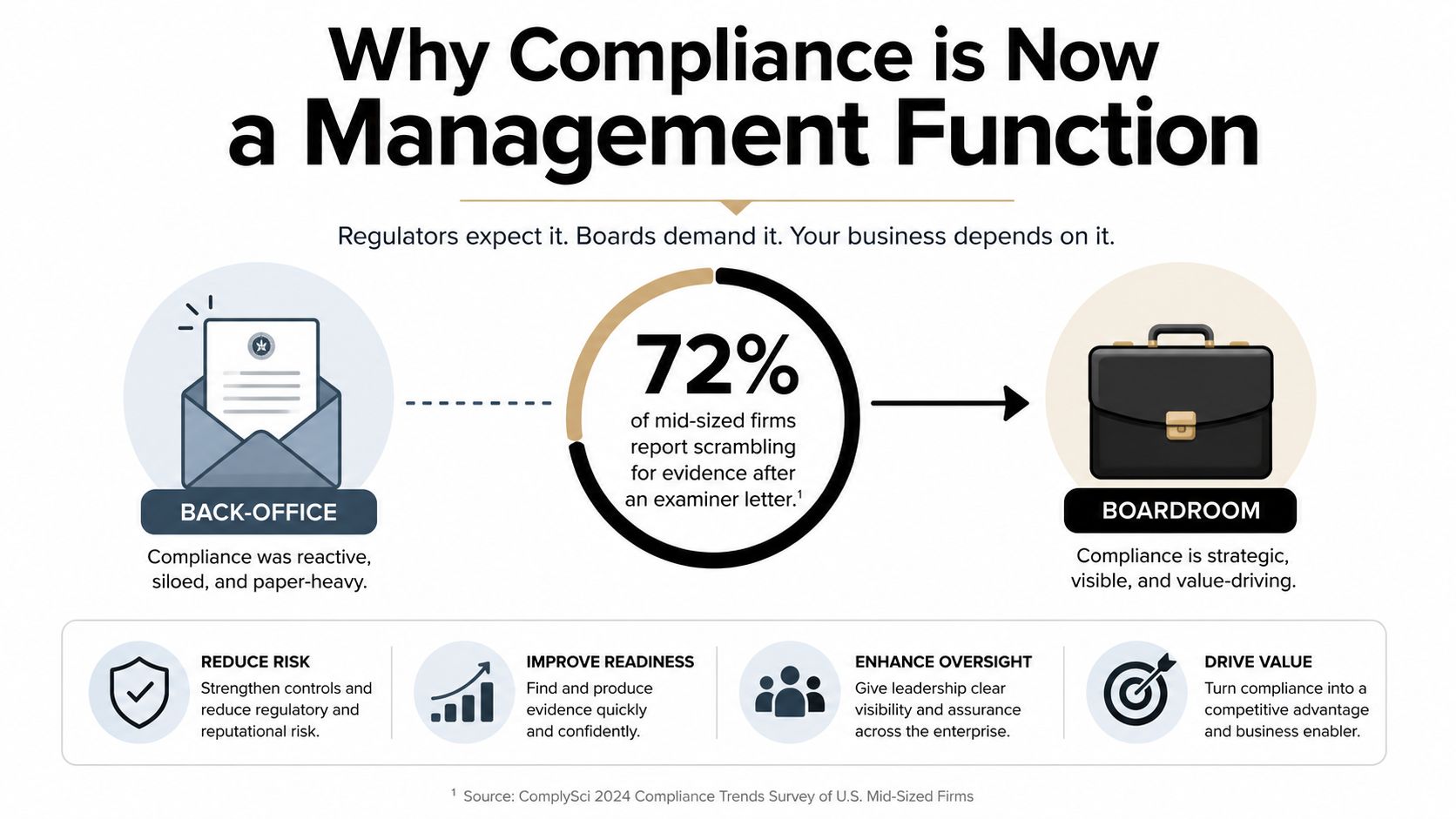
For a mid-sized firm, the right response is not to hire a giant team and bury the problem in process. It's to treat compliance as an operating system. That means naming owners, setting meeting cadence, making the board see open issues, and choosing tools that produce evidence without creating more manual work.
What management actually has to own
Management owns three things that examiners can see fast. First, it owns the control environment, which includes who signs off, who tests, and who fixes breaks. Second, it owns the evidence path, which means documents, logs, and timestamps have to be easy to produce. Third, it owns the trade-off calls, because every compliance programme reflects a choice about where to spend attention and where to accept residual risk.
That is why resource allocation matters so much. If compliance spend sits only in a legal budget line, the programme usually ends up reactive. If it sits inside the broader operating plan, leaders can connect headcount, systems, and remediation work to the actual risks the firm faces.
The regulatory architecture a mid-sized firm faces
A mid-sized firm rarely answers to one clean rulebook. It deals with a stack of obligations that overlap and sometimes pull in different directions. In the U.S., firms may have to satisfy SOX, FINRA Rule 17a-4(f), GLBA, CFTC, FDIC, and FFIEC expectations, while cross-border work can bring in GDPR and MiFID II. That mix is why a policy library alone never survives an exam.
The technical burden lands in the storage layer and the records process. Under FINRA Rule 17a-4(f), broker-dealer records must sit in non-rewriteable, non-erasable storage, with retention periods of up to six years. That requirement pushes firms toward WORM storage, tight audit trails, and a records-management workflow that can prove no one tampered with the file after the fact.
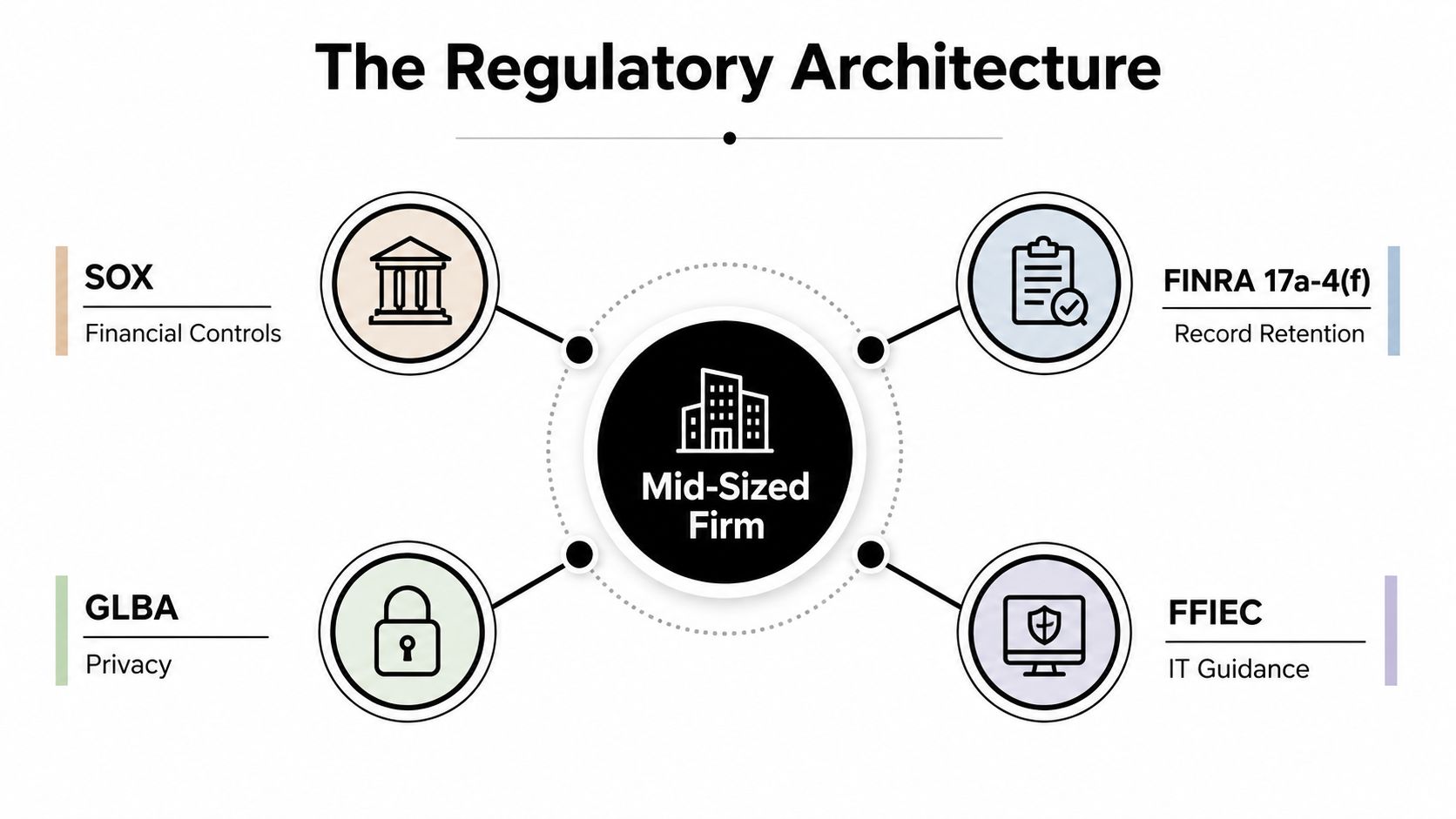
What each regime changes in practice
SOX pushes firms toward tighter financial controls and a better evidentiary trail around reporting. GLBA forces privacy discipline, so data access can't be broad by default. FFIEC guidance keeps IT risk and resilience inside the compliance conversation, which means security and records teams have to work together, not in silos.
GDPR adds another layer for firms that touch EU resident data. The law requires a lawful basis for each processing activity, and common bases in financial services include contract performance, legal obligation, and legitimate interests such as fraud prevention or risk monitoring GDPR guidance for financial institutions. The same guidance says personal data may only be collected for “specified, explicit and legitimate” purposes, which means firms can't treat data use as open ended once they already hold it.
That is the design point most firms miss. If retention, access, deletion, and immutability rules aren't built into the system from day one, you end up trying to retrofit governance after the data already sprawls across drives, ticketing systems, and inboxes. The result is usually inconsistent retention and a weak defence when an examiner asks who can change what, when, and why.
Operational evidence is part of the architecture, too. Examiners do not just ask which policies exist, they ask for calendar-tracked activities, time-stamped control execution, and end-to-end data lineage. A control that cannot show when it ran, who reviewed it, and what data it touched will not carry much weight in a review.
That is where tools matter. A platform such as CEFCore compliance tools can help centralize evidence, but only if the firm still defines ownership, review steps, and escalation paths. For teams trying to tie control work to recurring deadlines and proof of completion, time tracking for grant reporting is a useful reference for how timestamped activity records support audit trails.
Core elements every compliance program needs
A compliance programme at a 50 to 200 person firm usually fails for plain operational reasons, not because the policy language is weak. The issue is often that the firm can't show who owns each control, when it ran, or what proof sits behind it. Examiners notice that quickly.
Governance and written rules
Governance starts with a real reporting line, not a vague dotted line on an org chart. The board or executive team should know who owns compliance, who supports that person, and who receives the issue when something breaks. Written policies need version control, approval dates, and a clear review cadence, because an out-of-date policy tells an examiner the firm does not manage change well.
Training and testing
Training should show who completed what and when, not just that a slide deck exists. Independent testing needs to stay separate from the people who built the control, because self-testing rarely catches the gaps that matter. At smaller firms, programs weaken when one person is asked to handle policy, training, and testing at the same time.
Issue management and proof
The programme either holds or fails at this point. A remediation log should show the issue, the owner, the target date, the closure date, and the sign-off. If a firm cannot produce that on demand, it usually cannot prove control maturity either.
That proof also needs an evidence trail examiners can follow. Calendar-tracked activities, time-stamped control execution, and end-to-end data lineage matter because they show how the firm ran the control, not how the policy says it should run. Tools can help package that work, but only if they are set up with clear ownership and review steps, as outlined in TimeTackle's enterprise security compliance guidance.
What examiners ask for first: current policies, current owners, current testing, and current remediation. Not the theory, the proof.
Risk assessment, controls, and continuous monitoring in practice
A risk assessment that sits untouched for long does not reflect how a firm operates. New products go live, vendors change, staff move roles, and reporting logic shifts, so the original map quickly drifts away from the business. Examiners want to see that the firm keeps reassessing risk, reassigning control owners, and checking whether controls still work in practice.
The operational proof sits in data lineage. ACAMS recommends source-to-target architecture diagrams, data dictionaries, and lineage documentation for mission-critical data used in transaction monitoring, along with explicit ETL execution controls and escalation steps when data transfers fail ACAMS guidance on data completeness and integrity. That is not documentation for its own sake. It is the trail that lets a firm reconcile transactions, alerts, and filings from start to finish.
A good program also records how the controls are being run, not just how they were designed. Calendar-tracked reviews, time-stamped approvals, and recurring checkpoints give the firm evidence that monitoring happened on schedule and that exceptions were handled before they became findings. For teams trying to connect activity logs to compliance work, TimeTackle's time tracking for grant reporting shows the same basic discipline, tying work activity to a defensible record instead of a loose to-do list.
The metrics that matter
Track measures that show control health, not numbers that merely look active. Three that usually matter most are regulatory filing error rate, alert rate, and remediation timing. Those figures show whether the process is stable, noisy, or starting to drift.
A practical test is simple. If a filing goes out wrong, can the firm trace the bad field back to the source? If an alert fires, can the team explain why it fired and whether the threshold still makes sense? If an issue closes, can the firm show who closed it and what changed?
For teams looking for tooling patterns that support this kind of monitoring, CEFCore compliance tools is a useful reference because it frames automation around evidence capture and repeatable workflows rather than just task lists. The same logic applies to reporting. If the system cannot produce the trail, the process is too fragile.
The operating rule is straightforward. Monitor the process, not just the outcome. A green dashboard without source data, ETL logs, and escalation records will not satisfy an examiner for long.
Calendar-based time tracking as an audit evidence layer
Most firms already have a daily activity trail, they just don't capture it in a form auditors can use. Calendar-connected time tracking changes that because it records who did what, when they did it, and which client, matter, or control it tied back to. That makes the evidence cleaner for billing reviews, AML lookbacks, and internal investigations.
The best version of this is not manual timesheet entry. It uses Google or Outlook calendar sync, tags, and rule-based automation so the log is time stamped and categorized as work happens. When a reviewer asks why a client meeting took place, or who prepared the follow-up, the firm can show the activity chain instead of reconstructing it from memory. The same evidence also supports utilization reporting and billing integrity, because it ties operational work to specific obligations.
Time capture becomes more useful when teams connect it to a separate compliance review of the calendar record itself. A useful example is calendar audit guidance, which shows how calendar history can function as a defensible activity log rather than a loose planning tool.
What this layer should prove
At a minimum, it should prove four things.
- Who did the work: the named person or role is visible in the log.
- When they did it: timestamps show the sequence.
- What it related to: tags or properties tie the task to a client, matter, or control.
- Whether it was consistent: repeated work patterns match the policy and billing record.
That last point matters because examiners and internal auditors both care about consistency. If the calendar, the work product, and the billing record point in different directions, someone will eventually ask which one is true.
The over-compliance trap and the case for a risk-based approach
Tighter controls do not always mean better compliance. FATF's 2025 financial inclusion guidance says AML and CFT safeguards can exclude legitimate consumers by limiting access to regulated services, and disproportionate risk management can push firms to refuse, terminate, or restrict accounts instead of assessing risk properly FATF guidance on financial inclusion. That matters because a blunt policy can create a different kind of risk, one tied to exclusion and public trust.
The Boston Fed's 2024 work on underserved digital-payment households uses four dimensions, access, use, safety, and affordability, to show that a household can still be underserved even when it has access on paper Boston Fed working paper. That framing is useful for compliance teams because it reminds them that a rule can be technically clean and still fail in practice if it makes the customer experience unsafe or too costly.
Risk-based compliance is not softer compliance. It is better judgment with better records.
What a real risk-based model looks like
A real model uses tiered due diligence, calibrated monitoring thresholds, and documented judgment calls. It does not treat every customer as identical, and it does not hide behind a blanket denial policy. If a firm decides to step up monitoring, it should be able to explain the trigger, the review, and the review outcome.
That is where many teams fail. They either over-document trivial cases or under-document the hard ones. The better path is to document the reasons behind the decision, then keep the supporting evidence in a form an examiner can follow without guesswork.
A 90-day roadmap to build or rebuild your program
The fastest path is not a perfect one. It is a sequence that gets the firm to usable evidence fast, then hardens the weak spots. That usually means scoping first, design second, testing third.
Days 1 to 30
Start with scope. List in-scope products, clients, jurisdictions, and data types, then map the rules that apply to each one. Assign owners across operations, finance, IT, and compliance so no one has to guess who answers the examiner.
Days 31 to 60
Write or refresh the policies, then build the control map. Capture the source-to-target data flow, the retention logic, and the approval path for exceptions. If a control needs a human sign-off, name the person and define the evidence they create.
Days 61 to 90
Test what you built. Run a sample review, train the team, and close the first remediation items with dates and sign-offs. If the first independent review finds gaps, that is normal. The mistake is pretending the gaps do not exist.
A good internal handoff at this point is simple. Operations owns the process, finance owns billing and record ties, IT owns system evidence, and compliance owns challenge and escalation.
Pre-audit checklist and common pitfalls to avoid
Most exam findings at mid-sized firms come from boring misses, not dramatic failures. Policies are stale, control owners are unnamed, training records are incomplete, and remediation logs die halfway through. The fix is rarely complex, but it does need discipline.
| Common compliance pitfall | Root cause | One-line fix |
|---|---|---|
| Missing or outdated policies | No review cadence | Set a dated quarterly review and version control |
| Undocumented control owners | Ownership lives in email | Publish a current owner list with reporting lines |
| Incomplete training records | Training tracked manually | Use a central log with completion dates |
| Weak issue-management trail | Fixes close without evidence | Require closure notes, sign-off, and proof |
| No tabletop practice | Leadership only reacts in real time | Rehearse an examiner letter before it arrives |
Run a tabletop exercise with leadership before the next review cycle. Use a fake document request, set a timer, and see how long it takes to produce the core evidence pack. If the answer is “too long,” the issue is not the audit, it's the operating model.
If you want a cleaner way to capture the daily evidence auditors ask for, TimeTackle can help you turn calendar activity into time-stamped proof without adding more manual reporting work. Visit TimeTackle to see how calendar-based tracking and automated activity capture can support a stronger compliance record.