


You're in a vendor review, the security questionnaire is open, and someone wants a straight answer by Friday. The platform team says it supports encryption, the customer asks which standard you require, and procurement wants the contract signed before anyone gets dragged into another review call. That's the normal moment when data encryption standards stop being a theory question and turn into an ops decision.
If you run SaaS, calendar-connected tools, or anything that moves customer data across systems, you need more than a badge that says “encrypted.” You need to know which algorithm protects the data, who controls the keys, what happens when the standard ages out, and what your vendor will do when that day comes. I've seen teams lose more time arguing about encryption than implementing it, usually because nobody wrote down the right requirements before the contract went out.
If you need a quick vendor review anchor while you read, keep a separate eye on your subprocessors list like this example from TimeTackle's published subprocessors page. That kind of inventory is boring until the first audit, then it becomes the first thing everyone asks for.
When an ops leader has to answer a crypto question fast
A real ops review doesn't start with a whiteboard and a clean diagram. It starts with a Slack ping, a procurement form, or a client security review where someone asks whether your platform uses AES, RSA, or something else, and whether data stays encrypted in transit and at rest. You do not get points for sounding clever here. You get points for giving a clear answer that matches the risk.
That's why this topic matters even when nobody on your team loves cryptography. If you buy software that handles meeting data, CRM syncs, customer notes, or internal scheduling data, the encryption answer is part of the operational contract, not just the security brochure. The wrong answer can slow onboarding, create audit pain, or force a last-minute exception that nobody wants to own.
What this guide is for
I'm writing for the person who has to sign off on the tool, not the person who wants to prove they can recite cipher math. You need enough depth to challenge a vendor, enough context to stop hand-wavy answers, and enough operational detail to write a requirement that engineering can enforce.
What you should be able to do after this
By the end, you should be able to tell the difference between a real standard and a marketing label, ask better questions about key handling, and decide whether a vendor is ready for an actual security review. You should also be able to spot where a system is still safe on paper but weak in practice, which is where a lot of encryption programs fail.
The core idea of a data encryption standard
A data encryption standard is a public rule for turning readable data into unreadable data and back again. The point is not mystery, it's consistency. If vendors, auditors, and engineers all use the same standard, they can build systems that work together without making the algorithm secret.
A sealed envelope with a lock illustrates the concept. In symmetric encryption, the same key opens and closes the lock, so one key handles both sides of the exchange. In asymmetric encryption, one key locks the envelope and a different key opens it, which is why public-key systems work so well for trust, handshakes, and signatures.
The two buckets you need in your head
Most algorithms fall into one of two families.
- Symmetric systems, like AES, use one shared key for encryption and decryption, which makes them fast and good for bulk data.
- Asymmetric systems, like RSA and ECC, use key pairs, which makes them slower but better for identity and key exchange.
That split matters because it tells you what a vendor should be using where. If they use asymmetric crypto to protect every byte of a file, the system will crawl. If they use symmetric crypto to exchange secrets without a safe way to share the key, the whole design gets brittle.
Block ciphers and stream ciphers are not the same thing
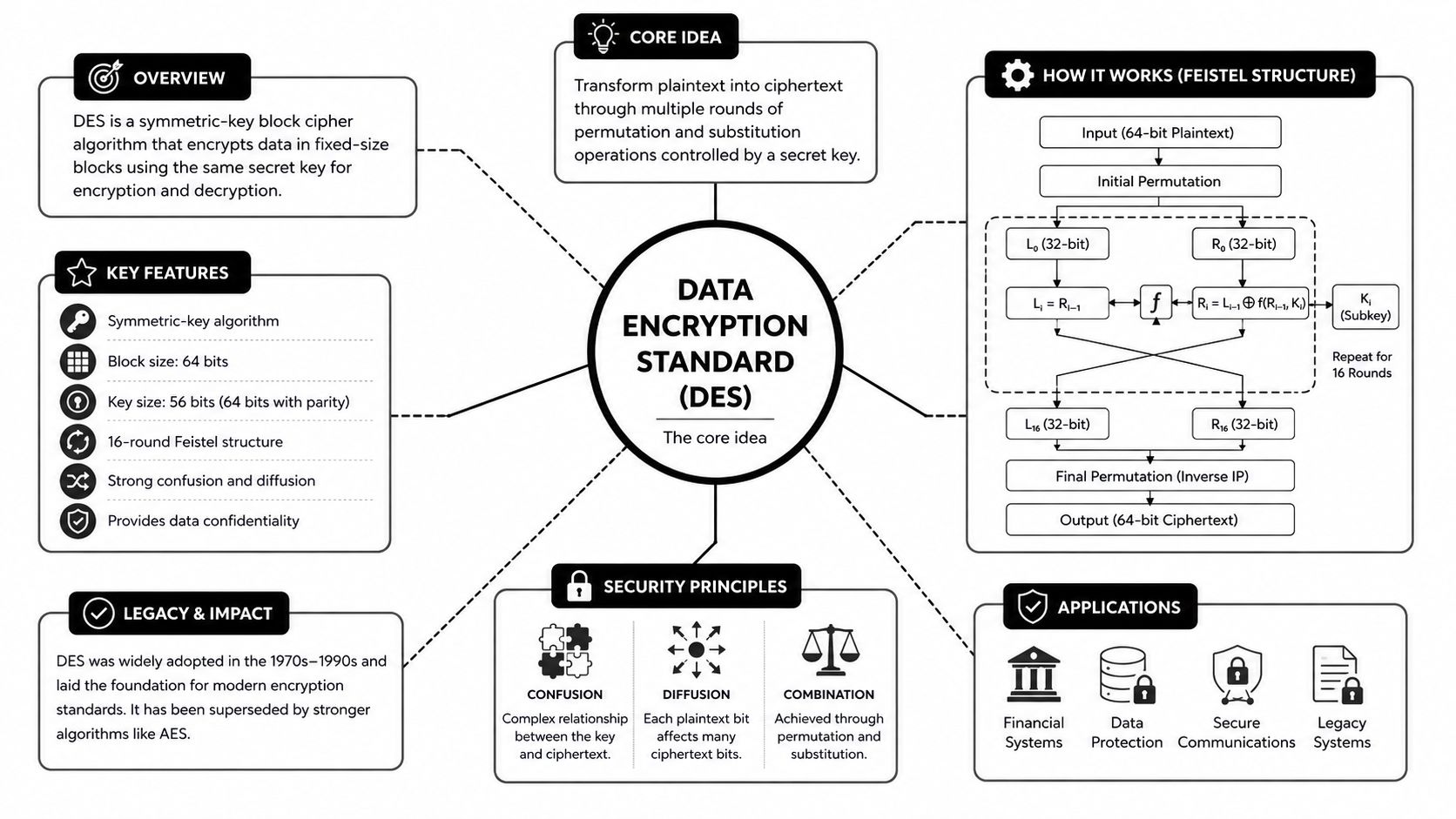
A block cipher works on chunks of data. DES is the classic example, and its 64-bit block size is part of why it mattered so much historically as described by Britannica. A stream cipher works more like a constant flow, which is why ChaCha20 often shows up in performance-sensitive paths. You do not need the math to make a procurement call, but you do need to know whether you're protecting a database dump, a file, or a live connection.
For a deeper background on public-key thinking, I like Blocsys Technologies' discussion of the foundation of digital ownership. It frames why private keys matter so much when you're deciding who can open protected data.
Practical rule: if a vendor can't explain whether it uses symmetric or asymmetric crypto in a given workflow, they probably haven't separated design intent from implementation detail.
How DES aged out and why AES took over
DES was built by the U.S. National Bureau of Standards in 1973, approved as a federal standard in November 1976, published as FIPS 46 in January 1977, and made effective on July 15, 1977 for Federal Departments and Agencies protecting unclassified computer data during transmission NIST legacy publication. That matters because DES was not a fringe experiment. It became one of the first public encryption standards the U.S. government pushed for broad use, which is exactly why its retirement still matters to security and ops teams today.
DES used a 64-bit block cipher with a 56-bit key, and the key length aged badly. By the late 1990s, brute force was no longer theoretical. The EFF broke a DES key in 56 hours in July 1998, and a joint effort by distributed.net and the EFF cut that down to 22 hours and 15 minutes in January 1999 historical summary. Once public testing proved that weakness, DES stopped being a defensible choice for real workloads.
Why AES won
NIST launched the first worldwide public competition for a replacement in 1997, looking for a 128-bit block cipher with key-size options of 128, 192, and 256 bits historical summary. That is the operational lesson. Standards need room to age, because compute gets cheaper and attackers get more time.
AES replaced DES as the default standard because it was designed for the next era, not the last one. It was published in 2001 and effective in 2002 historical summary. If a vendor says “we use AES,” stop there only long enough to ask the useful questions. Which mode. Which key size. Where the keys live. How rotation works. How quickly the vendor can move if the standard shifts again.
The operational lesson
DES did not fail because people were careless. It failed because cryptography sits inside changing compute power, and old security margins disappear. Ops leaders should treat that as a vendor review requirement, not a history lesson, because today's acceptable standard can turn into tomorrow's liability.
Comparing the standards you will actually see
When you read vendor docs, you'll keep seeing the same few names. That's not random. Most systems mix a fast symmetric standard for data and a public-key standard for key exchange or signatures.
| Standard | Type | Typical key size | Where you see it |
|---|---|---|---|
| AES | Symmetric block cipher | 128, 192, or 256 bits | Data at rest, backups, storage, application payloads |
| RSA | Asymmetric public-key crypto | 2048 bits or higher in modern use | Certificates, signatures, handshake key exchange |
| ECC | Asymmetric public-key crypto | Smaller keys than RSA for similar strength | Modern TLS, mobile, constrained devices |
| ChaCha20 | Symmetric stream cipher | Commonly paired with modern protocol suites | Mobile, browser traffic, devices without AES acceleration |
AES is the workhorse. It protects files, databases, and stored content because it is fast and easy to run at scale. RSA and ECC do the trust work, so you see them in certificates, signing, and the first part of a secure connection. ChaCha20 shows up where hardware speed matters and where a lighter cipher makes the connection feel better on weaker devices.
What I tell teams to look for
- Bulk data should use AES, not RSA, because RSA is the wrong tool for large payloads.
- Handshake and identity should use RSA or ECC, because that's what they're good at.
- Performance-sensitive endpoints should support ChaCha20 where the protocol stack allows it.
- Legacy systems need careful review, because old crypto can hide in old integrations long after the main app has moved on.
If a vendor lists these standards, that's a start. If they only name one algorithm and ignore the rest of the stack, they're probably simplifying away the hard part.
Where encryption fails in production
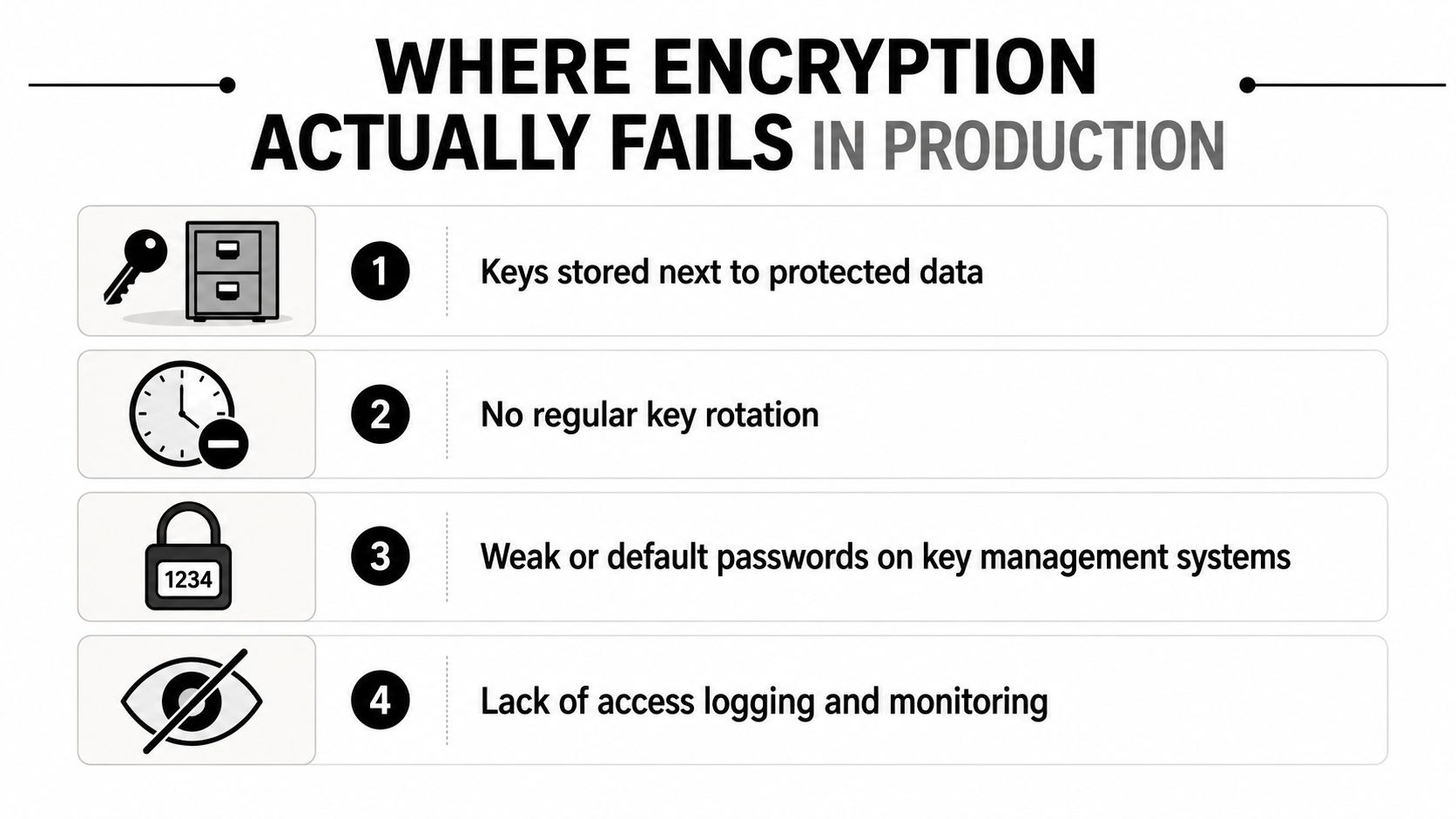
The broken part is usually the key management, not the cipher. I've watched more than one rollout fail because the team said “we use AES-256,” then stored the keys next to the data, skipped rotation, or left hardcoded secrets in a repo. Without proper key management, encryption is performance theater, not real security.
Operational rule: if the key and the protected data live in the same place, your security story is already weak.
Treat encryption as an ongoing control, not a checkbox. NIST says cryptographic standards have evolved over 50 years, and the ICO says organizations should keep a cryptographic inventory, check whether encryption still remains secure, and prepare a plan to switch quickly if a method becomes unsafe NIST guidance and ICO encryption guidance. That is the operational side most explainers skip, and it is the side ops leaders have to own.
The failure points I look for first
- Keys stored with data, which gives an attacker too much in one place.
- No rotation plan, which means one old secret stays live far longer than it should.
- Hardcoded secrets, which show up in repos, CI files, or stale config.
- Weak random generation, which can make key creation predictable.
- Bad mode choice, especially when teams treat insecure defaults like a harmless detail.
OWASP also says to keep keys separate from encrypted data and store them in encrypted form OWASP guidance. That is simple advice, but teams still miss it because they focus on the algorithm name and ignore the storage path. For a cleaner operating model, our enterprise-grade encryption architecture shows how to keep access boundaries tighter across the stack.
I'd rather see a vendor with solid key management and a clear migration path than one that talks about encryption in vague superlatives. The cipher matters, but the ops around it matter more.
What ops leaders should require from SaaS and calendar tools
If a vendor handles calendar events, CRM links, or meeting metadata, don't accept “encrypted” as a full answer. Require TLS 1.2 or higher in transit, AES-256 at rest, and a documented key management setup, ideally with a KMS. Ask who can access plaintext, because if too many people can reach decrypted data, the control boundary is already too wide.
For calendar-connected tools, I'd ask a sharper question. Are event titles, attendee lists, descriptions, and linked CRM fields protected only at the database level, or do they get field-level protection where it matters? That distinction matters because a database can be encrypted and still leak too much through application logs, exports, or admin views.
Questions I'd put in the vendor review
- Transit protection: What protocol protects data in motion, and is it current?
- At-rest protection: Is the stored data protected with AES-256, and where are the keys?
- Access control: Who can view plaintext, and how is that access logged?
- Key separation: Are customer keys separated from the protected data?
- Evidence: Can the vendor show a current audit report, not just a policy statement?
SOC 2 Type II is useful here, but only if you read it as evidence, not decoration. A vendor can be technically strong and still sloppy in operations, so I also look for audit trails and clear escalation paths. If you want a reference point for how a vendor frames this kind of evidence, TimeTackle's SOC 2 Type II certification page is the sort of document I'd expect to see in a serious review packet.
Good encryption in SaaS is boring in the right way. It means you can explain the controls to a customer without making excuses or improvising a half-answer.
Algorithm agility and the post-quantum shift
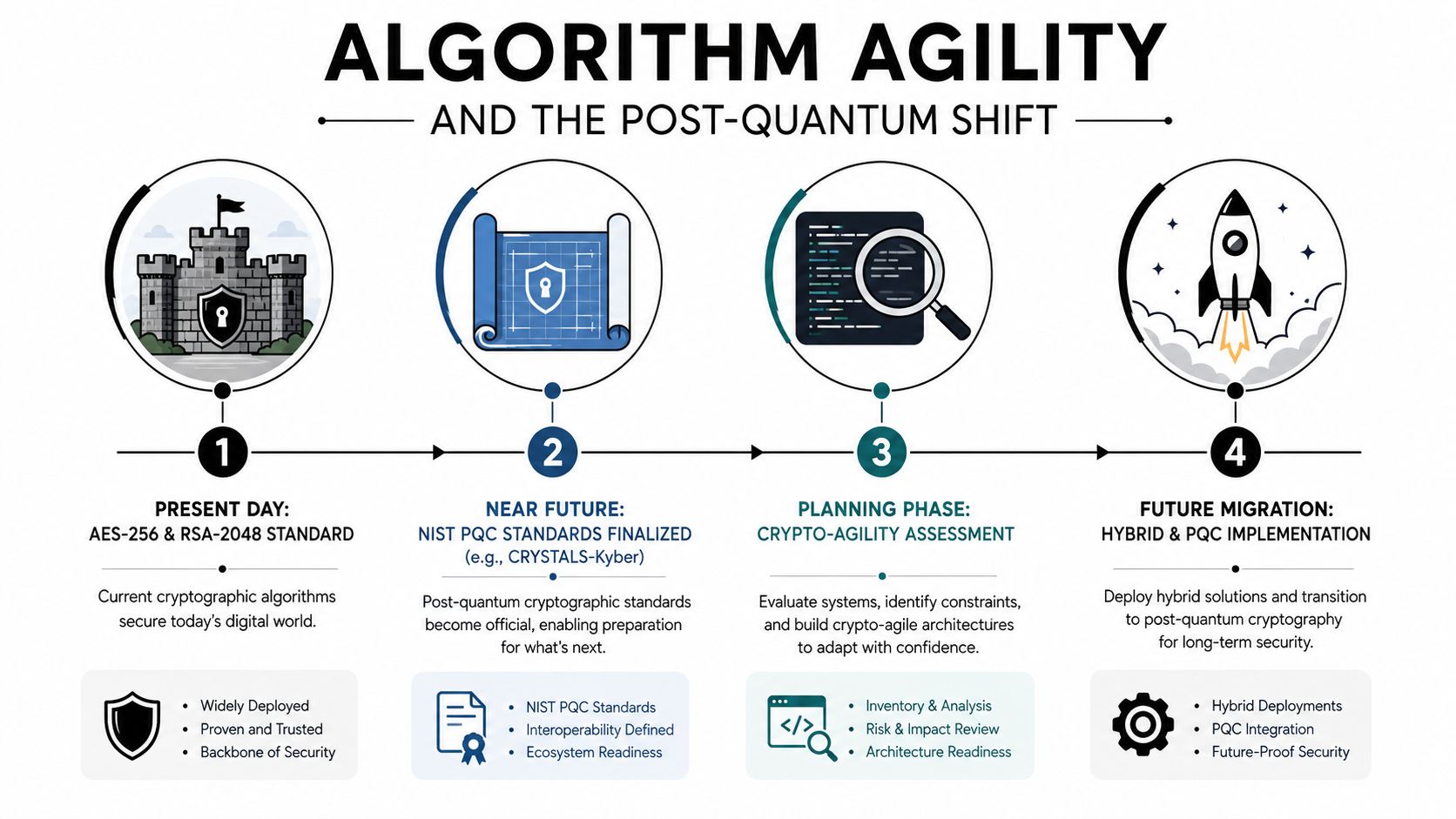
A lot of teams still talk as if AES, RSA, and ECC are permanent defaults. They're not. NIST has already published initial post-quantum standards, and the work for ops teams is not waiting for a crisis, it's building the ability to swap algorithms without breaking the app.
What crypto-agility means in practice
Crypto-agility is not a slogan. It means you know where each algorithm is used, you keep that inventory current, and you build the application so you can swap the crypto layer without rewriting the whole system. If your product team has to touch six services just to replace one key exchange method, you do not have agility, you have a cleanup project waiting to happen.
I'd plan for three things right away.
- Inventory: know every place encryption is used.
- Abstraction: keep the algorithm choice out of business logic.
- Transition path: draft the migration before you need it.
The ops value is simple. If the next standards shift lands and you already know where your crypto lives, you can move. If you don't, you'll spend the first month just finding it.
Decision checklist and quick answers for ops leaders
Use this checklist in a vendor review or annual security review.
- Algorithm choice: Does the product use AES for stored data, and does it use modern public-key crypto where handshake or signatures are needed?
- Key management: Are keys stored separately, rotated on a schedule, and destroyed cleanly when no longer needed?
- Audit posture: Can the vendor log cryptographic access and prove who touched plaintext?
- Transition readiness: Is there a documented plan for algorithm changes, including post-quantum migration?
A few quick answers come up every time.
How often should keys rotate? Ask for a documented rotation policy, not a guess. The right cadence depends on the system, but no cadence at all is a bad sign.
Is AES-128 still safe? It can be, but if a vendor can support AES-256 without breaking performance or controls, I'd rather have the larger margin.
What about legacy 3DES data? Treat it as a migration item, not a forever setting. If it still exists, it needs a path out.
How does encryption fit GDPR and SOC 2? It helps, but it's not enough on its own. You still need access control, logging, review, and a real operational process behind the crypto.
If you're building or buying a calendar-connected platform and you want encryption, auditability, and reporting to work together instead of fighting each other, take a hard look at TimeTackle. It's built around calendar data, SOC 2 Type II certified, and designed for teams that need better control over operational data without adding more manual work.