

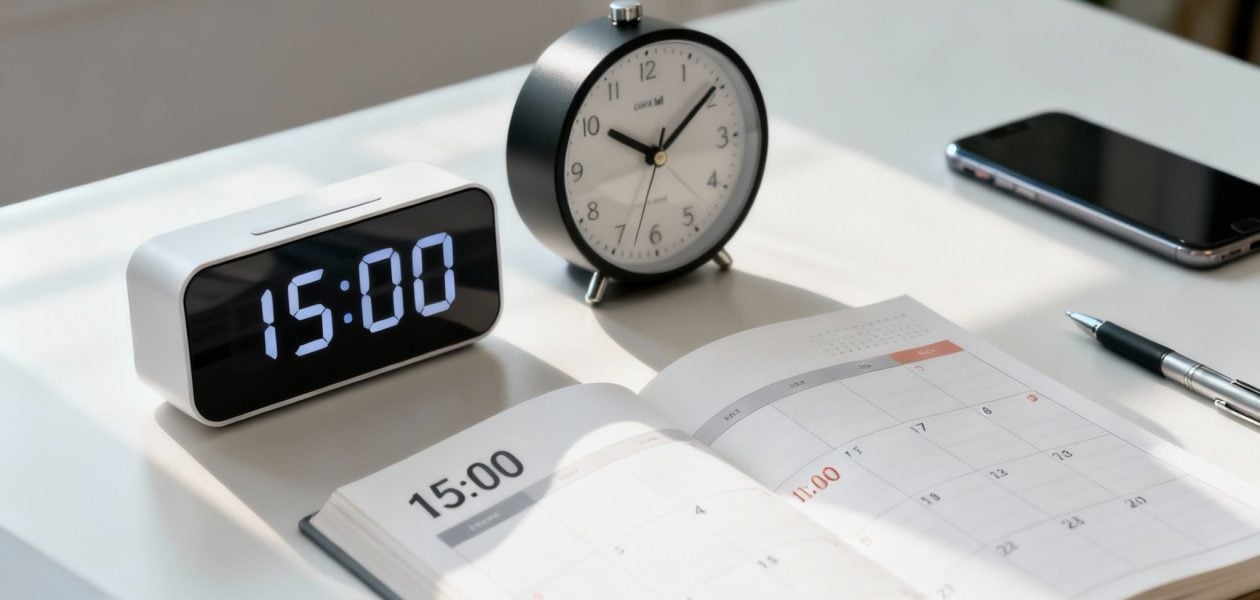
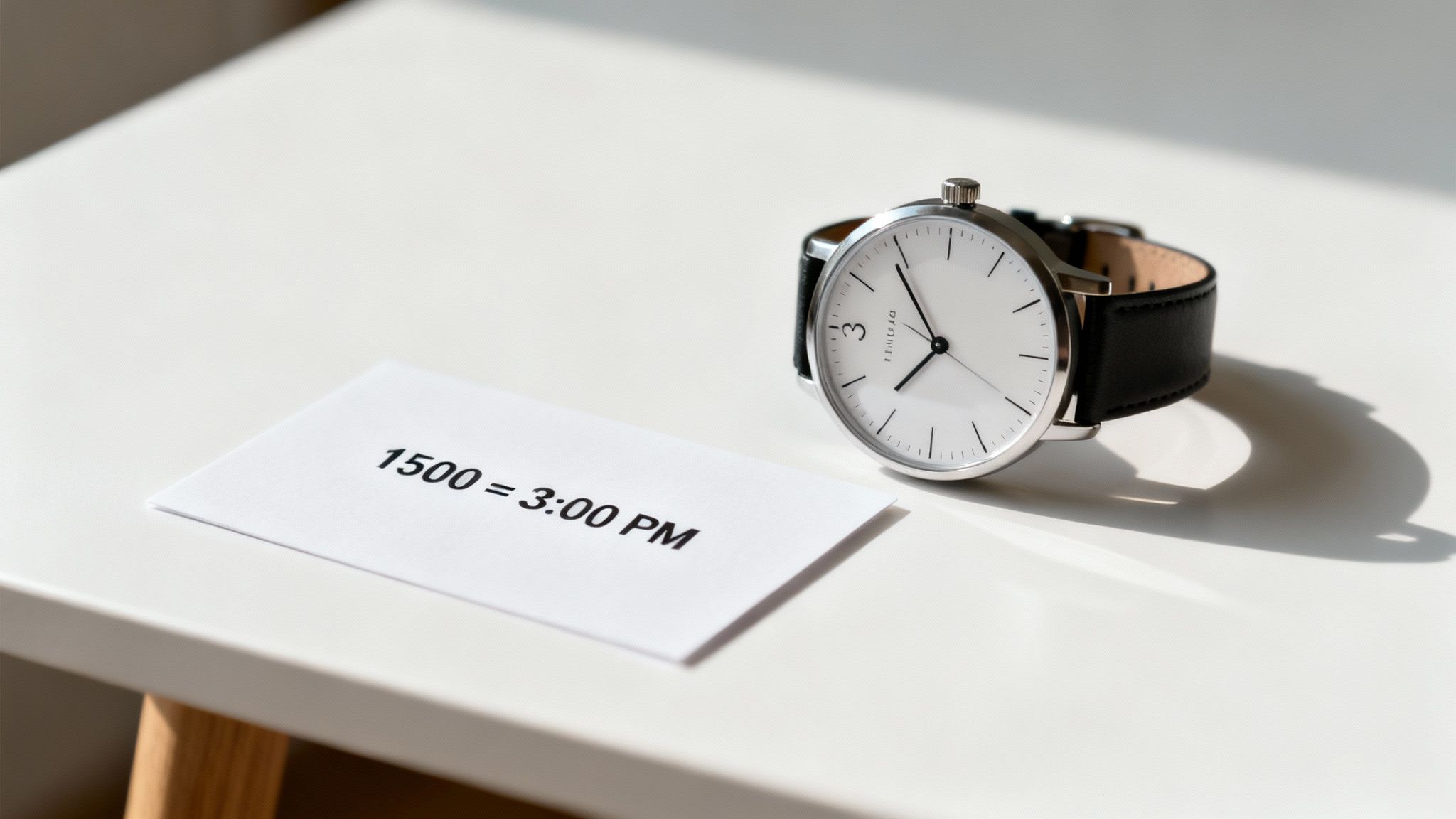
Let’s get straight to it: 1500 military time is 3:00 PM in the standard 12-hour format you see on most wall clocks. The whole point of the 24-hour system is to eliminate the guesswork of "AM or PM," creating a crystal-clear timeline for the entire day.
What 1500 Military Time Actually Means
Imagine the day as a single, continuous loop. Instead of the clock resetting after 12:00 PM noon, it just keeps counting up. That’s how 1:00 PM becomes 1300, 2:00 PM becomes 1400, and so on.
The beauty of this is its total lack of ambiguity. When you see a meeting scheduled for "0700," there's zero confusion about whether it's bright-and-early or after dinner.
The Conversion Made Simple
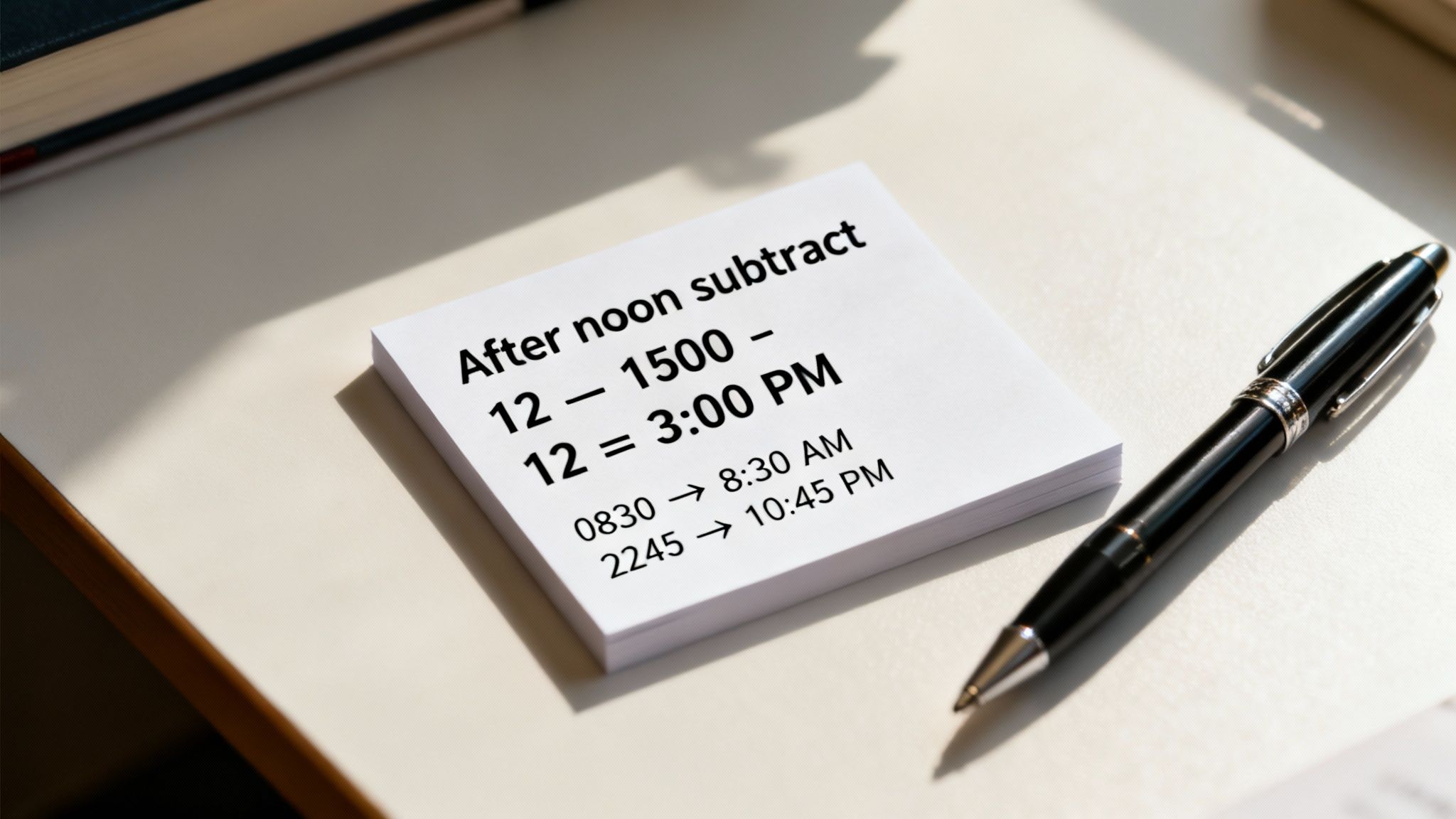
The rule for any time after noon is refreshingly simple: just subtract 1200.
- For 1500 military time: 1500 – 1200 = 300, which is just a formal way of saying 3:00 PM.
By that same logic, an event set for 1600 military time is 4:00 PM. It’s a clean, logical system rooted in ancient timekeeping but perfected for modern fields where precision is everything.
You’ll see the 24-hour clock everywhere—from aviation and healthcare to logistics. Why? Because it cuts down on scheduling errors, boosting operational efficiency by an estimated 25-30%. That level of clarity is exactly why 1500 military time is so common in professions where a simple AM/PM mix-up could be a huge problem.
Military Time to Standard Time Quick Reference
To make things even clearer, here’s a quick-glance table for some common times you'll encounter.
| Military Time | Standard Time (12-Hour) | Common Association |
|---|---|---|
| 1300 Hours | 1:00 PM | Lunch is over, back to work. |
| 1400 Hours | 2:00 PM | Mid-afternoon stretch. |
| 1500 Hours | 3:00 PM | Wrapping up the workday. |
| 1700 Hours | 5:00 PM | Quitting time for many. |
| 2100 Hours | 9:00 PM | Prime time television starts. |
This table shows just how intuitive the system becomes once you get the hang of it. It’s all about a smooth, continuous flow from morning to night.
Why Precision Timekeeping Is So Important
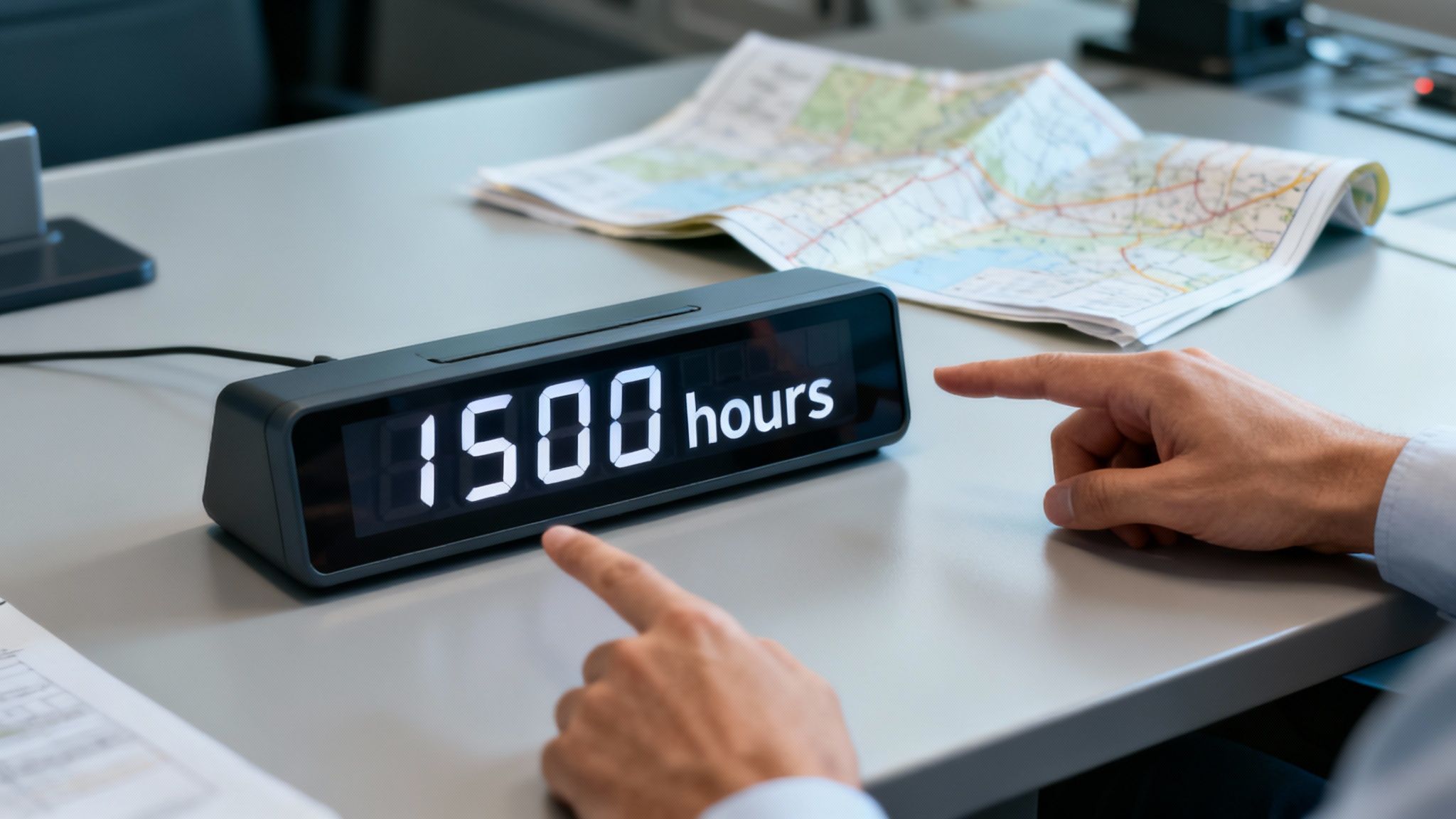
The 24-hour clock was born out of pure necessity. It was forged in high-stakes environments where a simple mix-up between AM and PM could be catastrophic. Just imagine trying to coordinate a military strike or a complex flight schedule where "seven o'clock" could mean two completely different, mission-critical times.
This system wipes out that dangerous ambiguity. Using a number like 1500 military time isn’t just a different way to tell time—it's a commitment to absolute clarity and precision. It's about ensuring flawless coordination when every single second counts.
A System Forged in Conflict
The need for this kind of unwavering accuracy became crystal clear during World War I. Facing the chaos of round-the-clock naval battles where confusing AM and PM could be fatal, the British Royal Navy was the first major force to adopt the 24-hour system in 1915.
By 1918, the British Army had officially switched over, making sure more than 3 million soldiers communicated with unambiguous timing. This single change is believed to have slashed critical scheduling errors by an incredible 90%, proving its power in coordinating massive, complex operations.
At its core, military time is a communication tool designed to remove doubt. It ensures that an order given at 0600 is understood exactly the same way across different teams, locations, and time zones.
Modern Precision Beyond the Battlefield
Today, that same demand for precision extends far beyond the military. Professionals in aviation, healthcare, and global logistics all rely on the 24-hour clock to prevent costly and sometimes dangerous mistakes. The clear, sequential nature of the format makes it an ideal framework for detailed planning.
For anyone serious about optimizing their schedule, this system can be a game-changer. Mastering military time can be a key part of developing effective time management strategies, bringing a new level of structure and clarity to both your personal and professional life. It helps you tackle complex projects with a whole lot more confidence.
Learning the Simple Rules of Time Conversion
Switching between military and standard time might seem like a chore, but it really just comes down to a couple of straightforward rules. The whole system is designed for clarity, and once you get the hang of it, you'll be converting times in your head without a second thought.
The first rule takes care of the morning, from 0000 (midnight) to 1159 (11:59 AM). For these hours, the numbers are almost identical to what you’d see on a standard clock. All you have to do is add a leading zero to single-digit hours and drop the colon. So, 8:30 AM becomes 0830. Easy enough.
The second rule is for the afternoon and evening hours, from 1200 (noon) to 2359 (11:59 PM). This is where the real conversion magic happens.
The Subtract 12 Rule
For any time from 1300 onward, you just need to subtract 1200. That’s it. This one simple step is the key to figuring out afternoon times like 1500 military time. It’s a clean formula that works every single time, no exceptions.
The core principle is simple: If the military time is 1300 or higher, subtract 1200 to get the PM time. If it's 1259 or lower, the time is already in its AM or noon format.
Let's walk through a few real-world examples to lock it in. This method clears up any confusion and makes sure you can read a 24-hour schedule with complete confidence.
Real-World Conversion Examples
Seeing the rules in action makes them much easier to remember. Here’s a quick breakdown of how you’d translate a few times from the 24-hour format over to the standard 12-hour clock we all know.
-
Example 1: Converting 1500 Military Time
- Since 1500 is higher than 1200, you subtract 12.
- 1500 – 1200 = 300.
- This means 1500 is 3:00 PM.
-
Example 2: Converting 2245
- Again, 2245 is well past 1200.
- 2245 – 1200 = 1045.
- So, 2245 is simply 10:45 PM.
This logic works perfectly in reverse, too. For instance, you can see how 1400 military time converts to 2:00 PM using the exact same principle. A little practice with these rules, and you'll become fluent with the 24-hour clock in no time.
Don't let the name fool you—the 24-hour clock is far from exclusive to the armed forces. It’s the silent, organizational backbone for many of the critical industries you rely on every single day.
Why is it so popular? Simple: it kills ambiguity. An instruction given for a specific time means the exact same thing to everyone involved, no questions asked.
This universal clarity is precisely why the 24-hour format is the global standard in fields where even a tiny mistake can have huge consequences. From the logistics company shipping your packages to the first responders in an emergency, it keeps incredibly complex operations running like clockwork.
Where Accuracy Is Everything
Think about the last time you took a flight. Pilots, air traffic controllers, and ground crews all operate on a 24-hour clock to prevent catastrophic scheduling errors. A flight scheduled for 1500 military time is understood across the globe as 3:00 PM, leaving zero room for AM/PM confusion, especially when crossing multiple time zones.
The same goes for healthcare, where the timing of medication or a surgical procedure can literally be a matter of life and death. When a prescription is marked for 1500, nurses know the patient needs treatment in the afternoon, not at 3:00 in the morning.
By getting rid of the 12-hour cycle's potential for error, military time acts as a universal language for safety and efficiency. It ensures critical actions happen exactly when they're supposed to.
This isn't just theory; the data backs it up. For example, the U.S. Department of Defense reports that using 24-hour time in 98% of operations prevents errors that could lead to over 500 potential casualties each year. FAA data also shows that logs from 1500 hours often align with peak traffic at major airports, helping them handle thousands of flights daily without dangerous scheduling overlaps. You can learn more about how the military uses this precise system for safety at Military.com.
From your travel itinerary to your medical records, the influence of military time is all around us, providing a hidden layer of safety and order in our modern lives.
Setting Up the 24-Hour Clock on Your Devices
Ready to bring the clarity of military time to your own schedule? Switching your digital tools over to the 24-hour format is a simple change that completely eliminates any AM/PM confusion. It's a quick way to ensure that a meeting at 1500 military time always means 3:00 PM, no questions asked.
Most calendar apps and operating systems have a straightforward toggle for this. Let's walk through how to flip the switch in some of the most popular tools you're probably already using.
Enabling the 24-Hour Format
In Google Calendar, the setting is a breeze to find. Just head into your settings, and under "View options," you'll see a selection for time format.
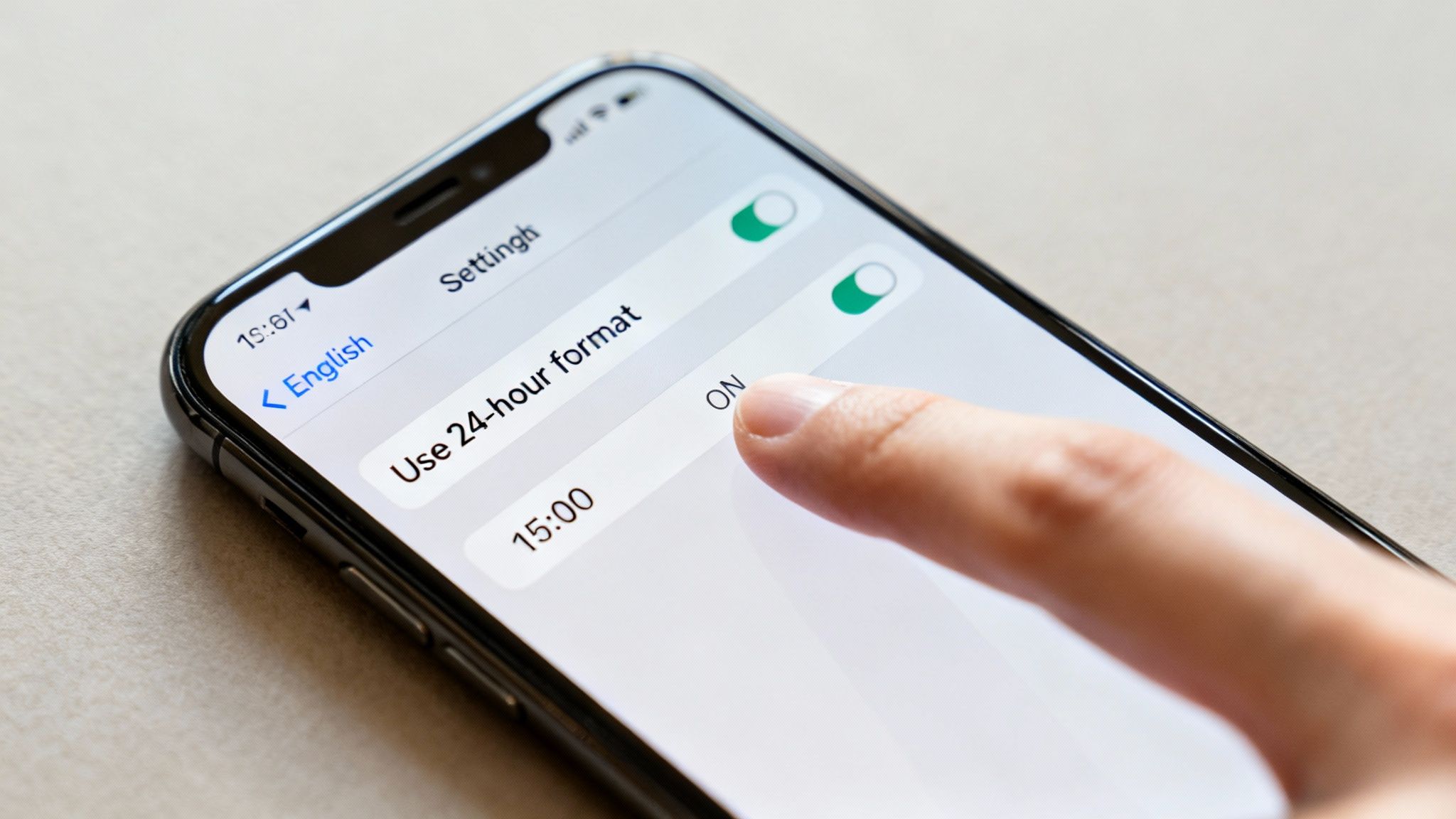
This screenshot shows exactly where you can swap the default 12-hour clock (e.g., 1:00 PM) for the 24-hour format (13:00). Microsoft Outlook has a similar option tucked away in its Calendar settings under "Work hours."
By switching your calendar to the 24-hour format, you create a single source of truth for your schedule. This small adjustment can significantly reduce mental friction when coordinating with teams across different regions or in high-stakes environments.
For professionals who rely on scheduling automation, this consistency is non-negotiable. Tools like TimeTackle integrate directly with your calendar to analyze how you're spending your time. Using a 24-hour clock ensures the data is clean and accurate, making any reports on productivity or resource allocation that much more reliable.
If you really want to dial in your scheduling, check out our guide on mastering your schedule with Google Calendar work hours.
Common Questions About Military Time
Once you get the hang of the basics, a few specific questions always seem to pop up. Nailing down these final details is the key to using the 24-hour clock confidently, whether you're saying it out loud or writing it down. Let’s clear up the common sticking points.
One of the first things people ask is how to actually say military time. It’s a bit different from the standard way we talk about the clock.
How Do You Say 1500 in Military Time?
When you see a time like 1500, you say it as "fifteen hundred hours." This isn’t just jargon; it’s a specific pronunciation designed for absolute clarity, especially over a crackly radio or in a noisy environment. You skip the "o'clocks" entirely.
Here's the simple rule to follow:
- For times on the hour: Just say the first two digits as a number, then add "hundred hours." So, 0800 becomes "zero eight hundred hours," and 2100 is "twenty-one hundred hours."
- For times with minutes: You say each pair of numbers. For example, 1530 is spoken as "fifteen thirty hours." It's a simple, direct method that leaves no room for error.
Is 2400 the Same as 0000?
Ah, the classic midnight question. While both can refer to the same moment, they represent two different concepts on the timeline, and the distinction is important.
0000 (Zero Hundred Hours) is the very beginning of a new day. It's the starting line for the next 24-hour cycle.
2400 (Twenty-Four Hundred Hours) marks the absolute, final end of the current day. It's the finish line.
In practice, you'll almost always see midnight written as 0000. The term 2400 is rarely used and is typically reserved for situations where the exact end of a period has to be crystal clear, like in legal documents or operational schedules where no overlap is allowed. For day-to-day use, midnight is simply 0000.
Why Does Military Time Not Use a Colon?
You've probably noticed that military time is written as a solid block of four numbers, like 1500 instead of 15:00. This is completely intentional. The main reason is to eliminate any chance of error in written communications—think logs, official orders, and digital systems where a typo could cause serious issues.
By removing the colon, the four-digit format becomes a single, unambiguous piece of data. This makes it much harder to misread or mistype, especially when information is being passed along quickly or under pressure. It's one of those small details that makes the 24-hour system so reliable in professional settings.
Ready to bring this level of clarity to your own team's scheduling and productivity? TimeTackle integrates with your existing calendar to provide powerful analytics and automation, helping you understand exactly where your time goes. Eliminate manual tracking and gain actionable insights by visiting https://www.timetackle.com to learn more.