



The 4 on 4 off schedule is a rotating shift pattern where employees work for four consecutive days, then get four consecutive days off. To make this work, the shifts are longer—usually 10 or 12 hours—so that everyone still gets their full-time hours in. The real prize, though, is the consistent, extended blocks of personal time it creates.
How the 4 on 4 off schedule really works
Forget the standard Monday-to-Friday grind. The 4 on 4 off schedule runs on a simple, predictable eight-day cycle. An employee works a four-day “block,” then immediately gets a four-day “rest block.” Think of it as a mini-week of work followed by a mini-week of personal time, on repeat.
This is a totally different way of structuring the week. Instead of five shorter workdays for a two-day weekend, you work four longer days and earn a four-day break. The schedule is incredibly consistent, but it also means your workdays and days off will float across the days of the week. One “weekend” might be Tuesday to Friday, while the next one could be Saturday to Tuesday.
A sample rotation
To see how this provides continuous coverage, let’s look at how two teams would work this schedule over a 28-day period. As Team A is finishing their work block, Team B is rested and ready to take over.
Sample 4 week rotation for two teams
| Day | Date | Team A Status | Team B Status |
|---|---|---|---|
| Monday | 1 | Work | Rest |
| Tuesday | 2 | Work | Rest |
| Wednesday | 3 | Work | Rest |
| Thursday | 4 | Work | Rest |
| Friday | 5 | Rest | Work |
| Saturday | 6 | Rest | Work |
| Sunday | 7 | Rest | Work |
| Monday | 8 | Rest | Work |
| Tuesday | 9 | Work | Rest |
| Wednesday | 10 | Work | Rest |
| Thursday | 11 | Work | Rest |
| Friday | 12 | Work | Rest |
| Saturday | 13 | Rest | Work |
| Sunday | 14 | Rest | Work |
| Monday | 15 | Rest | Work |
| Tuesday | 16 | Rest | Work |
| Wednesday | 17 | Work | Rest |
| Thursday | 18 | Work | Rest |
| Friday | 19 | Work | Rest |
| Saturday | 20 | Work | Rest |
| Sunday | 21 | Rest | Work |
| Monday | 22 | Rest | Work |
| Tuesday | 23 | Rest | Work |
| Wednesday | 24 | Rest | Work |
| Thursday | 25 | Work | Rest |
| Friday | 26 | Work | Rest |
| Saturday | 27 | Work | Rest |
| Sunday | 28 | Work | Rest |
This simple handover ensures there are never any gaps in your operation, making it perfect for businesses that need someone on deck at all times.
The rhythm of work and rest
The core idea isn't just to squeeze a 40-hour week into fewer days; it's about creating a completely different rhythm for work and life. The balanced rotation of four days on and four days off gives employees predictable, meaningful breaks to recharge without having to wait for a traditional weekend.
This visual shows just how simple and repeatable the cycle is.
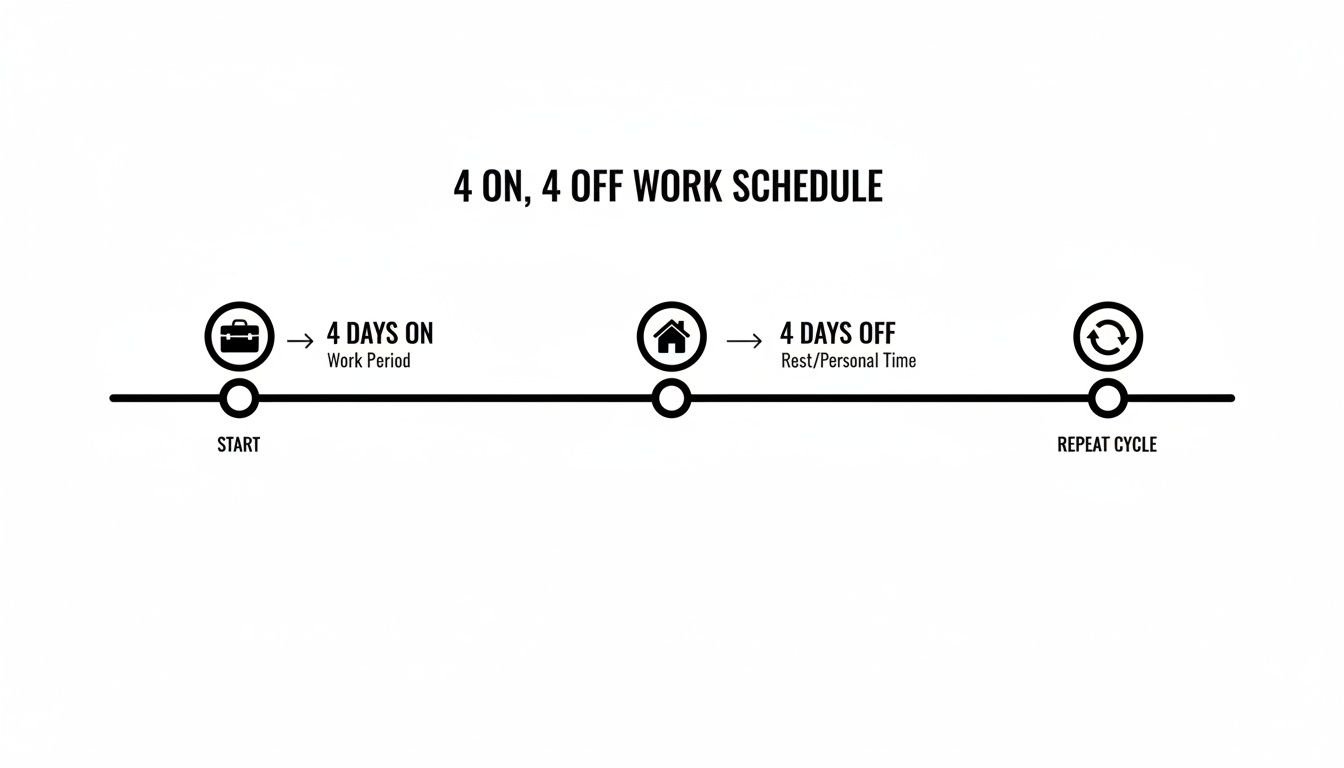
It’s this very rhythm—an intense block of work followed by an equally long block of rest—that makes the pattern so appealing.
Why more industries are adopting it
While industries that run 24/7, like healthcare and law enforcement, have used this model for years, its benefits are catching the eye of other sectors.
- Manufacturing & Logistics: The schedule keeps production lines and supervisory roles running without any downtime between shifts.
- Creative & Tech: It offers long, uninterrupted blocks of “deep work” time, which is perfect for complex coding, design, or problem-solving.
- Consulting: For project-based work, it allows teams to go all-in during intense sprints and then gives them significant time to decompress, helping prevent burnout.
The key to its success is staggering teams. While one team is on their four-day work cycle, another team is on their four days off, creating a seamless loop of coverage. If you want to explore other ways to organize shifts, you can find more in our post covering example work schedules.
Real benefits and drawbacks for your team and business
The 4 on 4 off schedule sounds like a dream, right? A four-day weekend, every single week. But before you jump in, it’s worth looking at both sides of the coin. This schedule is a huge commitment with real trade-offs for your employees and your bottom line.
While the promise of better work-life balance is a massive selling point, it's not a one-size-fits-all solution. Let’s weigh the clear advantages against the potential snags you’ll need to navigate.

For employees, the biggest perk is obvious: those four consecutive days off. Think of it as a mini-vacation built into every single week. This gives your team serious time to rest, run errands, and enjoy their hobbies, which can be a game-changer for work-life balance.
This extended rest period is a powerful tool against burnout. With four full days to disconnect and recharge, teams often report feeling more refreshed and focused when they return to work.
The employee perspective
The upsides for your team are compelling. That consistent block of time off means fewer scheduling headaches for personal appointments and more chances for travel or quality family time. For many, this is a massive improvement over the standard two-day weekend.
Of course, the schedule isn't without its challenges. Those long shifts—often 10 or 12 hours—can be physically and mentally draining. Four of these intense days back-to-back takes real stamina, and some employees might struggle with the sheer intensity. This is especially true in demanding roles where constant focus is needed.
For any team considering a 4 on 4 off setup, figuring out how to create burnout-friendly roles is the key to making it work long-term. There's also a social downside to consider: it can be tough feeling disconnected from friends and family who work a standard Monday-to-Friday week, since your “weekend” rarely lines up with theirs.
- Pro: Better work-life balance: Four days off allows for genuine rest and personal time, so people aren't just living for the weekend.
- Con: Long, intense shifts: Working for 10 or 12 hours straight can lead to serious fatigue, especially over four consecutive days.
- Pro: Reduced commuting: Your team travels to work less often, saving them time and money on gas, transit, and other costs.
- Con: Social disconnect: Having floating days off can make it hard to sync up with friends and family who are on traditional schedules.
The employer perspective
From a business angle, the 4 on 4 off model has some powerful perks, especially if you need to keep operations running around the clock. With teams rotating in and out seamlessly, you can achieve 24/7 coverage without the messy handoffs that come with more fragmented schedules.
This consistency often leads to some great side effects, like lower absenteeism and better employee retention. When staff feel well-rested and have a handle on their work-life balance, they're more likely to stick around and stay engaged. In fact, many companies find this schedule becomes a major draw for attracting top talent.
The main drawback for employers is the complexity. You can't just wing it. Managing rotating shifts, calculating payroll for compressed workweeks, and staying compliant with overtime laws all require careful planning and solid systems. If you don't manage the implementation well, you could create more problems than you solve.
Clear and effective handoff procedures between shifts are non-negotiable. Without them, information gets lost, projects stall, and the business suffers from a frustrating lack of continuity. This model demands a high degree of operational discipline to really succeed.
How to implement this schedule without breaking the law
Switching to a 4 on 4 off schedule is more than just rearranging calendar invites. It’s a move that requires a hard look at the legal and payroll side of things. Those longer shifts—often 10 or 12 hours—can easily bump up against overtime rules, and those rules change depending on where you operate. Before you even think about a new work model, getting a firm handle on HR compliance is a must. It’s the only way to be sure your new schedule is on solid legal ground.
For example, in some places, overtime is a daily calculation. Anything over eight hours in a day gets paid at a premium, even if the weekly total is under 40 hours. Elsewhere, only the weekly total matters. That’s a massive difference that hits your payroll costs directly. This is why having a clear, written shift work agreement isn’t just a good idea—it’s non-negotiable.
Calculating staffing and coverage needs
One of the biggest draws of the 4 on 4 off pattern is the promise of seamless 24/7 coverage. But how many people does that actually take? The math is surprisingly straightforward.
For true, round-the-clock operations, you’ll need four separate teams. Each team works a 12-hour shift. This setup creates a simple, repeating cycle: two teams are on duty (one for the day shift, one for the night), while the other two teams are enjoying their four days off.
This structure ensures that as one team’s work block ends, another is fully rested and ready to begin, eliminating coverage gaps and the risk of employee burnout from constant on-call duties.
Automating payroll and compliance
Trying to manually track hours, calculate funky overtime, and stay compliant on a rotating schedule is a recipe for disaster. It’s a swamp of administrative headaches and inevitable errors. This is where modern tools completely change the game. Using a calendar-based time tracking system can put most of this process on autopilot.
The appeal of compressed workweeks is exploding. The 4 on 4 off model is part of a bigger trend, mirrored by the rise of four-day school weeks, which grew from 650 U.S. districts in 2019 to nearly 900 by late 2023. In the corporate world, an APA survey found 22% of U.S. employers now offer four-day options, a huge leap from just 14% in 2022.
With an automated system, hours are pulled right from employee calendars. You can set up predefined rules to handle all the complex overtime math for you. This doesn't just guarantee payroll is accurate; it builds a rock-solid record for compliance. For managers, it means less time buried in spreadsheets and more time actually leading their teams.
If you’re looking for ways to make this even smoother, check out our guide on how to track employee attendance efficiently. Moving away from manual entry is a smart play for any organization adopting a schedule this rewarding—and this complex.
Creating smooth handoffs and clear communication
With a 4 on 4 off schedule, the biggest risk isn't the long hours you work—it's the four days you’re gone. When one team clocks out and another clocks in, any missed detail can bring a project to a screeching halt. A bulletproof handoff process is the only way to make sure nothing falls through the cracks.

The entire goal is to eliminate guesswork. Your incoming team shouldn't have to waste their first few hours just figuring out what happened while they were away. This kind of continuity is built on a foundation of clear, consistent communication channels that everyone on the team actually uses.
Standardize your handoff process
Don't leave handoffs to chance or someone's memory. You need a mandatory, standardized process that every single shift follows without fail. This could be a shared document, a dedicated Slack channel, or a simple template in your project management tool.
A great handoff document isn't just a boring list of tasks; it’s the story of the shift. It should clearly answer a few key questions:
- What was completed? List the key accomplishments and any tasks that were fully closed out.
- What is in progress? Detail any ongoing work, including its current status and what the very next steps are.
- Are there any blockers or urgent issues? Flag anything that needs immediate attention from the incoming crew.
- What client communication took place? Summarize important conversations and note any pending client requests.
This document becomes the “single source of truth” for every transition, giving the next team all the context they need to hit the ground running.
Use data to drive handoffs
For many teams, especially agencies, relying only on written notes can still leave dangerous gaps. This is where pulling data from your existing tools can make the process nearly foolproof. Instead of just writing “we worked on the campaign,” calendar analytics can show exactly what the previous shift did and for how long.
By pulling data directly from team calendars, managers and incoming shifts can see a verifiable log of activities. This data-driven approach removes subjectivity and provides a clear, factual account of what work was done, for which client, and by whom.
This simple method transforms the handoff from a quick chat into a data-backed review. It helps teams quantify their progress, spot potential bottlenecks before they become problems, and ensure every minute of the 4 on 4 off schedule is accounted for.
Imagine an incoming team reviewing the last shift’s calendar data to understand project momentum before their day even begins. This creates a truly seamless continuation of work, preventing the costly stop-and-start cycle that can completely undermine a rotating schedule.
Adopting a 4 on 4 off schedule completely changes how your team operates. So, it stands to reason that it must also change how you measure success.
When hours are no longer the best yardstick, you have to move beyond just counting them. The focus has to shift from sheer presence to actual performance—from time spent in a chair to results delivered.
This means swapping out old-school timesheet habits for metrics that are based on output. It’s not about watching the clock; it’s about tracking real, tangible progress. This approach is a game-changer for roles where value is measured in outcomes, not hours logged, like in creative and consulting agencies.
Focus on output-based metrics
Instead of asking, “Did they work their 10 hours?” managers should be asking, “Did the team hit their goals for this shift block?” Getting into this mindset is the first step toward tracking productivity effectively without creeping into micromanagement territory.
Here are a few examples of output-based KPIs that work particularly well for teams on a 4 on 4 off schedule:
- Project milestones completed: Track how many key project phases are finished during each four-day work block. This shows clear, forward momentum.
- Client satisfaction scores: Use simple surveys (like NPS) to get a pulse on how clients feel about the work being delivered.
- Task velocity: Measure how quickly tasks move from “in-progress” to “complete.” It's a fantastic indicator of a team’s efficiency and flow.
- Response and resolution times: For any client-facing roles, keep an eye on how fast the team is responding to and, more importantly, resolving client requests.
For a deeper look into different methods, our guide on how to track employee productivity offers more strategies that respect your team's autonomy. By concentrating on these kinds of metrics, you give your team the freedom to manage their intense workdays while holding them accountable for what truly matters.
Use dashboards for clear insights
To make this all work, you need a way to see performance at a glance. Setting up a reporting dashboard is the perfect way to monitor these new KPIs. You can configure it to display key metrics filtered by each shift team, giving you a clear, side-by-side comparison of how each group is performing.
This gives managers a data-backed view into whether the schedule is actually boosting performance or creating unforeseen problems. It helps answer important questions: Is Team A consistently outperforming Team B on project deliverables? Is client satisfaction dipping during a specific team’s work block? These insights allow for targeted coaching and support instead of making broad, unhelpful assumptions.
Studies on condensed workweeks consistently show a surprising trend: less time in the office often leads to more work getting done. By focusing on results, companies can tap into this efficiency without burning out their teams.
The data absolutely backs this up. Since 2019, trials run by 4 Day Week Global across multiple countries found that 92% of participating firms kept the new schedule. They saw revenues hold steady or even increase by an average of 1.4%, all while employee stress dropped significantly.
Microsoft Japan’s famous experiment boosted productivity by a staggering 40%, showing what’s possible when the focus shifts from hours to output. You can explore more of these findings on the four-day week from the World Economic Forum.
Don’t forget about team morale
Finally, remember that performance data only tells half the story. The 4 on 4 off schedule is a huge change for your employees, and their well-being is directly tied to their productivity. You need to check in on morale to make sure the new rhythm is working for your people, not just for the business.
Studies and company reports consistently show that when implemented thoughtfully, condensed schedules like the 4 on 4 off have a positive impact on the employee experience.
Employee experience before vs after a 4 on 4 off schedule
| Metric | Reported Change | Source Study Highlight |
|---|---|---|
| Work-Life Balance | +71% Improvement | Employees report more time for family, hobbies, and personal errands. |
| Burnout Levels | -63% Reduction | The extended rest period is cited as key for mental and physical recovery. |
| Team Engagement | +45% Increase | Employees feel more valued and trusted, leading to higher engagement with their work. |
| Stress Levels | -58% Decrease | Fewer commuting days and a clearer separation between work and life reduce daily stress. |
| Job Satisfaction | +68% Improvement | The appeal of a better schedule leads to higher overall satisfaction with their role. |
These figures show a clear trend: a well-managed 4 on 4 off schedule can improve employee well-being, which in turn fuels better performance and retention.
Regular, anonymous pulse surveys are a simple but powerful tool for gathering this kind of feedback. Ask direct questions about work-life balance, stress levels, and team communication. This feedback is invaluable for spotting burnout before it becomes a crisis and for making small adjustments to the schedule that can have a big impact on your team's happiness and engagement.
Diving into the details: common questions about the 4 on 4 off schedule
When you start exploring a schedule as different as the 4 on 4 off pattern, it’s natural for a lot of practical questions to surface. Moving away from the familiar Monday-to-Friday grind is a big change, and both leaders and their teams will have perfectly valid concerns about how it all plays out in the real world.
Let's get straight to it and tackle some of the most common things people ask.
How does pay work with this schedule?
Think of it this way: employees are still working full-time hours, just in a different rhythm. For example, an employee working four 10-hour shifts logs a standard 40-hour workweek during their “on” block. Because the total hours are the same, their base salary or hourly rate doesn't need to change.
The real catch is your payroll system. It has to be set up to handle a compressed workweek, especially when it comes to overtime. Some states or provinces have labor laws that trigger overtime for any hours worked over eight in a single day, regardless of the weekly total. This is a big detail to get right. Before you flip the switch, it’s always a good idea to chat with an HR or legal pro to make sure you’re fully compliant with local rules.
Is this schedule good for client-facing jobs?
Absolutely. It can be a game-changer for customer service and client-facing roles, but only if you plan for continuous coverage. A 4 on 4 off schedule doesn't mean your business shuts down for four days; it just means one team is resting while another takes the baton.
By staggering at least two teams on opposite rotations, you can ensure someone is always there to support clients during your business hours.
The secret to making this work isn't just about having people available—it's having a flawless handoff process. The client should feel a seamless, consistent level of service, which only happens when the incoming team is fully briefed on every active conversation, project status, and pending request.
In many cases, this can actually slash your response times because you've completely eliminated the “weekend gap” where client requests would normally sit unanswered until Monday morning.
How do you handle holidays and paid time off (PTO)?
This is one of the biggest logistical puzzles to solve. Since the workdays are longer, a traditional “8-hour day” of PTO just doesn't line up. The simplest and fairest solution is to switch from a “days” system to an “hours” system. Instead of giving 10 days of vacation, you would offer 80 hours, which employees can then use to accurately cover their 10 or 12-hour shifts.
For public holidays, you'll need a clear, written policy from day one.
- If a holiday falls on a scheduled workday, the employee usually gets that day off with holiday pay.
- If the holiday falls on one of their scheduled days off, many companies offer a “floating holiday” that the employee can use another time.
The most important thing is to have these rules clearly defined and communicated before you implement the 4 on 4 off schedule. It prevents a world of confusion later on.
Will employees get burned out from 12-hour days?
It’s a fair question. The thought of a 12-hour shift sounds intense, but the experience is often the complete opposite. Having four full days off right after allows for genuine recovery—a real chance to disconnect, recharge, and handle personal life without stress. In fact, many studies on compressed workweeks show that burnout rates often go down because that extended rest period is so incredibly effective.
Of course, success really hinges on the type of work being done. For jobs that are physically or mentally draining, smart management is non-negotiable. This means making sure people take proper breaks during their long shifts and keeping an eye out for signs of fatigue. It’s not a one-size-fits-all solution, which is why running a trial period and actively collecting employee feedback is always the smartest way to start.
Are you tired of messy spreadsheets and manual time tracking for complex schedules? TimeTackle uses AI to automate time capture directly from your calendar, making it easy to manage payroll, monitor productivity, and get clear insights without the administrative headache. See how TimeTackle works.