



Trying to manage an agency project can feel like you're conducting an orchestra where every musician is playing from different sheet music. The result isn't harmony; it's chaos. This disconnect isn't just frustrating—it's a silent profit killer. The fix is to embrace integrated management of projects, a framework built to sync every single person, tool, and process into one unified system.
The Real Cost of Disconnected Agency Projects

For a lot of professional services teams, the daily grind is just a series of fires that never had to start. The design team gets blindsided by a last-minute client request that sales promised weeks ago. Finance can't invoice accurately because nobody's time tracking is consistent. All the while, project managers are stuck chasing down status updates instead of actually steering the ship.
These aren’t just one-off problems. They're symptoms of a much deeper, systemic issue: disconnected project management. When your tools don’t talk to each other and your teams operate in silos, the consequences ripple across the entire agency, creating a ton of financial and operational waste.
The Hidden Drain on Your Bottom Line
Every missed deadline, budget overage, and burned-out employee chips away at your agency's profitability. These aren't minor hiccups; they're a significant drain on your resources and a direct threat to your client relationships. And the scale of this problem is pretty staggering.
Globally, only 35% of projects are actually completed successfully on time and within budget. Poor integration is the culprit for scope creep in a whopping 52% of cases. This mess means that nearly 9.9% of every dollar invested in projects goes down the drain—a figure that balloons to over $2 trillion annually across all industries. This data also points to a massive opportunity for the agencies that get it right. You can dig into more project management statistics and trends to see the global impact for yourself.
A siloed approach forces teams to make decisions with incomplete information. It’s like trying to navigate a complex journey with only a fragment of the map—you’re bound to get lost, waste fuel, and arrive late.
How Disconnected Systems Sabotage Growth
The costs of a fragmented system go way beyond simple budget misses. The real damage is in the operational friction and strategic blindness it creates. When your data is scattered everywhere and processes are a free-for-all, your agency is constantly reacting instead of planning.
This reactive state traps you in a cycle of inefficiency that's tough to escape:
- Resource Burnout: Talented people are constantly over-allocated because there's no clear view of their workload across multiple projects. This leads to exhaustion and, eventually, high turnover.
- Eroding Client Trust: When communication is inconsistent and milestones are missed, your reputation takes a hit. That makes it harder to keep valuable clients and even harder to win new ones.
- Inaccurate Forecasting: Without a single source of truth, leaders can't accurately predict project profitability, resource needs, or future revenue. It's all just guesswork.
Ultimately, a lack of integration handcuffs your agency's potential. It stops you from scaling effectively, adapting to market changes, and delivering the high-value work your clients expect. The path forward requires a shift from just managing individual tasks to orchestrating a fully connected system—and that's the core idea behind the integrated management of projects.
What Integrated Management of Projects Actually Means
Let's cut through the jargon. Integrated management of projects isn’t some stuffy theory you find in a textbook; it’s the central nervous system for your entire agency. Think of it like the conductor of an orchestra, making sure every section—from creative and sales to finance and operations—is playing from the same sheet of music.
Instead of treating projects like a series of disconnected tasks, this approach views them as a single, cohesive system. When a decision is made in one area, like scope, its ripple effect on the budget, resources, and timeline is immediately visible to everyone. This creates a single source of truth that finally kills the guesswork and reactive firefighting that plagues so many professional services teams.
At its heart, this philosophy is all about building connections where silos used to stand. It’s about making sure your data, processes, and people are all pulling in the same direction.
Beyond a Simple Checklist
Really, integrated management is a shift in perspective. You stop just tracking individual deliverables and start focusing on the dynamic relationships between all the core project components. This means no single element ever exists in a vacuum.
Let's make this real. Here’s what this integration looks like in practice for a busy agency:
- Integrated Scope Management: A client asks for a "small" change to a campaign. Instead of a simple "yes," the system automatically flags the potential impact on the budget, the timeline, and the lead designer's already-full schedule. That isolated request now has visible consequences.
- Integrated Schedule Management: Your project timeline is no longer a static Gantt chart hanging on the wall. It becomes a living document that adjusts when a key team member calls in sick or when another high-priority project suddenly needs resources, giving you a constantly realistic view of delivery dates.
- Integrated Cost and Resource Management: This is where the magic really happens. You don't just assign tasks; you can see that your star developer is already booked at 110% capacity for the next three weeks before you promise a new feature to a client. That kind of foresight prevents burnout and protects your profitability.
This level of interconnectedness is the key to improving overall workflow efficiency because it systematically replaces risky assumptions with hard data.
The Power of a Unified View
The need for this kind of coordination is exploding, especially with so many teams working from different locations. The project management software market, valued at USD 5.6 billion in 2023, is projected to more than double to USD 11.4 billion by 2032. A huge driver for this growth? The 72% of teams operating in remote or hybrid models who desperately need unified systems to stay aligned and productive.
But this shift isn't just about buying new software. It's about building a framework where every piece of information makes the entire system stronger.
An integrated system turns your project data from a series of isolated snapshots into a continuous, real-time film of your agency’s operations. It lets you see what's coming and make adjustments, instead of constantly trying to fix what already went wrong.
Ultimately, the goal of integrated management of projects is to empower your team to make smarter, faster, and more informed decisions. It's how you turn chaos into clarity and move your agency from a state of constant reaction to one of strategic control and predictable growth.
Why Integration Is a Game Changer for Agencies
Let's shift from talking about what integrated project management is to why it's so important. For agency leaders and COOs, the benefits aren't just lines on a PowerPoint slide; they show up in your profitability, team morale, and client happiness. It’s the difference between navigating with a real-time GPS and trying to find your way with a torn, outdated map.
An integrated framework connects all the dots. Every project function—from time tracking to financials—starts talking to each other, creating one unified view of your operations. This is how you escape the endless cycle of chasing down managers for status updates and trying to stitch together reports from five different spreadsheets. Instead, you get a live, accurate dashboard of project health.
From Reactive Firefighting to Proactive Strategy
One of the first things you'll notice is the shift away from constant firefighting. When your project management, time tracking, and financial tools are all sharing data, you can spot trouble long before it becomes a full-blown crisis.
Think about these all-too-common agency headaches, but see them through an integrated lens:
- Preventing Burnout: Instead of realizing your lead designer is swamped after they’ve missed a deadline, an integrated view flags that they're at 110% capacity weeks in advance. This gives you time to actually do something about it—rebalance workloads, protect your best people, and keep project quality high.
- Maximizing Billable Hours: You can see, right now, which projects are making you the most money and where your team's time is delivering the most value. This isn't a gut feeling; it's data. You can then put your best people on your highest-margin work, directly boosting the bottom line.
- Pivoting with Agility: A key client suddenly changes the project scope. In a siloed world, that’s pure chaos. With an integrated system, you can immediately model the impact on your timeline, budget, and team availability. What was a crisis becomes a managed, strategic adjustment.
The real power of an integrated management of projects approach is foresight. It lets leaders make sharp, strategic decisions based on what's happening right now, not on information that's already a week old.
A Single Source of Truth That Drives Profitability
Disconnected systems create friction and waste money at every turn. Time gets burned reconciling conflicting data, opportunities are missed because no one saw them coming, and profit just leaks through the cracks of messy workflows. It's not just a hunch—research shows that organizations that nail project and change management integration are 17% more likely to hit or even beat their project goals.
This all comes down to creating a single source of truth. When everyone—from account managers to creatives to the finance team—is working from the same playbook, the whole agency gets smarter, faster, and more profitable.
An integrated system helps you:
- Improve Project Margins: By tracking every minute and every dollar with real accuracy, you can hunt down inefficiencies and shield your margins from scope creep.
- Enhance Client Trust: Delivering projects on time and on budget stops being the exception and becomes the standard. That kind of reliability builds amazing client relationships that lead to more repeat business and referrals.
- Streamline Operations: The tedious stuff, like manual reporting and data entry, gets automated. This frees up your team to focus on the strategic work that actually matters.
To get this kind of clarity, many operations leaders are looking for the best agency project management software to act as a central hub, pulling all their different tools into one cohesive system.
Ultimately, integration isn’t just about better project management. It’s about building an agency that's more resilient, agile, and profitable. It gives you the clarity you need to handle whatever comes your way and drive real, sustainable growth.
Your Framework for Putting Integrated Management into Action
Shifting to an integrated framework can feel like a massive undertaking, but it doesn't have to be a painful, all-at-once overhaul. Think of it less like a risky flip of a switch and more like a steady upgrade to your agency's operating system. The key is a phased approach that builds momentum, proves its value quickly, and brings your team along for the ride.
The whole point is to build a system that sticks. It needs to be something that everyone, from project managers to creatives, can see makes their work life easier and more effective. This isn't about adding another layer of bureaucracy—it's about clearing out the friction that's been holding your agency back.
This simple flow shows how the process works to optimize, unify, and ultimately boost your agency’s performance.
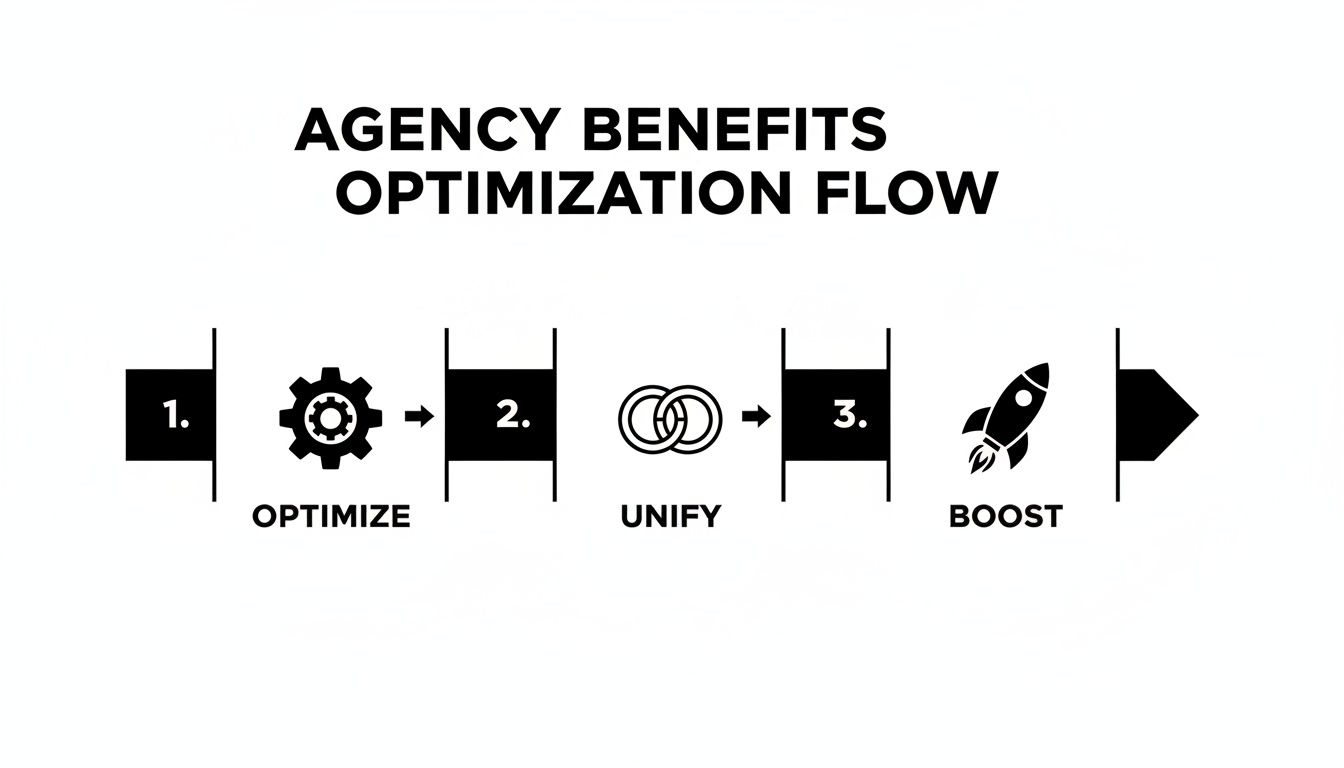
As you can see, true integration starts by first optimizing what you already do. Only then can you unify those processes with the right tech, which is what leads to a real boost in efficiency and profitability.
Phase 1: Diagnose Your Current Workflows
Before you can build something better, you have to get painfully honest about what you have now. This first phase is all about mapping your current reality—warts and all. The goal is to get past assumptions and find the exact sources of your team's headaches, bottlenecks, and disconnected data.
Get your team in a room (virtual or otherwise) and walk through a project's entire life, from the first client call to the final invoice. Ask the tough questions at every step:
- Where does information get dropped or twisted?
- Which tasks demand the most manual grunt work and double-entry?
- At what point do teams feel like they're working on separate islands?
This isn’t about pointing fingers. It’s a group effort to find the cracks in your foundation. The insights you gather here are pure gold, forming the business case for change and making sure you focus on solving problems that actually matter to your people.
Phase 2: Set Clear Integration Goals
Once you have a clear diagnosis, it’s time to define what "winning" looks like. Vague goals like “be more efficient” just won’t cut it. You need specific, measurable targets that will guide the entire project and show a real return on your efforts.
Your goals should directly attack the pain points you found in Phase 1. For example:
- Cut project reporting time by 50% within the first three months.
- Boost resource utilization accuracy from 60% to 85% in six months.
- Slash the time spent on manual timesheet entries by at least five hours per person, per month.
Setting concrete targets transforms this from a vague "IT project" into a strategic business move. It gives everyone a clear finish line and a shared understanding of what you're all working toward.
These goals also double as your key performance indicators (KPIs). They let you track progress and, just as importantly, celebrate wins along the way—which is critical for keeping your team bought-in and motivated.
Phase 3: Choose and Connect Your Technology
Technology is the glue that holds a modern integrated framework together. But be careful—the goal is to choose tools that connect your existing systems, not just add another silo. You're trying to build a central hub where information flows freely, creating a single source of truth for everything project-related.
To make this happen, you need seamless data flow, often powered by real-time data integration through API workflows. This is what allows your CRM, accounting software, and PM tools to finally speak the same language.
So, when you're looking at new tech, prioritize platforms that:
- Play nice with your current stack: Look for tools with solid APIs and ready-made integrations for the software your team already lives in.
- Automate the boring stuff: The right tool should kill repetitive work like data entry and report-pulling, freeing up your team for more valuable thinking.
- Give you a unified view: It absolutely must pull data together to give leaders a real-time dashboard on project health, team capacity, and profitability.
This is where you build the digital plumbing for a truly connected agency, making sure every piece of data works for the whole system, not just one part of it.
Phase 4: Standardize Your Key Processes
The final piece of the puzzle is all about creating consistency. Technology can’t fix workflow chaos on its own; you also need to standardize your core processes so everyone is working from the same playbook. This means documenting and rolling out best practices for the most critical project activities.
To start, focus on the areas that cause the most confusion and inconsistency. Good candidates include:
- Project kickoff procedures: A simple, consistent checklist ensures every project starts with clear goals, scope, and stakeholder buy-in.
- Time tracking and reporting: Define exactly how time should be logged to keep your data clean and reliable. For a deeper look, our guide on building a project management resource plan is a great resource.
- Change request management: Put a formal process in place for handling scope creep. This alone will save your timelines and budgets from disaster.
By standardizing these fundamentals, you create a predictable, scalable way of operating. This consistency is what allows your new integrated management of projects framework to deliver reliable results and drive sustainable growth.
Solving Timesheet Fatigue with Calendar Automation

Even the most thoughtfully designed framework for integrated management of projects can crumble if it's built on a shaky foundation of bad data. And the biggest source of that bad data? Manual timesheets. They're the universal chore everyone puts off, rushes through on a Friday afternoon, or fills out with pure guesswork.
This isn't just an administrative headache—it's a critical point of failure. Inaccurate time tracking poisons every metric you depend on, from project profitability and resource utilization to client billing and future forecasting. The entire system becomes untrustworthy because the data feeding it is flawed from the start.
This chronic problem has a name: timesheet fatigue. It's the burnout that stems from the relentless, manual slog of trying to remember, log, and categorize every minute of your workday. This broken process actively works against the goal of integration, creating data silos built on memory instead of reality.
The True Cost of Manual Time Tracking
The time your managers spend chasing down late timesheets is just the tip of the iceberg. The real damage is buried in the faulty decisions leaders are forced to make based on bad information. When you can’t trust your data, you can’t confidently assign resources, quote new work, or even know which clients are actually profitable.
Relying on manual time entry creates a few systemic problems that can quietly sink an agency:
- Inaccurate Project Costing: Guesswork leads to under-billing clients or, just as bad, failing to see which projects are secretly draining your margins.
- Hidden Resource Burnout: Without a real picture of where the hours are going, you won't notice your top performers are consistently over-allocated until they're already on the verge of quitting.
- Flawed Strategic Planning: You end up basing future business decisions on a distorted view of past performance, locking you into a cycle of repeating the same mistakes.
Relying on manual timesheets is like asking a master architect to build a skyscraper on a foundation of sand. No matter how brilliant the design, the whole structure is doomed to be unstable.
Shifting from Manual Entry to Automated Capture
The answer isn't more nagging emails or stricter timesheet policies. The real solution is to get rid of the manual task entirely. This is where calendar-driven AI time tracking becomes the bedrock of a truly integrated system. Instead of asking your team to piece together their week from memory, the technology automatically captures what they did from the tools they already live in—like Google Calendar or Outlook.
This approach turns your team's calendar from a simple scheduling tool into a rich, passive source of data. Every client meeting, internal sync, and focused work block is captured and categorized without anyone having to lift a finger.
Connecting Time Data to Business Outcomes
Automated time capture does more than just save a few hours each week. It delivers the clean, reliable data needed to make your entire integrated management framework actually work. By automatically turning raw calendar events into structured business intelligence, you can finally draw a straight line from day-to-day activities to high-level strategic goals.
This simple shift brings some powerful, tangible benefits:
- Unlocks True Project ROI: You get a crystal-clear view of the exact time and resources poured into every project, which allows for dead-accurate profitability analysis.
- Powers Proactive Resource Management: With real-time utilization data, you can balance workloads, prevent burnout, and put the right people on the right tasks, every time.
- Drives Data-Backed Decisions: Leadership finally gets trustworthy dashboards for forecasting, capacity planning, and making smart operational improvements.
By automating the most tedious part of data collection, tools like the Tackle AI-powered time tracker make integrated project management a practical reality, not just a theoretical goal. It closes the loop between planning and execution, ensuring your agency operates on a foundation of truth, not guesswork. This is how you unlock your team's full potential and build a more predictable, profitable business.
Best Practices for Long-Term Success
Getting an integrated project management framework off the ground is a huge win, but the real magic happens when it becomes a natural, baked-in part of your agency's culture. To make it stick, you need more than just slick software; you need a real commitment to getting better every day and being transparent about it. This isn't a "set it and forget it" kind of deal—it's about nurturing a living system that grows with your team.
The bedrock of long-term success is building a culture where data is shared openly—not to micromanage, but to empower. When your team sees firsthand that unified data helps them balance their workload, sidestep burnout, and produce better work, they’ll become your biggest champions. That kind of transparency builds trust and turns project metrics from abstract numbers into shared goals everyone can get behind.
Measure What Truly Matters
To keep your integrated system humming, you have to focus on the right key performance indicators (KPIs). These are the metrics that give you a constant pulse on your agency's health, turning raw data into insights you can actually use. Forget the vanity metrics and zero in on what directly impacts your bottom line and efficiency.
Here are a few essential KPIs to keep a close eye on:
- Resource Utilization Rate: This number shows you exactly how much of your team's billable time is being put to good use. A healthy rate, typically around 75-85% for agencies, means you're staying profitable without running your people into the ground.
- Project Margin: This is where the rubber meets the road. Track the real profitability of each project by comparing what you earned against the true cost of the time and resources you invested. It's the quickest way to spot your most (and least) profitable gigs.
- Schedule Variance: This metric tells you how well your projects are sticking to their original timelines. It’s an early warning system that flags potential delays before they spiral into full-blown crises.
And here’s the thing: tracking these KPIs isn’t some once-a-month chore. With a truly integrated system, you can watch them in near real-time, giving you the agility to make smart adjustments on the fly.
The goal is to create a feedback loop where insights from your performance data are continuously fed back into your project planning and execution processes, making your agency smarter with every project you complete.
Conduct Regular Project Health Reviews
One of the most powerful habits you can build is the regular project health review. No, this isn't just another soul-crushing status meeting. Think of it as a proactive huddle where project leaders use unified dashboard data to look ahead—assessing risks, celebrating wins, and spotting opportunities for improvement across the entire portfolio.
These reviews should be data-driven, forward-looking, and focused on answering the big questions:
- Are our resources lined up effectively for the next quarter?
- Which projects are flashing warning signs of going over budget or missing deadlines?
- What patterns can we see in our biggest wins that we can bottle up and replicate?
By making these reviews a consistent rhythm in your operations, you weave the principles of integrated project management directly into your agency’s DNA. This creates a cycle of constant improvement where your system doesn't just manage projects—it actively helps you build a more predictable, resilient, and profitable business.
Questions on Your Mind?
I get it. Even with a perfect plan on paper, switching to an integrated project management framework brings up some real-world questions. Let's tackle the common ones I hear from agency leaders when they're about to make this shift.
How Much Disruption Are We Talking About?
The idea here is a gradual rollout, not a chaotic "rip and replace." You don't have to flip a switch and change everything overnight.
Start with a single pilot project or one team. Let them prove the concept and iron out the kinks in a controlled environment. This approach keeps the disruption to a minimum and actually builds momentum. When other teams see the pilot group spending less time on admin and having clearer priorities, they'll be lining up to get on board.
Is This Really for a Mid-Sized Agency Like Mine?
Absolutely. While the big corporate giants certainly use these systems, it’s often the mid-sized agencies that feel the benefits most profoundly and immediately.
Integrated systems are what allow smaller, more nimble teams to punch way above their weight class. It’s all about maximizing the efficiency of the resources you already have and getting rid of the operational friction that quietly kills growth. This isn't about becoming a big, clunky enterprise; it's about being smarter.
Integrated management isn't about adding bureaucracy; it's about removing the hidden barriers that prevent your talented team from doing their best work. It simplifies complexity, providing the clarity needed to scale profitably.
What's the Biggest Thing That Could Derail This?
Nine times out of ten, the biggest roadblock is cultural, not technical. Your success lives and dies with your team's buy-in. If they see this as just another top-down mandate or, even worse, more administrative work, they simply won't adopt it in a meaningful way.
The trick is to frame the change around what’s in it for them. It's not about tracking them; it's about helping them.
- Spend way less time filling out manual timesheets.
- Get a much clearer view of workloads to head off burnout.
- Deal with fewer "fire drill" surprises coming from other departments.
When you focus on making their jobs genuinely easier, the technical pieces have a funny way of just falling into place. Real integrated management of projects takes off when everyone in the room understands the "why" behind the "what."
Ready to finally kill the timesheet drudgery and get a razor-sharp view of your agency's profitability? See how TimeTackle uses calendar-driven AI to lay the perfect foundation for a truly integrated system. Learn more about TimeTackle.