


Strategic workforce planning is all about looking ahead—aligning your agency's talent and skills with its long-term business goals. Instead of just hiring reactively whenever a new project pops up or someone leaves, it’s about proactively figuring out the roles and capabilities you’ll need to win in the future. The goal is simple: have the right people in the right roles at the right time.
What Is Strategic Workforce Planning Anyway?
Imagine your agency is a high-performance ship about to set sail toward your five-year business plan. Reactive hiring is like building that ship while you’re already in the middle of a storm. You’re frantically patching holes and grabbing any crew member you can find. It’s chaotic, stressful, and rarely gets you where you intended to go.
Strategic workforce planning, on the other hand, is the work of a master shipbuilder. Before the ship even hits the water, the builder studies the maps (market trends), understands the cargo (business goals), and drafts a detailed blueprint. This plan specifies exactly what kind of crew is needed—from an expert navigator (maybe that new AI specialist) to skilled engineers (your upskilled project managers).
This thoughtful approach ensures your foundation is solid and every resource is ready before the journey begins. It’s the difference between constantly fighting fires and running a well-oiled machine.
Shifting From Reactive Chaos to Proactive Clarity
For many mid-sized agencies, the day-to-day feels a lot closer to that chaotic storm. We've all seen the pain points: mismatched skills on key projects, sinking utilization rates, and that never-ending cycle of urgent hiring. More often than not, the root cause is a missing forward-looking talent strategy.
A strategic approach tackles these issues by creating a direct line between your business goals and your people. It forces you to ask the tough questions:
- Where are we going? What new services will we offer in two years?
- What skills will we need? Do we have the talent to support that new service line?
- Who do we have now? What are the current strengths and hidden talents already on our team?
- How do we close the gap? Should we hire new talent, train our existing people, or maybe even restructure a few teams?
The table below breaks down the two mindsets. It’s a stark contrast between simply filling seats and intentionally building a team for the future.
Reactive Hiring vs Strategic Workforce Planning
| Aspect | Reactive Hiring | Strategic Workforce Planning |
|---|---|---|
| Focus | Filling immediate, open positions | Aligning talent with long-term business goals |
| Timing | Short-term, urgent, and often rushed | Proactive, long-range (1-5 years) |
| Driver | Employee turnover or unexpected projects | Business strategy, market shifts, and growth plans |
| Cost | High (recruitment fees, onboarding, lost productivity) | Lower, as it optimizes internal talent and plans hires |
| Outcome | Skill gaps, cultural mismatches, inconsistent quality | A skilled, agile workforce ready for future challenges |
Answering those big-picture questions prevents you from constantly being caught off guard. It's about taking control of your agency's future, and a big piece of that puzzle is mastering concepts like workforce capacity planning to make sure you have the right people with the right skills ready to go.
The Untapped Opportunity for Agencies
In a world where agencies are battling timesheet fatigue and a lack of visibility, this kind of planning is a massive advantage. Yet, a surprisingly low 15% of companies actively engage in this type of forward-looking talent strategy.
This reveals a huge opening for mid-sized firms, especially those where manual reporting overhead can eat up to 30% of work hours. That’s time and money that could be funneled back into growth if the right processes and tools were in place.
By failing to plan, you are planning to fail. The old saying couldn't be more true, especially when it comes to your most valuable asset—your people. A reactive talent strategy is a direct path to burnout, missed opportunities, and stalled growth.
The Five Pillars of an Effective Workforce Plan
Breaking down strategic workforce planning from a daunting concept into a manageable process is the only way to get started. Don't think of it as one giant leap. Instead, see it as five deliberate steps—or pillars—that build on each other to create a strong, resilient talent structure. This framework gives your agency a repeatable roadmap, turning abstract goals into concrete actions.
This is all about moving from chaos to deliberate, sustainable growth. It's a journey powered by thoughtful planning.
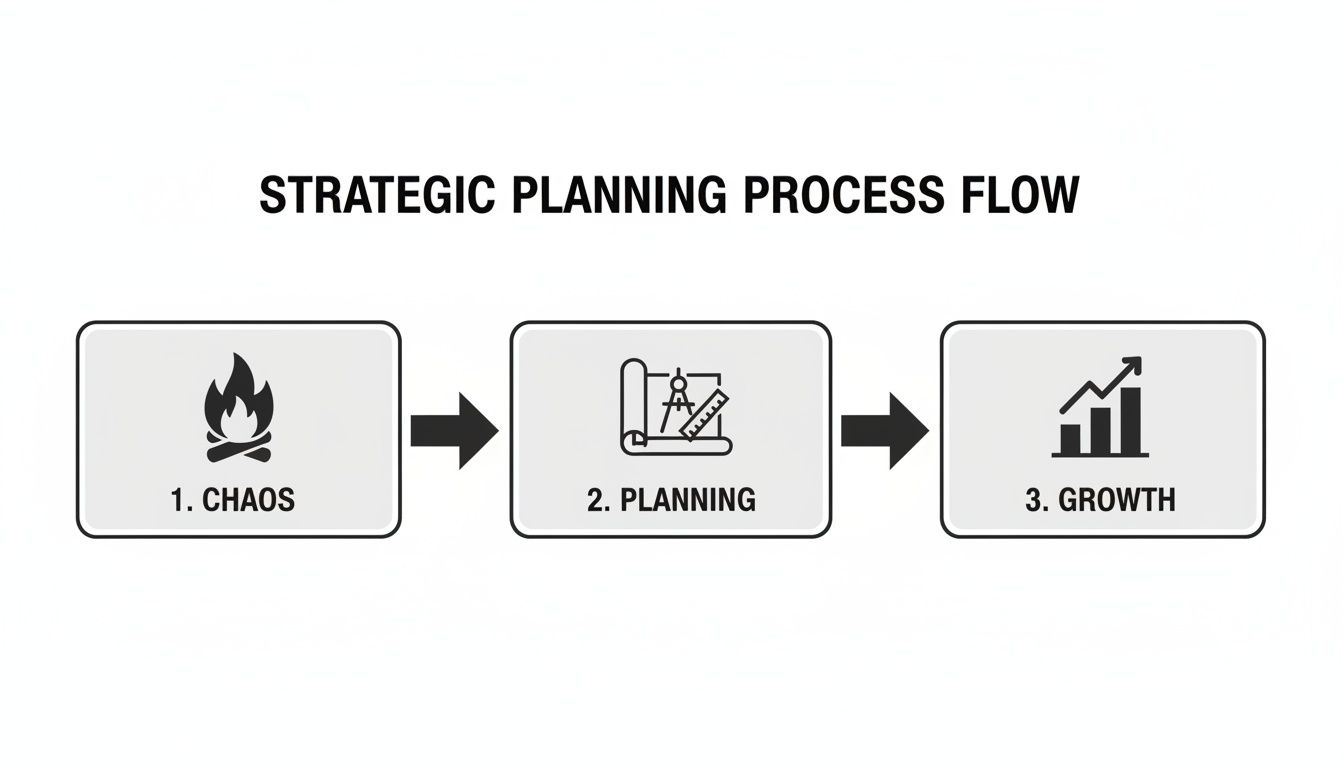
This simple flow shows how escaping a reactive, "firefighting" state for a deliberate planning phase is what truly enables a business to grow without breaking.
1. Forecast Future Demand
The first pillar is all about looking ahead. You can't build a team for the future if you don't have a clear picture of what that future looks like. This means analyzing your own business goals alongside external market trends to predict the skills and roles you'll need in the next one to three years.
For a mid-sized agency, this has to be more than just guesswork. Start by digging into your sales pipeline. Are you consistently pitching larger, more complex digital transformation projects? That’s a clear signal you’ll need senior strategists and data analysts, not just more account managers.
Then, look outside your own walls at market shifts. Is a new social media platform gaining serious traction with your ideal clients? You might need to hire or train specialists in that specific area before it's too late. The goal is a demand forecast that quantifies the types and numbers of roles you'll need to hit your strategic goals.
2. Analyze Your Current Workforce
Once you know what you'll need, the next logical step is to figure out what you already have. This pillar involves a deep, honest audit of your current team's skills, competencies, and even their career aspirations. It's about creating a comprehensive inventory of your internal talent.
This analysis goes far beyond job titles. Your senior graphic designer might have a hidden passion and growing expertise in motion graphics—a skill your demand forecast just flagged as critical for next year. It's a shocking reality, but one study found that only 54% of leaders feel they have a clear view of the skills within their own organization.
A thorough workforce analysis uncovers hidden talents and reveals potential leaders. It’s the essential step that prevents you from needlessly spending on external recruitment when the perfect candidate might already be sitting in your office.
To pull this off, you can use a combination of methods:
- Skills Assessments: Have employees and their managers map current skill levels against a standardized competency framework.
- Performance Reviews: Dig into recent performance data to identify high-potentials and people ready for a new challenge.
- Career Conversations: Hold dedicated meetings with your team members to talk about their long-term goals and interests.
3. Identify the Gaps
This is where the magic happens. By overlaying your future demand forecast (Pillar 1) on top of your current workforce analysis (Pillar 2), the gaps become immediately obvious. This step is all about pinpointing the specific shortfalls—and surpluses—of skills and roles between where you are today and where you need to be.
You might discover a critical shortage of project managers who know their way around agile methodologies, which is essential for the larger clients you're trying to land. Conversely, you might find you have a surplus of junior designers but a serious lack of senior creative leadership to guide them.
Identifying these gaps lets you prioritize. A missing cloud engineer could delay a critical product launch, making that a high-priority gap to fill. Creating a simple matrix that ranks each gap by its potential business impact helps focus your efforts where they'll matter most.
4. Develop a Tangible Action Plan
With your gaps clearly identified and prioritized, it’s time to build the action plan. This pillar translates all your analysis into a set of specific, measurable initiatives designed to close those gaps. This is where your strategy becomes reality.
Your action plan isn't just a hiring list. It's a multi-faceted approach that should always consider four core tactics, often called "Buy, Build, Borrow, or Bridge."
- Buy: Recruit new talent from outside the organization to bring in skills you don't currently have.
- Build: Develop your existing employees through training, upskilling, and mentorship programs.
- Borrow: Engage contractors, freelancers, or consultants for specific projects or temporary skill needs.
- Bridge: Redesign roles or restructure teams to better align existing talent with strategic priorities.
For an agency, a blended approach is almost always best. You might decide to "buy" a new Head of Strategy, "build" a certification program for your account team, and "borrow" a freelance video editor for a one-off campaign. Effective resource planning for project management is absolutely crucial at this stage to make sure you're allocating people effectively.
5. Monitor and Adapt the Plan
Finally, a strategic workforce plan is not a static document you create once and file away. The fifth pillar is a continuous cycle of monitoring, measuring, and adapting. Your business environment will change, new opportunities will pop up, and your plan must be agile enough to evolve right alongside them.
Establish a regular review cadence—quarterly is a great starting point. During these reviews, track key metrics like time-to-fill for critical roles, employee turnover in key departments, and the success rate of your internal promotions.
This ongoing process ensures your workforce strategy stays locked in with your business strategy. If a major client is unexpectedly lost or a new market opportunity appears, your plan can be adjusted on the fly, keeping your agency resilient and ready for whatever comes next.
Connecting Your Data to Smarter Decisions
A brilliant strategic workforce plan built on flawed data is like an architect designing a skyscraper on a foundation of sand. It looks impressive on paper, but it’s destined to collapse.
For most mid-sized agencies, the biggest hurdle isn't the strategy itself; it's the quality of the data feeding that strategy. Let's talk about bridging that gap between theory and reality.
For years, agencies have been held hostage by manual, inaccurate timesheets. These error-prone, guesstimated logs lead to fundamentally flawed workforce decisions, hurting everything from project profitability to team burnout. The whole thing becomes a frustrating chore, not a source of strategic insight.
The alternative? A shift toward automated, calendar-based data capture. By analyzing the actual events and work blocks that already exist in your team's calendars, you get a crystal-clear picture of where time is truly being spent. No guessing, no rounding up, and no end-of-week scramble to remember what happened on Monday.
Unlocking Answers Hidden in Your Data
This foundation of accurate data is what turns strategic workforce planning from a theoretical exercise into a powerful decision-making engine. It helps you answer the critical questions that determine your agency's health and future.
Here’s an example of the kind of clarity a time analytics dashboard can provide.

This kind of visualization instantly surfaces insights. It shows how time is allocated across different projects, clients, and internal work, making it easy to spot trends and inefficiencies at a glance.
With this level of visibility, you can finally move beyond gut feelings and start making choices based on reality. The data allows you to dig deep into questions like:
- Who are our most profitable clients? By accurately tracking every hour, you can calculate the true ROI of each account.
- Which projects are draining our resources? Identify scope creep and unprofitable work before it sinks your margins.
- Where are our hidden resource gaps? Pinpoint teams or roles that are consistently overextended.
- Which team members are ready for new challenges? See who is efficiently managing their workload and has capacity for growth.
Accurate data isn't just a nice-to-have; it's the engine of an effective talent strategy. You can explore a variety of workforce planning software solutions that automate this process, turning raw calendar data into actionable business intelligence.
The Role of AI in Modern Data Analysis
Artificial intelligence is rapidly changing how agencies can use this data. Advanced AI data analysis tools can uncover complex patterns and predictive insights from your workforce data, enabling more proactive and informed decisions. AI can spot burnout risks, suggest optimal project staffing, and forecast future capacity needs with a high degree of accuracy.
This isn't some far-off concept; it's delivering real gains today. New research shows that AI's role in strategic workforce planning is already boosting productivity, with 39% of employees reporting gains. For agencies tired of manual timesheets, this is a game-changer. Skills-based planning, powered by AI, could free up 30% of work hours for automation by 2030, all without reducing headcount.
Data tells a story. Manual timesheets tell a work of fiction, full of plot holes and unreliable narrators. Automated, calendar-based data tells the truth, giving you the clarity needed to write your agency's next successful chapter.
Ultimately, connecting your data to your decisions is the single most important step in making your strategic workforce plan a success. It moves you from a world of assumptions to a world of certainty, ensuring every talent investment you make is smart, strategic, and aligned with your most important business goals.
Using Scenario Planning for an Uncertain Future
Your agency doesn’t operate in a predictable world, so why would you build a workforce plan that assumes it does? Static, one-track plans are brittle. They shatter the moment they encounter unexpected market shifts, new client demands, or competitive threats. This is where you move beyond simple forecasting and into the powerful technique of scenario planning.
Think of it as creating a "flight simulator" for your business. Instead of just hoping for the best, you intentionally create a handful of plausible 'what-if' stories—both good and bad—to test how well your talent strategy holds up under pressure. This proactive approach ensures you have a playbook ready for whatever the future throws at you.

This process isn't about predicting the future with perfect accuracy. It's about building an agile, adaptable agency that doesn't just survive uncertainty but knows how to capitalize on it. You can't control the storm, but you can build a more resilient ship.
Building Your What-If Playbook
To get started, gather your leadership team and brainstorm a few realistic future scenarios. A good practice is to create one for growth, one for risk, and one for disruption. This covers your bases and forces you to think beyond just straight-line growth.
Let’s walk through three concrete examples that a mid-sized agency might face.
1. The Growth Scenario: Landing a Dream Enterprise Client
Imagine your agency signs a massive, multi-year contract that’s set to double your revenue. It's a fantastic problem to have, but it will stretch your current team to its absolute breaking point.
- Workforce Impact: You’ll face an immediate and urgent need for senior-level project managers, specialized tech leads, and dedicated client service directors. Without rapid reinforcement, your existing teams will be at a high risk for burnout.
- Proactive Response Plan: Pre-identify top-tier freelancers or partner agencies you can bring on for the initial surge. Create a fast-track onboarding process for new hires and a temporary project-based bonus structure to reward the existing team for their extra effort. If you need a starting point, check out our guide on using a capacity planning template in Excel to model this kind of surge.
2. The Risk Scenario: A Key Competitor Poaches Your Team
A new, well-funded competitor enters your market and successfully poaches half of your award-winning design team. This instantly creates a massive delivery gap and puts key client relationships in jeopardy.
- Workforce Impact: Critical projects are at risk of stalling, team morale plummets, and your reputation for creative excellence is on the line. The remaining designers are now overloaded and become immediate flight risks themselves.
- Proactive Response Plan: Develop a robust succession plan for critical roles. Invest in cross-training to create skill redundancy and maintain a "bench" of vetted creative contractors. More importantly, get serious about retention by regularly benchmarking salaries and strengthening your agency's culture.
Scenario planning forces you to confront uncomfortable possibilities before they become reality. It transforms panic-driven reactions into calm, calculated responses, giving you a powerful competitive advantage in a volatile market.
3. The Disruption Scenario: AI Makes a Core Service Obsolete
A new generative AI technology emerges that automates a core service you offer, like basic content creation or performance marketing analytics. Suddenly, a significant portion of your billable work is at risk of becoming irrelevant.
- Workforce Impact: You have a team of skilled specialists whose primary value is now threatened. This could lead to low utilization, decreased profitability, and eventual layoffs if you don't adapt quickly.
- Proactive Response Plan: Invest in an aggressive upskilling program to retrain the affected team on how to manage and leverage the new AI tools, shifting their roles from "doers" to "strategists." At the same time, identify new, higher-value advisory services you can offer that complement the automated technology.
The table below illustrates how you might map out these scenarios and their corresponding workforce actions.
Agency Scenario Planning Matrix
| Scenario | Potential Impact | Strategic Workforce Response |
|---|---|---|
| Growth: Land Enterprise Client | Immediate talent shortage, risk of burnout, strain on project management. | Activate freelancer network, fast-track hiring for senior roles, offer project bonuses. |
| Risk: Competitor Poaching | Delivery gaps on key projects, low morale, loss of institutional knowledge. | Strengthen retention efforts, build a contractor bench, implement cross-training programs. |
| Disruption: AI Obsolescence | Skills mismatch, reduced billable hours, decreased profitability in core service. | Launch upskilling programs in AI strategy, pivot to higher-value consulting services. |
By thinking through these possibilities, your agency can prepare thoughtful, strategic responses instead of being caught flat-footed.
This agile approach is becoming more critical. As we head into 2026, global talent scarcity is reshaping how businesses plan. For instance, the strategic value of global mobility programs is expected to jump from 6.0 to 7.1 out of 10. This is especially important for agencies handling cross-border projects, where poor visibility into skills and locations can lead to over 25% wasted capacity. By preparing for multiple futures, you build a resilient, forward-thinking organization ready for anything.
Common Workforce Planning Mistakes to Avoid
Starting a strategic workforce plan is a huge step in the right direction. But even with the best intentions, it's easy to get derailed by a few common, completely avoidable missteps. Knowing what these pitfalls look like ahead of time is the best way to make sure your plan creates real business value instead of just gathering dust on a shelf.
Lots of agencies dive in headfirst, full of energy, only to watch the whole thing grind to a halt. The culprit is usually one of several classic mistakes. By getting real about these challenges now, you can sidestep the headaches and build a plan that actually works from day one.
Mistake 1: Planning in an Executive Bubble
One of the fastest ways to kill a workforce plan is to create it in isolation. When only the C-suite is in the room, the strategy inevitably misses the ground-level insights that make it practical. It completely overlooks the realities of day-to-day operations and ends up feeling disconnected from the very people it’s supposed to help.
This top-down approach is a recipe for poor adoption. Why would team members and department heads champion a plan they had zero say in? They won't.
Do This Instead: Build a cross-functional planning team from the get-go. Pull in people from HR, finance, operations, and your key delivery departments. This collaborative method builds immediate buy-in and ensures your strategy is grounded in how your agency actually gets work done.
Mistake 2: Relying on Messy Data
We've touched on this already, but it's worth repeating: a brilliant strategy built on bad data is doomed. Basing your future talent decisions on guesstimated timesheets or half-baked skill profiles is like trying to navigate a new city with a map drawn from memory. You'll end up going in circles, investing in the wrong training or hiring for skills you don't really need.
Bad data hides the truth. It obscures true project profitability, team utilization, and actual capacity. Without a clean, reliable source of data, your entire workforce planning effort is just a high-stakes guessing game.
Do This Instead: Make data integrity your top priority before you start planning. Get tools in place that automate data capture from sources your team already uses, like their calendars. This will give you an honest picture of where time and effort are really going. Clean data is the foundation of any plan worth making.
Mistake 3: Treating the Plan as a One-Off Project
Another fatal flaw is seeing workforce planning as a task you can check off a list. Agency life is anything but static—clients come and go, markets shift, and new tech pops up constantly. A plan you create in January can feel ancient by July if it isn't treated like a living, breathing document.
When a plan is never revisited, it quickly becomes irrelevant. The agency slips back into reactive hiring, and all the time and resources you invested go down the drain.
Do This Instead: Set up a regular review cadence and stick to it. Schedule quarterly check-ins to see how you're tracking against your goals, look at the latest data, and tweak the plan to match current business realities. This turns your plan from a static snapshot into a dynamic GPS that adjusts to the road ahead.
Mistake 4: Focusing Only on Hiring New People
It’s incredibly easy to fall into the "hiring-only" trap, where every skill gap is a problem to be solved with a new hire. Of course, recruitment is part of the puzzle, but leaning on it exclusively is expensive, slow, and frankly, demoralizing for your current team. It completely ignores the incredible potential you already have in-house.
This approach stunts internal talent development and often leads to higher turnover when your ambitious people leave to find growth somewhere else. It's no surprise that 82% of companies are shifting their focus to internal mobility to keep their talent and close skill gaps more effectively.
Do This Instead: Think in terms of "Buy, Build, or Borrow." For every gap you find, first ask if you can build the skill through training. If not, can you borrow it with a contractor for a specific project? Only after considering those options should you default to buying new talent by hiring someone. This balanced approach is way more cost-effective and helps you build a more engaged, loyal team.
Your First Steps to a Smarter Workforce Strategy
It's one thing to see the value in strategic workforce planning, but turning that idea into action is where the real magic happens. The good news? You don't need a massive team or some complicated, expensive system to get started. In fact, the most effective strategies I've seen always start small, focusing on one clear objective to build confidence and show everyone what's possible.
Your journey has to start with data. Before you can even think about planning for the future, you need an honest, accurate picture of your workforce right now. This means getting past the guesstimates and gut feelings to understand how your team’s time and skills are actually being used.
Create Your First Pilot Plan
With a clear baseline in hand, it's time to pick your first target. Choose one critical department or a single high-value project to run a pilot plan. Seriously, don't try to boil the ocean here. Focus your energy where it will make the biggest, most visible impact.
- Select a Focus Area: Pick a team that’s absolutely essential to your upcoming business goals. Maybe it's your lead generation team or a key product development squad.
- Map Skills to Goals: Take a hard look at that team’s current skills. Now, map them directly against their project pipeline for the next six months.
- Identify One Key Gap: Pinpoint the single most significant skill or capacity gap that could put those projects at risk.
- Develop a Micro-Action Plan: Now, make a decision. Will you buy (hire), build (train), or borrow (contract) to fill that one gap? This targeted action is your first win.
The goal isn’t to create a perfect, five-year plan on day one. It's about taking a single, informed step that moves you from reactive chaos toward strategic clarity. This small-scale success becomes the proof you need to get buy-in and expand your efforts.
By starting this way, you begin to build a case for the powerful outcomes that await—higher profitability, better team engagement, and true operational agility. Your journey to becoming a future-proof agency starts right now.
Answering Your Workforce Planning Questions
Moving from theory to action always surfaces a few practical questions. Getting a strategic workforce planning initiative off the ground means you'll have to clear some common hurdles first. Here are some straightforward answers to help you start building a more resilient, future-ready team with confidence.
How Do I Get Buy-In From Skeptical Leaders?
The fastest way to win over skeptics is with data, not just big ideas. Leaders respond to numbers that directly tie to the bottom line. So, instead of trying to sell a complex, theoretical framework, find a small, tangible problem you can solve right now.
For example, pull accurate time tracking data to show the precise dollar cost of low utilization rates in just one department. Then, map out a focused workforce plan showing how strategic tweaks—like upskilling two team members instead of hiring a new one—can directly improve that metric and save the company money. A small, measurable win is the most powerful proof of concept you can possibly offer.
The goal isn't to sell the entire philosophy of strategic workforce planning at once. It's to solve a real, painful business problem that leaders already care about. Once they see tangible results, they'll be asking you what's next.
What Key Metrics Should We Track for Success?
Your metrics need to build a bridge between your talent initiatives and real business outcomes. While every agency has its own unique pressures, a few key performance indicators (KPIs) create a strong foundation for measuring the impact of your workforce planning.
- Time-to-Fill for Critical Roles: This tracks how fast you can fill high-impact positions. A decreasing time-to-fill is a great sign that your plan is getting ahead of needs.
- Internal Mobility Rate: This measures the percentage of roles filled by your own people. A higher rate shows you’re succeeding at talent development and retention. In fact, research shows 82% of companies are focusing more on internal mobility to keep their best people.
- Voluntary Turnover in Key Positions: High turnover in critical roles is a major red flag. Keeping an eye on this helps you address issues before they destabilize your most important teams.
- New Hire Performance Score: This compares how new hires are performing (after 90 days, for example) against your established benchmarks. It’s a great way to validate whether your hiring profiles and processes are actually working.
How Often Should We Revisit and Update Our Plan?
A workforce plan isn't a static document you create once and file away; it’s a living guide for your business. Think of it as a dynamic tool that has to adapt to the shifting realities of your market and client list.
A good rule of thumb is to set up a quarterly review cycle.
This cadence is frequent enough to let you respond to market shifts, big new client wins, or unexpected team changes without feeling like you're constantly in planning mode. During these quarterly check-ins, your cross-functional team should review progress against your KPIs, look at any new business goals on the horizon, and adjust the action plan accordingly. This rhythm ensures your workforce strategy stays locked in with your agency’s direction.
Ready to build your workforce plan on a foundation of accurate, real-time data? TimeTackle automates data capture directly from your team's calendar, giving you the crystal-clear utilization and productivity insights needed to make smarter strategic decisions. https://www.timetackle.com