



Takt time isn't just for factory floors; it's the secret pulse of a high-performing agency. Think of it as the exact rhythm you need to maintain to hit every client deadline without your team collapsing from exhaustion. The formula is simple: Net Available Time divided by Customer Demand. This gives you a precise beat for your entire workflow.
Why takt time is your agency's most important metric

Imagine a busy coffee shop during the morning rush. The manager knows they need to serve a new customer every 90 seconds to keep the line moving and stop chaos from breaking out. That 90-second interval is their takt time. This idea works perfectly for service and creative work, where your "customer demand" might be client reports, design mockups, or project milestones.
Takt time calculations give you a data-driven answer to a tough question: "Do we have the right number of people for the work we've committed to?" It helps you move past guesswork and vague feelings of being "too busy" into a world of clear, measurable reality.
A quick trip to the origins of takt time
The idea came from Toyota’s lean production system back in the 1950s. In the competitive world of car manufacturing, takt time was a breakthrough. It helped factories perfectly sync their output with customer demand, which was key to cutting waste.
For instance, a factory with 420 minutes of available production time and a customer demand for 210 car parts would have a takt time of exactly two minutes per part (Takt Time = 420 / 210). This simple math set the 'heartbeat' for the entire production line.
The same logic works for an agency. If your team has 1,200 available work hours this month and needs to deliver 40 major project milestones, your takt time is 30 hours per milestone. That number isn't just a metric; it's the pace you need to hold to succeed.
Takt time turns abstract demand into a concrete operational rhythm. It’s not about working faster; it's about working at the right pace to meet commitments without burning out your team.
How it brings your workflow into focus
Once you set this clear production pace, you can start to see where your process really stands. It forces you to define what a "unit of work" is for your team and to figure out your true capacity. This brings several immediate benefits:
- Pinpoints bottlenecks: If your actual time to complete a task (that's your cycle time) is consistently longer than your takt time, you’ve just found a bottleneck.
- Improves resource planning: Knowing your required pace helps you make informed, confident decisions about hiring, training, or shifting team members to where they're needed most.
- Reduces team burnout: It gives a realistic, achievable target, ending the constant, draining pressure of undefined and seemingly endless workloads.
- Boosts predictability: When your team operates at a consistent rhythm, you can give clients more accurate timelines and reliably deliver on your promises.
Takt time vs. cycle time vs. lead time
It's easy to mix these three metrics up, but they each tell you something different and important about your workflow. Think of them as three different lenses for viewing your team's performance.
| Metric | What It Measures | Purpose |
|---|---|---|
| Takt Time | The pace needed to meet demand. | Sets the target rhythm for production (a "pull" metric). |
| Cycle Time | The actual time it takes to complete one unit of work. | Measures your current production speed (a "push" metric). |
| Lead Time | The total time from when a request is made until it's delivered. | Measures the entire customer experience from start to finish. |
Understanding takt time is the first step. But to get the full picture, you need to see how it works with cycle time. Comparing your target pace (takt time) to your actual pace (cycle time) is where the real value is. We look into this in our guide on how to calculate cycle time, as using these two metrics together is what truly unlocks your team's efficiency.
Calculating takt time for your agency's workflow

Alright, let's get down to actually calculating takt time for a real-world agency. This isn't about running some complex algorithm. It’s about getting honest answers to two basic questions: How much time do we really have, and what do our clients actually need from us?
The formula is simple: Takt Time = Net Available Work Time / Customer Demand. The real work—and where most people trip up—is accurately defining those two variables, especially in an agency where projects aren't as uniform as widgets on a factory line.
Defining net available work time
First, you need to figure out your team’s real, productive work time. This is not the total hours they're in the office or online. You have to remove all the time spent on non-billable activities that are still needed to keep the lights on.
Think about it: your team is paid for 40 hours a week, but they aren’t producing client deliverables for all 40 of those hours. Not even close.
To find your Net Available Work Time, you start with the total paid hours for a period—say, a week or a month—and then subtract the time sinks:
- Breaks and lunches: All the planned, unpaid time people spend away from their desks.
- Internal meetings: Your weekly team huddles, all-hands meetings, and one-on-ones.
- Administrative tasks: The necessary work of timesheets, expense reports, and sifting through internal comms.
- Training and development: Any time dedicated to professional growth or learning new tools.
What’s left over is the true amount of time your team has to produce the work clients are paying for. Nailing this number is the foundation of a meaningful takt time calculation.
Defining customer demand
Next, you have to measure what your clients expect you to deliver within that same time frame. For an agency, "customer demand" isn't a single product; it's a mix of deliverables, each with its own level of effort.
Your goal is to find a consistent unit of value that you deliver. For a content agency, it might be "blog posts." For a design firm, it could be "mockups." For a PPC agency, "client reports" could be the unit of measure.
The key here is consistency. If you choose "project milestones" as your unit, then you need to count every major milestone due in that period. If you go with "client reports," count all of them. Don't mix and match units within a single calculation, or you'll just end up with a meaningless number.
A practical example: a 50-person agency
Let’s walk through how a 50-person marketing agency would calculate its weekly takt time.
Calculate total available hours:
- 50 employees × 40 hours/week = 2,000 total hours
Subtract non-productive time:
- Breaks & lunch: (1 hour/day × 5 days/week × 50 people) = 250 hours
- Internal meetings: An average of 3 hours/week/person × 50 people = 150 hours
- Admin tasks: An average of 2 hours/week/person × 50 people = 100 hours
- Total non-productive time: 250 + 150 + 100 = 500 hours
Find net available work time:
- 2,000 total hours – 500 non-productive hours = 1,500 net available hours
Define customer demand:
- For this week, the agency has committed to delivering 30 major client project milestones.
Calculate takt time:
- Takt Time = 1,500 hours / 30 milestones = 50 hours per milestone
This single number—50 hours per milestone—is incredibly powerful. The agency now has a clear benchmark. They know that to stay on track, they have an average of 50 hours of real team time to complete each milestone.
This becomes the heartbeat of their entire workflow and is a key input for effective capacity planning. It helps leaders confidently decide if they can take on a new project or if they need to shift resources around to prevent burnout and delays.
Adapting takt time for different types of agency work
Here’s a common roadblock I see agencies hit: not all work is the same. A simple takt time calculation is perfect when every unit is identical, but that's almost never the case in a creative or consulting setting. A website mockup requires a different level of effort than a quick social media graphic, so lumping them together into a single takt time can be very misleading.
This is what’s known as a mixed-model environment. When you use one-size-fits-all calculations, you’ll either overestimate or underestimate your actual capacity, and that's a fast track to scheduling chaos. The fix is to create a weighted average that accounts for the complexity of your different deliverables.
Using weighted averages for better accuracy
Let's imagine a creative agency that juggles large website projects alongside quick-turnaround social graphics. Just counting them as equal "units" of demand would give you a useless takt time. Instead, you need to assign a weight to each type of work based on the effort it typically demands.
You might find, for example, that one website project takes about the same amount of effort as 20 social graphics. That gives you a useful conversion factor.
Now, let's say your demand in a given month looks like this:
- 4 Website Projects
- 40 Social Media Graphics
You can now convert this mixed bag of demand into a single, standardized unit. We'll use "social graphic equivalents" as our standard.
First, convert the website projects into their equivalent value: 4 website projects × 20 = 80 social graphic equivalents.
Then, add the actual social graphics to that total: 80 + 40 = 120 total equivalent units of demand.
If your team has 240 net available work hours for the month, your new, more accurate takt time calculation becomes: 240 hours / 120 units = 2 hours per social graphic equivalent.
This gives you a far more reliable benchmark. You now know that for every two hours of available team time, you need to complete work equivalent to one social graphic.
This weighted approach stops you from falling into the one-size-fits-all trap. It creates a realistic production schedule by reflecting the true effort behind different types of creative and strategic work.
This method is borrowed directly from how complex manufacturing lines handle varied product demands. A multi-product assembly line might have a target average takt time, but individual products get their own specific time requirements based on complexity. To keep the line flowing smoothly, manufacturers use these weighted calculations to level-load the schedule and stop bottlenecks. You can explore more about how this works in a production setting to get additional insights on takt time.
Turning takt time data into smarter decisions
Okay, so you've calculated your takt time. What now? Getting that number is just the start—the real value comes when you use it. Your takt time is your target, the pace you need to keep to meet customer demand.
The next move is simple: compare your takt time to your actual cycle time (how long it really takes your team to complete a task). This one comparison will tell you everything you need to know about your agency's health and will sort you into one of three scenarios. Each one requires a completely different game plan. This is the heart of turning data into actionable insights and using metrics to build a smarter, more resilient agency.
Scenario 1: Cycle time is faster than takt time
If your team is finishing work faster than the takt time requires, congratulations. You have extra capacity. This is a "good problem," but it’s still a problem you need to solve. Letting that extra bandwidth disappear into idle time is just wasting money.
Don't let that happen. Instead, you can:
- Invest in professional development: Use that found time for training, certifications, or exploring new skills that make the entire agency more valuable.
- Work on internal projects: Now's the time to finally overhaul your own website, create that new case study, or refine the internal processes you've been putting off.
- Pursue new business: Your team has the capacity to onboard another client without feeling stretched thin. Go for it.
Scenario 2: Cycle time is slower than takt time
This is the situation most agencies find themselves in. When your team consistently takes longer to complete work than your client demand dictates, you’re on a fast track to bottlenecks, missed deadlines, and burnout. It’s a huge red flag that something in your workflow is broken.
The power of takt time calculations is how they shine a spotlight on these exact mismatches. For example, an automotive parts line with a takt time of four minutes per part but an actual cycle time of five minutes is looking at a 25% capacity shortfall. That’s a recipe for stockouts. In fact, since 2015, manufacturers using real-time data platforms have reported resolving these kinds of bottlenecks up to 30% faster. If you want to dig deeper into how cycle time affects production, check out this insightful analysis.
Your next steps should focus on closing that gap:
- Improve your processes: Map out your workflow and hunt for inefficiencies. Where are the redundant steps or communication breakdowns that are slowing you down?
- Adopt better tools: Are people still doing manual, repetitive tasks that a piece of software could handle? Automate what you can to free up your team’s focus.
- Make a case for strategic hiring: Your data is no longer a "feeling." You can now prove that you don't have enough people to meet current demand, which gives you a solid foundation to request a new hire.
Scenario 3: Cycle time and takt time are aligned
You've hit the sweet spot. Your team's capacity is perfectly in sync with your client demand, which leads to a smooth, predictable, and calm workflow.
This state of balance is the goal. It means you're operating efficiently, meeting deadlines without overworking your team, and delivering value predictably.
Your job now shifts from fixing to maintaining. You have to protect this balance. Keep a close eye on both metrics, because a single new client or a sudden change in project scope can throw everything out of whack. Stay on top of your agency's operational rhythm.
Automating your takt time calculations with calendar data
Let’s be honest: manual time tracking is a chore. It’s usually inaccurate, time-consuming, and your team probably hates doing it. But what if you could get all the data you need for precise takt time calculations without anyone having to fill out a single timesheet?
The answer is likely sitting right in your team’s Google or Outlook calendars. By connecting to this source of truth, you can turn your team's daily schedule from a simple planning tool into a goldmine of operational data.
Let your calendar do the heavy lifting
Instead of chasing down your team for timesheet entries, you can use a tool like TimeTackle to automatically analyze their calendar events. The platform captures their activities directly from their schedules, giving you a real-time, accurate picture of your "Net Available Work Time." It can even help you measure the "Cycle Time" for specific types of work.
This completely removes the guesswork and the administrative headache. Every meeting, every focused work block, and every client call is already accounted for, creating a solid foundation for your operational metrics.
The diagram below shows how this automation feeds the core decision-making loop: comparing your target pace (Takt Time) with your team's actual work pace (Cycle Time).
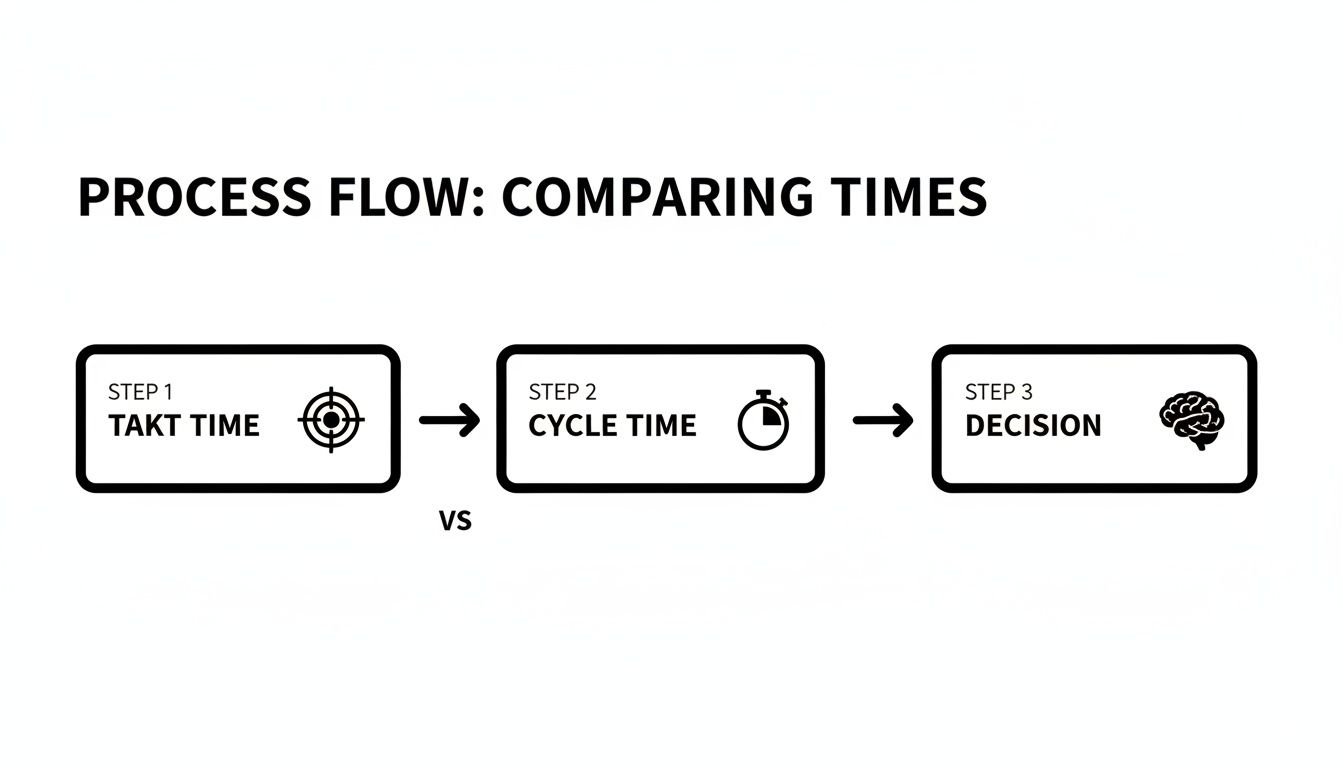
When you automate, you're constantly feeding this loop with real-time data, which is what allows you to make smarter, faster operational decisions.
From raw data to actionable insights
Simply capturing blocks of time isn't enough. The real value comes when you start categorizing that time to understand exactly where your team's effort is going. This is where a bit of automation truly shines.
You can set up rules and tags to automatically classify calendar events by client, project, or the type of work being done. It's surprisingly simple.
- Tag events with a client name, like "[Client-A]", to instantly group all related meetings and work sessions.
- Use keywords in event titles, such as "Design Mockup," to track the time spent on specific deliverables.
- Create rules that automatically assign project codes based on who is attending a meeting.
This kind of structured data makes it incredibly easy to calculate demand-specific takt times. For instance, if you need to know the takt time just for "Website Projects," you can just filter your data and have an answer in seconds. No more digging through spreadsheets or hunting down manual time logs.
You can find more hands-on tips for setting this up in our guide on time tracking with Google Calendar. It breaks down exactly how to turn your calendar into a powerful reporting tool.
Common questions about agency takt time
Switching to a takt time mindset is a big change, and it's natural for some questions to pop up as your team gets the hang of it. It’s a new way of thinking, so running into a few hurdles is part of the process.
Let's tackle some of the most common questions we hear from agencies. These answers should help you get past those initial challenges and start using takt time with confidence.
What if my team’s cycle time is consistently faster than the takt time?
First off, congratulations! This is a great sign, but it’s one that needs your attention. It means you have extra capacity, a resource you don't want to see turn into idle time.
Instead of letting your team sit idle, you need to reallocate that time strategically. This is a clear signal that you can take on more clients without overloading your team. You could also invest that time internally, letting your team focus on professional development or work on improving your own agency's processes. You might even use it for proactive client work, going above and beyond to strengthen those relationships.
The goal is to turn that found time into a tangible benefit for your agency.
How do you handle unexpected client requests or revisions?
The best way to handle the unexpected is to plan for it. Let's be honest—unplanned work and urgent revisions are a normal part of agency life. So, instead of treating them like interruptions, build a buffer for them right into your takt time calculations.
Start by digging into your historical data. If you see your team usually spends about 15% of their time on unplanned tasks and urgent client requests, you have your number. Simply reduce your "Net Available Work Time" by that percentage. This creates a much more realistic takt time that accounts for the unpredictable nature of client work, making your targets far more achievable.
By building a buffer into your available time, you create a system that can absorb shocks without breaking. This makes your workflow more resilient and your team less stressed.
Can takt time work for purely creative or strategic roles?
Absolutely. The trick is to shift your perspective from measuring "units" to measuring "deliverables." Even for work that isn't easily standardized, there's always an output you can track.
For example, a strategist's customer demand might be "one strategy deck per week." For a content writer, it could be something like "three blog posts per month." The takt time calculations will then show you the rhythm required to meet those specific commitments. This isn't about trying to standardize creativity; it's about understanding the pace you need to keep to deliver on your promises.
How often should we recalculate our takt time?
Your takt time is only as useful as the data behind it. As soon as your client demand or team capacity changes, your takt time is officially outdated. As a rule of thumb, it’s a good idea to review and recalculate it at least once a quarter.
That said, you should also do it any time you have a major change, like:
- Onboarding a major new client
- Hiring new team members or having someone leave
- Making a significant change to your internal processes
If your agency's work is highly seasonal, you might even find it helpful to recalculate it monthly. This allows you to adjust your operational rhythm to match those predictable ebbs and flows in demand.
Ready to stop guessing and start getting real-time, accurate data for your takt time calculations? TimeTackle connects directly to your team’s calendars to automatically capture work time without manual timesheets. See exactly where your effort is going and build a more predictable, profitable agency. Learn how it works at timetackle.com.