



So, what exactly is capacity planning? Think of it as the strategic process of matching your team's resources—their time, unique skills, and availability—with the actual demands of your client projects and workload.
It's all about making sure you have precisely the right people with the right skills available at the right time. Nail this, and you prevent your team from burning out while keeping your projects profitable and on track.
Defining Capacity Planning for Modern Agencies

Imagine your agency is an airline. You can't just sell more tickets than you have seats on the plane—that leads to chaos. But at the same time, flying with a bunch of empty seats is a surefire way to lose money.
Capacity planning is the system you build to ensure every "flight" is profitably full without overbooking and creating a nightmare for everyone involved. It helps you shift from making reactive, gut-feel decisions to taking a proactive, data-driven approach to managing your most valuable asset: your team's time.
This isn't just about juggling schedules or trying to avoid burnout. It's a fundamental business function that has a direct line to your bottom line, client happiness, and how long your best people stick around.
Get it wrong, and you're staring down the barrel of missed deadlines, stressed-out employees, and shrinking profit margins. But get it right? You're on the path to a more predictable, scalable, and successful agency.
Why It's a Non-Negotiable Strategy
In any service-based business, your team's capacity is your inventory. If you don't have a clear view of it, you're essentially flying blind.
Despite how critical it is, a lot of companies are struggling. A recent survey found that two-thirds of organizations pointed to forecasting and the mismatch between capacity and demand as their biggest resource management headaches. Even more telling, only a tiny 13% felt their forecasting abilities were 'extremely effective.'
When you get capacity planning right, you solve several massive problems at once:
- Profitability: It ensures you're not paying for idle hands during slow periods or, even worse, turning down profitable projects because you think you're swamped.
- Employee Well-being: It's your best defense against the chronic overwork that torches morale, causes burnout, and leads to high turnover.
- Client Satisfaction: You can confidently guarantee that you have the bandwidth to deliver top-notch work on schedule, every single time.
- Strategic Growth: It gives you the hard data you need to make smart calls about hiring, training, and whether you're ready to take on that huge new client.
The Core Components of Capacity Planning
At its heart, capacity planning is really about balancing a few key elements. Getting a handle on how these pieces fit together is the first step toward building a system that actually works. Let's break down what goes into the mix.
The Core Components of Capacity Planning
Here's a quick look at the essential elements that form the foundation of a solid capacity planning process.
| Component | Description | Key Question It Answers |
|---|---|---|
| Demand Forecasting | This is the process of predicting future project needs and client work based on historical data, sales pipelines, and market trends. It's about looking ahead. | "What work is coming our way, and when will we need to do it?" |
| Resource Capacity Analysis | This involves measuring the total available work hours of your team, accounting for time off, holidays, and non-project work like meetings or training. | "How much productive time do we actually have available?" |
| Resource Allocation | This is the practical step of assigning specific team members to specific tasks or projects based on their skills, availability, and the project's priority. | "Who is the best person for this job, and do they have the time?" |
| Monitoring and Optimization | Capacity planning isn't a "set it and forget it" task. This component is about continuously tracking progress against the plan and making adjustments as things change. | "Is our plan working, and how can we make it better?" |
Understanding how these parts interact is crucial for making smarter operational choices and getting a true sense of your team's output. Efficient management and allocation are fundamental, especially in fast-moving fields. For those in tech roles, this guide on DevOps resource allocation optimization offers a deeper, more technical perspective.
A huge part of this process involves monitoring how your team’s time is actually being spent, which is where utilization rates come into play. This metric is foundational, and you can get the full rundown in our detailed guide on how to calculate utilization rate.
The Hidden Costs of Guessing Your Capacity
Ignoring capacity planning isn't just a minor oversight; it's a slow leak that drains your agency's finances and morale. When you operate on guesswork, you kick off a cascade of expensive problems—problems that often stay hidden until the damage is already done. Flying blind about what your team can realistically handle is a surefire recipe for missed deadlines, unhappy clients, and a completely fried workforce.

This constant cycle of saying "yes" to everything and then scrambling to deliver has a very real human cost. Burnout becomes the norm, not the exception. Before you know it, your best people start looking for the exit, triggering a painful and expensive recruitment cycle that drains institutional knowledge and leaves you scrambling to fill critical gaps.
The Financial Drain of Inefficiency
Beyond the human toll, winging it with capacity management hits your bottom line—hard. Two areas, in particular, bleed profits when left unchecked:
- Employee Burnout and Attrition: When your top talent walks, replacing them is a huge financial hit. We're talking 50-200% of their annual salary once you factor in recruitment, onboarding, and lost productivity.
- Wasted Bench Time: On the flip side, misjudging your project pipeline leads to "bench time." This is where skilled, salaried employees are sitting idle between projects, a direct hit to your profitability. You're paying for expertise you aren't even using.
Without a clear picture of who is available and when, you're either running your team into the ground or paying them to do nothing. Neither is a sustainable way to run a business.
Poor planning doesn’t just create stress; it creates measurable waste. Research shows that a lack of effective capacity planning directly contributes to higher rates of employee burnout and missed deadlines, with some organizations facing 20-30% inefficiency in how they allocate their resources.
The Damage to Your Reputation
The fallout doesn't stop at your front door. When your teams are stretched thin, the quality of your work is the first thing to go. Deadlines start slipping, communication breaks down, and clients definitely notice when the level of service drops.
This kind of inconsistency erodes the trust you've worked so hard to build. And once your reputation is damaged, it's incredibly difficult and expensive to repair. This is why proactive capacity management isn't just an operational task—it's a critical investment in your agency’s future. Proper planning tackles these issues head-on, helping you retain talent and deliver consistently great work. To see just how deep this problem runs, you can read the full research on capacity planning and its impact on businesses.
Choosing Your Capacity Planning Strategy
Once you realize what it costs to just guess, the next step is picking a formal capacity planning strategy. But which one is right for your agency? Most agencies lean into one of three approaches, each with its own take on growth, risk, and managing resources.
Think of it like building a team for a big game. Do you sign all-stars before the season even starts, hoping they'll guarantee a winning record? Do you wait until you're in the playoffs to bring in a last-minute specialist? Or do you keep a flexible roster you can adjust on the fly?
The Proactive Approach: Lead Strategy
The Lead Strategy is the bold, forward-looking play. It’s all about increasing your capacity before the demand actually shows up. Imagine hiring a new creative director because you’re confident you’ll land a major client next quarter. You're betting on future growth and building the team to support it ahead of time.
This proactive method ensures you're never caught flat-footed when a great opportunity lands on your doorstep. When that dream client signs on the dotted line, your team is ready to hit the ground running from day one—a massive competitive advantage.
Of course, this strategy comes with the risk of underutilization. If that expected growth doesn't happen as fast as you predicted, you could end up with expensive talent sitting on the bench. It's a great fit for agencies in a high-growth phase with a strong, predictable sales pipeline.
The Reactive Approach: Lag Strategy
On the flip side, the Lag Strategy is a more cautious, reactive model. With this approach, you only add capacity after demand has already spiked and been locked in. This means waiting until a new account is officially signed before you start hiring that new project manager or developer.
The main advantage here is cost control. You sidestep the financial risk of carrying excess payroll because every hiring decision is tied directly to secured revenue. This approach minimizes waste and is perfect for agencies that need to prioritize stability or operate in less predictable markets.
The downside? You create a potential service gap. There’s an unavoidable delay between winning the work and being fully staffed to deliver it. This can put a serious strain on your existing team and might impact initial project timelines or client satisfaction.
No single strategy fits every agency. The best approach depends entirely on your specific business goals, risk tolerance, and the maturity of your workforce planning. As your agency evolves, understanding these different models is crucial. For a deeper dive, explore these essential workforce planning best practices to refine your approach.
The Flexible Approach: Match Strategy
The Match Strategy strikes a dynamic middle ground, trying to align your capacity with current demand as closely as possible, almost in real-time. For most modern agencies, this is often the most practical and agile option.
It usually means keeping a core team of full-time employees to handle your baseline workload. Then, when things get busy or a specialized project comes up, you scale by bringing in trusted freelancers or contractors. A huge part of making this work is knowing when and how to deploy outside help, which for many includes utilizing IT contractors to stay nimble.
This hybrid model gives you the stability of a core team plus the adaptability to handle fluctuating demand without the long-term cost of more full-time hires. The main challenge is in managing a blended team and keeping a strong network of reliable contractors ready to go.
Comparing Capacity Planning Strategies
To make it even clearer, let's break down how these three strategies stack up against each other. Each one serves a different purpose, and seeing them side-by-side can help you pinpoint which one aligns best with your agency's current situation and future ambitions.
| Strategy | Core Principle | Best For… | Potential Risk |
|---|---|---|---|
| Lead Strategy | Build capacity before demand increases. | High-growth agencies with a predictable sales pipeline and a strong appetite for risk. | Underutilization. Paying for resources that aren't generating revenue. |
| Lag Strategy | Add capacity only after demand is confirmed. | Stable or budget-conscious agencies in unpredictable markets that need to minimize risk. | Service Gaps. Straining the current team and delaying project kickoffs. |
| Match Strategy | Align capacity with demand in real-time using a hybrid team. | Agile agencies with fluctuating workloads that need both stability and flexibility. | Management Overhead. Juggling contractors and maintaining quality control. |
Ultimately, the right strategy isn't set in stone. It might even change as your agency grows and the market shifts. The key is to be intentional, understand the trade-offs, and choose the approach that gives your team the best shot at success.
A Practical Framework for Agency Capacity Planning
Theory is great, but putting it into practice is what actually drives results. The good news is that implementing capacity planning doesn't require a massive, complex overhaul of your entire agency. It really boils down to a clear, four-stage framework.
Think of this as a roadmap that moves you from guesswork to a data-backed system for managing your team's time—your most valuable resource.
Planning a long road trip provides a perfect analogy. You wouldn't just jump in the car and start driving without checking your fuel, glancing at a map, and knowing your destination. This framework gives your agency's workload that same level of crucial preparation.
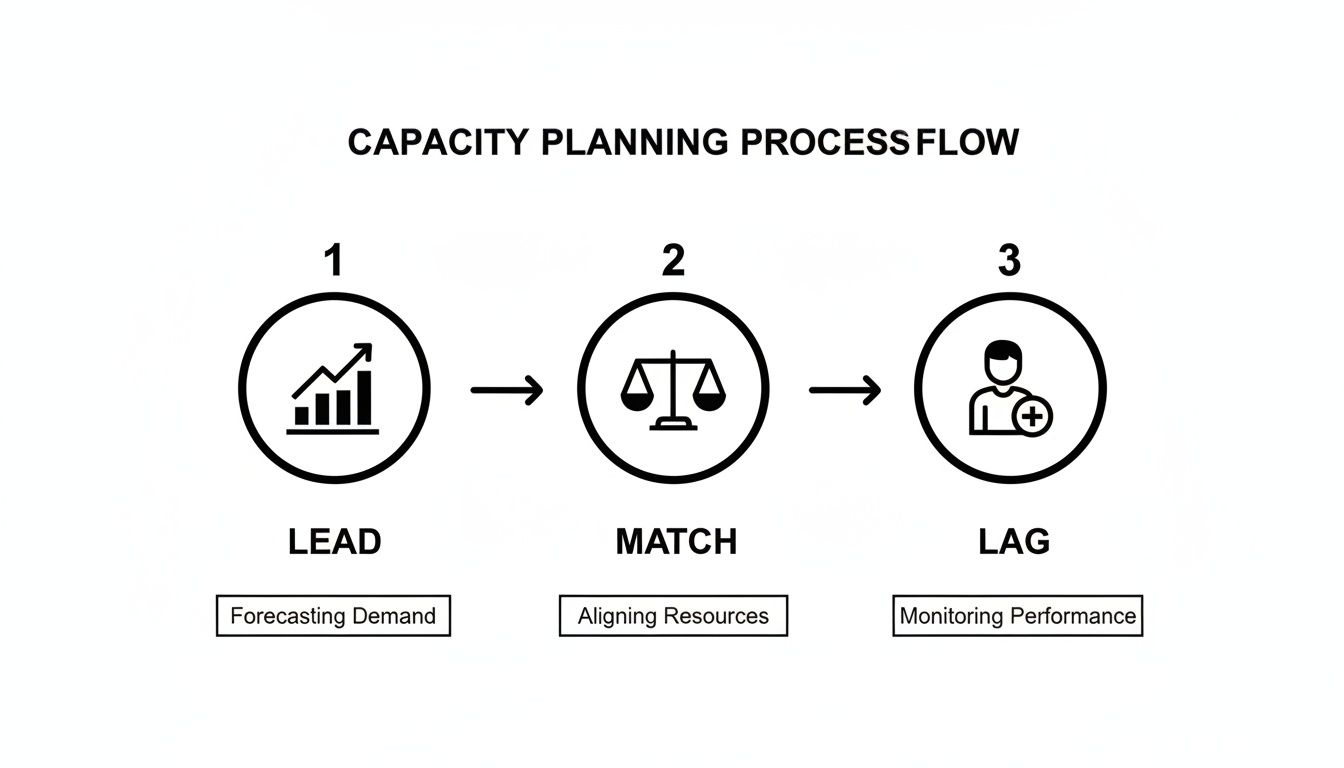
This process flow shows the three core strategies you can adopt—Lead, Match, and Lag—each representing a different level of proactivity in how you manage your resources.
Step 1: Measure Your True Capacity
First things first: you need an honest look at your current capacity. This is about more than just assuming every full-time employee gives you 40 billable hours a week. In the real world of agency life, that number is a complete myth.
To figure out your true capacity, you have to calculate the actual productive hours your team has available. Start with their total potential hours, then start subtracting all the non-billable time sinks.
- Paid Time Off (PTO): This includes all the holidays, vacation days, and sick leave.
- Internal Meetings: Think all-hands, department check-ins, and one-on-ones.
- Administrative Tasks: Time tracking, filling out expense reports, and other operational duties all count.
- Training and Development: Any time spent on workshops, courses, and professional growth activities.
Once you account for these necessary deductions, you'll discover a team member's actual capacity is often closer to 75-85% of their contracted hours. This realistic baseline is the absolute foundation for any capacity plan that works.
Step 2: Forecast Future Demand
With a solid grip on your current resources, the next move is to look ahead and predict the work coming down the pipeline. Getting demand forecasting right is what keeps you from being blindsided by a huge new project or, just as bad, being overstaffed during a slow spell.
To do this, you'll want to tap into two key sources of information: your sales pipeline and your historical data. Comb through active leads, signed contracts, and potential projects to map out your short-term demand. After that, dig into past project data to spot any seasonal trends or recurring client needs that can help shape your long-term forecasts.
Step 3: Conduct a Gap Analysis
Now it’s time to bring it all together. You'll compare your supply (your team's true capacity) with your demand (all that forecasted work). This gap analysis is where the magic happens—it’s how you pinpoint critical imbalances before they become crises.
Are you careening towards a major resource crunch in three months? Is your design team going to be twiddling their thumbs next quarter?
This stage shines a spotlight on exactly where you are over or under-resourced. The whole point is to identify these gaps before they become five-alarm fires, giving you enough runway to plan a strategic response instead of making a reactive, last-minute hire out of desperation.
A gap analysis transforms capacity planning from a purely administrative task into a strategic one. It allows you to see the future of your agency's workload and make proactive decisions to shape it.
Step 4: Create a Data-Backed Action Plan
Finally, with a crystal-clear understanding of your resource gaps, you can build an action plan that's actually informed by data. This plan isn't just about "hiring more people." It's about picking the smartest, most effective solution for the specific gap you've identified.
Your options here are more varied than you might think:
- Strategic Hiring: This is for bringing on new full-time team members when you see a clear, long-term, and sustained demand.
- Cross-Training Staff: A fantastic way to fill skill gaps and create more flexibility is to upskill the talented people you already have.
- Engaging Freelancers: Use contractors to absorb those short-term spikes in demand without piling on permanent overhead.
- Adjusting Timelines: Sometimes the best move is to proactively manage client expectations and project schedules to smooth out those intense workload peaks.
Following this four-step process gives you a repeatable framework for making smarter, more strategic decisions about your team and their time.
Moving Beyond Spreadsheets with Modern Planning Tools
For years, spreadsheets were the go-to for managing resources. But for a dynamic, modern agency? They're a liability. Manual tracking is slow, riddled with errors, and creates a chaotic mess of "final_v3" files that never reflect what's actually happening on the ground. This forces leaders into a purely reactive mode, constantly putting out fires instead of preventing them.
This old-school approach just can't keep up with the complexities of a modern workforce. When it comes to sales and resource planning, manual methods are notorious for botching forecasts for new hire ramp-up times and attrition. In fact, many companies stuck on spreadsheets see their sales teams miss targets by 10-20% because the data is just too static to be useful. You can dig into more data on how manual methods hurt sales goals in this report from Forecast.io.
The Shift to Automated, Real-Time Insights
This is exactly where modern capacity planning software changes the game. These tools completely transform how agencies see and allocate their most valuable resource: their team's time. Instead of leaning on manual timesheets—which are often inaccurate and filled out days or even weeks late—new platforms give you a real-time, automated source of truth.
Tools like TimeTackle are at the forefront, connecting directly to your team's calendars. The platform uses AI-powered analytics to automatically figure out how time is actually being spent—on which client, project, or internal task—all without anyone having to log a single minute manually.
The real advantage of modern tools is the shift from rearview-mirror reporting to forward-looking strategy. When data is captured automatically and in real-time, you can stop guessing about capacity and start making decisions based on facts.
This hands-off approach gives you instant visibility into key metrics like utilization rates and project ROI. The result is a crystal-clear, up-to-the-minute picture of your agency's capacity. It allows leaders to finally get out of that reactive posture and start making proactive, strategic moves. While a well-built spreadsheet can be a decent starting point, it's simply no match for dynamic software. You can learn more about the differences in our guide to creating a capacity planning template in Excel.
From Reactive Firefighting to Proactive Strategy
The whole point of a modern capacity planning tool is to turn your operational data into a strategic asset. By plugging into the tools your team already uses every day, this technology lifts the administrative weight of data collection and unlocks much deeper insights.

The dashboard you see here is a perfect example of how automated calendar data can be turned into actionable insights on team utilization and project allocation. This gives leaders a bird's-eye view of resource distribution, letting them spot potential bottlenecks early and make smart adjustments to balance workloads and boost profitability.
Answering Your Agency Capacity Planning Questions
Even with a perfect framework on paper, real-world questions always pop up the minute you try to put it into practice. Let's dig into some of the most common hurdles agency leaders face when they move from theory to actually getting it done.
Nailing these details is what turns a good plan into a great operational habit.
How Often Should We Be Looking at Our Capacity Plan?
Your capacity plan isn't a report you create once and then file away to gather dust. Think of it as a living document that needs regular attention. For most agencies, a high-level strategic review should happen quarterly. This is your chance to make sure the plan still lines up with your bigger business goals, like hiring plans and sales targets.
But when it comes to the day-to-day, you need to be more nimble. A more detailed, tactical review of project-level resources needs to happen far more often—think a weekly or bi-weekly check-in. This rhythm lets you adapt on the fly to the usual agency curveballs: scope creep, unexpected team absences, or that new deal that suddenly closes a month early.
This is where modern tools really shine. With real-time data, these check-ins become quick and painless. You’re always working with what’s happening now, not waiting around for last week's manually entered timesheets.
What's the Real Difference Between Resource Planning and Capacity Planning?
This is a big one, and it's easy to get them mixed up. While the terms are often thrown around together, they operate on completely different timelines and answer very different questions about your agency's health.
-
Capacity Planning is the big picture, the long game. It answers the strategic question: "Do we have the right number of people with the right skills to hit our goals for the next quarter or year?"
-
Resource Planning is tactical and immediate. It’s all about the here and now, answering the question: "Who is working on what specific task for this specific project this week?"
Here’s an analogy: capacity planning is like an architect deciding if a city needs a new bridge to handle traffic growth over the next decade. Resource planning is the foreman scheduling the specific construction crews and cranes for that bridge on a day-to-day basis. You absolutely need both, but they solve for very different problems.
Capacity planning sets the overall strategy for your team's size and skills. Resource planning executes that strategy at the project level. One helps you see the forest; the other helps you manage the individual trees.
How Do We Figure Out Our Team's Actual Capacity?
This is the bedrock of any solid plan, and it’s never as simple as plugging in 40 hours a week for every person. In the real world of agency life, the 40-hour billable week is a complete myth.
To get a number you can actually count on, you have to start with an employee's total available hours and then subtract all the non-billable time. This step is non-negotiable if you want a realistic plan.
This non-billable time includes everything from:
- Paid time off (PTO), holidays, and sick days
- Internal meetings and company all-hands
- Admin work like filling out expense reports
- Training and professional development sessions
Once you make these deductions, you’ll quickly find that a team member’s true billable capacity is usually somewhere between 75-85% of their total hours. The fastest way to get this right is by using a tool that automatically pulls and analyzes calendar data. It gives you a precise, data-backed number for your whole team without any of the guesswork.
Stop the guesswork and start making data-driven decisions. TimeTackle transforms your team's calendar data into a powerful capacity planning tool, giving you real-time visibility without manual timesheets. See how much time you can save at https://www.timetackle.com.