



Let's cut through the jargon. A sprint is just a short, fixed period of work—usually one to four weeks—where a team focuses on completing a specific set of tasks. It’s like building a house one room at a time instead of trying to frame the whole thing at once.
Understanding a sprint in simple terms
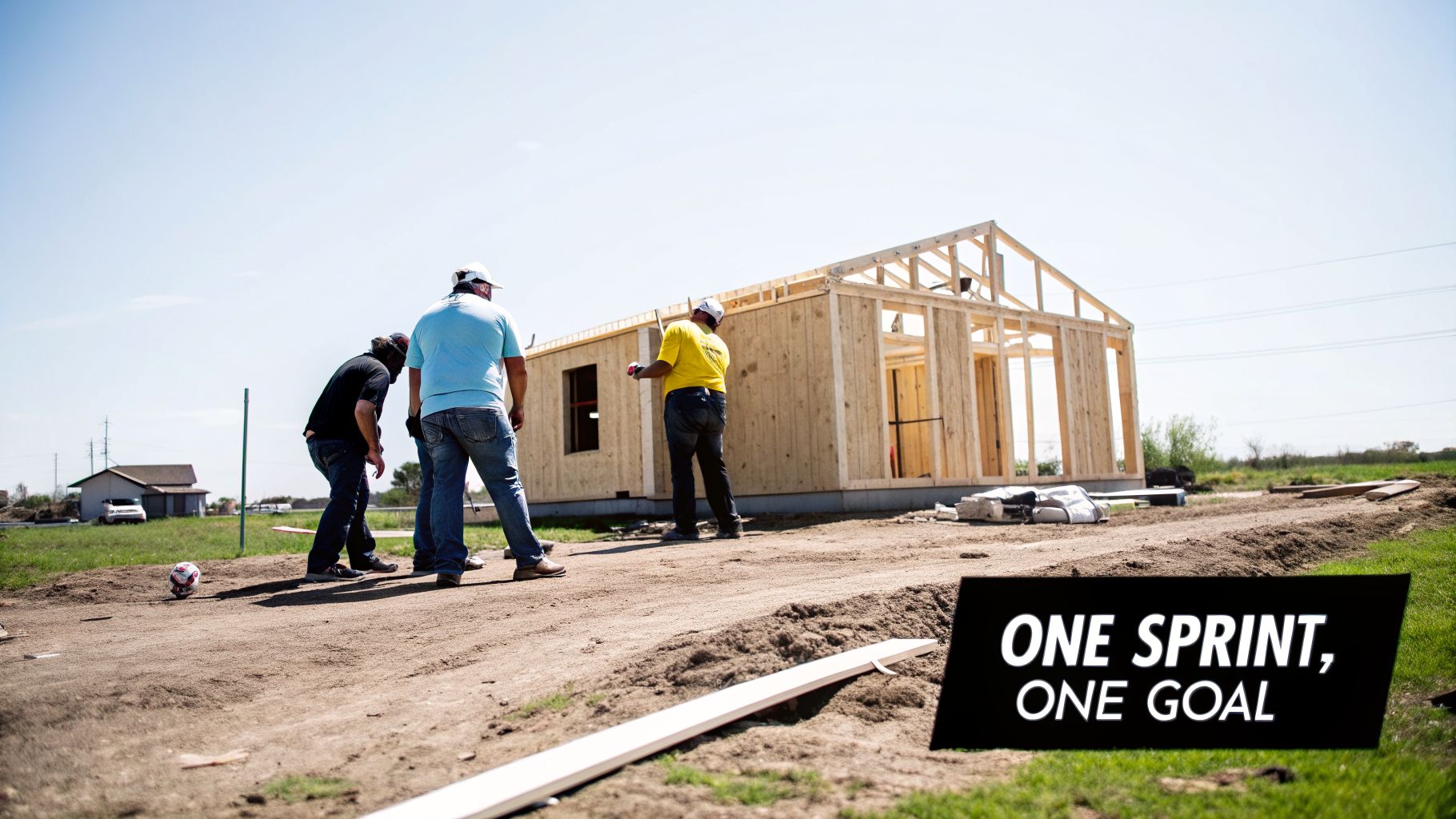
Each sprint delivers a finished, usable ‘room’—like a new software feature or a bug fix—that adds immediate value. This approach helps teams chop big projects into predictable, manageable pieces.
You're not just moving faster; you're building real momentum and getting real work done. This rhythm is effective for agencies and product teams because it gives them the flexibility to adapt to changes without derailing an entire project.
The core idea isn't speed for speed's sake. It's about creating a predictable cycle of work that produces a real outcome. You build, you deliver, you learn, and you repeat.
This iterative process is a world away from the old model of spending months on a "big-bang" launch, only to find out it completely missed the mark. Instead, sprints give you regular checkpoints to gather feedback and adjust your course.
The power of a fixed timeline
The fixed length of a sprint creates a healthy sense of urgency. It forces the team to make smart, realistic decisions about what they can actually achieve in the time they have. This is a core part of a technique known as timeboxing, where you set a firm limit on the time dedicated to a task. If you're interested in structured work cycles, you can learn more about how timeboxing is a powerful tool for amplifying your productivity in our guide.
This structure is a big win for stakeholders and clients, too. They know exactly when they’ll see the next piece of working software or the next campaign deliverable. That predictability builds trust and keeps everyone on the same page. Instead of asking "When will it be done?", everyone is focused on what can be accomplished in the next two weeks.
For the team, the benefits are clear:
- Sharp Focus: Everyone is locked in on the same small set of goals.
- Reduced Risk: You can’t go too far down the wrong path in just two weeks.
- Constant Improvement: Each sprint ends with a review of what went well and what can be done better next time.
- Faster Feedback: Delivering working software every few weeks means you get real user feedback quickly, not months later.
Why running sprints actually works
It’s easy to think sprints are all about speed. They’re not. The real magic is in creating a steady, predictable rhythm for your team to deliver work and, just as important, get feedback. This rhythm forces everyone to focus on a small, specific set of goals, which is a powerful cure for the chaos of constant context-switching.
When your team is locked in on only what’s in the current sprint, they can dig in and produce much higher-quality work. This consistent cadence delivers the one thing every leader and client wants: predictability.
Making work predictable and focused
Imagine knowing your team can reliably ship a certain amount of work every two weeks. Suddenly, you can forecast delivery dates with real confidence. For agencies, this means fewer nasty surprises and much happier clients. For product teams, it keeps engineering efforts tightly connected with what the business actually needs.
Sprints flipped the old model of months-long development cycles on its head, replacing it with short bursts that can pivot as priorities shift. According to the 16th State of Agile Report, 87% of companies now use Agile approaches like sprints to stay nimble. You can get more background on how Agile shook up the development world in this Ideamatics.com overview.
This focused structure also helps teams make better trade-offs. Instead of getting bogged down in endless debates about what to do next, the sprint goal is a compass, guiding every decision.
Connecting work to real impact
In the end, the sprint framework isn't just about churning out more work; it’s about getting the right work done. It draws a straight line from a developer's daily tasks to the big-picture business goals.
A sprint isn't a race to finish a random list of tasks. It's a focused effort to achieve a specific goal that moves the needle for the business or the customer.
This tight link between effort and impact is a huge motivator. Instead of waiting months for a huge launch, teams see their contributions go live and make a difference every few weeks. This cycle of shipping and learning creates a powerful feedback loop that keeps everyone bought into the mission.
The key meetings that structure a sprint

A sprint isn’t just a free-for-all block of time to get work done. It’s a carefully structured process held together by four key meetings. These events, often called "ceremonies," are what give a sprint its rhythm and keep the team focused, aligned, and constantly getting better.
Think of them as the guardrails on a winding road. They make sure work starts on the right foot, stays on track, and wraps up with valuable lessons that make the next sprint even stronger. Without them, it's easy to get lost.
Sprint planning
This is where every sprint begins. Before the clock starts ticking, the entire team gets together to figure out what they can realistically accomplish. The Product Owner comes to the table with the highest-priority items from the product backlog, and the team discusses them, asks questions, and decides what to commit to.
The two main outputs are the Sprint Goal—a single, clear sentence explaining what the sprint is all about—and a Sprint Backlog, which is the specific list of tasks the team has pulled in to achieve that goal. For a deep dive, check out this tactical guide to Sprint Planning.
Daily stand-up
This is the team’s daily pulse check. The daily stand-up is a quick, 15-minute sync-up for the people doing the hands-on work. It's not a status report for managers; it’s a quick huddle for the team to coordinate their day and clear any obstacles.
Each person usually answers three simple questions:
- What did I do yesterday to move us closer to the Sprint Goal?
- What am I working on today to help us meet the Sprint Goal?
- Are there any roadblocks in my way or the team’s way?
Sprint review
At the end of the sprint, it’s showtime. The Sprint Review is an informal session where the team demonstrates the finished, working product to stakeholders—clients, executives, or anyone else with an interest.
This isn’t just a demo; it’s a feedback loop. It’s a chance to celebrate what got done and for stakeholders to see the progress firsthand, making sure everyone is still on the same page and the project is heading in the right direction. A structured approach to agile project planning can make these reviews even more effective.
Sprint retrospective
The final meeting of the sprint is the Retrospective. After the review, the team gets together privately to reflect on the sprint itself. The spotlight here is entirely on the process.
What went well? What didn't go so well? What can we change in the next sprint to get better? This is the engine of continuous improvement, where small tweaks to how the team works together lead to big gains over time.
To tie it all together, here’s a quick summary of how these four events anchor a typical sprint.
The four key sprint ceremonies
| Ceremony | Purpose | Who Attends | Typical Duration (for a 2-week sprint) |
|---|---|---|---|
| Sprint Planning | Define the Sprint Goal and select work from the backlog. | The entire Scrum Team (Product Owner, Scrum Master, Developers). | Up to 4 hours |
| Daily Stand-up | Sync on progress, plan the day, and identify roadblocks. | The Development Team (Scrum Master and Product Owner can observe). | 15 minutes |
| Sprint Review | Demonstrate the completed work and get feedback from stakeholders. | The Scrum Team and key stakeholders (clients, users, leadership). | Up to 2 hours |
| Sprint Retrospective | Reflect on the sprint process and identify areas for improvement. | The entire Scrum Team. | Up to 1.5 hours |
Each ceremony has a distinct but connected role in creating a cycle of focused work, valuable feedback, and continuous improvement.
Measuring sprint performance with metrics that matter

You’ve heard the old saying, "you can't improve what you don't measure." In a sprint, that's especially true. Metrics aren't about pointing fingers or judging performance; they’re about giving your team a shared language to understand what’s working and what isn’t.
Think of these numbers as your team's health dashboard. They turn vague feelings like "this sprint feels slow" into concrete data you can actually discuss and act on. For managers, this data is gold, helping you forecast timelines, manage resources, and tie the team’s hard work back to business goals.
Velocity
Velocity is the average amount of work your team can get done in a single sprint, usually measured in story points. It’s not about speed—it’s about capacity. After just a few sprints, you can calculate an average velocity that gives you a surprisingly accurate picture of what the team can realistically commit to.
For example, if your team consistently finishes about 30 story points every sprint, you know that trying to cram 50 points into the next one is just a recipe for burnout. Velocity swaps guesswork for confidence.
Burndown chart
The Burndown Chart is a simple but powerful graph that tracks your team's progress toward the sprint goal. The vertical axis shows how much work is left (in story points or hours), and the horizontal axis shows time. Ideally, you want to see that line steadily "burn down" to zero by the end of the sprint.
This chart is your best early warning system. If the line isn’t trending downward, it’s a clear signal that the team needs to huddle up and figure out what’s blocking them—long before you’re staring down a missed deadline.
Commit-to-done ratio
This metric is as straightforward as it sounds: what percentage of the work the team committed to did they actually finish? A consistently high Commit-to-Done Ratio is a sign of a team that has mastered its estimation game and reliably delivers on its promises.
Tracking this helps uncover important patterns. Top-performing squads often hit a 90-100% ratio. For more on how teams use data to improve, you can explore the evolution of development methodologies on Dev.to.
These key numbers give your team the vocabulary for honest, productive conversations. You can dive deeper into how to track and apply these by exploring these agile software development metrics.
Common sprint problems and how to fix them
Sprints are an effective framework, but let's be honest—they aren't magic. Without the right focus, a sprint can quickly go off the rails, leaving you with a burnt-out team and a pile of missed goals.
If you’re running into trouble, you’re not alone. According to Digital.ai's 16th State of Agile report, 87% of companies have adopted Agile methods, but that doesn't mean they've ironed out all the kinks. Poor planning is still a big source of team burnout, and high Churn Rates—work that gets added or yanked out mid-sprint—are a clear sign that something’s broken. You can read more about key sprint metric findings on Harness.io to see just how common these issues are.
The perils of scope creep
One of the fastest ways to kill a sprint is scope creep. This is what happens when new tasks or "urgent" requests are shoehorned into an active sprint. It's a surefire way to jeopardize the sprint goal and crush team morale.
- The Fix: This is where your Product Owner becomes the team's hero. Their job is to be the gatekeeper, protecting the team and the sprint goal from outside pressure. All new requests should go through them to be assessed and, if necessary, added to the product backlog for a future sprint, not the current one.
Underestimation and burnout
Consistently getting estimates wrong is a recipe for disaster. It leads straight to missed deadlines, late nights, and a team that's completely fried. Before you know it, your team loses all faith in the planning process.
- The Fix: Your retrospective is the perfect place to dig into why estimates were off. Was the work more complex than anyone thought? Did unexpected problems pop up? To get better, break larger stories into smaller, more manageable tasks and use your team's historical velocity to make more realistic commitments.
The goal of a sprint isn't to work the team to exhaustion. It's to create a sustainable pace that delivers predictable value. If your team is constantly "sprinting," you're doing it wrong.
Unproductive retrospectives
Does your retrospective feel more like a group complaint session where nothing ever changes? If you’re hearing the same issues sprint after sprint, the meeting has lost its purpose and become a waste of time.
- The Fix: Make your retros actionable. End every single one by identifying one or two concrete improvements the team will try in the next sprint. Assign an owner to each action item, and make it a habit to start the next retrospective by reviewing how those experiments went. This is how you turn talk into real, meaningful change.
Sprint FAQs: your questions, answered
As teams start to adopt sprints, a few common questions always seem to pop up. It's completely normal. Let's tackle them head-on to clear up any confusion and get you working with confidence.
What’s the ideal sprint length for an agency team?
For most agencies, short and sweet is the way to go. We've found that a one or two-week sprint really hits the mark. These shorter cycles create a tight feedback loop with clients and make it much easier to pivot when project requirements inevitably change—a daily reality in agency life.
A two-week sprint is often the sweet spot. It gives your team enough runway to get meaningful work done, but it's not so long that projects lose momentum. This cadence helps keep the pressure on (in a good way) and ensures you’re constantly showing clients progress, which keeps them happy and engaged.
Can sprints work for non-technical teams like marketing?
Absolutely. Sprints may have been born in the software world, but their core principles are valuable for just about any team. Marketing teams, for example, can use sprints to manage everything from creating content and planning events to launching full-blown campaigns.
The secret is breaking down those big, intimidating deliverables into bite-sized tasks that can actually be finished within a single sprint. A campaign launch, for instance, could be split into dedicated sprints for research, content writing, design, and promotion. Many non-technical teams find this structure brings a whole new level of focus and collaboration to their work.
How do you handle urgent work that pops up mid-sprint?
Ah, the classic curveball. Every team runs into this. In a perfect world, a sprint is a protected block of time, and it's the Product Owner's job to shield the team from interruptions so they can hit the Sprint Goal.
But we don't live in a perfect world. Sometimes, a request is genuinely urgent and simply can't wait. When that happens, it's time for the Product Owner and the team to have a frank conversation and negotiate.
This could mean a couple of things:
- Swapping out a current sprint task for the new urgent item, provided they're about the same size and effort.
- In very rare situations, you might need to cancel the current sprint and immediately start a new one to tackle the sudden shift in priority.
If you find that unplanned "emergencies" are constantly derailing your sprints, it's not a sign that sprints are broken. It’s actually a big red flag pointing to a bigger problem—your planning process needs to get much better at anticipating these "urgent" needs before the sprint kicks off.
Ready to ditch manual timesheets and get a crystal-clear, automatic picture of where your team's time is actually going? See how TimeTackle uses the calendar data you already have to deliver effortless utilization insights for your projects and sprints.
Learn more and start your free trial to see it in action.