

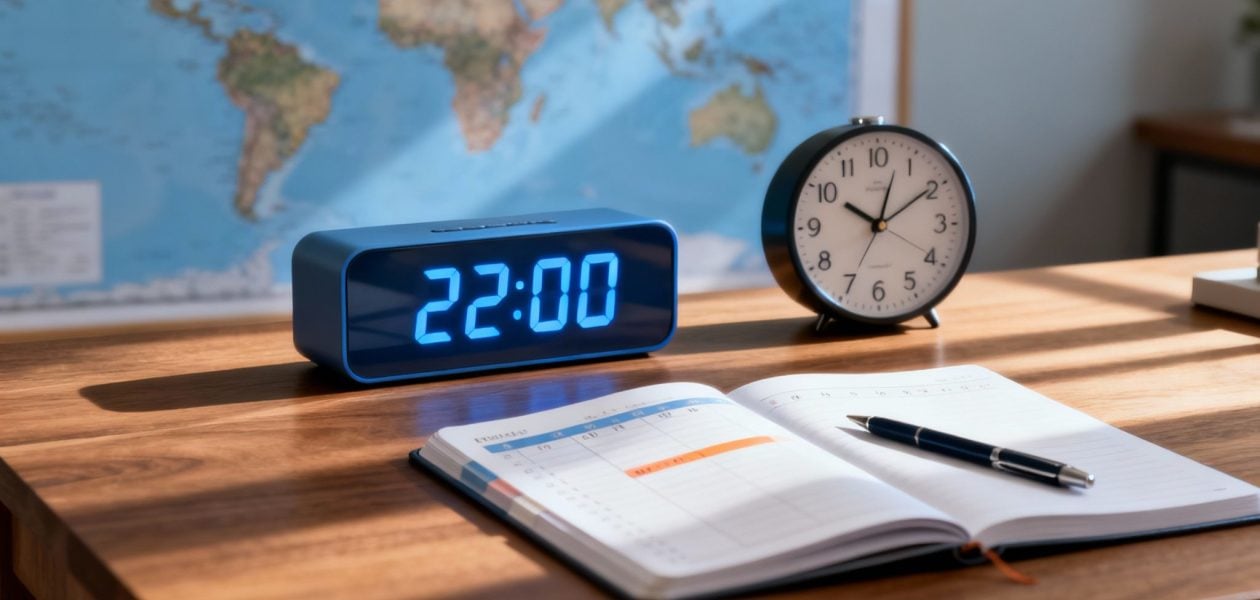
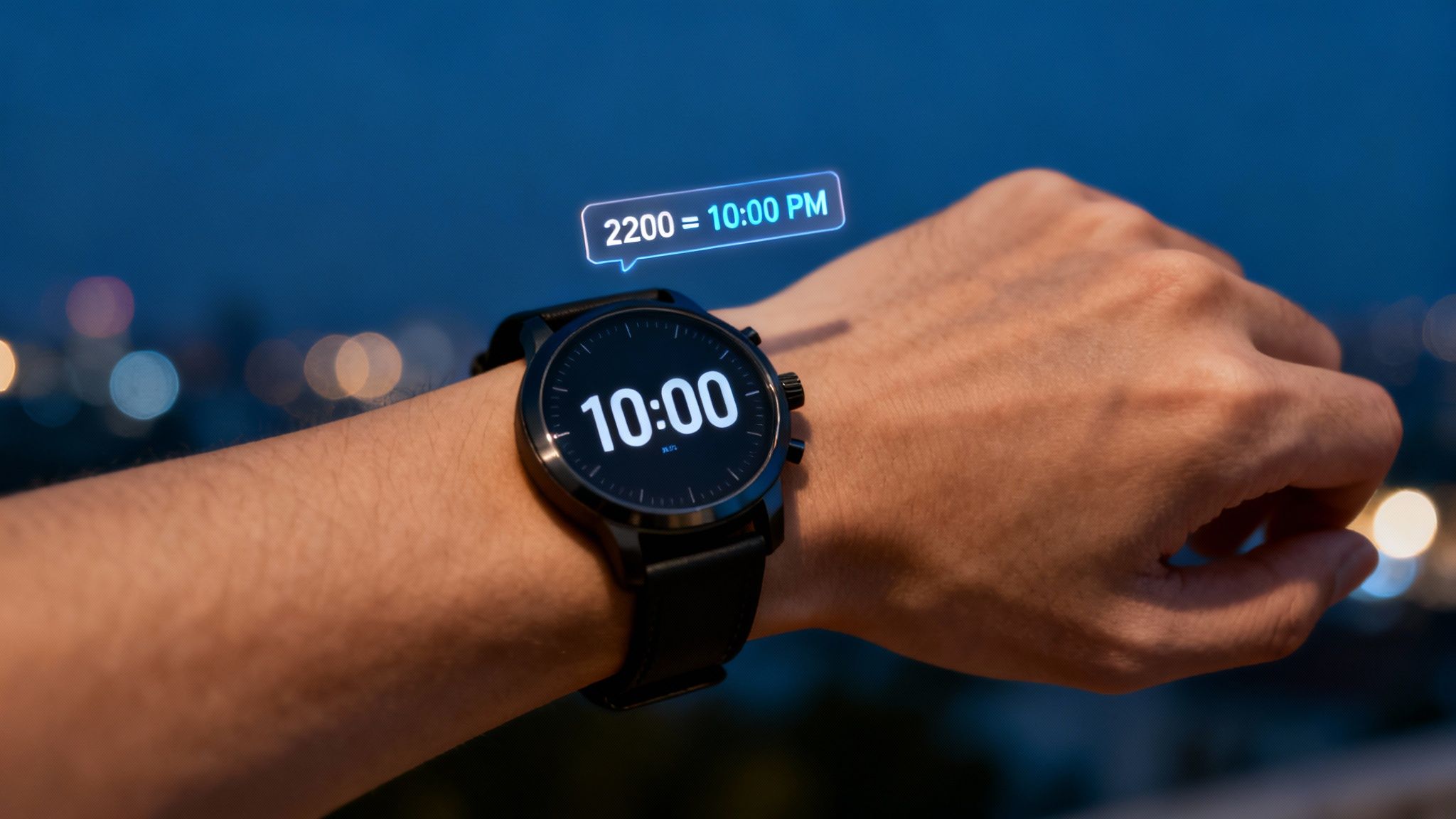
Let's get straight to it: 2200 in military time is simply 10:00 PM on a standard 12-hour clock. It's part of the 24-hour clock system, a straightforward way to tell time that gets rid of any AM/PM mix-ups by giving every minute of the day its own unique four-digit code.
Understanding the 24 Hour Clock
Imagine the day not as two 12-hour chunks, but as one smooth, 24-hour timeline. It kicks off at 0000 (midnight) and runs all the way to 2359 (11:59 PM). This single change prevents those classic blunders, like setting your alarm for 7 PM when you meant 7 AM.
This system isn't just a gimmick; it offers some real advantages:
- Absolute Clarity: No more guessing games between morning and evening. 10:00 is morning, 2200 is night. Simple.
- Global Standard: It’s a lifesaver for coordinating across different time zones, especially for international teams and operations.
- Error Prevention: In fields like aviation, healthcare, and logistics, a small time mix-up can lead to huge problems. The 24-hour clock is essential for keeping things running safely and on schedule.
The logic is consistent across the board. Just as 2200 marks a late evening hour, you can see the same pattern with our guide on 2100 military time, which represents 9:00 PM. Once you get the hang of it, the whole system clicks into place.
At its heart, the 24-hour clock is all about creating a clear, universal language for time. Once you grasp the simple conversion rules, scheduling becomes far more precise. This isn't just a military thing; it’s a powerful tool for anyone who needs to communicate time without a hint of confusion.
Why Precision Scheduling Depends on Military Time
Ever set your alarm for 7:00 PM instead of 7:00 AM? That one simple mistake, and the frantic morning that follows, perfectly captures the problem the 24-hour clock was built to solve. It completely gets rid of that AM/PM ambiguity, creating a system where every single minute of the day has its own unique name.
This is why it's the gold standard for any field where getting the time right is absolutely critical.
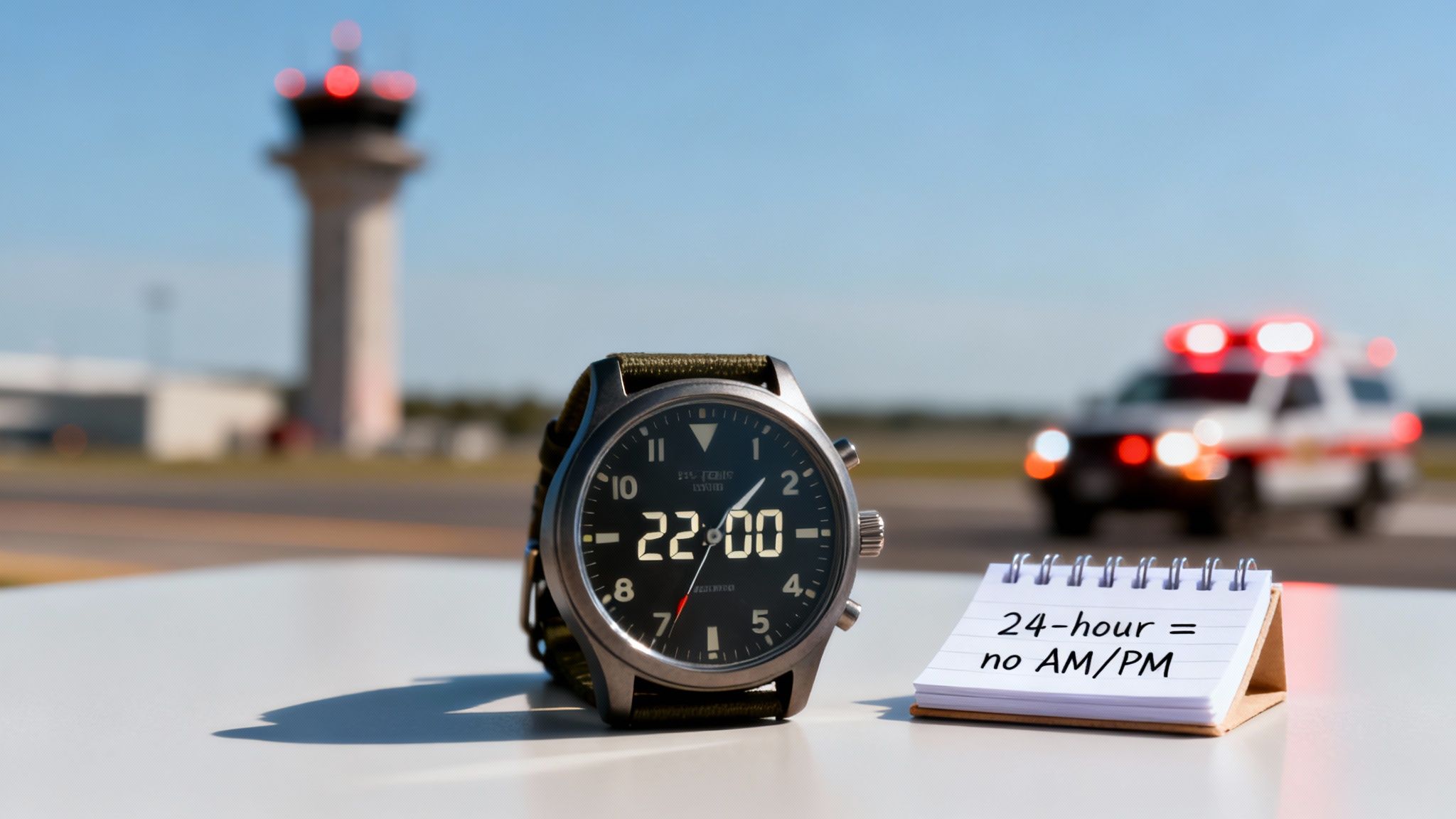
This demand for clarity is how the system became a global go-to. Its adoption by armed forces was a huge turning point, especially during world conflicts where coordinating actions across different units and time zones was the key to success. Just imagine the chaos a simple AM/PM mix-up could cause during a critical maneuver.
The history here is pretty interesting. The U.S. Navy officially switched to the 24-hour clock way back in 1920, and the U.S. Army followed in 1942. This simple change drastically cut down on the communication errors that were a constant headache with 12-hour clocks in high-stakes situations. You can read more about this historical shift and how it shaped military life.
Beyond the Battlefield
But you don’t have to be in the military to see the benefits. Today, military time is the quiet, efficient engine running behind the scenes in many essential civilian sectors. Think about it:
- Logistics and Shipping: Global supply chains never sleep. A container leaving Shanghai at 1400 has to be logged with total precision to coordinate its arrival in Los Angeles, making sure handoffs happen without a hitch.
- Emergency Services: Paramedics, firefighters, and police rely on the 24-hour clock to document every event. Recording an incident at 0215 versus 1415 gives them an unmistakable timeline, which is crucial for reports and investigations.
- Scientific Research: When you’re running a long-term experiment or working with research partners across the globe, a universal time format is a must. It prevents data from getting mixed up and ensures every observation is logged at the exact right moment.
The 24-hour clock isn't just some military quirk; it's a seriously powerful tool for any organization that can't afford mistakes. By removing the single point of failure in 12-hour time—that pesky AM/PM distinction—it creates a stronger, more reliable system for scheduling and operations.
From coordinating a flight's departure at 2200 military time to scheduling a patient's critical medication, this system provides the clarity needed to keep complex operations running like clockwork. It’s a small tweak in format with a massive impact on efficiency and safety.
How to Convert Any Military Time With Confidence
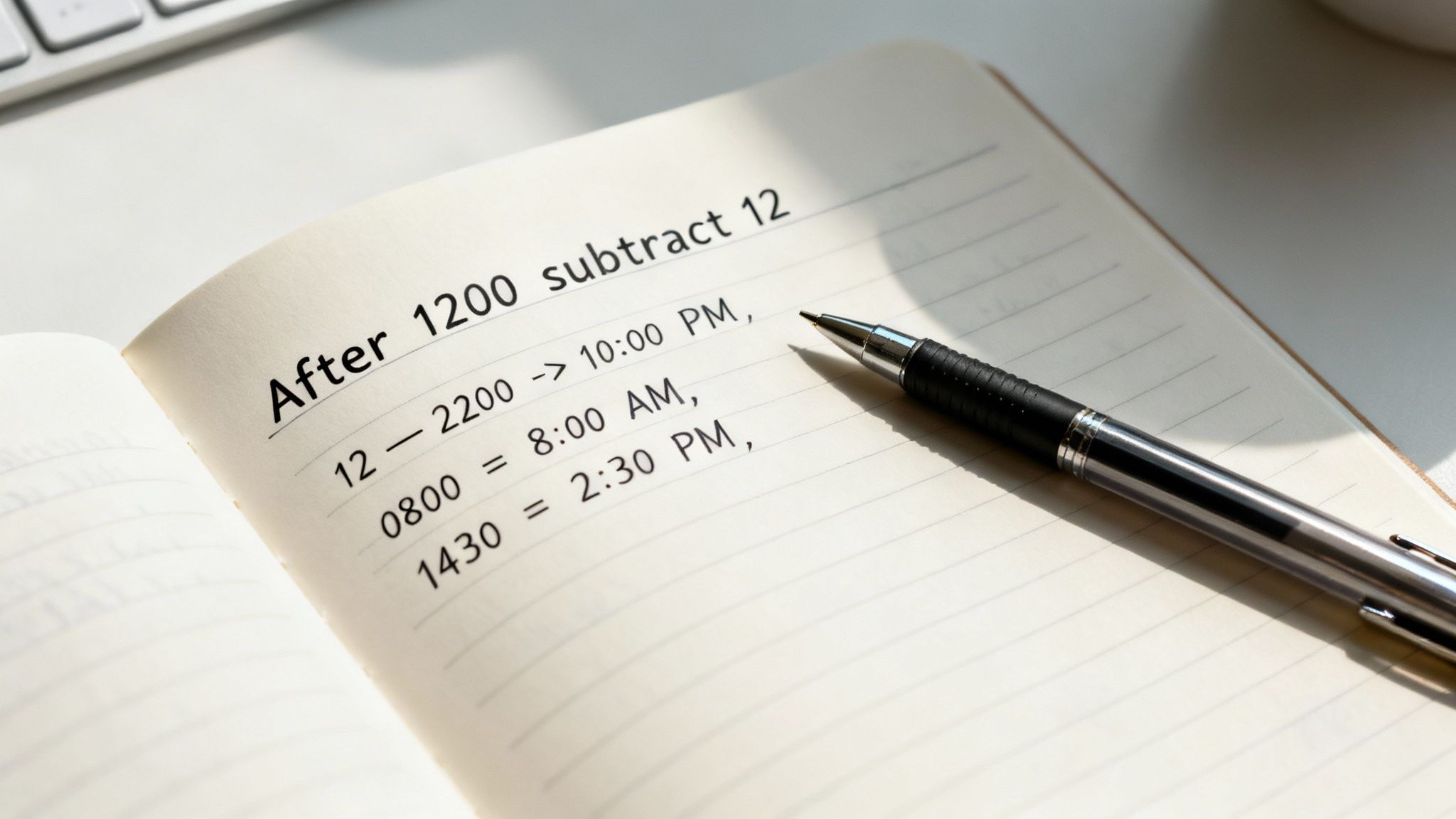
Don't let the 24-hour clock intimidate you. Converting military time isn't about complex math—it really just boils down to a couple of simple rules you can commit to memory in no time.
Once you get the hang of it, you’ll be able to switch between the 24-hour and 12-hour formats without even thinking. It’s a handy skill for everything from reading flight schedules and coordinating international meetings to just getting comfortable with a different way of tracking your day.
The secret to it all? The number 12. The rules for conversion all hinge on whether the time is before or after 1200 hours (which is just a fancy way of saying noon).
From Military Time to Standard Time
Let's break down how to turn a military time figure into the familiar AM/PM format. It's a simple, two-step process that depends on whether you're dealing with morning or afternoon hours.
- For times between 0000 and 1159 (the AM hours): This is the easy part. The hours are almost identical. All you have to do is add a colon and the "AM" suffix. For instance, 0800 becomes 8:00 AM. Simple as that.
- For times from 1300 to 2359 (the PM hours): This is where that magic number 12 comes in. Just subtract 1200 from the military time, then add a colon and the "PM" suffix. So, 2200 military time becomes 10:00 PM because 2200 – 1200 = 1000.
Keep in mind the two exceptions are midnight (0000) and noon (1200). In the 12-hour system, 0000 is 12:00 AM (the very start of a new day), and 1200 is 12:00 PM.
From Standard Time to Military Time
Going the other way is just as straightforward. You’ll use the same logic, but in reverse—this time adding 12 for any times in the afternoon or evening.
- For AM Hours (12:00 AM to 11:59 AM): For any time between 1:00 AM and 11:59 AM, just get rid of the colon and the "AM." Make sure it’s a four-digit number, adding a leading zero if needed. So, 9:30 AM turns into 0930. Midnight (12:00 AM) is the special case here; it becomes 0000.
- For PM Hours (12:00 PM to 11:59 PM): For any hour from 1:00 PM to 11:59 PM, add 12 to the hour, then drop the colon and the "PM." For example, a 2:00 PM meeting becomes 1400 military time. We dive deeper into this specific time in our guide to 1400 military time. Noon (12:00 PM) is the one time that stays put as 1200.
By sticking to these simple addition and subtraction rules, you can handle any time conversion with total confidence. Before you know it, military time will feel like second nature.
Military Time in Real-World Scenarios
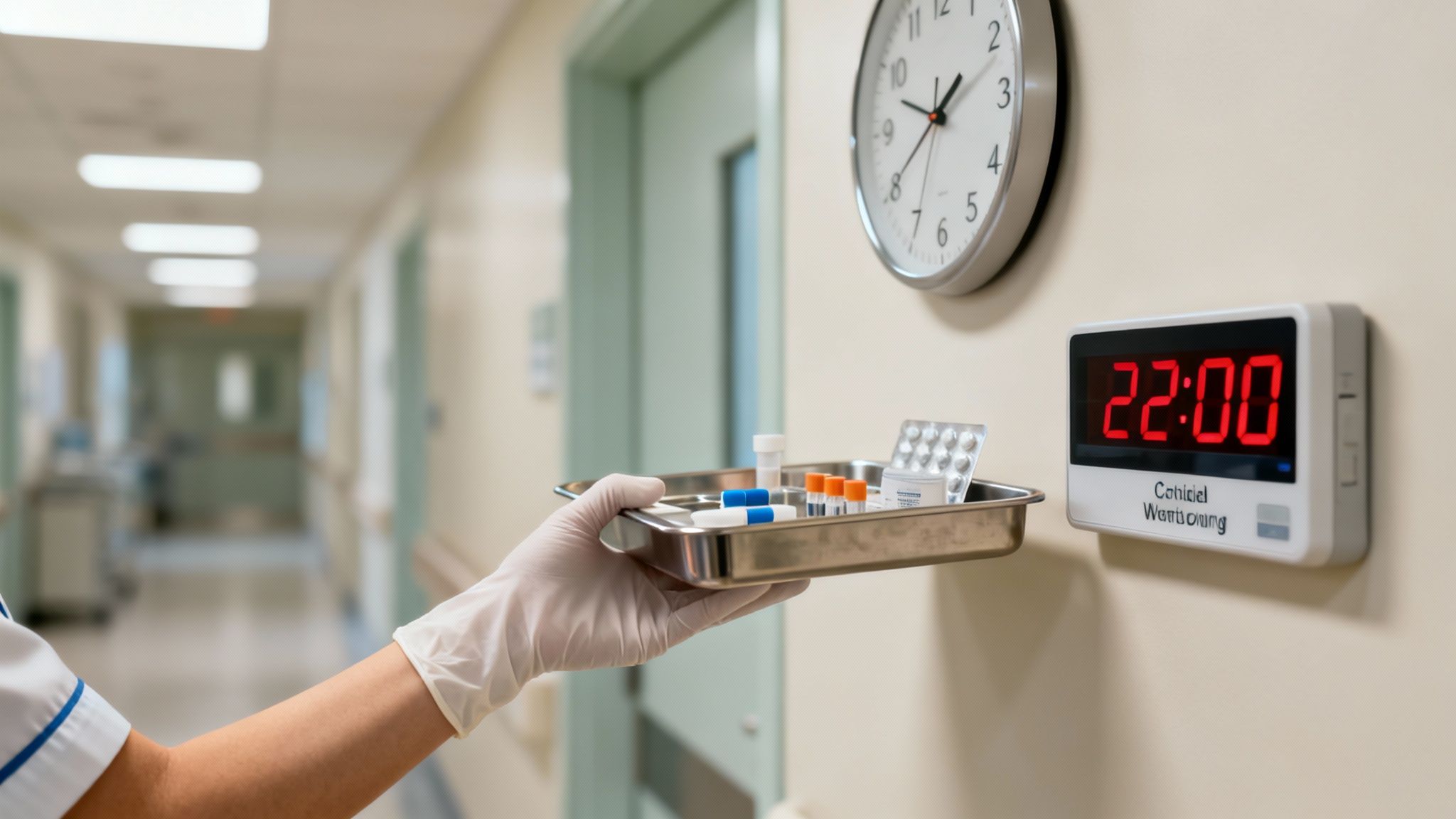
Alright, now that we've nailed the conversion rules, let's look at where the 24-hour clock really shines—in professional fields where a simple mistake can be a very big deal. In these high-stakes environments, ambiguity isn't just an inconvenience; it can have serious consequences.
Think about the aviation industry, which is responsible for over 4.5 billion passengers every single year. For them, 2200 military time isn't just 10 p.m.; it could be the final cutoff for an international departure or a critical air traffic control handoff. There's simply no room for error, which is why the 24-hour clock is essential for keeping schedules—and people—safe on the ground and in the air. You can actually discover more insights about aviation timekeeping and see just how deep this goes.
Critical Operations Across Industries
This need for absolute clarity goes way beyond the airport tarmac. Military time is a non-negotiable tool in countless fields.
Here are a few examples of where it makes all the difference:
-
Healthcare: In a hospital, 2200 often marks the start of late-night medication rounds. A mix-up between 10 AM and 10 PM isn't just a scheduling hiccup—it could be a life-threatening mistake. The 24-hour clock is a fundamental safety measure.
-
Global Project Management: Juggling time zones is a daily headache for international teams. When a project kickoff is set for 2200 UTC (Coordinated Universal Time), everyone from Tokyo to San Francisco knows exactly when to log on. No more missed meetings due to time zone confusion.
-
Emergency Services: When first responders are logging incident details, every second counts. Noting an event at 2200 instead of "10 o'clock at night" creates a clear, indisputable timestamp for reports and investigations.
In every one of these situations, the 24-hour clock acts as a universal language. It gets rid of the single biggest weakness in 12-hour time—the AM/PM distinction—to build a system that's far more robust and reliable.
At the end of the day, using military time in these fields isn't just about sticking to tradition. It's a strategic decision to put accuracy first. Whether you’re coordinating a flight, managing patient care, or leading a global team, the system ensures everyone is working from a single, unified timeline. That shared understanding is what keeps critical operations running safely and effectively.
Practical Tips for Using Military Time in Your Schedule
Moving beyond just knowing what 2200 military time is, actually weaving the 24-hour format into your life can bring a whole new level of clarity to your planning. The easiest first step? Change the settings on your digital devices.
Most smartphones, computers, and digital calendars from Google Calendar to Outlook have a simple toggle to switch to a 24-hour display. This small adjustment immerses you in the system, helping you internalize times like 1600 (4:00 PM) or 2200 (10:00 PM) without constantly doing the mental math. It also instantly kills any AM/PM confusion, a lifesaver when you're scheduling across different time zones.
Align Your Team and Tools
For teams, making military time the standard ensures everyone is perfectly synced up on deadlines and milestones. An end-of-day deadline set for 1700 is crystal clear. You're not going to get any of those costly mix-ups that can happen when someone sees a "5:00" deadline and isn't sure if it's AM or PM.
This precision is also a goldmine for productivity analysis.
When your entire team logs hours using the 24-hour clock, the data becomes cleaner and more reliable. Tools that analyze calendar data can provide far more accurate insights into resource allocation and project timelines without the ambiguity of AM/PM entries.
You end up with a much more dependable system for tracking work and making smart decisions. Sharpening your scheduling habits is one of the fastest ways to build a more efficient workflow. You can find more strategies in our guide to effective calendar management and scheduling tips.
It's a small change, but adopting this format has a surprisingly big impact on personal and team efficiency. By embracing the simple clarity of the 24-hour system, you strip away a layer of potential confusion from your daily planning, making your schedule more robust and reliable.
Common Questions About Military Time Answered
Even when you've got the conversion rules down, a few tricky questions always seem to pop up. Nailing these details is the key to using military time with confidence, whether you're scheduling an international call or just setting your watch.
Let's clear up some of the most common points of confusion.
How Do You Say 2200 Military Time?
This one's all about clarity. In any professional or military setting, 2200 is spoken as "twenty-two hundred hours." This formal phrasing is designed to be completely unmistakable, which is critical when you're communicating over a radio or a spotty phone connection.
In more casual conversations, you’ll probably just hear "twenty-two hundred." The main thing is to avoid saying "ten o'clock," since that could easily be confused with 10:00 AM. The whole point is to eliminate that kind of ambiguity.
Is 0000 Midnight or the Start of a New Day?
Great question. The simple answer is: it's both. The time 0000, pronounced "zero hundred hours," marks the exact beginning of a brand new day. It’s the very first minute.
But for logging and scheduling, there's a practical distinction that keeps everything perfectly clear:
- An event that ends precisely at midnight on Monday would be logged as 2400 Monday.
- An event that starts at the very beginning of Tuesday would be scheduled for 0000 Tuesday.
It’s a subtle difference, but it ensures that logs and schedules are airtight, leaving no gray area about when one day ends and the next begins.
Why Is There No Colon in Military Time?
You'll almost always see military time written as a solid four-digit number, like 2200, not the 22:00 you see on your phone. This is a classic case of function over form, a tradition rooted in efficiency.
Writing time without a colon makes it faster to jot down in logs and reduces the chance of misreading a smudge or a poorly written mark as a number. While many civilian devices add the colon for readability, the standard military format keeps it simple for maximum clarity and speed.
Ready to bring this level of clarity to your team's scheduling and productivity tracking? TimeTackle provides AI-powered calendar analytics that automates time tracking and delivers powerful insights. Eliminate timesheet headaches and see exactly where your team's effort is going. Learn more and get started at https://www.timetackle.com.