


Let's cut through the jargon. Project planning isn't just about building Gantt charts and setting deadlines. It's the groundwork your agency lays before a single line of code is written or a single design is mocked up. Think of it as turning a client's big, abstract idea into a concrete, step-by-step roadmap for your team.
This plan is your first line of defense against the classic project pitfalls: budget blowouts, team burnout, and the dreaded “we missed our launch date” email.
What is project planning really?
Imagine you’re planning a cross-country road trip. You wouldn't just hop in the car and start driving, hoping you end up in the right place. You’d map your route, figure out your budget for gas and food, book places to stay, and probably argue over who controls the playlist.
Your project plan is that road map. It’s the discipline of answering all the important questions upfront so your team can focus on the journey, not on figuring out where to go next.

It’s about getting crystal clear on what you’re building, why it matters, who’s on the hook for each piece, when it’s all due, and how much it’s going to cost. This isn't some document you create once and forget about. It's a living guide for communication and course correction that helps you through the entire project.
This kind of strategic thinking thrives in a well-defined project management environment.
The real magic of project planning is that it forces you to make the hard decisions early on, when the cost and effort of making a change are incredibly low. This discipline is what separates profitable, happy projects from chaotic, money-losing ones.
At its core, a solid plan must provide simple answers to a few non-negotiable questions. Getting these answers is what transforms a vague concept into a structured, manageable project.
Project planning at a glance
Here are the simple answers to the core questions every project plan must address.
| Question | What It Defines |
|---|---|
| What are we doing? | The Scope and Deliverables |
| Why are we doing it? | The Project Objectives and Goals |
| Who is doing the work? | Resource Allocation and Team Roles |
| When will it be done? | The Timeline and Key Milestones |
| What could go wrong? | Risk Assessment and Mitigation |
Without clear answers to these basic questions, your project is basically flying blind. You’re inviting scope creep, where one “small request” after another slowly pushes your timeline and budget off a cliff.
A great plan, on the other hand, gives your team the clarity and confidence they need to do their best work and hit the mark, every time.
The five pillars of effective agency project planning
To get a project from a vague idea to something your team can actually execute, you need a solid plan. For agencies, that plan needs to be built on five core pillars. If you neglect even one of them, the whole project can get wobbly and start to show the cracks every project manager dreads.
Nailing these five areas gives you the clarity and control to steer a project from kickoff all the way to a successful launch. Think of them as the complete blueprint for your team.
1. Scope and objectives
This is your project’s North Star. The scope sets the firm boundaries—what you’re delivering and, just as importantly, what you are not delivering. It’s all about creating a crystal-clear, shared understanding with your client on the specific deliverables and outcomes.
Objectives, on the other hand, are the “why” behind all the work. They define what success actually looks like in real, measurable numbers. Is the goal to boost leads by 15%? Or maybe to cut down on customer support tickets by 30%? Clear objectives stop the project from drifting and make sure everyone is pulling in the same direction.
2. Schedule and milestones
A schedule is so much more than a final deadline. It’s a realistic timeline that breaks the entire project down into manageable phases and individual tasks. This is where you map out all the dependencies, figuring out which tasks have to be finished before others can even start. It’s the key to preventing those frustrating bottlenecks where one person is just waiting on another.
Major milestones are your checkpoints along the way. See them as the signposts on your project roadmap that confirm you're still on the right path. Hitting these milestones gives both your team and your client a real sense of progress and creates natural points to review the plan and make adjustments if needed.
3. Resources and budget
This pillar answers two make-or-break questions: who’s doing the work, and how much is it going to cost? Resource planning is the art of assigning the right people to the right tasks, all based on their unique skills and current availability. Without solid project resource planning, you’ll end up overbooking your best people, which only leads to burnout and sloppy work.
The budget is simply the financial version of your project plan. It assigns money to every part of the project—from billable hours to software licenses—and it’s absolutely necessary for protecting your agency's profit margins.
4. Risk management
Let's be honest: no project goes perfectly. Risk management is your early-warning system. It’s the process of proactively looking ahead to see what could go wrong, figuring out how bad the damage could be, and coming up with a plan to handle it.
A risk is just a problem you haven’t had yet. Planning for it means you're prepared to solve it quickly, instead of being caught by surprise when it finally happens.
Common risks for agencies include key team members getting sick, unexpected client feedback delaying a phase, or a new piece of tech not working as promised. Having a plan for these scenarios is what separates a minor hiccup from a full-blown crisis.
5. Communication plan
Finally, the communication plan sets the rhythm for how everyone stays in the loop. It clearly defines who gets updates, how often they get them, and which channels you'll use (Slack, email, weekly calls, etc.). A simple plan like this prevents both “death by a thousand meetings” and stakeholders feeling like they’re completely in the dark.
When these pillars are weak, projects fail. Research from the Project Management Institute shows that the top reasons for project failure are shifting priorities (39%), changing objectives (37%), and poor requirements gathering (35%)—all problems that these five pillars are designed to solve.
How smart planning separates successful agencies from the rest
Solid project planning does a lot more than just get a project across the finish line. Think of it as the engine that powers a profitable, scalable, and respected agency. When planning is treated as a core business function, it's what separates the agencies constantly putting out fires from the ones enjoying predictable success.
This isn't just a project manager's problem—it's a real concern for anyone responsible for an agency's financial health and stability. The gap between agencies that thrive and those that just get by often comes down to how seriously they take their planning.
Drive profitability through smarter resource use
One of the most immediate wins from smart planning is getting the most out of your people. A clear plan shows you exactly who is working on what and, importantly, for how long. This visibility is your best defense against overbooking your top performers—a sure path to burnout and high turnover.
When you have a real handle on your team's capacity, you can strategically assign them to high-value tasks that truly move the needle. Instead of your best designer burning hours on low-impact revisions, you can make sure they’re focused on the kind of work that drives revenue and wows clients. It’s not about keeping people busy; it’s about making sure their work actually counts.
Create predictable margins with accurate budgets
Guesswork is the arch-nemesis of profitability. Methodical planning is how you sharpen your budget accuracy, letting you lock in predictable profit margins on every single project. By breaking down the work and estimating the real effort needed for each piece, you build a budget grounded in reality, not just wishful thinking.
This accuracy hands you the financial steering wheel. You can spot potential overages weeks ahead of time and make adjustments before they start eating into your profits. Once your budgets become reliable, you can price new projects with confidence and forecast your revenue with far greater precision.
A well-structured plan turns each project into a predictable financial asset. It removes the anxiety of wondering whether you’ll make money and replaces it with the confidence of knowing you will.
Build client trust and earn repeat business
Nothing builds a client's trust faster than transparency and predictability. When you share a detailed project plan, you're showing them you have a firm grip on their goals and a clear map for getting there. It sets expectations from day one and gives them confidence that their investment is in safe hands.
This kind of trust is invaluable. When clients see you consistently delivering on time and on budget, they stop seeing you as just another vendor and start seeing you as a genuine partner. This is how you turn one-off projects into long-term retainers and glowing referrals. To truly separate your agency from the pack, it's essential to implement proven methods, like these 10 IT Project Management Best Practices, and end the chaos for good.
From kickoff to handoff: a practical planning process
The project planning phase is where all the talk turns into real, tangible action. It’s the structured journey that takes a client’s big idea and transforms it into a detailed, executable plan your team can actually follow.
Think of it as a repeatable framework. Once you have it down, you can ensure nothing important gets missed, project after project.
Defining scope and objectives
It all kicks off with a conversation. The very first step is to translate those initial client chats and project briefs into concrete, measurable goals. This means digging deeper than vague requests like “we need a new website.”
You need to pin down the specifics: what pages are absolutely essential? What features are must-haves versus nice-to-haves? And most importantly, what does a "win" actually look like for their business? When you nail this stage, you create a firm boundary around the project, which is your single best defense against scope creep down the line.
Creating a work breakdown structure (WBS)
Once you know what you’re building, the next move is to break it all down. A Work Breakdown Structure (WBS) is a deceptively simple but incredibly powerful way to deconstruct a huge, intimidating deliverable into small, manageable tasks.
So, instead of a single massive task like “Build Website,” a WBS would break it into smaller, bite-sized pieces:
- Wireframe Homepage
- Design Product Pages
- Develop Checkout Flow
- Write Blog Content
This approach instantly makes the project feel less overwhelming. It gives your team a clear checklist of what needs to get done and sets the stage for accurate scheduling and resource planning.
The infographic below shows how this kind of smart, step-by-step planning drives real benefits for your agency.
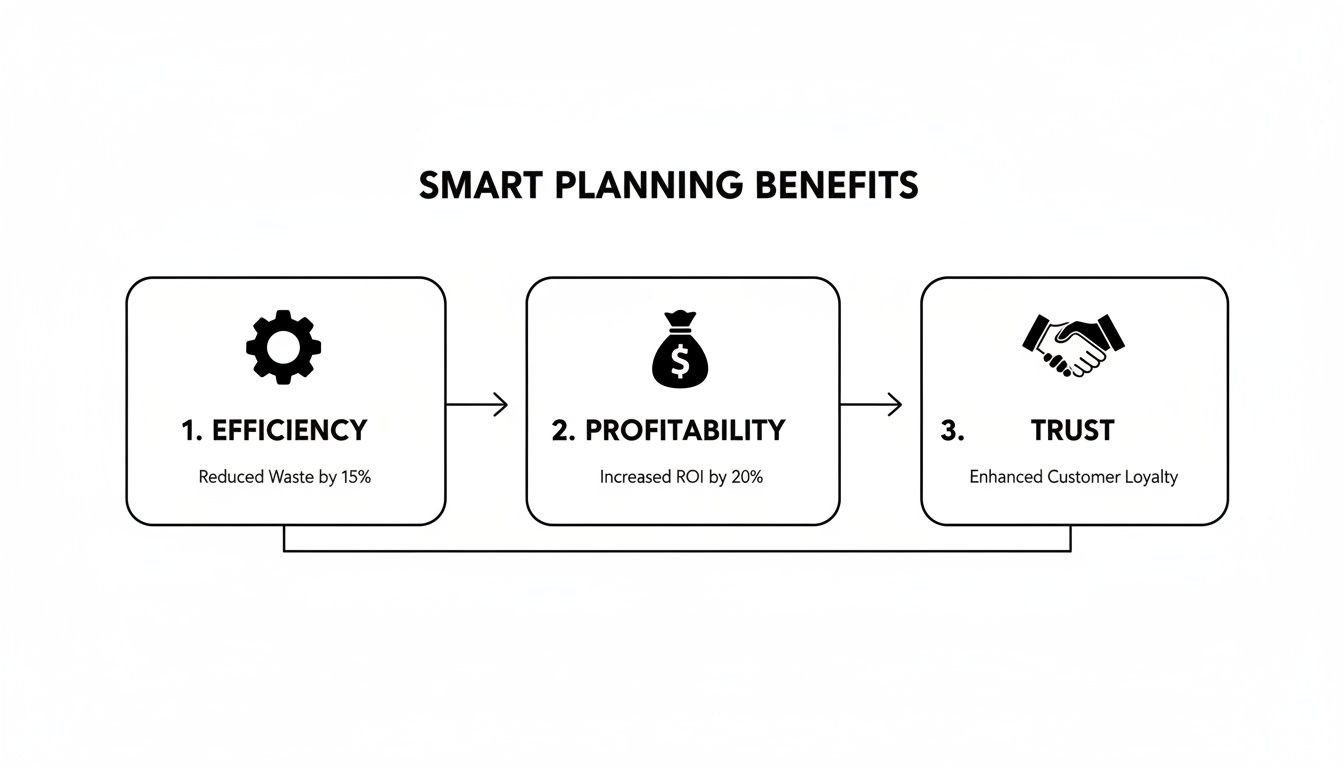
This visualizes exactly how structured planning leads directly to better efficiency, higher profitability, and stronger client trust.
Developing the schedule
With your tidy list of tasks from the WBS, you can now build a realistic timeline. This stage is all about estimating how long each task will take and mapping out the dependencies—those important tasks that must be finished before others can even start.
Doing this correctly prevents bottlenecks and creates a smooth workflow where no one is stuck waiting around for someone else’s work to be finished. The result is a project schedule with clear milestones that everyone on the team can see, understand, and follow.
Allocating resources and budget
Here’s where you put your people and your money to work. Based on the schedule and task list you’ve created, you can now assign the right people to the right jobs, making sure their skills are a perfect match for the work and that their availability lines up with the project timeline.
For a complex internal project, a robust CRM implementation project plan can act as a great blueprint for allocating both technical and human resources.
At the same time, you'll assign funds to each part of the project. This necessary step ensures your project doesn't go over budget and, ultimately, protects your agency’s profit margins.
Assessing risk and setting a communication cadence
Last but not least, you need to prepare for the unexpected. This involves taking a clear-eyed look at potential risks—things like a key team member getting sick, critical software failing, or a client providing agonizingly slow feedback—and creating a solid backup plan for each.
You also need to set a clear communication rhythm from day one. Decide how often you’ll hold status meetings, how you’ll share updates with stakeholders, and what tool you'll use. This simple step keeps everyone in the loop, aligned, and feeling confident about where the project is headed.
Using calendar data to make your planning more accurate
Even the most buttoned-up process can be completely torpedoed by one single thing: bad time estimates. Most agencies are still building plans based on pure guesswork or, even worse, flawed timesheets filled out from memory. This old-school approach forces you to build schedules and budgets on a foundation of wishful thinking.
There’s a much better way. The fix is to use the mountain of data you already have but are probably ignoring—your team's calendars.

Digging into your team's historical calendar data gives you a ground-truth look at how time is really being spent. This simple shift moves you from subjective guesses to objective facts.
From guesswork to data-driven forecasting
The core idea is pretty simple: your team's calendars are an incredibly rich source of real-world data. They don't just show scheduled meetings; they reflect the reality of how long client calls, internal reviews, and focused work sessions actually take.
When you analyze this data, you stop having to rely on hazy memories or overly optimistic projections.
A tool like TimeTackle plugs directly into your team’s calendars to automatically capture and categorize all this activity. By looking at past projects, you can finally see the true time cost of specific tasks and deliverables.
This shift from subjective estimates to data-driven forecasting is the single most powerful change you can make to improve planning accuracy. You're no longer asking, "How long do we think this will take?" Instead, you're answering, "How long has this taken us the last five times we've done it?"
This historical data becomes your new source of truth for all future planning. For example, you might discover that those “quick client check-ins” consistently run for 45 minutes, not the 15 you've been budgeting for. Insights like that are gold.
Want to see how it works? Check out our guide on time tracking with Google Calendar to learn more.
How calendar data improves specific planning stages
Using real data has a ripple effect, making every part of your plan more robust and reliable.
- More accurate scoping: When you know the real effort required for different types of work, you can scope new projects with much greater confidence. This helps ensure your proposals are both competitive and profitable.
- Achievable deadlines: Schedules built on historical data lead to deadlines that are achievable milestones, not stressful guesses. You can set delivery dates you know your team can hit without burning out.
- Smarter resource allocation: Calendar data exposes your team’s true capacity. You can see who is genuinely buried in meetings and who has blocks of focus time available, letting you assign work based on proven availability, not just assumptions.
Ultimately, this data-first approach transforms project planning from a theoretical exercise into a predictable, strategic function that directly grows your agency’s profitability and keeps clients happy.
Common project planning mistakes and how to sidestep them
Ever had a project that looked perfect on paper, only to have it unravel weeks later? Even the most experienced teams can fall victim to a few classic mistakes. The good news is, these pitfalls are easy to spot and avoid once you know what to look for.
Getting this right isn't about creating a flawless plan—it's about building a realistic and resilient one that can handle a few bumps in the road. This is the very definition of project planning: anticipating challenges before they derail you. A staggering number of projects don't hit their business goals. According to one source, the average project performance rate is only 73.8%, meaning about one in four fails. This is precisely why planning is so important; it's your best defense against becoming another statistic. You can check out more stats on project performance on breeze.pm.
Unrealistic optimism
We've all been there. The team is excited, the energy is high, and everyone is eager to jump in. This often leads to timelines built on best-case scenarios, a classic mistake known as unrealistic optimism. It’s the tendency to forget about all the little things—meetings, unexpected bug fixes, or that last-minute client feedback—that eat up time.
The Solution: Stop guessing and start using historical data. Look at how long similar tasks actually took in the past. Calendar analysis tools are a goldmine for this, giving you an objective view of where your team's time really goes. This grounds your planning in reality, not just wishful thinking.
Scope creep
This one is the silent project killer. It starts innocently enough with one "small" request from the client. Then another. And another. Before you know it, the project has ballooned way beyond its original boundaries, but your deadline and budget are still the same.
The Solution: Your best defense is a formal change request process. Any new request that steps outside the original scope has to be documented, estimated, and officially approved. This forces everyone to have a real conversation about the impact on time and cost, turning a casual "can you just…" into a conscious business decision.
Scope creep isn't the client's fault—it's a process failure. A clear change process protects both your team and the client by making the trade-offs of every new request visible.
Poor stakeholder communication
When stakeholders feel like they're in the dark, they get nervous. That anxiety leads to misaligned expectations, frantic "emergency" meetings, and feedback that throws everything off track. Simply assuming everyone knows what's going on is a recipe for frustration.
The Solution: Put together a dead-simple communication plan. Decide right at the start who needs to be updated, how often you'll do it, and which channel you’ll use. It could be a weekly email summary or a bi-weekly status call. This simple rhythm keeps everyone on the same page and feeling confident in the project's progress.
Frequently asked questions about project planning
As you start getting serious about improving your project planning, a few common questions always seem to pop up. Let's tackle them head-on.
How is project planning different from project management?
It’s easy to use these terms interchangeably, but they represent two very different things. The simplest way to think about it is that project management is the entire road trip, from start to finish.
Project planning is the specific, early phase where you decide on the destination (the scope), plot the route (the schedule), and figure out how much gas money you'll need (the budget). It's the critical first step: creating the map before you even turn the key in the ignition.
What is the first step to improve our agency's planning?
Start by looking backward. The fastest way to get better is to run a “post-mortem” or a project retrospective on a recently completed job. Dig into what went right, but more importantly, what went wrong.
This kind of audit gives you immediate, data-backed insights into where your process is weakest. Was it fuzzy scope, unrealistic time estimates, or poor resource allocation? The data will tell the story.
Don't just go by what you think happened. Use real data to uncover the truth. For example, if you see that the design phase actually took 20% longer than you planned, that's a perfect, concrete starting point for improvement.
Do small projects really need a formal plan?
Absolutely. But the plan doesn't need to be a 50-page document. For smaller jobs, a "lite" plan is all you need to make sure everyone is on the same page about the goals, the final deadline, and what you’re actually delivering.
Even if it’s just a simple one-page brief, that little bit of planning prevents the misunderstandings that can cause even tiny projects to go completely off the rails.
Stop guessing and start getting accurate, data-driven insights into your team's real capacity. TimeTackle turns your calendar data into a powerful planning tool. Learn more about how TimeTackle can help your business.