



So, what exactly is Monk Mode?
Think of it less as a productivity "hack" and more as a deliberate, disciplined commitment to focus. It’s the practice of carving out intense, uninterrupted blocks of time dedicated to one single, high-value task. You shut out all the noise—digital and physical—to enter a state of deep work, letting you produce your best work in a fraction of the time.
The High Cost of Distractions and the Rise of Monk Mode

Picture your agency’s top strategist, right on the cusp of a brilliant campaign idea. They're in the zone. Then, a Slack notification pings. An "urgent" email lands in their inbox. A calendar reminder for a meeting about another meeting pops up.
Just like that, the momentum is gone. This isn’t just a small frustration; it's a direct hit to your agency's profitability.
The Problem of Context Switching
That constant juggling of tasks and information streams is the silent productivity killer in almost every agency. We call it context switching, and every time an employee shifts their focus, their brain pays a cognitive tax. This mental friction leads to weaker creative work, blown-out project timelines, and that all-too-familiar feeling of being busy but getting nothing done.
This isn’t just a hunch; it’s a measurable drain on your resources. Research on workplace efficiency has shown that constant task-switching can torpedo productivity by as much as 40%. At the same time, it can spike stress hormones by 50%. This vicious cycle traps teams in a state of chronic overload, making deep, meaningful work feel like a distant memory. You can get more insights on deep work productivity here.
Monk Mode is the deliberate act of building a fortress around your focus. It’s like a master craftsman closing their workshop door, shutting out the world, and dedicating themselves completely to their craft. It's about intentionally creating the conditions for excellence.
A Structured Solution for Agency Pain Points
Monk Mode isn't just about ignoring notifications. It's a strategic framework for scheduling and protecting blocks of deep work, offering a direct solution to some of the most persistent operational headaches agencies face.
Take a look at how a day with Monk Mode compares to the chaotic norm.
A Tale of Two Workdays: Monk Mode vs. The Norm
| Metric | Standard Agency Workday | Workday with Monk Mode |
|---|---|---|
| Focus | Fragmented across 5-7 tasks/projects | Sustained focus on 1-2 major tasks |
| Interruptions | Constant Slack pings, emails, tap-on-the-shoulder questions | Scheduled communication blocks; "Do Not Disturb" is respected |
| Output Quality | Prone to errors, surface-level thinking | Higher quality, more innovative, and thorough |
| Cognitive Load | High; mentally exhausting by EOD | Lower; energy is preserved for high-value work |
| Time Tracking | Guesswork; "Where did the day go?" | Simple and accurate; logged against specific tasks |
| Employee State | Reactive, stressed, feeling "behind" | Proactive, in control, sense of accomplishment |
The difference is stark. By formally adopting this practice, agencies can immediately start to see tangible benefits:
- Improved Timesheet Accuracy: When someone works on a single project for a solid two-hour block, tracking that time becomes dead simple and far more precise.
- Accurate Utilization Data: With cleaner time tracking, you finally get a true picture of how your team's time is being allocated to billable client work versus internal tasks.
- Enhanced Creative Output: Uninterrupted focus is the secret ingredient for deep thinking. It leads to the kind of innovative solutions and high-quality deliverables that keep clients coming back.
- Reduced Employee Burnout: Giving your team protected time for focused work makes them feel less scattered and more in control. That's a powerful antidote to the stress and burnout plaguing the industry.
The Foundational Principles of Monk Mode
So, what’s the secret sauce behind Monk Mode? It’s not just about putting your Slack on silent for an hour and hoping for the best. It’s a full-on strategic framework, built on a few core principles that turn your good intentions into real, tangible results.
Think of it like a surgeon prepping for a complex operation. They don’t just stroll into the OR and wing it. Every tool is laid out, the room is sterile, and every possible interruption has been dealt with beforehand. That's the level of intention we're aiming for.
Monk Mode is all about creating more value within the hours you have, not just piling on more hours. To get there, we need to lean on four pillars.
Define Your Mission
Every single Monk Mode session has to kick off with one, crystal-clear, high-value goal. And I don't mean a vague to-do item like "work on the Q3 client report." No. We need something specific and outcome-driven, like: "Draft the complete findings and recommendations section of the Q3 client report."
Getting this specific wipes out decision fatigue right from the start and gives your brain a clear target to lock onto. If you go in without a mission, you’ll just burn through your precious focus time trying to figure out what to do instead of actually doing it.
Engineer Your Environment
Your physical and digital spaces are constantly sending signals to your brain. If you want to drop into a state of deep focus, you have to deliberately build an environment that screams "work time." That means getting ahead of distractions by kicking them out before they even have a chance to knock.
This comes down to two key moves:
- Your Physical Space: Find a quiet corner, throw on some noise-canceling headphones, or even just put a simple sign on your desk. The idea is to create a real, physical barrier between you and the usual office chatter.
- Your Digital Space: This one's non-negotiable. Close every tab you don't absolutely need. Turn off all email and chat notifications. Put your phone in another room or, at the very least, flip it to airplane mode.
This approach flips the script on distraction-riddled workflows, delivering the laser-like concentration that agencies crave. By dedicating chunks of your day to single-tasking high-priority goals, you slash pointless meetings and pings, boosting output quality and speed. Discover more insights about workforce management on Workstatus.io.
Commit to Time Blocks
Monk Mode isn't just a state of mind; it's a hard-and-fast appointment on your calendar. By time blocking—scheduling these focus periods as non-negotiable events—you're actively defending your most valuable asset: your attention.
You need to treat these blocks with the same respect you'd give a top-tier client meeting. They can't be moved on a whim or double-booked. End of story.
This practice is right at the heart of deep work, a skill that’s becoming incredibly rare—and therefore incredibly valuable. You can dive much deeper into this with our complete guide to deep work for beginners.
Practice Deliberate Disconnection
Finally, you have to let your team know you're off-limits. This isn't you being difficult; it's you setting clear expectations for everyone.
A quick status update in your communication tools to "Focusing" or "In Monk Mode" does the trick. It's a simple act that starts training your colleagues to respect your focus time, and it helps build a culture that actually values deep, uninterrupted work. It’s a proactive shield, stopping interruptions before they even start.
How to Launch Monk Mode at Your Agency
Getting the idea of monk mode from a cool concept to a daily habit in your agency takes a real, actionable plan. It's not enough to just tell people to "focus more." You have to build a system where deep work is actually the easiest option. The process starts with a solid business case and ends with data you can actually measure.
First things first: you need the leadership team on your side. Agency leaders and ops managers live and breathe data, not just good ideas. Show them the numbers. Present them with clear metrics on lost productivity—hours burned on context switching, the real financial cost of constant pings, and how it all directly impacts project timelines and client happiness. Frame monk mode as the direct answer to these very real business pains.
Establishing the Rules of Engagement
Once leadership is bought in, the next step is to lay down some unambiguous rules for the whole team. When it comes to focus, ambiguity is the enemy. Everyone needs to know exactly what monk mode looks like, how to signal they're in it, and—just as importantly—how to respect it when others are.
This means getting specific about how you communicate and schedule your time.
- Standardize Calendar Titles: Settle on a simple, consistent naming convention. Something like "Monk Mode – [Project Name]" or "Deep Work – Client X" makes it instantly obvious that someone is off-limits to interruptions.
- Define Communication Channels: Create a clear pecking order for urgent stuff. A Slack message can probably wait. A direct phone call to a team lead? That should be reserved for true, hair-on-fire client emergencies.
- Set Clear Expectations: Make it known that a "Monk Mode" status is a hard boundary, not a friendly suggestion. To build a true culture of focus, this has to be respected by everyone, from the newest hire to the CEO.
To really cut down on the noise and let your teams dive deep, you might even consider practical solutions like utilizing a virtual receptionist service to handle incoming calls and other administrative tasks that pull people out of their flow.
This simple, four-step process breaks down the essential parts of any successful monk mode session, from defining the goal to unplugging from the noise.
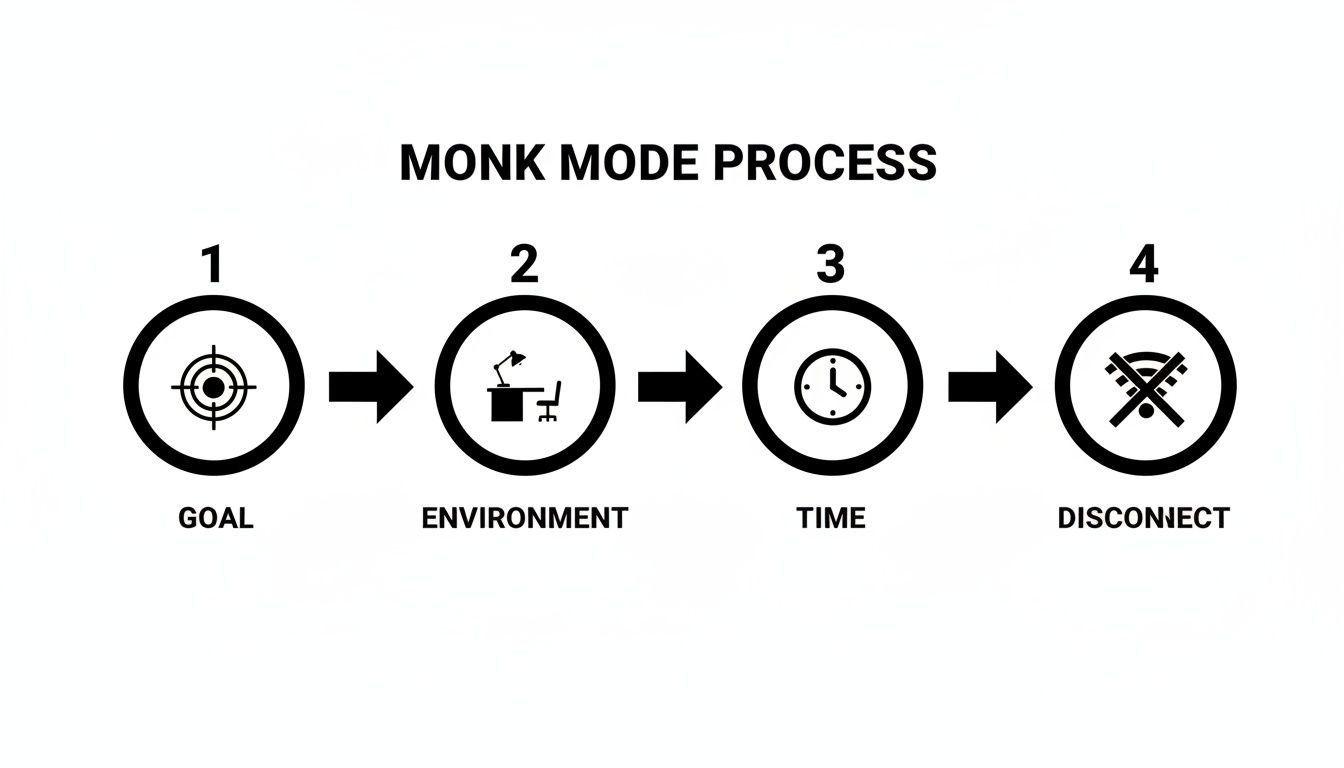
This flowchart really drives home the point that effective deep work isn't just about willpower. It's a structured process that requires you to be intentional at every stage.
Turning Focus into Measurable Data
The final, and most critical, piece of the puzzle is using tools to make this new habit stick and prove it’s working. This is where an abstract idea becomes concrete, reportable data that your leadership team will love. By creating a dedicated tag in your calendar system—like "Monk Mode" or "Deep Work"—you can start tracking these high-value focus blocks.
With a platform like TimeTackle, you can set up rules that automatically apply this tag to any calendar event with the right title. This little bit of automation is a game-changer. It removes the manual work and ensures you're capturing consistent data across the entire agency.
With a simple rule in place, you can automatically categorize every 'Deep Work' session, making them incredibly easy to track and analyze.
Suddenly, you're not just hoping people are focusing; you're running reports that show exactly how much time is being invested in productive, billable work. Now you can finally prove the ROI of your monk mode initiative.
Measuring the Real Impact of Focused Work
How do you prove that adopting monk mode is more than just a feel-good initiative? For ops leaders and finance managers, the real story is always in the numbers. Shifting from a culture of constant pings and interruptions to one of structured focus needs a solid business case, and that case is built on clear, measurable data. The mission is to draw a straight line from these protected blocks of deep work to tangible business outcomes.
The good news? You don't need to invest in a complex new software suite to see the results. The proof is probably already sitting in your team's calendars, just waiting to be analyzed. By learning to treat calendar events as structured data, you can connect focused work sessions directly to your bottom line.
From Calendar Events to Business Intelligence
The first step is a mental shift: stop seeing your calendar as just a scheduling tool and start treating it as a rich data source. When your team gets into the habit of tagging their focus sessions—for instance, with a simple event title like "Monk Mode – Client X Project"—they're creating a powerful dataset without any extra effort. Analytics tools can then slice and dice this information, revealing patterns that were completely invisible before.
This simple practice allows you to answer critical operational questions with hard evidence:
- Utilization Rates: How much of our dedicated monk mode time is actually spent on billable client projects versus internal housekeeping?
- Project Velocity: Do projects where the team logs more focused hours get across the finish line faster?
- Administrative Drag: As we cut down on meetings and interruptions, are we seeing a corresponding rise in productive output?
By implementing a simple 'Monk Mode' tag, you transform your team's calendar from a passive scheduling grid into an active business intelligence tool. Suddenly, every focused hour becomes a data point proving the ROI of deep work.
Key Metrics to Track and Report
To build a narrative that resonates with leadership, you need to focus on metrics that speak their language: financial and operational gains. Instead of relying on vague testimonials about "feeling more productive," you can walk into a meeting with reports that show specific, quantifiable improvements.
Here are the essential KPIs to get you started:
- Increased Billable Utilization: Filter your team's calendar data to see the percentage of time spent on billable work during monk mode versus regular hours. A jump in this number is a direct link to increased revenue potential and a more efficient team.
- Faster Project Completion: Look at the lifecycle of similar projects. You can often show that projects with consistent, tagged focus sessions move from kickoff to completion in far less time. That means happier clients and more capacity for new work.
- Reduction in Administrative Churn: Track the time spent in meetings and on admin tasks before and after you roll out team-wide focus blocks. A significant drop proves that monk mode is successfully killing the low-value "work about work" that drains budgets and stalls momentum.
A Practical Monk Mode Schedule for Agency Teams

Talking about monk mode is one thing, but actually seeing how it fits into a chaotic agency week makes it feel possible. Let's be real: a rigid, all-day focus block just isn't going to fly for most client-facing teams.
The real goal is to build a sustainable rhythm—one that carves out space for deep work while still accommodating the collaborative, and often reactive, nature of agency life. It's about removing the guesswork and giving managers a clear path to integrate structured focus time without blowing up the whole system.
Building Your Team's Focus Rhythm
A balanced schedule is all about protecting your team's most valuable hours while leaving room for essential meetings and client check-ins. A great starting point is implementing "Focus Mornings."
Think Tuesdays and Thursdays from 9 AM to 11 AM. This is often when cognitive energy is at its peak. During these two-hour blocks, all internal pings are paused, giving everyone a real shot at making uninterrupted progress on their most important work.
This structure is a perfect, real-world application of timeboxing. It’s a simple but powerful technique where you dedicate specific windows to specific tasks. If you want to go deeper, our guide on why timeboxing is a powerful tool for amplifying your productivity is a fantastic resource.
Once the morning focus session ends, the schedule opens back up. Mid-day becomes the sweet spot for internal syncs and collaborative problem-solving. Afternoons? Perfect for client calls and external meetings. This creates predictable windows for different types of work and dramatically cuts down on that soul-crushing context switching.
The best monk mode schedules aren’t about total isolation. They’re about creating a predictable, team-wide agreement on when to collaborate and when to focus. That simple agreement is the cornerstone of sustainable productivity.
To help you visualize this, I've put together a sample weekly schedule below. Think of it less as a rigid set of rules and more as a flexible framework. You can and should adapt it to fit your team’s unique workflow and client demands.
Sample Weekly Monk Mode Schedule
This template shows how a typical mid-sized agency can weave dedicated deep work sessions into their week.
| Time Slot | Monday | Tuesday | Wednesday | Thursday | Friday |
|---|---|---|---|---|---|
| 9-11 AM | Weekly Kick-off & Admin | Monk Mode (Deep Work) | Project Work & Check-ins | Monk Mode (Deep Work) | Project Work & Wrap-up |
| 11-1 PM | Internal Team Syncs | Collaborative Work | Internal Team Syncs | Collaborative Work | Client Status Updates |
| 1-2 PM | Lunch Break | Lunch Break | Lunch Break | Lunch Break | Team Lunch / Social |
| 2-4 PM | Client Meetings | Client Meetings | Open for Project Work | Client Meetings | Client Meetings |
| 4-5 PM | Daily Wrap-up & Planning | Daily Wrap-up & Planning | Daily Wrap-up & Planning | Daily Wrap-up & Planning | Weekly Review & Planning |
By providing a clear, visual guide like this one, the whole idea of monk mode becomes a lot less intimidating and much easier to get buy-in for across your organization.
Common Mistakes to Avoid When Starting Monk Mode
Rolling out a new work habit like monk mode never goes perfectly right out of the gate. Trust me. The key to making it stick, rather than watching it fizzle out after a week, is knowing what potholes to steer clear of. Most of these initiatives fail not because the idea is bad, but because the execution ignores some basic truths about how people work.
One of the biggest mistakes I see is the "all-or-nothing" trap. A team gets fired up about the idea and immediately tries to block off marathon four-hour focus sessions on day one. This almost always backfires, leading to burnout, frustration, and a quick retreat to the old way of doing things. You have to remember, deep focus is a muscle; it needs to be trained gradually.
The Alignment and Planning Failures
Another huge roadblock is a lack of team-wide buy-in. What happens if only half the team respects the "Do Not Disturb" status? The interruptions continue, and the entire point is lost. This is what happens when the ground rules aren’t clearly communicated and agreed upon by everyone, from the top down.
It’s just as bad when teams jump into a monk mode session without a clear mission. An hour of "focus" with no specific goal—like "Draft the introduction for the client's Q3 report"—quickly turns into an hour of pseudo-deep work. You end up spending all your time figuring out what to do instead of actually doing it.
A study from the University of California found it takes an average of 23 minutes to fully get back on track after a single distraction. That number alone should tell you why it’s so critical to eliminate interruptions, not just try to reduce them.
The good news is, you can sidestep these issues with a little bit of foresight. It all comes down to gradual implementation and crystal-clear communication.
- Start Small: Don't go for the four-hour marathon. Begin with manageable 30 or 45-minute focus blocks and build up your team's stamina from there.
- Set Clear Goals: Every single focus session needs one achievable objective. Have everyone write it down before they start.
- Establish Protocols: Create a dead-simple guide for when and how to interrupt someone in a focus block (the answer should almost always be: you don't).
- Embrace Asynchronous Tools: Get your team into the habit of using communication tools that don’t demand an instant reply.
Dodging these common errors is half the battle. To really get a handle on the root cause, check out our guide on how to successfully say no to digital distractions.
Your Monk Mode Questions, Answered
Even the best-laid plans run into real-world questions. When you're rolling out a new way of working like monk mode, your team is bound to have a few. Let's tackle some of the most common ones head-on so you can move forward with confidence.
How Do We Handle Urgent Client Requests During Focus Time?
This is probably the biggest question for any agency, and for good reason. The answer isn't to ignore clients; it's to create a smarter system. A team-wide focus block should never mean radio silence when there's a real fire to put out.
The solution is to designate a single point person for each focus period—this is often a project manager or a team lead. They become the gatekeeper, fielding incoming requests and only interrupting a team member if it's a genuine, time-sensitive crisis. This simple buffer protects the team's concentration while making sure clients are never left in the dark.
Is Monk Mode a Good Fit for Every Role?
Absolutely, but it won't look the same for everyone. The core idea of deep, uninterrupted work is universal, but how you apply it needs to be flexible. For example, a creative director might need a solid three-hour block to map out a new campaign concept. An account manager, on the other hand, might use shorter, 60-minute monk mode bursts to power through client emails without constant pings.
The key is adaptation. The goal isn't to cram every role into the same rigid schedule. It's about empowering each person to carve out and protect the focused time they need to do their best work, whatever that looks like.
Many teams report a noticeable reduction in stress within the first week of implementing scheduled focus time. Measurable productivity gains, like faster project turnaround, often become visible within the first month as the new habits solidify.
How Long Does It Take to See Results?
While every team's journey is a bit different, the benefits kick in faster than you might think. That immediate feeling of having more control over your day is often a day-one win. From there, the more tangible business results tend to follow a clear pattern.
- Week 1: You'll feel it first. Expect less stress and a greater sense of accomplishment at the end of the day.
- Month 1: This is when you start to see it. There will be noticeable improvements in how many tasks get done and a drop in silly mistakes.
- Quarter 1: Now you can prove it. The data will start showing higher billable utilization and projects moving through the pipeline faster.
Getting over that initial cultural shift is the hardest part. Once you're past that, the momentum really starts to build.
Ready to turn your team's calendar data into a clear picture of productivity? TimeTackle provides the analytics and automation you need to measure the impact of focused work and prove the ROI of monk mode. Learn more at https://www.timetackle.com.