



If your company works on public projects in New York, you’ve probably heard the term NYS prevailing wage. This isn't just another piece of administrative jargon—it's a set of rules dictating how much you must pay your workers and how you report every dollar.
Getting this wrong is a big deal. We’re talking serious financial penalties, and you could even get barred from bidding on future government contracts.
What is the NYS prevailing wage and who it affects

New York State's prevailing wage is a specific pay rate—plus benefits—that must be paid to workers on public work projects. Don't confuse it with the standard minimum wage. Think of it as a special pay scale, set by job type and county, to ensure fair pay on any job funded by the public.
So, what counts as a “public work” project? It’s pretty broad: any construction, renovation, or maintenance project paid for in whole or in part with public funds.
This covers a huge range of jobs, such as:
- Building or repairing public schools
- Road and bridge construction
- Work on municipal buildings like libraries or fire stations
- Any project for a state or local government agency
Who must comply with the law
The law directly targets contractors and subcontractors working on these public projects. If you're a project manager or an operations leader at an agency that bids on this kind of work, these regulations apply to you and every person you hire to work on that site.
It's a common mistake to think only the prime contractor is on the hook. The reality is that all contractors and subcontractors on the project are required to comply. This shared responsibility is a core part of the law's design.
The big idea behind prevailing wage is to level the playing field. It stops contractors from winning bids just by undercutting worker pay. This way, skilled labor gets compensated fairly, and projects are built to a high standard.
New York’s prevailing wage law isn’t new; it was first enacted way back in 1897 to protect workers on public jobs. It makes sure they get pay and benefits that are on par with local union-scale wages, which often means much higher earnings than they'd see in the private sector.
Just to give you an idea, in New York City during 2011-2012, boilermakers on public projects were earning between $47.32 and $47.98 per hour. That rate was 165-167% higher than the private sector average of $28.72 at the time. If you're curious, you can explore more about the history of New York's wage laws and see how they've changed over time.
For a quick reference, this table breaks down the law's key elements.
Core components of NYS prevailing wage law
| Component | What It Means for Your Agency | Who Is Directly Affected |
|---|---|---|
| Mandated Pay Rates | You must pay the specific hourly wage and benefit ("supplement") rate set for each job classification in the project's county. | All "workers, laborers, or mechanics" performing physical or manual labor on the project site. |
| Job Classifications | Each worker must be correctly classified based on the tasks they perform, not just their job title. | Anyone performing trade-specific work (e.g., electrician, plumber, painter, laborer). |
| Certified Payroll Reports | You must submit weekly certified payroll reports proving you've paid the correct rates. | Your payroll and compliance teams, project managers, and ultimately, your company's leadership. |
| Prime Contractor Liability | The prime contractor is ultimately responsible for their subcontractors' compliance. | Prime contractors, who must oversee their entire team, and subcontractors, who are also directly liable. |
Understanding these parts is the first step to staying compliant and avoiding the headaches that come with violations.
An analogy to make it click
Still a little fuzzy? Let’s try an analogy.
Think of the standard minimum wage as the general speed limit on any old road in the state. The NYS prevailing wage, on the other hand, is like a special, higher speed limit posted just for a high-performance racetrack.
When you enter that racetrack (the public works project), you have to play by its unique rules. The speed limit changes depending on which track you’re on (the county) and the kind of car you’re driving (the worker’s job classification). A Formula 1 car (an electrician) has a different required speed than a stock car (a general laborer).
Your job as the contractor is to make sure every driver is going the correct speed, every lap of the way. Fall behind, and you’re looking at serious penalties.
How to determine rates and classify your workers correctly
Getting the numbers right on an NYS prevailing wage project is where many contractors stumble. This isn't just about paying a flat, high rate; it's about paying the exact rate for the specific work being done, in the specific county where the project is located. Nailing this process is your best defense against some very expensive mistakes.
The rates aren't a one-size-fits-all number. They are incredibly specific and change based on two main factors:
- Geographic Location: A carpenter's rate in Westchester County is going to be different from one in Albany County.
- Trade or Occupation: An electrician has a different rate schedule than a general laborer or a plumber, even if they're all working on the same job site.
Finding the official prevailing wage schedules
The only place to find these rates is the New York State Department of Labor (DOL). Don't ever rely on old schedules you have lying around or what someone tells you the rate is. The DOL updates these schedules regularly, and it's your responsibility to use the most current version for your project.
You can find the official schedules directly on the DOL's website, which publishes separate rate sheets for construction and public services.
This portal is your single source of truth. As you can see, you have to select the right county and the correct publication date to get the schedule that applies to your specific contract.
The importance of worker classification
Finding the right rate sheet is only half the battle. The most common—and most costly—mistake contractors make is misclassifying workers. This is where the details can make or break you.
A worker's classification comes down to the actual tasks they perform on the job site—not their job title, their seniority, or what you agreed to pay them.
If a worker is doing the job of an electrician, you must pay them the electrician's prevailing wage rate for that county. It doesn't matter if you have them on your payroll as a "general helper" or if they agreed to a lower wage. The work itself dictates the rate.
For instance, say you have someone classified as a "general laborer" helping your electrical crew. The moment that person starts running conduit or pulling wire, even for just an hour, they are performing the duties of an electrician. If you keep paying them the laborer rate, you are now in direct violation of the law, opening yourself up to audits, back pay with interest, and big fines.
Here are a few common classification traps to watch out for:
- The "helper" mistake: Paying a skilled worker's rate to the lead journeyman and a laborer's rate to their "helper," even when that helper is performing skilled tasks right alongside them.
- Apprentice misclassification: You can only pay the apprentice rate if the worker is officially registered in a program approved by the NYS Commissioner of Labor. Without that formal registration, they must be paid the full journey-person rate for their trade.
- Ignoring split tasks: If a worker performs tasks from multiple classifications in a single day (e.g., three hours of carpentry and five hours of general labor), you must track that time precisely. You have to pay the correct rate for the hours spent on each specific task.
Getting this right demands meticulous record-keeping and a real-time understanding of who is doing what on your job site every single day. For a deeper look into the differences between what you charge a client and what you pay your employees, check out our guide on bill rates vs. pay rates. While it's UK-specific, getting familiar with the factors that influence construction labour rates can also give you a broader perspective on how these complex compensation structures work.
Mastering certified payroll and reporting
So, you've nailed down the right rates and classifications for everyone on your crew. The next big hurdle? Proving you're actually paying them correctly. On a New York State prevailing wage job, this isn't about trust—it's about documentation. This means getting very familiar with certified payroll reports.
Think of these reports as your weekly, sworn statement to the contracting agency, confirming you’re playing by the rules. You have to submit one for every week you have workers on that job site.
Let me be clear: getting the paperwork right is just as important as getting the paychecks right. A simple clerical error on a report can trigger an audit just as fast as underpaying a worker. These documents are your primary line of defense, so nailing them from the start will save you from a world of hurt.
What goes into a certified payroll report
A certified payroll report is far more than a simple timesheet. It’s a weekly breakdown of every dollar paid to every person on a public work project. Each report has to be paired with a "Statement of Compliance"—basically, you signing on the dotted line, legally attesting that everything on that report is true.
For every worker on the project, you need to be prepared to report:
- Employee Information: Their full name, address, and Social Security number.
- Work Classification: The official job title from the prevailing wage schedule (e.g., Electrician, Plumber, Laborer-General). This has to be exact.
- Hours Worked: A daily and weekly log of all hours, making sure to separate regular time from overtime.
- Wage and Supplement Rates: The specific hourly cash wage paid and the hourly supplement (or "fringe benefit") rate.
- Gross Wages: The total amount earned before any deductions.
- Deductions and Net Pay: A full accounting of all deductions, like taxes, and the final net pay the worker received.
This process flow shows just how central that job classification is—it's the direct link to the final wage rate you have to report.
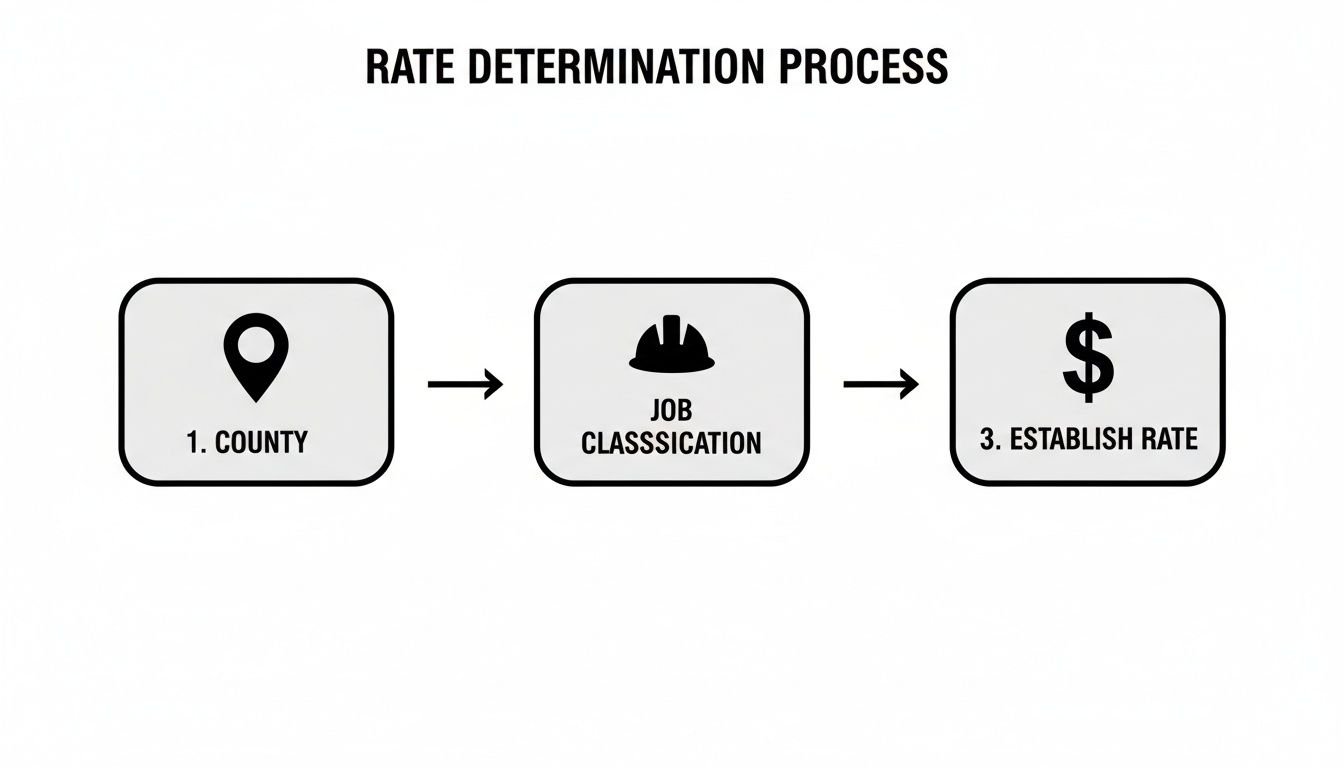
As you can see, getting the final rate right is a two-step process: you need the project's location and the specific type of work being done. Both have to be documented perfectly on your payroll report.
A walkthrough of the reporting process
While you can generate reports from different software, many contractors still use the federal WH-347 form or the state's PW-12 form as their foundation. The process is meticulous and leaves zero room for guesswork.
First, you have to capture solid time data for every worker, every day. This is the bedrock of your entire report. An entry that just says "8 hours" won't cut it in an audit; you need start times, stop times, and break times to create a bulletproof record.
Second, you carefully transfer that data onto the payroll form, column by column. A key detail here is that you must list the cash wage and the supplement rate separately. If you provide benefits like a health plan, you have to calculate their hourly value and list it under supplements. If your benefits package doesn't meet the full supplement rate, you’re on the hook to pay the difference directly in cash.
The single most common mistake I see is contractors failing to properly document supplements. Just having a health insurance plan isn't enough. You must prove its hourly value for each employee and ensure it meets the specific supplement rate for their trade. Any shortfall has to be paid out in their check.
Finally, you complete and sign the Statement of Compliance. That signature legally binds you to the accuracy of the report. The whole package then gets submitted to the public agency, typically within 30 days of the last payroll period covered.
This entire chain of events lives or dies by flawless data collection. If your time tracking is sloppy from the start, creating a compliant certified payroll report is a nightmare. It's no surprise that many contractors are seeing how specialized construction time tracking apps can drive productivity and take the risk out of this process, turning a manual headache into a much more manageable workflow.
Understanding enforcement and the high cost of non-compliance
We’ve walked through the nuts and bolts of NYS prevailing wage—from figuring out rates to handling certified payroll. Now for the part that really matters: the “why.” Why is getting this right so important? Because the consequences of getting it wrong are severe, and enforcement isn't just a distant possibility.
The New York State Department of Labor (DOL) and the State Comptroller’s Office are the two main agencies policing these laws. They don’t just sit around and wait for you to mess up; they are actively looking for mistakes.
How compliance is monitored
Don't assume you're flying under the radar. Enforcement is an active process that happens through a few key channels, and every contractor needs to be aware of them.
- Worker Complaints: This is the number one way investigations get started. Any worker who feels they've been shorted on pay can file a confidential complaint directly with the DOL. The state takes these claims extremely seriously.
- Routine Checks and Audits: It's not uncommon for contracting agencies or the Comptroller's office to conduct spot checks on active projects. They might show up on your job site or send a request for certified payroll reports for a random review.
- Full-Scale Investigations: If they spot red flags—like inconsistent reports or a credible complaint—the DOL’s Bureau of Public Work can launch a deep investigation into your company. They'll scrutinize every public work project you’ve ever touched.
The financial pressure to cut corners is real. For instance, the cost impact of New York's prevailing wage on affordable housing has been a hot topic, with studies showing it can increase costs by 5% to 16% per unit. That's a huge number for anyone trying to manage a project in NYC’s cutthroat real estate market. This is only amplified by rules for 421a tax abatements, which can push average wages to $60 per hour for big projects in Manhattan. You can see the research yourself on the Citizens Housing & Planning Council's data portal to truly grasp the numbers.
The steep penalties for getting it wrong
Failing to comply with NYS prevailing wage law is far more than a simple fine. The penalties are designed to be painful and can easily put a company out of business.
If an investigation finds you've underpaid workers, here’s what you’re looking at:
- Full Back Wages: You will be ordered to pay every cent of the underpayment back to the affected employees.
- Interest: This isn't your typical bank loan interest. The law requires interest on unpaid wages, which can be as high as 16% per year.
- Civil Penalties: On top of everything else, the DOL can slap you with fines of up to 25% of the total underpayment amount.
- Criminal Charges: If the violation is seen as willful or part of a pattern, you could even face criminal charges, bringing the risk of jail time and much larger fines.
But the most devastating penalty of all is debarment. This means your company is blacklisted and banned from bidding on or being awarded any public work contracts in New York State for up to five years. For any business that relies on public projects, debarment is a death sentence.
Joint liability: the prime contractor’s burden
Here’s a detail every prime contractor needs to burn into their memory: you are financially on the hook for your subcontractors' wage violations. This is a concept known as joint liability.
If your electrical sub underpays their crew, the DOL can—and often does—come after you, the prime contractor, for the back wages and penalties. It makes absolutely no difference if you did everything by the book with your own employees. This makes your choice of subcontractors and your oversight of their work so important. You can't just hire a team and hope for the best; you must actively vet their compliance practices and demand their certified payroll reports. Your company’s financial health and reputation are riding on it.
How to automate compliance and prevent common errors
We've walked through the risks, the steep penalties, and the sheer administrative burden of NYS prevailing wage compliance. So, let’s pivot from the problems to a practical solution. The right technology can move you from manual chaos to automated clarity, slashing your risk of costly errors.
For most contractors, the biggest headache comes from relying on mistake-prone spreadsheets for time tracking and payroll. This old-school approach is a compliance disaster waiting to happen. A single typo, a misremembered start time, or a copy-paste mistake can throw off an entire certified payroll report.
From manual headaches to automated workflows
Now, imagine a different way. Instead of chasing down timesheets and manually hunting for the right rates, you can build an automated workflow that handles the heavy lifting for you. This approach connects the tools your team already uses—like Google or Outlook calendars—to an intelligent time-tracking platform.
The goal is to create a system where every minute of work is captured, categorized, and reported correctly with almost no manual effort. This doesn't just save countless admin hours; it builds a solid audit trail.
Here’s how a modern, automated workflow completely changes your compliance process:
- Automated Time Capture: Forget relying on memory. Time tracking tools can automatically log hours based on calendar events, giving you a precise record of time spent on each project.
- Rule-Based Project Tagging: You can set up rules that automatically tag any public work project as ‘prevailing wage’ the second it's added to your calendar.
- Intelligent Worker Classification: By connecting to your project management software, the system can automatically assign the correct job classification to each worker based on their specific role for that project.
- Real-Time Cost Visibility: Managers get a live dashboard view of labor costs, including the impact of prevailing wages. This helps them monitor project profitability without waiting for someone to crunch the numbers.
This modern setup makes the dreaded task of certified payroll almost effortless. Using technology like AI legal software can also help manage many compliance tasks and reduce the chance of errors in prevailing wage reporting.
A tale of two systems
To really see the difference, let’s compare a typical manual process with an automated one. The contrast is stark.
This table breaks down how automation transforms each core compliance task, moving it from a high-risk gamble to a low-risk, efficient process.
Manual vs. automated prevailing wage workflow
| Compliance Task | The Manual Way (High Risk of Errors) | The Automated Way (Low Risk & Efficient) |
|---|---|---|
| Time Tracking | Workers fill out paper timesheets or spreadsheets from memory, often at the end of the day or week. | Time is automatically captured from calendar events and mobile check-ins. Accuracy is built-in from the start. |
| Job Classification | A project manager or payroll admin manually assigns classifications, creating a high risk of using the wrong one. | The system automatically applies classifications based on predefined rules for each project and worker. |
| Rate Calculation | Someone has to manually look up the correct wage and supplement rate for each worker, for every single pay period. | The system stores current rate schedules and applies the correct wage and supplement based on project location and classification. |
| Certified Payroll | Data is manually typed into a PW-12 or WH-347 form, a process that’s a breeding ground for typos and calculation mistakes. | Audit-proof certified payroll reports are generated automatically with a few clicks, ready for submission. |
As you can see, automation isn't just a minor improvement—it's a fundamental shift in how you operate, creating a system that protects you from liability.
The fundamental difference is this: The manual way forces you to reconstruct what happened. The automated way creates a perfect record of what happened as it occurs. One is prone to human error; the other is designed for accuracy.
Setting up a smarter compliance system
Getting started with automation is less complicated than you might think. The key is to connect your existing systems in a logical flow. If your team already schedules work on a shared calendar, you’re halfway there. You can check out this guide to automated timesheet software for agencies to see how these platforms can be set up for your specific needs.
By creating rules that tag specific calendar events with project codes and prevailing wage classifications, you ensure every hour tracked is categorized correctly from the get-go. For example, a calendar event titled "Install Electrical – 123 Main St. Project" can be automatically logged with the "Electrician" classification and flagged as a prevailing wage job.
This creates a powerful, auditable data trail. When it’s time to run certified payroll, you’re not scrambling to piece together information from different sources. You’re simply exporting a report that was built correctly, minute by minute, throughout the entire pay period. This gives leaders the real-time insights they need to manage budgets and protects the company from the costs of non-compliance.
Frequently asked questions about NYS prevailing wage
Even after getting the basics down, most contractors find that NYS prevailing wage comes with a lot of specific "what if" scenarios. We get these questions all the time from folks in the field, so here are some straight answers to the most common ones.
What is the real difference between prevailing wage and minimum wage?
Think of it this way: the state minimum wage is the absolute floor for what any employer in New York can pay someone, for any job. It's a general rule.
Prevailing wage, on the other hand, is a much higher, project-specific pay scale just for public works jobs. It’s not a single hourly number; it’s a full package deal that includes both the cash wage and a benefit amount, called a "supplement." These rates are set county by county and job by job to match local, union-level pay, which is why an electrician’s rate in NYC is worlds apart from a laborer’s rate in Albany.
How do I correctly pay for benefits and supplements?
The total prevailing wage rate is made of two parts: the base hourly wage and the supplement rate for benefits. Your job is to make sure your total compensation hits that combined number.
You can pay the whole thing in cash, or you can use a mix of wages and genuine, bona fide benefits like health insurance, a retirement plan, or paid time off. But here's the key part: if the hourly cost of your benefits doesn't meet the full supplement amount, you absolutely have to make up the difference in cash on the employee's paycheck. You'll need meticulous records of your benefit contributions to back this up on your certified payroll reports.
Are apprentices and trainees covered by prevailing wage?
Yes, they are, but you can often pay them a lower percentage of the full journey-person rate. There’s a huge catch, though. To legally pay this reduced rate, the apprentice must be individually registered in a program officially approved by the NYS Commissioner of Labor.
If a worker isn’t in one of these registered programs, you have to pay them the full prevailing wage for whatever work they’re doing. Just calling someone an "apprentice" on your payroll is a massive compliance trap that will get you in hot water. You need the state-issued registration paperwork to prove their status.
What specific records do I need to keep for these jobs?
New York law is serious about record-keeping. You’re required to keep incredibly detailed records for a minimum of six years after a public work project wraps up. Failing to have the right paperwork can lead to penalties, even if you paid everyone correctly.
Here’s what you absolutely must keep on file:
- Names and addresses of all workers on the project.
- The exact work classification for each employee.
- A daily and weekly breakdown of every hour worked by each person.
- The hourly wage rates, supplement rates, and a full accounting of all deductions and benefits paid out.
Your most important document is the weekly certified payroll report. It's a sworn legal statement confirming you've followed the law for that pay period.
Trying to manage all these complex rules with spreadsheets and manual data entry is a recipe for errors and audits. TimeTackle automates this entire headache by capturing time right from your team’s calendars, using rule-based automations to apply the correct classifications, and generating audit-proof reports without the manual effort. Stop chasing timesheets and start protecting your business at https://www.timetackle.com.