



Let’s get one thing straight about Arizona overtime: it’s surprisingly simple. Unlike many states with their own complicated layers of rules, Arizona keeps things straightforward by sticking to federal law.
That means the magic number is 40. For any hours an employee works beyond 40 in a single workweek, they earn overtime pay at 1.5 times their regular rate.
The one overtime rule you need to know in Arizona

When it comes to overtime in Arizona, everything circles back to one core fact: the state follows the federal Fair Labor Standards Act (FLSA). There's no separate, state-specific overtime law to get tangled up in.
For employers and employees, this is a huge relief because you only need to worry about a single weekly threshold.
Think of it like this: each workweek is a bucket that holds 40 hours of work. Once that bucket is full, any extra hours "spill over." That spillover is overtime, and it has to be paid at a premium.
No daily overtime—just a weekly count
This is where a lot of confusion comes in, especially for people familiar with rules in other places. States like California have daily overtime, requiring time-and-a-half after just 8 hours in a day. Arizona doesn't do that.
Here, the focus is strictly on the workweek. An employee could work 12 hours one day and 6 the next, and as long as their total for the week stays at or below 40, no overtime is due.
To see just how streamlined Arizona’s approach is, it helps to compare it directly with a state that has more complex rules. The table below shows the key differences.
Arizona overtime at a glance: federal vs. state rules
| Overtime Rule | Arizona (Follows FLSA) | California (State-Specific Example) |
|---|---|---|
| Weekly Overtime | Yes, after 40 hours in a workweek. | Yes, after 40 hours in a workweek. |
| Daily Overtime | No daily threshold. | Yes, after 8 hours in a workday. |
| Double Time | No double time requirement. | Yes, after 12 hours in a workday or after 8 hours on the 7th consecutive day of a workweek. |
| 7th Day Rule | No special rules for the 7th day. | Yes, overtime for the first 8 hours on the 7th consecutive day of a workweek. |
This comparison makes it clear: managing overtime in Arizona is much less complicated because you’re only tracking one number—the weekly total.
In Arizona, overtime is all about the workweek. You can't average hours over two or more weeks to avoid it. Each workweek stands on its own.
A quick example
Let's put this into practice. Imagine a graphic designer at a marketing firm who is a non-exempt employee. Her hours change depending on client deadlines.
Here’s her schedule for one week:
- Monday: 10 hours
- Tuesday: 8 hours
- Wednesday: 11 hours
- Thursday: 9 hours
- Friday: 7 hours
Her total for the week comes to 45 hours. The first 40 hours are paid at her normal rate. But those extra 5 hours? They must be paid at 1.5 times her regular rate. It doesn't matter that she worked more than 8 hours on Monday and Wednesday—only the weekly total of 45 triggers overtime.
This weekly rule is the foundation of Arizona overtime. Of course, the real challenge—and where compliance mistakes often happen—is figuring out who is eligible for overtime and how to calculate their "regular rate" correctly. We'll dig into those details next, but if you're looking to get ahead, check out our other guides on payroll and overtime compliance.
Who is eligible for overtime pay
Here’s where things get tricky—and expensive—for many Arizona employers. One of the most common mistakes is assuming that paying an employee a salary automatically makes them ineligible for overtime. That’s a dangerous myth.
The federal Fair Labor Standards Act (FLSA) lays out very specific, strict rules for who gets overtime and who doesn’t. It all comes down to two categories: non-exempt and exempt.
- Non-Exempt Employees: Think of these as your default. These employees are covered by FLSA overtime rules and must be paid time-and-a-half for any hours worked over 40 in a single workweek. The vast majority of hourly workers fit squarely into this category.
- Exempt Employees: These are the exceptions to the rule. They are not entitled to overtime pay, but getting this classification right is essential. To be legally exempt, an employee has to pass a specific, three-part test. No exceptions.
Getting this wrong is incredibly costly. Misclassifying an employee as exempt when they should be non-exempt can lead to massive back-pay claims. According to the U.S. Department of Labor, in 2023, the agency recovered over $19 million in back wages for workers in the Southwest region, which includes Arizona, often stemming from misclassification and overtime violations. You can dive deeper into these compliance traps and what they mean for local businesses with these overtime law insights from Shields Petitti.
The three tests for exemption
For an employee to be legally exempt from overtime, they must meet all three of the following criteria. If they fail even a single test, they are automatically non-exempt and must be paid overtime.
1. The salary basis test
First, the employee has to be paid a fixed, predetermined salary. This amount can't fluctuate based on the hours they work or the quality of their output.
Basically, their paycheck should be the same week after week, whether they put in 35 hours or 45. If you dock an exempt employee's pay for taking a half-day off, for instance, you could destroy their exemption status and make them eligible for overtime.
2. The salary level test
Next, that salary has to meet a minimum threshold set by the Department of Labor. This is a hard-and-fast number.
As of July 1, 2024, the standard salary level is $844 per week, which works out to $43,888 per year. Mark your calendar, because on January 1, 2025, that threshold jumps to $1,128 per week ($58,656 per year). If an employee earns less than this amount, they're non-exempt. Period. It doesn't matter what their job title is or what duties they perform.
3. The duties test
This is where it gets most complicated. The employee’s primary job responsibilities must fit into one of the specific "white-collar" exemption categories laid out by the FLSA. A fancy job title is meaningless; it’s all about the actual work they do day in and day out.
An employee must pass all three tests—Salary Basis, Salary Level, AND the Duties Test—to be correctly classified as exempt. Failing just one means they are owed overtime.
Common exemption categories explained
Let’s break down the most common exemption categories and what they look like in the real world.
Executive Exemption
- Primary Duty: Their main job has to be managing the business or a recognized department within it.
- Key Responsibilities: They must regularly supervise at least two full-time employees (or the equivalent) and have the authority to hire or fire. If they can’t fire someone, their recommendations on hiring, firing, or promotions must carry significant weight.
- Example: A store manager who oversees a team of five employees, creates work schedules, and has the power to hire cashiers is likely exempt. A "team lead" who just mentors junior staff but has no real authority over them would not qualify.
Administrative Exemption
- Primary Duty: Their work must be non-manual office work that is directly related to the management or general business operations of either the company or its clients.
- Key Responsibilities: The core of this role involves exercising discretion and independent judgment on matters of significance. This isn’t about just following a procedure; it's about evaluating options and making decisions that matter to the business.
- Example: An office manager who has the authority to negotiate with vendors and purchase office equipment is likely exempt. An administrative assistant who simply orders supplies from a pre-approved list is likely non-exempt because their work doesn't involve independent judgment.
Professional Exemption
- Primary Duty: The work requires either advanced knowledge in a field of science or learning, typically gained through specialized, prolonged schooling (a "Learned Professional"), or it requires originality and talent in a recognized creative field (a "Creative Professional").
- Example (Learned): A staff accountant with a CPA or an in-house lawyer fits the bill. A bookkeeper who just handles data entry according to a set process would not.
- Example (Creative): A graphic designer who develops the original artistic concepts for a marketing campaign is likely exempt. A production artist who simply takes those concepts and creates different ad sizes based on strict instructions is likely non-exempt.
Auditing your employee classifications against these three tests isn’t just good housekeeping—it’s an essential defense against costly legal trouble and a fundamental part of complying with Arizona’s overtime laws.
How to correctly calculate overtime pay
Figuring out who qualifies for overtime is just the first hurdle. The real trick is calculating it correctly, and that’s where things can get complicated—especially when you’re dealing with more than a simple hourly wage. Even a small miscalculation can snowball into major payroll headaches and legal trouble down the road.
Let's break down how to handle overtime pay for different compensation structures, starting with the most common one.
Calculating overtime for hourly employees
This is about as straightforward as it gets. An employee's regular rate of pay is simply their hourly rate. For every hour they work beyond 40 in a single workweek, you owe them 1.5 times that rate.
Example: An hourly employee
- Employee: David, a non-exempt warehouse associate.
- Pay Rate: $20 per hour.
- Hours Worked: 43 hours in one workweek.
Calculation:
- Regular Pay: 40 hours x $20/hour = $800
- Overtime Hours: 43 hours – 40 hours = 3 hours
- Overtime Rate: $20/hour x 1.5 = $30/hour
- Overtime Pay: 3 hours x $30/hour = $90
- Total Pay for the Week: $800 (regular) + $90 (overtime) = $890
Calculating overtime for non-exempt salaried employees
This is a common tripwire for employers. It's a huge mistake to assume that putting an employee on salary automatically makes them exempt from overtime. If they don't meet the duties tests for an exemption, you absolutely must calculate and pay for any extra hours worked.
The key is to determine their "regular rate of pay" for that specific week. Since they don't have a set hourly wage, you have to create one for the calculation.
The regular rate for a salaried, non-exempt employee is found by dividing their weekly salary by the total number of hours worked in that week. This rate will change each week they work overtime.
Example: A non-exempt salaried employee
- Employee: Sarah, a non-exempt account coordinator.
- Pay Rate: $800 weekly salary.
- Hours Worked: 45 hours in one workweek.
Calculation:
- Find the Regular Rate: $800 / 45 hours = $17.78 per hour
- Calculate the Overtime Premium: Here’s the tricky part. The salary already paid for the "straight time" on all 45 hours. You only need to add the extra "half-time" premium for those 5 overtime hours.
- Half-Time Rate: $17.78 / 2 = $8.89 per hour
- Total Overtime Premium: 5 hours x $8.89/hour = $44.45
- Total Pay for the Week: $800 (salary) + $44.45 (overtime premium) = $844.45
This infographic can help you quickly sort through the initial questions to see if an employee might be eligible for overtime in the first place.
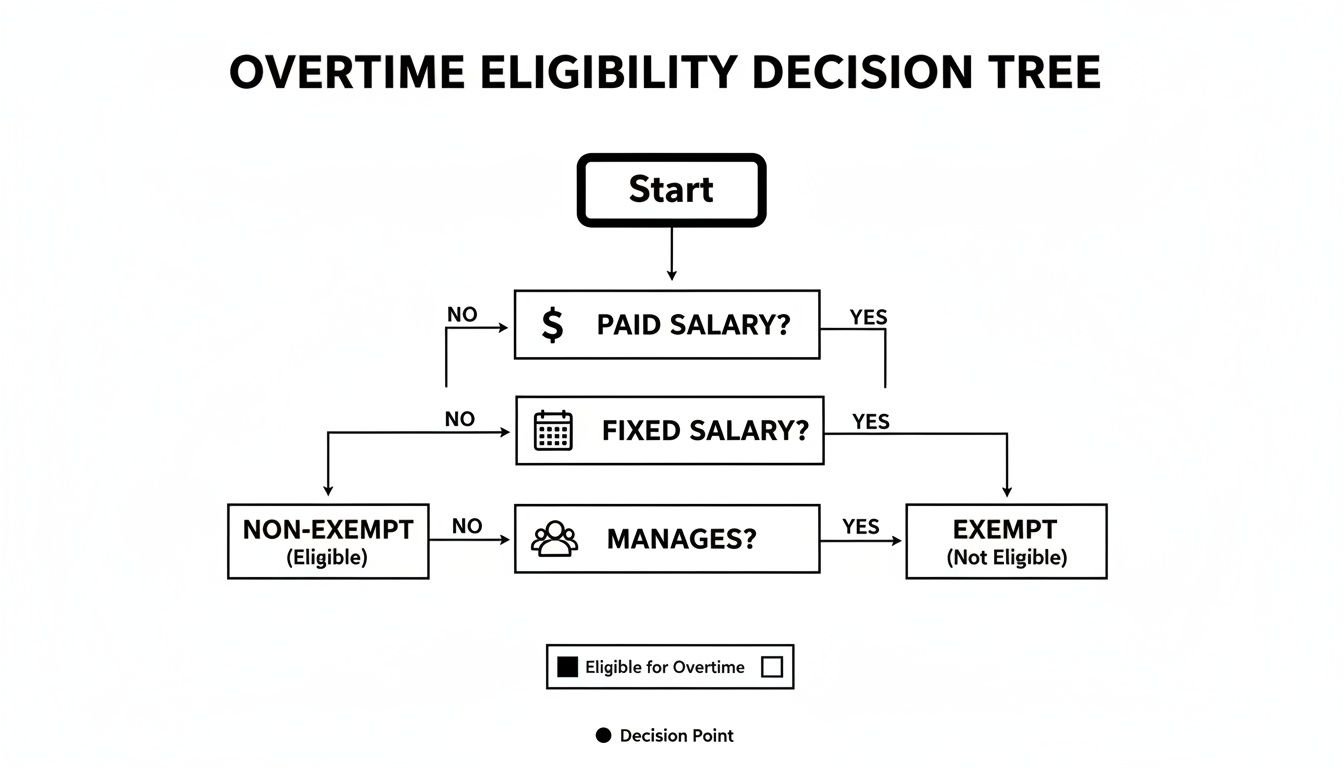
As the flowchart shows, just being on salary isn't enough to be exempt. The actual job duties and level of management authority are what really matter.
Including bonuses and commissions in overtime
Here’s another detail that often gets missed and can lead to big problems. Non-discretionary bonuses and commissions must be included when you calculate an employee's regular rate of pay. A non-discretionary bonus is any bonus that’s expected or announced ahead of time, like hitting a sales target or getting a reward for perfect attendance.
To get this right, you have to add the bonus or commission to the employee’s total earnings for that workweek before you divide by the hours worked.
Example: An hourly employee with a bonus
- Employee: Maria, a non-exempt retail associate.
- Pay Rate: $18 per hour.
- Hours Worked: 42 hours.
- Bonus: A $100 non-discretionary bonus for excellent weekly performance.
Calculation:
- Calculate Total Straight-Time Earnings: (42 hours x $18/hour) + $100 bonus = $756 + $100 = $856
- Find the Regular Rate: $856 / 42 hours = $20.38 per hour
- Calculate Overtime Premium: Since the straight time and bonus are already covered in the total earnings, you only owe the additional "half-time" premium for the overtime hours.
- Half-Time Rate: $20.38 / 2 = $10.19 per hour
- Total Overtime Premium: 2 hours x $10.19/hour = $20.38
- Total Pay for the Week: $856 (straight-time earnings) + $20.38 (overtime premium) = $876.38
Getting these calculations right is non-negotiable for staying compliant. For businesses that still lean on spreadsheets for payroll, our guide on how to use timesheet formulas in Excel can help you build in some of these steps and reduce manual errors.
The most common overtime traps and how to sidestep them
Knowing Arizona's overtime laws is one thing, but putting them into practice flawlessly is a whole different ballgame. Even employers with the best intentions can make simple mistakes that spiral into major financial headaches. Getting familiar with these common pitfalls is the first step to building a payroll process that’s both fair and bulletproof.
Most overtime violations aren't born from bad intent. They're usually the product of simple misunderstandings about who qualifies for overtime, how to calculate the rate, or what actually counts as work time. Let's walk through the most frequent errors we see and, more importantly, how you can get ahead of them.
The "salaried means exempt" myth
This is, without a doubt, the most common and costly mistake an employer can make. Paying an employee a salary does not automatically make them exempt from overtime. It’s a persistent myth that trips up countless businesses.
For an employee to be legally exempt, they have to pass all three of the FLSA's stringent tests: the salary basis test, the salary level test, and the duties test. A fancy title like “Manager” or “Administrator” is meaningless if the person’s actual, day-to-day work doesn’t involve true management duties or exercising independent judgment on important company matters.
How to Fix It: Conduct regular audits of your exempt positions. Don’t just glance at the job description; dig into what your employees actually do all day. If their responsibilities don't squarely fit the executive, administrative, or professional exemptions, it's time to reclassify them as non-exempt and start tracking their hours.
Botching the regular rate of pay
Here’s another classic error: calculating overtime based only on an employee's base hourly wage. The "regular rate of pay" is a broader legal term that must include all forms of compensation. Think non-discretionary bonuses, commissions, and shift differentials.
That $100 performance bonus you gave isn't just a gift; it's part of that employee's earnings for the week. It has to be factored into their overtime rate for that pay period. Forgetting to do so will result in underpayment.
Here's how that mistake plays out:
- An employee works 45 hours at $20/hour and also earns a $100 bonus for the week.
- The Incorrect Math: The employer pays overtime based only on the $20 rate, completely ignoring the bonus.
- The Problem: The employee's actual regular rate for that week was higher than $20/hour once the bonus was added in, which means their overtime pay is too low.
Not tracking all hours worked
"Off-the-clock" work is a massive, ticking liability. This covers any time a non-exempt employee is allowed to work, whether that’s answering emails after hours, prepping their station before clocking in, or skipping lunch to catch up. The risk is even higher with remote teams, where the lines between work and personal time get blurry.
If you know work is being done—or even if you have reason to believe it’s being done—that time has to be paid. A policy against unauthorized overtime won’t protect you if you turn a blind eye when employees work extra hours to hit a deadline.
How to Fix It:
- Create a Rock-Solid Policy: Your handbook should state clearly that all time worked must be recorded and all overtime must be approved in advance. No exceptions.
- Train Your Managers: Make sure your supervisors know they are your first line of defense. They must prevent off-the-clock work and can't pressure non-exempt staff to work through breaks or after their shift officially ends.
- Use Dependable Tracking Tools: Put a reliable time-tracking system in place. Tools that integrate with calendars, like TimeTackle, make it incredibly simple for all employees—especially remote ones—to log every minute accurately.
Giving illegal "comp time"
In the private sector, you simply cannot give employees "comp time"—or paid time off in a future week—instead of paying them for overtime hours worked this week. For payroll purposes, every workweek stands on its own.
If a non-exempt employee works 45 hours one week, you owe them for five hours of overtime pay on that paycheck. You can't "balance it out" by letting them work only 35 hours the following week. While this is legal for some public sector jobs, it's a direct violation of the FLSA for private businesses in Arizona.
Navigating these rules can feel like walking through a minefield, but avoiding these common traps is a huge step toward compliance. The table below breaks down these pitfalls and gives you a clear path forward for each one.
Common overtime compliance traps and solutions
| Common Mistake | Why It's a Problem | How to Fix It |
|---|---|---|
| Assuming Salary = Exempt | Exemption depends on strict salary and duties tests, not how someone is paid. Misclassifying an employee can lead to years of back-pay liability. | Audit all exempt roles against FLSA duties tests annually. When in doubt, classify the employee as non-exempt. |
| Ignoring Bonuses in Rate Calculation | The "regular rate" must include all non-discretionary bonuses, commissions, and other incentive pay, not just the base hourly wage. | Recalculate the regular rate of pay each week that extra compensation is paid. Use payroll software that can handle this automatically. |
| Allowing "Off-the-Clock" Work | All time an employer "suffers or permits" an employee to work must be paid, even if it wasn't pre-authorized. | Enforce a strict time-tracking policy, train managers to prevent unrecorded work, and use a reliable time-tracking system. |
| Using "Comp Time" for Private Sector | Private employers cannot substitute future time off for legally required overtime pay. Each workweek stands alone. | Always pay time-and-a-half for all overtime hours in the pay period they are earned. No exceptions. |
Ultimately, a proactive approach is your best defense. By regularly auditing your practices and training your team, you can steer clear of these costly mistakes and focus on running your business.
How automated time tracking ensures compliance

Knowing the rules around overtime in Arizona is one thing. Having the bulletproof records to back you up is another challenge entirely. For years, businesses have scraped by with manual timesheets and clunky spreadsheets, but let's be honest—those methods are slow, clunky, and just begging for human error.
One forgotten entry or a single miscalculation can snowball into payroll mistakes and, down the line, serious compliance headaches. This administrative nightmare gets even worse for project-based teams, where tracking hours against different clients and tasks feels like a full-time job in itself.
Moving beyond manual entry
The hard truth is that manual time tracking is a fragile system. It hangs on the hope that employees remember every single task perfectly and that managers have the time to double-check every entry. This process isn't just inefficient; it creates inaccurate records, which is a major red flag for the Department of Labor.
Automated time tracking offers a modern fix by taking the guesswork out of the equation. Instead of depending on memory, these systems capture work hours directly from the digital tools your team already lives in every day.
By integrating with calendars like Google or Outlook, automated time tracking creates a single, accurate source of truth for all work activities. Every meeting, every focused work block, and every client call is logged automatically, ensuring no billable or non-billable minute is missed.
This builds the kind of detailed, reliable records you need to prove compliance with overtime laws in Arizona. If an audit or wage claim ever comes knocking, you’ll have a clear, timestamped history of every hour worked, ready to go.
Gaining real-time visibility
One of the biggest wins with automation is seeing potential overtime issues before they become expensive problems. Manual timesheets are always backward-looking; you often don’t realize an employee has hit overtime until the workweek is already over and the damage is done.
Automated systems, on the other hand, provide real-time dashboards that give managers a live, up-to-the-minute view of hours worked across their entire team.
You can set up rules that automatically flag anyone approaching the 40-hour weekly threshold. This proactive heads-up allows managers to step in, rebalance workloads, and make smarter staffing decisions on the fly—preventing surprise overtime costs and keeping you compliant. Our guide to automated timesheets digs deeper into how this technology can completely change your operations.
With a calendar-based system, you get a clear visual breakdown of how everyone's time is spent. Instead of a frantic scramble through messy spreadsheets, generating reports for payroll or responding to an audit becomes a simple, one-click process.
Simplifying payroll and reporting
When it's time to run payroll, the benefits of automation become incredibly clear. Forget about manually tallying hours and cross-referencing spreadsheets. Now, you can generate perfectly accurate reports in just a few minutes.
- Error-Free Calculations: The system automatically does the math, separating regular hours from overtime based on the rules you’ve set.
- Seamless Integration: You can export the data directly into your payroll software, which kills the risk of manual data entry errors.
- Audit-Ready Records: All your time logs are stored securely and are easy to pull up, giving you the exact documentation required by the FLSA.
By automating this part of your business, you’re not just protecting the company from legal trouble. You’re also freeing up countless administrative hours, letting your team focus on productive work instead of getting buried in paperwork.
Frequently asked questions about Arizona overtime
Getting the basics of overtime down is one thing, but the real world always throws a few curveballs. These gray areas are where most businesses get into trouble. Here are some quick, clear answers to the most common questions we see from Arizona employers and employees.
Does travel time count as hours worked?
This is a classic "it depends" scenario. Your team's daily commute from home to their main workplace? That’s on their own time and not counted toward the 40-hour workweek.
However, once travel becomes part of the job itself, it’s absolutely compensable. This includes situations like:
- A service technician driving between client sites throughout the day.
- Any travel an employee is required to do during their normal work hours, even if it's on a Saturday.
- Travel to another city for a special, one-day assignment.
Overnight travel gets even trickier. While time spent as a passenger outside of normal work hours might not count, any work they actually do while traveling (like answering emails on a plane) must be paid.
Are employees paid for on-call time?
This all comes down to one question: how much freedom does the employee really have? If someone has to stay on-site or is so restricted they can’t use the time for personal activities, that’s considered "hours worked." Think of a security guard who must remain at their post, even if things are quiet.
On the other hand, if an employee can be at home and just needs to carry a pager or phone, that waiting time is typically not compensable. The clock only starts ticking if they are actually called in to work.
Do we have to pay for training sessions?
Almost always, yes. Time spent in meetings, lectures, and training programs is considered work time and must be paid. The only exception is if the training meets all four of these specific criteria:
- It happens outside of the employee’s normal working hours.
- Attendance is 100% voluntary.
- The training is not directly related to their current job.
- The employee doesn't do any productive work during the session.
If even one of these conditions isn't met, you have to pay for the time.
What if an employee works through lunch?
This is a massive compliance trap, and it’s easier to fall into than you think. If a non-exempt employee does any work during an unpaid meal break—even something as quick as answering a few emails or taking a work call—that break becomes paid time.
For a meal break to be legally unpaid, the employee must be completely relieved from duty. The break usually needs to be at least 30 minutes long. If their "break" is constantly interrupted by work, it's not a real break, and that time must be counted toward their weekly hours.
Navigating the fine print of overtime requires absolute precision, something manual tracking just can’t guarantee. TimeTackle offers an AI-powered platform that automatically captures work hours from your team's calendar, giving you the accurate, audit-proof records you need for Arizona compliance. Get a crystal-clear view of every hour worked, eliminate costly mistakes, and make payroll a non-issue.