



Let's be honest—traditional timesheets are a broken system for modern agencies.They’re notorious for creating inaccurate data and burning through valuable hours that could be spent on client work. In contrast, real time tracking is about capturing work as it actually happens, giving you a live, accurate view of project status, team utilization, and profitability without the soul-crushing manual entry.
Why Traditional Timesheets Just Don't Cut It Anymore
For decades, the timesheet was the unchallenged king of productivity measurement. The problem is, it’s built on a fundamentally flawed premise: that human memory is a reliable tool for business intelligence.
Think of manual timesheets as trying to reconstruct a detailed movie scene a week after you’ve watched it. You might remember the main characters and the basic plot, but all the crucial, minute-by-minute details that made the scene work? Those are long gone. That's exactly what happens when your team tries to recall their work at the end of the day or, even worse, the end of the week.
This reliance on memory is a recipe for inaccuracy. A forgotten five-minute client call here, an overlooked half-hour of research there—these little gaps add up fast. Across a whole team and over an entire year, this easily translates into thousands of unbilled hours and a completely skewed understanding of which projects are actually profitable. The system isn't just inefficient; it's actively costing you money.
The Pain of Manual Entry
Beyond the fuzzy data, the sheer administrative burden of manual timesheets is a massive drain on productivity and morale. It forces your most valuable assets—your creative thinkers, strategists, and technical experts—to act like data entry clerks.
This repetitive, low-value task constantly interrupts deep work, tanks job satisfaction, and pulls focus away from the billable activities that actually move the needle. Instead of solving complex client problems, your team is stuck trying to piece together a puzzle of their past work week. The process is universally disliked and almost always rushed, which only makes the data quality worse. This administrative drag is a hidden tax on your agency's efficiency.
The core problem with periodic tracking is that it’s completely reactive. It forces teams to look backward, trying to document the past instead of focusing on the present and planning for the future with accurate, live data.
It's Time to Move On
The difference between this old-school manual process and a real time tracking system is night and day. Imagine your agency’s workflow as a smart home that anticipates your needs, versus one where you have to manually flip every single switch. That’s the leap you make from reactive timesheets to automated, in-the-moment tracking.
The right approach gives you a frictionless, accurate stream of data on every project and client task. It gets rid of all the guesswork and frustration tied to outdated reporting, setting the stage for a calendar-first system that captures work as it happens. For a deeper look at this, you can explore the limitations of spreadsheets and traditional timesheet apps in our detailed guide. This isn’t just about swapping out a tool; it’s about building a more resilient, profitable, and efficient agency from the ground up.
The Hidden Costs of Periodic Time Tracking
On the surface, filling out a weekly timesheet feels like a minor administrative chore. But beneath that simple task lies a quiet drain on your agency's profitability and your team's morale. This old-school method is built on a shaky foundation—human memory—and it creates a ripple effect of expensive problems that often go unnoticed until it's too late.
Relying on timesheets is like trying to drive a car by only looking in the rearview mirror. Sure, it tells you where you’ve been, but it gives you zero real insight into what’s happening right now or where you're headed. This backward-looking approach makes it impossible to be agile, shift project resources effectively, or catch scope creep before it blows up your budget.
The Inaccuracy Tax of Human Memory
The first and most glaring failure of periodic tracking is just how wildly inaccurate it is. Let's be honest, human memory is terrible at recalling the small, fragmented tasks that fill a typical workday. A study even found that timesheets filled out daily are only 67% accurate. When you ask someone to recall a full week's worth of work, that accuracy plummets.
This isn’t about your team being lazy or careless; it's a simple cognitive limitation. People are forced to guess, round up hours, or completely forget countless small but billable activities.
- A quick 15-minute call with a client.
- An unexpected 30-minute scramble to fix a critical bug.
- A 10-minute email chain to get clarity on project scope.
Each of these seems insignificant on its own. But when you multiply them across your entire team and all your projects, this "inaccuracy tax" adds up to a massive leakage of billable revenue. Even worse, you're left making critical business decisions with data that's little more than a rough guess.
The Crushing Burden of Administration
Beyond the bad data, manual timesheets place a heavy administrative weight on your team's shoulders, eating up their most valuable asset: time. Instead of focusing on creative, high-value client work, your experts are stuck spending hours every month trying to piece together their workweek. This repetitive, non-billable task is a direct hit to productivity and a well-known recipe for burnout.
The shift away from this burdensome process toward a smarter, automated future is clear.
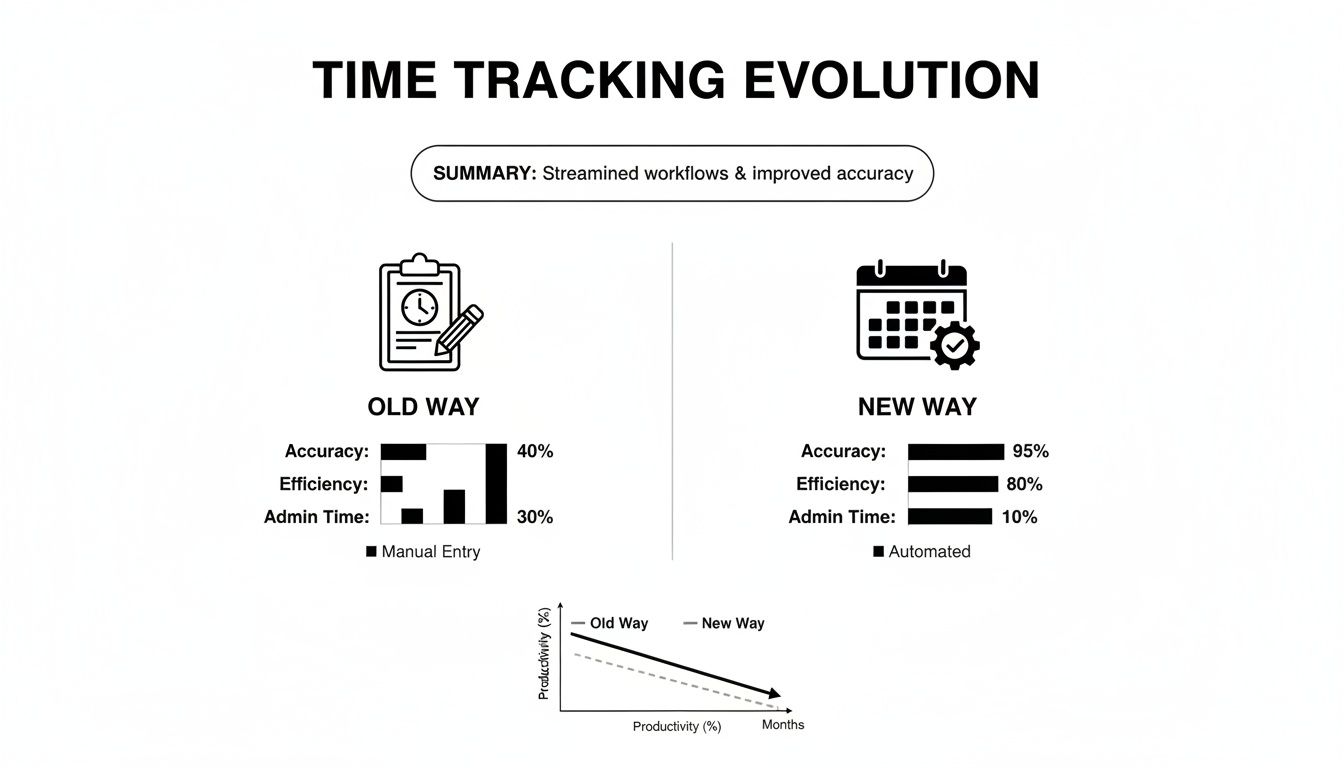
This evolution from clunky, memory-based systems to intelligent, calendar-driven ones captures work as it happens, completely eliminating that administrative drain.
A Complete Lack of Actionable Insight
Maybe the biggest hidden cost is the opportunity cost. Periodic timesheets give you historical data that's often weeks old by the time it's all collected and analyzed. This lag time makes the information strategically useless for agile resource management. You can't fix a problem that's brewing today if you only find out about it next month.
With periodic tracking, by the time you realize a project is over budget or a team member is overloaded, the damage is already done. You’re left reacting to problems instead of preventing them.
Real time tracking completely flips this dynamic. It gives you a live, continuous stream of data, offering immediate visibility into what’s actually happening on the ground. This allows leaders to finally get proactive.
To put it into perspective, here's a direct comparison of the two approaches.
Real Time Tracking vs Manual Timesheets
| Attribute | Real Time Tracking (Automated) | Manual Timesheets (Periodic) |
|---|---|---|
| Data Accuracy | High (captures work as it happens) | Low (estimates based on memory, often only 67% accurate) |
| Team Burden | Minimal (passive, runs in the background) | High (hours per month spent on manual entry) |
| Insight Lag | Zero (data is available instantly) | High (days or weeks old by the time it's analyzed) |
| Scope Creep | Detected immediately | Discovered after the fact, when it's too late |
| Resource Planning | Proactive and agile | Reactive and based on outdated information |
| Profitability View | Precise and up-to-the-minute | Distorted and based on guesswork |
The table makes it pretty clear: sticking with manual timesheets is a recipe for financial leakage, lost productivity, and strategic blindness. For any agency serious about growth and profitability, moving to a real-time system isn't just an upgrade—it's a necessity.
Why Real-Time Agency Data is a Game-Changer
Once you move past the mess of outdated tracking methods, you can start to see the real, tangible returns of real-time tracking. This isn't just about collecting slightly better data. It’s about fundamentally changing how your agency operates, leading to smarter decisions and sustainable growth. This strategic shift is built on three pillars that directly tackle the biggest headaches agency leaders face.

Making this leap from guesswork to data-driven confidence is quickly becoming a competitive must-have. Just look at the market—the global time tracking software space jumped from USD 7.13 billion to USD 8.36 billion in a single year, and it's projected to hit nearly USD 29.88 billion by 2033. That explosive growth tells a clear story: businesses are waking up to the critical need for accurate productivity insights. For a deeper dive into these numbers, you can read the full market research analysis.
Unlock True Project Profitability
The first, most immediate win from real-time data is getting a crystal-clear picture of project profitability. Let's be honest, traditional timesheets are a fog machine for your finances. They make it nearly impossible to know which clients are actually making you money and which are secretly draining your resources.
With automated, real-time data, every single billable minute is captured—from that quick five-minute client call to the unexpected revision that eats up an afternoon. This level of accuracy lets you:
- Instantly Spot Scope Creep: You’ll see the exact moment a project starts bleeding hours beyond the budget. This allows you to have a proactive conversation with the client instead of just eating the cost later.
- Price with Confidence: Your new project quotes can be based on hard data from past work, not just a gut feeling. That means your proposals are both competitive and profitable.
- Analyze Client ROI: You can finally identify your most and least profitable accounts with certainty, which helps you decide where to focus your team's energy for the best returns.
This granular visibility turns profitability from a vague, end-of-quarter guess into a live, actionable metric you can manage day in and day out.
Boost Operational Efficiency and Forecasting
Beyond just the bottom line, real-time data gives you the insights needed to run a leaner, more agile operation. When you know exactly how your team's time is being spent, you can finally shift from a reactive management style to a proactive, strategic one.
Real-time insights allow you to see around the corner. You can anticipate resource conflicts, predict project timelines with greater accuracy, and make informed staffing decisions before minor issues become major roadblocks.
This is where the real magic happens. The strategic value of real-time agency data is fully unlocked through real-time business intelligence and automated reporting, which puts immediate, actionable insights in the hands of leaders. You can put the right people on the right tasks based on their actual availability and skills, not on a week-old report. The result is smoother project execution, fewer bottlenecks, and a more balanced workload for everyone.
Elevate Team Productivity and Focus
Finally, let's talk about the impact on your most valuable asset: your people. By getting rid of the universally despised task of filling out timesheets, you're giving your team back hours of their week. This isn’t just a nice little perk; it’s a direct investment in their focus and job satisfaction.
When your team is freed from that kind of administrative busywork, they can dedicate their full brainpower to high-value, creative, and strategic work for your clients. This shift doesn’t just boost morale; it directly improves the quality of your agency's output.
Think about the ripple effect:
- More Time for Deep Work: Less time on admin means more time for the complex problem-solving that clients are actually paying for.
- Increased Job Satisfaction: People are happier and more engaged when they can focus on what they're good at, not on tedious reporting.
- Better Client Outcomes: A focused, energized team consistently delivers better work, which strengthens client relationships and drives retention.
At the end of the day, real-time tracking creates the data foundation for a smarter, more profitable, and more resilient agency. It gives leaders the power to steer the ship with confidence, backed by a constant stream of accurate, actionable intelligence.
How to Implement Real-Time Tracking in Your Agency
Switching to real-time tracking sounds like a massive operational headache, but it doesn't have to be. A successful rollout isn't about forcing your team to learn some clunky new software or completely change how they work. It’s about weaving a smarter system into the tools they already live in every single day.
The secret is to see implementation as a series of small, deliberate steps, not one giant leap. By focusing on quick wins that show immediate value, you build momentum and get everyone on board fast. A well-planned approach cuts down on the disruption and quickly proves the ROI of having accurate, live data right when you need it.
Start With Your Single Source of Truth
For almost any agency, the team's calendar is the most honest record of where time actually goes. It’s where meetings get booked, focus time gets blocked, and client work gets mapped out. A calendar-first approach uses this existing behavior as the bedrock of your entire tracking system.
Instead of rolling out a separate app that makes everyone hit a start-stop timer, you connect a system that quietly pulls data from their Google or Outlook calendars. This gives you two huge advantages right out of the gate:
- Zero Behavior Change: Your team keeps managing their day just like they always have. There are no new habits to build or software to remember to open.
- Instant Data Capture: Every single scheduled event is automatically logged as a time entry. This gives you an immediate, surprisingly accurate baseline of how time is being spent across the agency.
Just this first step alone can uncover some eye-opening insights into where your agency’s most valuable resource—time—is really going.
Integrate Your Existing Tech Stack
Once your calendar data is flowing in, the next move is to give it context by connecting it to your other critical business systems. A great real-time tracking platform doesn't live on an island; it builds bridges between your tools to give you a single, unified view of your operations.
Seamless integrations are everything here. By connecting your CRM (like HubSpot or Salesforce) and project management tools (like Jira or Asana), you can automatically link time entries to specific clients, projects, and even sales deals. This kills the need for manual data entry and makes sure your time data is directly tied to business results. For instance, a meeting on someone's calendar can instantly be linked to the right client in your CRM, showing you exactly how much effort each account is getting.
A truly effective system doesn't just track time; it connects time to value. By integrating your core business tools, you transform raw time data into a powerful lens for analyzing project profitability, client ROI, and sales cycle costs.
Establish Intelligent Automation Rules
With your data sources all linked up, you can now automate the soul-crushing work of categorizing and tagging time. This is the part where you graduate from simple data collection to smart analysis. A modern system lets you create rules that do all the heavy lifting for you.
Think about these common scenarios:
- Client Tagging: Automatically slap a "Client A" tag on any calendar event that includes someone with an @clientA.com email address.
- Project Allocation: If a meeting title contains the project code "PROJ-123," automatically assign that time to the correct project bucket.
- Billable vs. Non-Billable: Tag all internal meetings as "Non-Billable" while flagging every client-facing call as "Billable" by default.
These rules just hum along in the background, making sure your data is consistently and accurately categorized with practically zero manual work. Platforms like TimeTackle take this even further with an AI-powered time tracker that can suggest tags and categories based on event details, cutting down the admin burden even more.
Prioritize Enterprise-Grade Security
Finally, when you're centralizing all this sensitive client and project data, security can't be an afterthought. Handing over your operational data to another platform requires absolute confidence that they're taking its protection seriously.
Look for a solution that can prove its commitment to data security. Compliance with tough, third-party audited standards like SOC 2 Type II is a massive green flag. This certification isn't just a piece of paper; it validates that the provider has rock-solid policies and procedures for managing and securing customer data. It’s the peace of mind you need to know that your agency's—and your clients'—information is locked down tight.
Your Agency's Command Center: Key Metrics and Dashboards
Raw data from real-time tracking is a bit like unrefined crude oil—it's full of potential, but not very useful on its own. The real magic happens when you transform that steady stream of information into clean, actionable intelligence. For agency leaders, this means moving beyond simple time logs and building dynamic dashboards that tell the story of your business's health as it happens.
Think of these dashboards as your agency's command center. They translate millions of data points into clear signals that guide your most important decisions. They’re built to answer the questions that keep you up at night: Are we profitable? Are our people deployed effectively? Where are we leaking revenue? Without these insights, you're flying blind, making critical calls based on gut feelings instead of hard evidence.
Essential Metrics That Drive Profitability
To build a dashboard that actually moves the needle, you have to focus on metrics that directly connect your team's day-to-day activities to financial outcomes. While you could track dozens of different data points, a few core metrics provide the most strategic bang for your buck.
Here are the four essential metrics every agency leader should have front and center:
- Team Utilization by Client: This metric gives you a crystal-clear picture of how your team's time is spread across your client portfolio. It immediately flags which clients are eating up the most resources, helping you ensure your most valuable accounts get the right level of attention—and that you're not over-servicing the wrong ones.
- Project Profitability Margins: By comparing the total hours logged against a project's budget or retainer, you get a live view of its financial health. This metric is your early warning system for scope creep, letting you course-correct before a project goes deep into the red.
- Billable vs. Non-Billable Ratio: A classic for a reason. This ratio shows how much of your team's time is spent on revenue-generating work versus internal tasks like admin or business development. A healthy ratio is one of the strongest indicators of pure operational efficiency.
- Opportunity Cost Analysis: This is a more advanced metric that helps you see the hidden costs of your choices. For example, by tracking the time poured into non-billable pitches or internal R&D, you can calculate the potential revenue you gave up, forcing you to ask if those strategic initiatives have a clear and justifiable ROI.
These four metrics form the bedrock of a data-driven agency, giving you a constant pulse on performance.
Designing Dashboards for Action, Not Just Observation
A great dashboard doesn't just present data; it inspires action. The key is making your dashboards interactive, allowing you to slice and dice the information to uncover the real story behind the numbers. Imagine being able to filter your entire utilization report by a specific team, client, or even a single project with just one click.
The goal of a dashboard is to move from "what happened" to "what should we do next." Dynamic filtering lets you drill down from a high-level agency view to a granular project detail in seconds, uncovering the root cause of an issue instead of just observing the symptom.
This is what turns your data from a static report into a powerful diagnostic tool. If you see a project's profitability tanking, you can instantly filter down to see which specific tasks are ballooning or which team members might be getting stuck. That’s the difference between knowing there's a problem and knowing exactly how to fix it.
This shift toward genuine business intelligence is why the demand for smart tracking solutions is exploding. The time tracking software market is seeing compound annual growth rates between 13.38% and 18.3%, largely because businesses need better ways to monitor distributed teams and cut operational waste. You can discover more insights about time tracking statistics on Breeze.pm to get a feel for the trends. This growth signals a clear shift: leading agencies are no longer just logging hours; they're analyzing them to find their next competitive edge.
Why Calendar-First AI Is the Future of Tracking
Let’s be honest, the operational headaches from manual timesheets—the inaccuracies, the administrative drain, the frustratingly delayed insights—all boil down to one broken idea: treating time tracking as a separate, after-the-fact chore. The future of running a sharp, profitable agency means flipping that model on its head. Instead of chasing your team to report on their work, the best real time tracking systems capture it passively from the one place work is already planned and lived: the calendar.

A calendar-first approach recognizes your team's schedule as the ultimate source of truth for knowledge work. It’s where meetings happen, focus time is blocked out, and client commitments are logged. By tapping into this existing data stream, you get rid of the need for new behaviors or manual data entry. It becomes a zero-effort system.
The Power of Automated Intelligence
This is where AI changes everything. An intelligent platform doesn’t just scrape calendar events; it enriches them with crucial business context, all on its own.
- Intelligent Tagging: AI can analyze an event’s title, who's attending, and its description to suggest the right project and client tags, almost completely wiping out manual categorization.
- Seamless Integration: It connects your calendar data with your CRM and project management tools, giving you a single, unified view of your operations without anyone having to sync data by hand.
- Effortless Reporting: With accurate, categorized data flowing in constantly, those critical reports on profitability and utilization are generated automatically, ready whenever you need them.
This automated layer solves every problem we’ve talked about. It replaces fuzzy memories with hard data, frees your team from the grind of filling out timesheets, and delivers the immediate visibility you need to make smart, agile decisions. This 'Calendar-First AI' thinking also makes meetings more productive. For instance, an AI can automatically capture and summarize discussions, a concept explored in a guide on Using an AI Note Taker for Zoom Meetings.
Adopting a calendar-first, AI-driven system isn't just about getting a new tool; it's a competitive necessity for any agency serious about becoming data-driven. It provides the frictionless, accurate data foundation you need for sustainable growth and profitability.
The global demand for smarter tracking solutions reflects this shift. Analysis shows North America leading the market, but Europe is the fastest-growing region, thanks to widespread adoption by SMEs and the move to cloud technologies. For agencies with a global footprint, keeping an eye on these trends is crucial for benchmarking your own performance. If you want to dig deeper into this approach, check out our guide on how to revolutionize time management with AI time tracking.
Frequently Asked Questions About Real Time Tracking
Switching to any new system is going to bring up some good questions. It's only natural. Agency leaders want to know what the real-world impact will be on their teams, how much technical heavy lifting is involved, and of course, how their sensitive data will be protected.
Let's tackle these concerns head-on with some straightforward answers to the questions we hear most often.
Will My Team Feel Like They're Being Micromanaged?
This is probably the number one concern, and it's a completely valid one. But modern, real-time tracking isn't about watching over anyone's shoulder. It’s about getting the big-picture insights you're currently flying blind without.
The focus is on understanding work patterns at a high level—how much time are we really spending on Client A versus Client B? How much of our week is eaten up by non-billable work? For your team, the biggest win is that they get to ditch manual timesheets forever, saving them hours of painful admin work every single month. When you frame it as a tool to fix broken processes and make sure workloads are fair, people don't just accept it; they embrace it.
How Hard Is It to Integrate with Our Existing Tools?
Forget the nightmare rollouts of the past. Today’s platforms are built to be as low-friction as possible. A calendar-first system, for example, connects directly to Google and Outlook calendars with just a few clicks. That's it. The data starts flowing immediately with almost zero effort.
From there, integrations with your CRM and project management tools are usually native or easily handled. The whole point is to pull data from the systems your team already lives in every day, not to shove another clunky tool into their workflow. Any good provider will hold your hand through the process to make sure it's quick and painless.
The goal of a modern real-time tracking system is to fit into your current workflow, not blow it up. By piggybacking on the tools your team already uses, it makes the whole data capture process invisible and effortless.
Is Our Client and Project Data Secure?
Security is table stakes—it's completely non-negotiable. When you're looking at different solutions, your first question should be about enterprise-grade security standards and compliance certifications. And don't just take their word for it; look for ones that are independently verified.
For instance, a platform that is SOC 2 Type II certified has gone through an exhaustive, third-party audit to prove its systems and controls for protecting customer data are rock-solid. This is your assurance that all your sensitive client, project, and team information is locked down with the highest level of security protocols, including end-to-end encryption and strict access controls.
Ready to trade timesheet chaos for automated clarity? TimeTackle provides a calendar-first AI platform that gives you real-time visibility into project profitability, team utilization, and operational efficiency—without the soul-crushing manual effort. Discover how TimeTackle can transform your agency’s operations today.