

A stopwatch is an instrument used to measure the amount of time that elapses between its activation and deactivation. Think of it not as a clock that tells you the current time, but as a ruler for time that measures duration from a starting point of zero.
What Is a Stopwatch and How Does It Actually Work
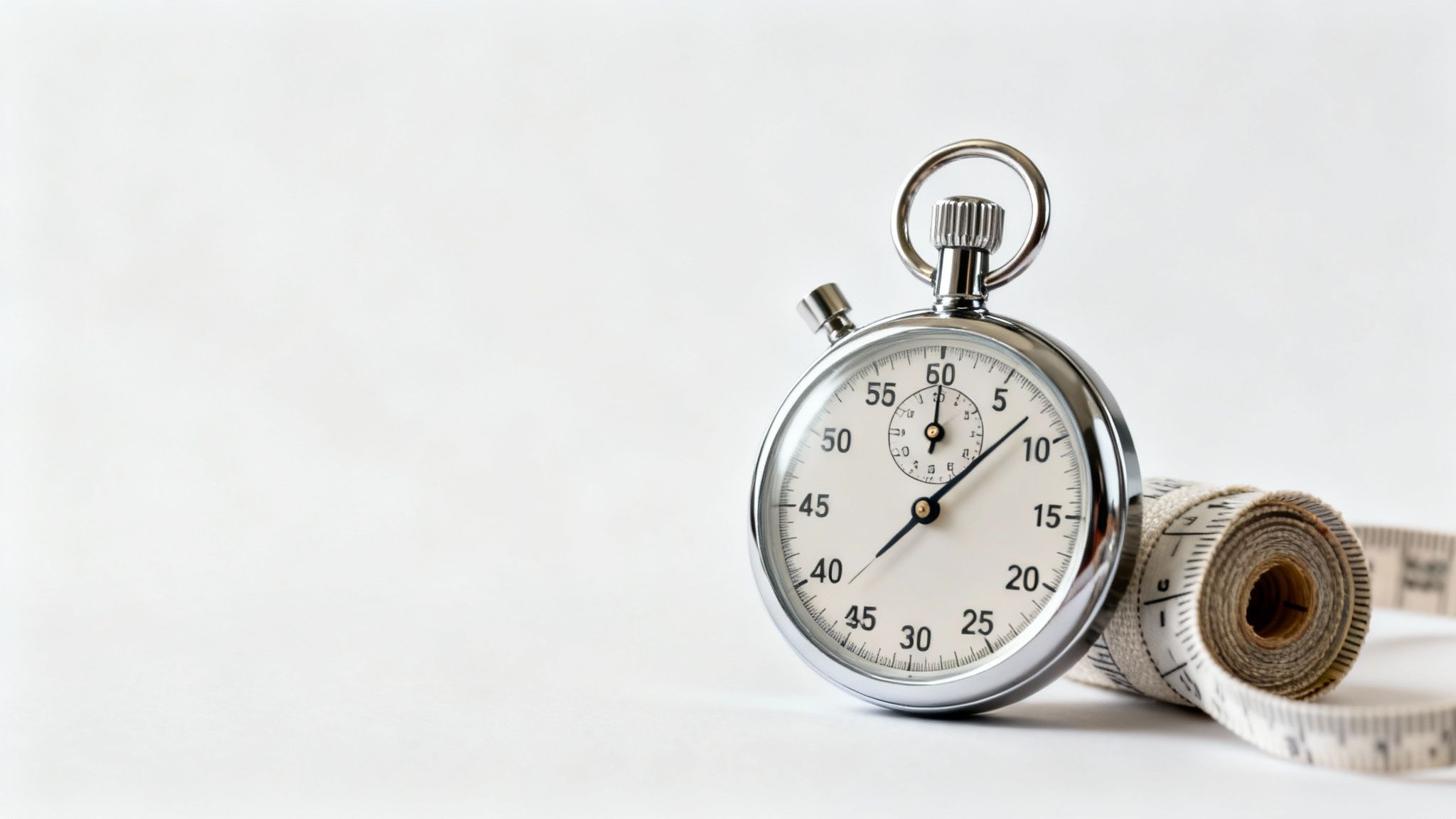
At its heart, a stopwatch does one simple job: count upwards from zero. While the clock on your wall answers the question, “What time is it?”, a stopwatch is built to answer a totally different one: “How long did that take?”
This fundamental difference is what makes it such a powerful tool.
Imagine you're timing a sprinter. The moment the race starts, you hit a button and the device begins counting—seconds, minutes, and often down to tiny fractions of a second. As soon as the runner crosses the finish line, you press it again. The final duration is frozen on the display, giving you a pure measurement of elapsed time, completely separate from the time of day.
The Basic Functions of a Stopwatch
No matter if you're holding a classic mechanical model or tapping on a phone app, every stopwatch is built around three universal commands.
- Start: This kicks off the time measurement, starting the count from zero.
- Stop: This action freezes the count, capturing the total elapsed time since you hit start.
- Reset: This command clears the displayed time and brings the counter back to zero, getting it ready for the next measurement.
This simple trio of functions is the foundation for its incredible versatility across sports, science, and the workplace.
Capturing Moments with Lap and Split Times
More sophisticated stopwatches have features that let you dig deeper into the timing without interrupting the main clock. The two most common are lap and split times—they sound similar, but they serve very different purposes.
Lap time measures the duration of one specific segment within a bigger event. Think of a swimming coach tracking how long it takes to complete each individual lap in the pool. Every time the swimmer touches the wall, the coach hits the button to record that single lap’s time while the main timer keeps ticking away.
A split time, on the other hand, shows the cumulative time up to a specific point. Sticking with our swimmer, the first split would be the time for lap one. The second split would be the total time for laps one and two combined, and so on.
The inner workings are fascinating. To really get a feel for the mechanics, it’s worth checking out a detailed guide to how a watch works, as they share many of the same core principles.
From Race Tracks to Pocket Screens: The Stopwatch Evolution
The simple stopwatch app on your phone is the final link in a long chain of inventions, each designed to capture fleeting moments with more and more accuracy. This journey didn't start in some sterile lab, though. It began on the dusty grounds of a horse racing track, born from a very practical need: to know, without a doubt, who won. The history of the stopwatch is really the story of our growing obsession with measuring performance, taking it from a niche sports gadget to an essential tool for science, industry, and our daily lives.
The story usually kicks off in 1821. French watchmaker Nicolas Mathieu Rieussec built a special device for King Louis XVIII, whose main goal was to time his horse races more accurately. This "seconds chronograph" literally "wrote the time"—an inked needle would mark a rotating dial as each horse crossed the finish line. This event at the Champ de Mars in Paris is often cited as the stopwatch's public debut in sports, though an even earlier device from 1816 by Louis Moinet was later discovered. To get a closer look at these foundational moments, the Seiko Museum offers a great history of the stopwatch.
The Race for Precision
As sports got more serious, the tools used to time them had to keep up. Early mechanical stopwatches were incredible for their time, but they could only measure down to about 1/5th of a second. That just wasn’t good enough for high-stakes races where champions were separated by the blink of an eye. The early 20th century, however, brought a huge leap forward.
In 1916, Heuer unveiled the "Micrograph," the first handheld stopwatch that could measure an incredible 1/100th of a second. This was a total game-changer. It wasn't long before it became the official timer for the Olympic Games in the 1920s, allowing officials to finally capture those tiny fractions of a second that separate a gold medalist from everyone else.
This drive for accuracy in sports created a ripple effect. Industries and science labs quickly adopted these high-precision stopwatches to fine-tune production lines, run experiments, and find efficiencies they couldn't even see before.
The evolution of the stopwatch is a fascinating look at how our demand for precision has grown. Here’s a quick rundown of the key milestones that got us from clunky mechanical devices to the apps we use today.
Key Milestones in Stopwatch Technology
| Era | Key Innovation | Impact on Accuracy and Use |
|---|---|---|
| Early 1800s | Mechanical Chronographs | Established the concept of starting and stopping a timer independently, accurate to within a fraction of a second. |
| Early 1900s | High-Frequency Movements | Devices like the Heuer Micrograph enabled measurement down to 1/100th of a second, revolutionizing sports timing. |
| 1970s | Quartz Crystal & Digital Displays | Replaced mechanical parts with electronics, offering accuracy to 1/1000th of a second and new features like lap memory. |
| 2000s-Present | Software & Mobile Integration | The stopwatch became a standard feature on all digital devices, making precision timing universally accessible. |
These shifts didn't just make stopwatches better; they made them a part of everyday life, accessible to anyone with a phone in their pocket.
The Digital Age and Beyond
The next big shake-up came with digital technology. In the 1970s, quartz crystals and electronic displays took over from gears and springs, and the change was immediate. Digital stopwatches offered some clear wins:
- Unbelievable Accuracy: Measuring down to 1/1000th of a second became easy.
- Smarter Features: Things we take for granted now, like memory for lap times, became standard.
- Available to Everyone: They were cheaper, tougher, and more reliable than the delicate mechanical versions.
This shift basically democratized precision timing. All of a sudden, a high school track coach could use a tool with the same level of accuracy as an Olympic official. From there, the stopwatch made its final jump—into our software. Today, it’s an app on every smartphone, smartwatch, and computer, having completed its journey from a specialized piece of hardware to a tool we all use to measure everything from a workout to a work task.
Choosing Your Tool: Mechanical, Digital, and App Stopwatches
Not all stopwatches are built the same. The right tool for your task depends entirely on what you’re trying to measure, whether you need the nostalgic feel of a mechanical click or the powerful features packed into your smartphone.
Figuring out the key differences between mechanical, digital, and app-based stopwatches is the first step to finding your perfect timing companion. Each one brings a unique blend of precision, functionality, and user experience to the table.
The Classic Mechanical Stopwatch
The mechanical stopwatch is a beautiful piece of craftsmanship, full of springs, gears, and satisfying clicks. Think of it like a vintage record player—it’s valued more for its tactile feedback and classic feel than for cutting-edge performance. It operates entirely without batteries, relying on a wound mainspring for power.
While they’re full of charm, these devices are less precise than their modern cousins, usually measuring time to 1/5th or 1/10th of a second. They are perfect for times when atmosphere and simplicity matter more than pinpoint accuracy, like coaching a youth sports team or adding a classic touch to a science experiment.
The image below traces the stopwatch’s journey from its early days as a modified pocket watch to a specialized timer for major events.
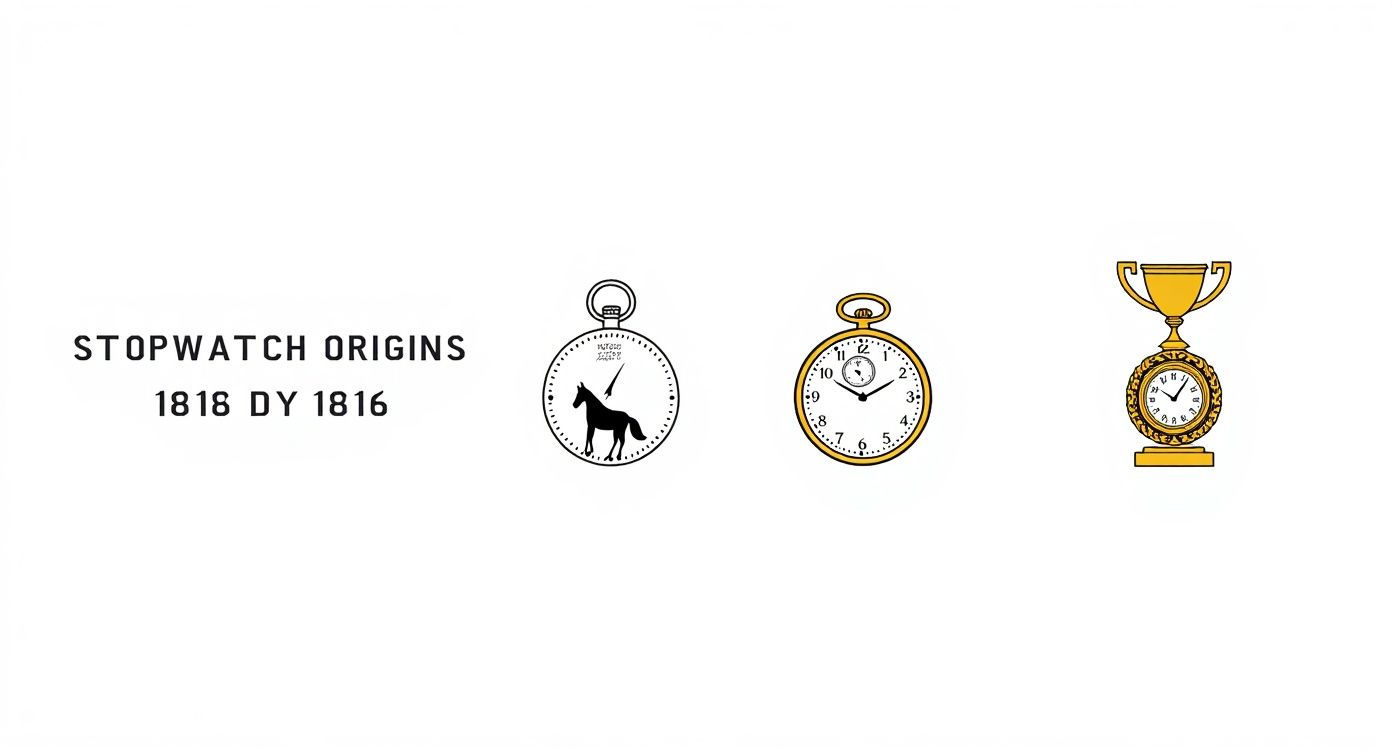
This visual timeline gives you a quick look at the stopwatch's origins, from its conceptual beginnings in the early 1800s to its widespread use in competitive sports.
The Versatile Digital Stopwatch
Digital stopwatches were a huge leap forward in timekeeping. The switch from mechanical to digital models in the 1970s was a true game-changer, pushing timing precision from fractions of a second to an incredible 1/1000th of a second.
Suddenly, highly accurate timing became accessible and affordable for everyone, from Olympic officials to high school gym teachers. These devices are the workhorses of the timing world, offering a ton of features that mechanical versions just can’t touch.
- Lap and Split Memory: Store multiple timings to analyze performance later.
- Backlit Displays: Read the time easily, even in low-light conditions.
- Durability: Many are built to be water-resistant and shockproof.
For serious athletes, professional coaches, and scientific researchers, the digital stopwatch is the undisputed standard thanks to its reliability and advanced functions.
The Convenient Stopwatch App
These days, the most accessible stopwatch is probably the one already in your pocket. Smartphone apps offer incredible convenience and a surprising number of features, often for free. They turn your phone into a powerful timing tool that can do everything a dedicated digital stopwatch can, and sometimes even more.
Stopwatch apps are great because they integrate so well with the rest of your digital life. You can easily log times, export data to a spreadsheet, and even set up complex interval timers for your workouts. Their biggest advantage is that they’re always with you.
For everyday tasks, fitness routines, and casual time tracking, an app is usually more than enough. If you’re looking to manage your professional time more effectively, you might also be interested in our guide to the top Android time tracking apps for seamless productivity.
Comparison of Stopwatch Types
To help you choose the right stopwatch for your needs, here's a side-by-side comparison based on precision, features, and ideal use cases.
| Feature | Mechanical Stopwatch | Digital Stopwatch | Stopwatch App |
|---|---|---|---|
| Precision | Low (1/10th of a second) | High (1/1000th of a second) | High (Varies by phone) |
| Power Source | Manual Winding | Battery | Phone Battery |
| Key Features | Tactile feedback, classic design | Lap/split memory, backlight, durability | Data export, custom timers, integration |
| Best For | Simple tasks, coaching, retro appeal | Sports, scientific research, professional use | Everyday tasks, fitness, casual tracking |
Ultimately, whether you need the old-school charm of a mechanical device or the data-rich features of an app, there’s a stopwatch perfectly suited for the job.
Stopwatch vs. Timer: Understanding the Critical Difference
On the surface, "stopwatch" and "timer" seem interchangeable. We use them casually to mean the same thing, but when it comes to actually measuring time, they are polar opposites. Getting them mixed up can mess up everything from a recipe to a race.
The easiest way to tell them apart is to think about the question each one answers.
A stopwatch answers the question, “How long did that take?” It counts up from zero, measuring the time that passes from a starting point. Think of it as a ruler for time—you start at the beginning and measure how long something lasts.
A timer, on the other hand, answers the question, “How much time do I have left?” You tell it a specific amount of time—like 10 minutes—and it counts down to zero. It’s more like an hourglass, showing you exactly how much sand is left before your time is up.
When to Use Each One
Let's ground this in some real-world examples to make it stick.
- Timing a 100-meter sprint: You need to know the total time from the starting gun to the finish line. A stopwatch is perfect here because it counts up, capturing the full duration of the event.
- Baking a cake: The recipe calls for 30 minutes in the oven. You need an alert when that specific time has passed, so you’d set a timer to count down from 30.
- Giving a presentation: You have a strict 15-minute slot. To make sure you don't run over, you'd set a timer to count down, giving you a clear signal when to wrap up.
Getting this simple difference right is the first step to using time more intentionally. A stopwatch measures an unknown amount of time that has passed; a timer tracks a known amount of time that is passing.
The function you choose directly impacts your goal. A stopwatch provides data after an event, telling a story of what happened. A timer, however, controls the future, defining a boundary for an activity yet to occur.
Connecting This to Productivity
This isn't just semantics; it's a vital distinction in modern productivity. You might use a stopwatch to figure out how long it actually takes you to write a report, collecting data to make better estimates in the future.
But for a method like timeboxing, a timer is your best friend. In fact, countdowns are the engine that makes the whole technique work. You can take a closer look at how timeboxing amplifies productivity to see this in action. By setting a timer for a 25-minute work sprint, you create a hard boundary that forces focus and stops a task from endlessly expanding.
Choosing the right tool gives you the right kind of feedback or structure. One measures what was; the other dictates what will be.
How to Use a Stopwatch in Sports, Work, and Life
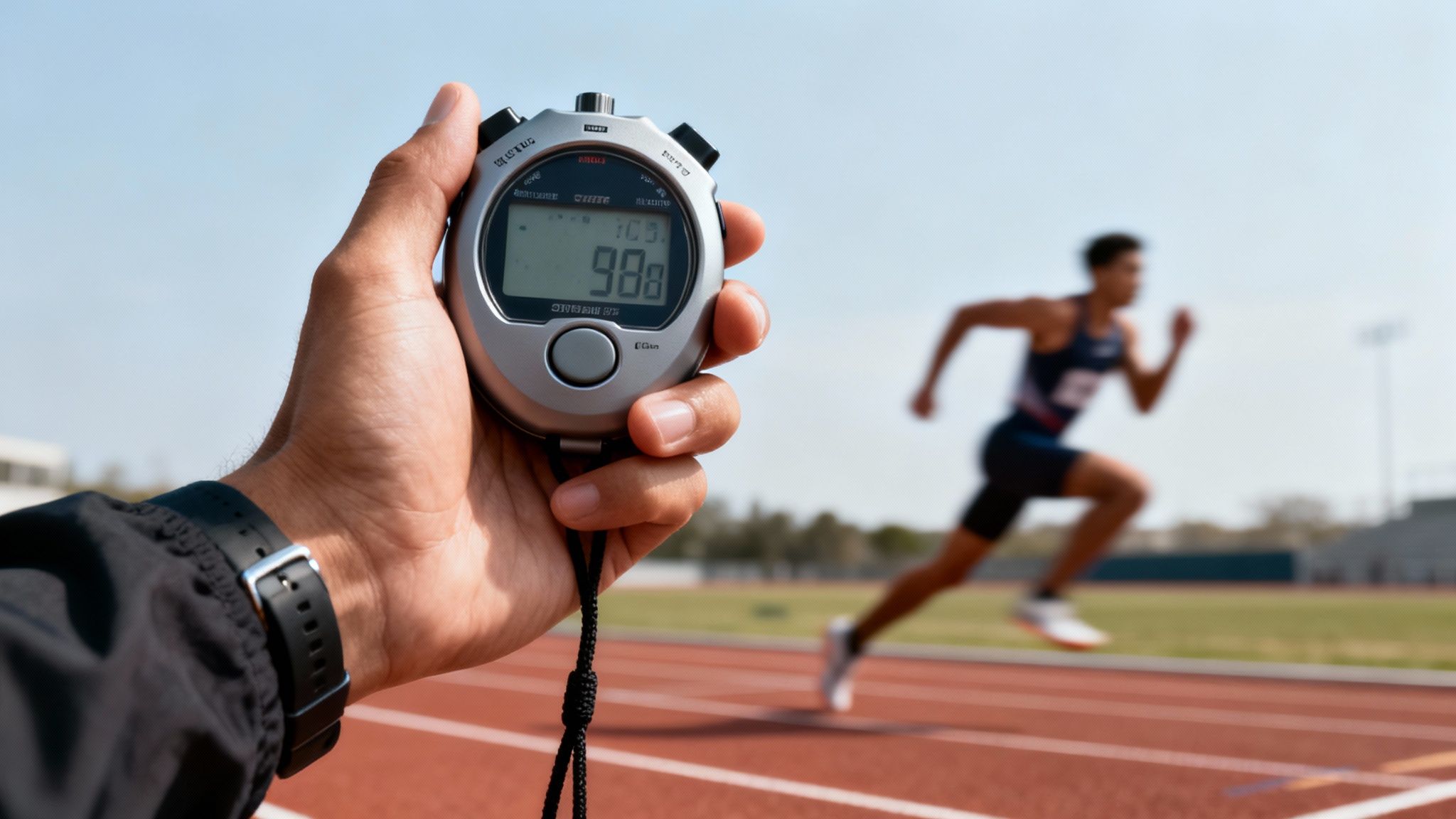
The stopwatch is far more than just a tool for timing Olympic athletes; it's a surprisingly versatile instrument that brings precision to all sorts of goals, both big and small. By simply measuring how long something takes, it gives us the raw data needed to get better at pretty much anything—from the running track to the corner office.
In the world of sports and fitness, its role is foundational. Coaches live by the stopwatch, timing sprints, drills, and recovery periods to get the objective data they need to build smarter training plans. For athletes, it's the ultimate source of truth, helping them chase that next personal best, one precious second at a time.
This relentless drive for accuracy in sports is what pushed the technology forward. Back in 1916, Heuer’s ‘Micrograph’ stopwatch was a game-changer, capable of measuring time down to 1/100th of a second. That was a massive leap from the old 1/5th of a second standard. This level of precision became non-negotiable at the Olympic Games in the 1920s, where races were won by fractions of a second and you needed a tool that could keep up.
From the Field to the Office
Beyond the stadium, the stopwatch is a powerful ally for professional and personal productivity. Freelancers and agencies rely on it to track billable hours accurately, ensuring they get paid fairly for their work while giving clients a transparent breakdown of the project. Every click of the "start" and "stop" button creates a clean, undeniable record of effort.
It's also the secret weapon behind some of the most popular focus techniques out there. Take the Pomodoro Technique, for instance. It uses a timer or stopwatch to break your workday into focused intervals—usually 25 minutes—followed by short breaks. This simple rhythm helps you stay locked in and prevents burnout by turning your day into a series of manageable sprints. If you want to give it a try, check out our simple guide to the Pomodoro Technique.
Using a stopwatch for focused work transforms time from an abstract idea into a tangible resource. It forces you to treat each block of work as a distinct event to be completed, rather than just an endless sea of time.
Everyday Practical Applications
The stopwatch's usefulness doesn't stop there. It pops up in all corners of daily life, bringing a little more accuracy to a huge range of activities.
- In the Kitchen: Want to perfect a recipe? Timing each step is key. From searing a steak for the perfect crust to steeping tea, a stopwatch ensures you get the same delicious result every single time.
- For Public Speaking: Rehearsing a presentation against a stopwatch helps you nail your timing. You can refine your pacing and delivery to make sure you fit your allotted slot and leave the biggest impact.
- During Medical Assessments: Clinicians often use stopwatches for functional tests that measure a patient's mobility and progress over time. For example, a common test like the 5 Times Sit to Stand Test relies on precise timing to evaluate lower body strength.
Whether you're trying to beat a personal record, manage a professional project, or just brew the perfect cup of coffee, the humble stopwatch provides the data and structure you need to keep improving.
When to Upgrade from a Manual Stopwatch
A manual stopwatch is a fantastic tool, perfect for timing a single, straightforward task. But when you're juggling multiple projects, clients, and deadlines, its simplicity quickly turns into a liability. Relying on it for professional work creates hidden costs in both lost time and shaky accuracy.
Think of it like trying to run your company's finances with just a pocket calculator. It works for adding up a few numbers, but it gets completely overwhelmed when things get complex. You end up with errors, wasted effort, and a whole lot of frustration. That mental energy you spend constantly starting, stopping, and logging every little thing? That's what we call timesheet fatigue.
Recognizing the Pain Points of Manual Tracking
Let's be honest, manual time tracking is a breeding ground for human error. A forgotten timer can mean hours of billable work vanishing into thin air. Inaccurate entries can erode the trust you've built with your clients. It's no surprise that studies show manually reported timesheets are often wildly inaccurate, usually because people are just guessing at the end of a long day.
This old-school approach brings a few common headaches:
- Inaccurate Billing: Forgetting to hit start or stop leads to either under-billing your clients (leaving money on the table) or overcharging them (risking your reputation). Neither is a good look.
- Lost Productivity Data: Manual logs almost never capture the full story of your workday. That makes it nearly impossible to see where your time is really going across different projects.
- Mental Overhead: The constant need to babysit a timer is a distraction. It pulls your focus away from the deep work you’re actually being paid to do.
When the effort of tracking your time starts to feel like as much work as doing the work, you’ve hit a wall. That’s the tipping point where the manual stopwatch is costing you more than it’s worth.
The Shift to Automated Time Capture
The logical next step is to move from actively measuring time to passively capturing it. Modern automated tools work quietly in the background, often plugging directly into your digital calendar or the apps you already use. Instead of you having to tell a stopwatch what you're doing, the system understands your activities based on your scheduled meetings and work blocks.
This shift delivers a record of your day that is far more accurate and completely effortless. It frees you and your team from the tedious routine of clock-watching, allowing everyone to focus on high-value tasks that actually move the needle. By automatically logging every meeting and scheduled work session, these tools kill the guesswork and give you a rock-solid foundation for billing, project management, and performance analysis.
Got questions about stopwatches? You're not alone. Even after you get the hang of the basics, a few common questions tend to pop up. Let's clear those up so you know exactly how to use this tool—and when it's time to reach for something more powerful.
What’s the Difference Between a Stopwatch and a Chronograph?
It's a common point of confusion, but the distinction is pretty simple. Think of a chronograph as a regular watch that happens to have a stopwatch built into it. It tells you the time of day and can measure elapsed time.
A dedicated stopwatch, on the other hand, does one thing and one thing only: it measures how much time has passed.
So, while every chronograph has a stopwatch function, a standalone stopwatch is just that—a stopwatch. It’s a lot like the camera on your phone versus a professional DSLR. One is a handy feature, while the other is a specialized tool built for a single, specific purpose.
How Can I Get More Accurate Timings with a Manual Stopwatch?
When you're using a manual stopwatch, your biggest enemy is human reaction time. Getting more accurate results is all about minimizing that delay. The best trick is to try and anticipate the start and stop moments just before they happen.
A classic tip for timing races is to watch for the smoke from the starter's pistol instead of waiting for the sound. Light travels a whole lot faster than sound, giving you a more precise start.
For the best consistency, it helps to have the same person operate the stopwatch for every measurement. And if you really need top-notch precision, time the same event a few times and take the average.
When Should I Use a Stopwatch App vs. an Automated Time Tracker?
A stopwatch app is your best friend for timing distinct, isolated tasks. Think of things like timing a workout set, a presentation, or how long your sourdough needs to prove. It's perfect for measuring one-off events.
But when your goal is to track all the hours you spend across dozens of different projects, clients, and tasks throughout the workday? That's when you need to graduate to an automated time tracker. These tools do the heavy lifting for you, preventing forgotten entries and ensuring your billing is spot-on. They give you a complete picture of your week without the constant mental load of hitting start and stop.
Ready to move beyond the manual stopwatch for your business? TimeTackle automatically captures your team’s work from your calendar, eliminating timesheet fatigue and providing crystal-clear insights into projects, clients, and team utilization. Discover a smarter way to track time.