

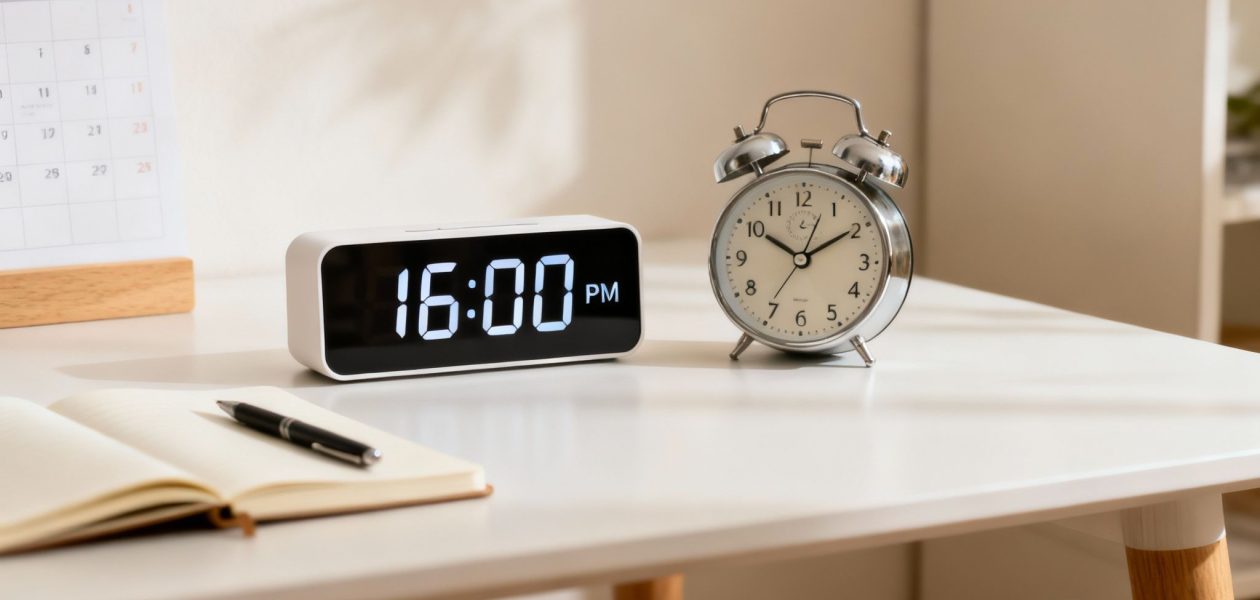
Let's get right to it: 1600 in military time is 4:00 PM on a standard 12-hour clock. This time usually marks the late afternoon, signaling that the end of the typical workday or school day is just around the corner.
Decoding 1600 Military Time Instantly
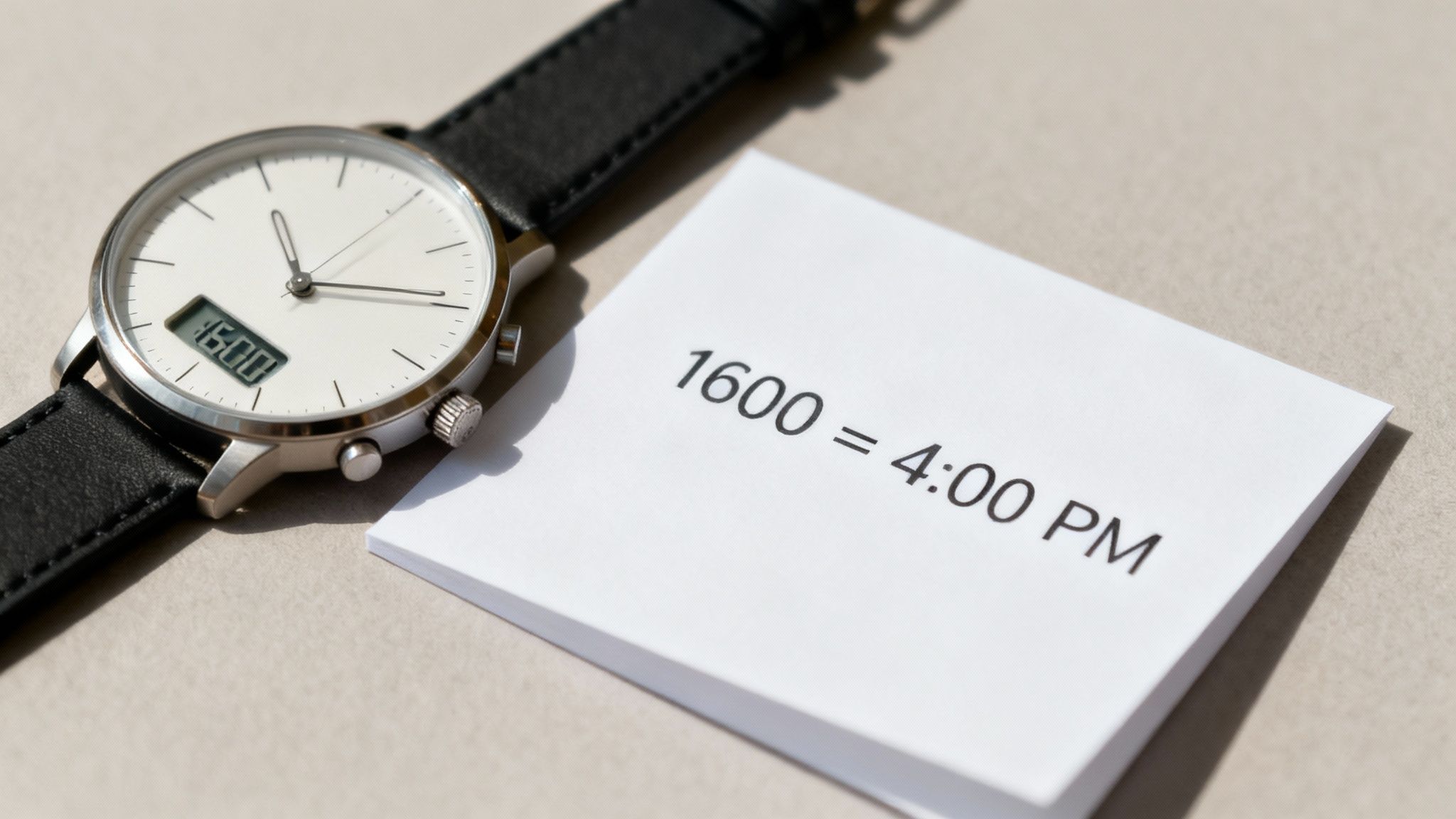
Think of military time as a clock that runs for a full 24 hours without ever needing an "AM" or "PM." It just keeps going. This system is crucial for clarity in fields like aviation, healthcare, and emergency services, where mixing up morning and evening could have some serious consequences.
The conversion for any afternoon hour is actually quite simple. If you see a military time that's past 1200 (noon), you just subtract 12 hours from it to get the standard time. It's a quick mental trick that works every single time for PM hours. You can dive deeper into military time conversion methods to see how they lock in scheduling accuracy.
But for a quick reference, this table breaks it down perfectly.
1600 Military Time at a Glance
For a quick summary, here's exactly how 1600 translates:
| Military Time | Standard 12-Hour Time | Time of Day |
|---|---|---|
| 1600 | 4:00 PM | Afternoon |
Once you get the hang of this simple subtraction rule, you’ve basically mastered the 24-hour clock. The whole system is built for precision, getting rid of any "wait, did you mean AM or PM?" confusion for good.
How the 24-Hour Clock Actually Works
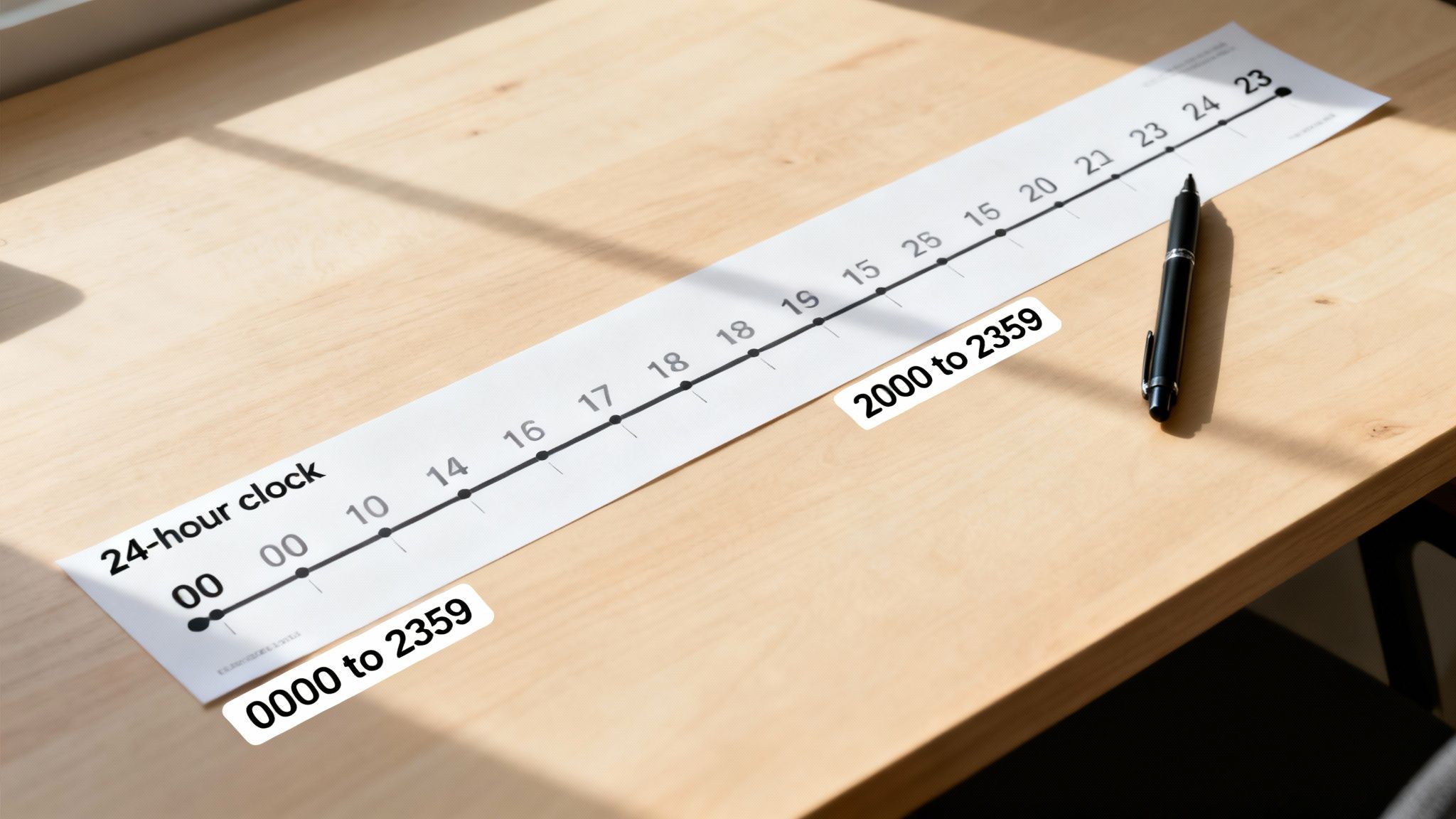
Picture a clock that doesn’t repeat itself all day. That’s the simple idea behind the 24-hour system, which many people call military time. Instead of resetting after noon and forcing you to add "AM" or "PM," the hours just keep on counting.
This continuous count is exactly why the 24-hour clock is the gold standard for clarity. In fields where mistakes are costly—like aviation, emergency services, and medicine—mixing up morning and evening can lead to serious errors. The 24-hour clock gets rid of that risk.
Understanding the Four-Digit Format
Every time in the 24-hour system is a clean four-digit number. The structure is dead simple and logical, making it a breeze to read once you see the pattern.
Here’s how it breaks down:
- The first two digits show the hour of the day, running from 00 (midnight) to 23 (11 PM).
- The last two digits show the minutes past that hour, from 00 to 59.
So, when you see 1600, you’re looking at the 16th hour of the day with 00 minutes past. It’s a straightforward system that gives every single minute of the day its own unique ID, leaving zero room for confusion.
The biggest advantage here is absolute clarity. A time like 0800 can only ever mean 8:00 AM, and 2000 can only mean 8:00 PM. That kind of precision is non-negotiable in jobs where a 12-hour mistake could be a disaster.
From Morning to Afternoon
The system works just as you'd expect as the day moves along. Morning hours, from 0100 (1:00 AM) up to 1159 (11:59 AM), look pretty familiar. The big shift happens right after noon at 1200.
Instead of the clock resetting back to 1, it just keeps counting up. For example, 1:00 PM becomes 1300, and 2:00 PM becomes 1400. As you can see, the structure stays the same all day. If you want to see how this works for earlier afternoon times, check out our guide on what 1400 military time means to build your understanding.
How to Convert Military Time to Standard Time
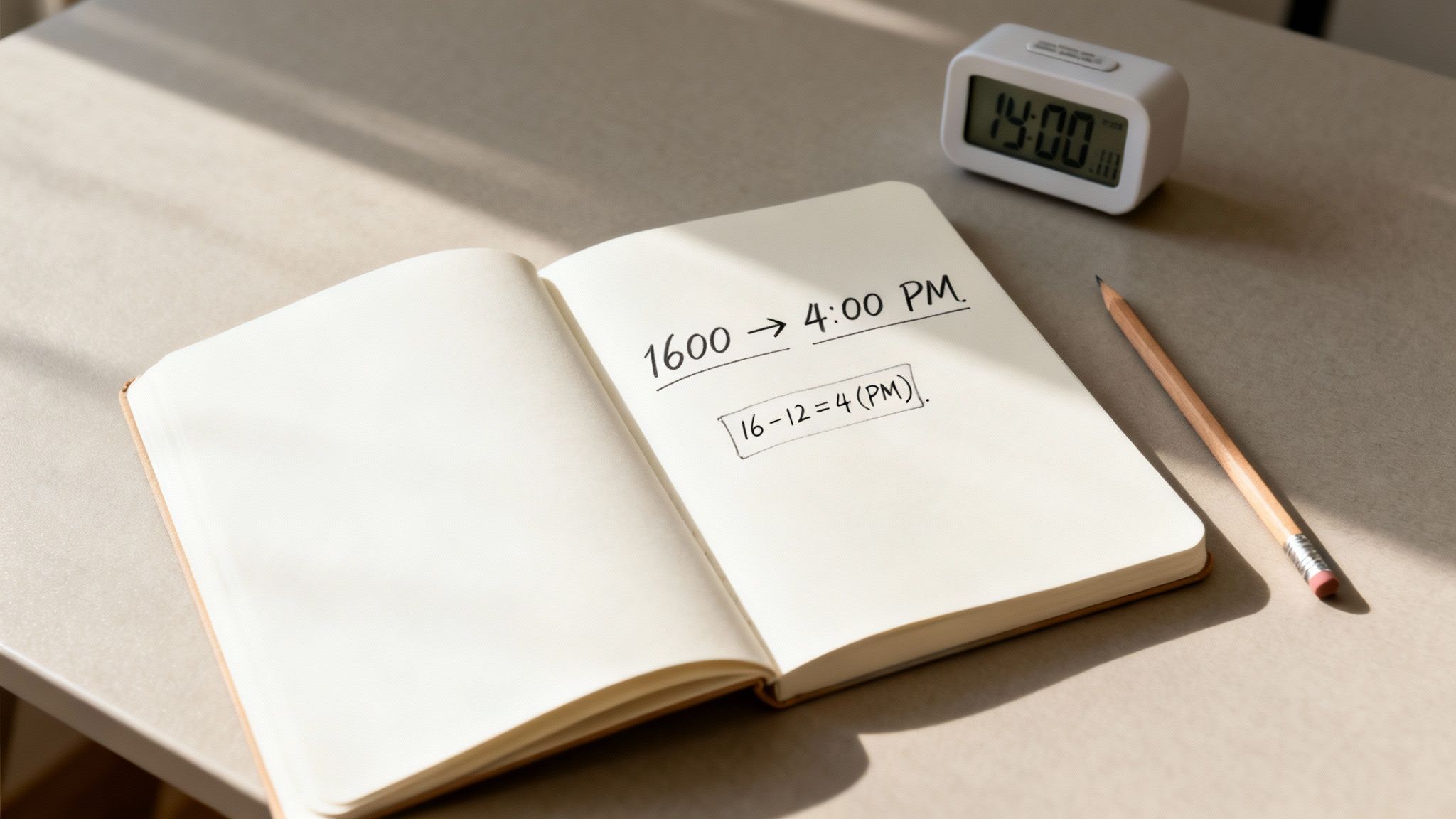
Ready to translate any military time with total confidence? Getting the hang of the conversion is way easier than it looks. It all boils down to two simple rules that split the day between the morning and the afternoon.
For any time between 0001 (12:01 AM) and 1159 (11:59 AM), the process couldn't be more direct. You just read the numbers, pop a colon in the middle, and add “AM.” For instance, 0830 is simply 8:30 AM. No complicated math needed for the first half of the day.
The real trick—and it's a simple one—comes after noon.
The Subtract 12 Rule for PM Hours
For any military time from 1300 to 2359, the magic formula is to just subtract 12 from the hour. This one move instantly flips the 24-hour format into the familiar 12-hour PM time we all use.
Let's walk through our main example, 1600:
- Step 1: Look at the hours. The first two digits are 16.
- Step 2: Apply the rule. Since 16 is greater than 12, you subtract 12.
- Step 3: Do the math. 16 – 12 = 4.
- Step 4: Add the finishing touches. Slap a colon and "PM" on the end, and you get 4:00 PM.
This method is foolproof. You can use it for any time in the afternoon or evening and get the right conversion in seconds. To help make this stick, here’s a quick cheat sheet to visualize how it works across the clock.
Military Time Conversion Cheat Sheet
This table breaks down the simple math for converting any military time hour into its 12-hour equivalent.
| Military Time | Calculation (If Applicable) | Standard 12-Hour Time |
|---|---|---|
| 0800 | None | 8:00 AM |
| 1200 | None | 12:00 PM (Noon) |
| 1300 | 13 – 12 = 1 | 1:00 PM |
| 1600 | 16 – 12 = 4 | 4:00 PM |
| 1700 | 17 – 12 = 5 | 5:00 PM |
| 2100 | 21 – 12 = 9 | 9:00 PM |
| 2300 | 23 – 12 = 11 | 11:00 PM |
| 0000 | None | 12:00 AM (Midnight) |
See the pattern? Once you hit 1300, it's just a simple subtraction problem.
Let’s try a few more. A time like 2145 becomes 21 – 12, giving you 9, so it's 9:45 PM. Likewise, our guide on what 1700 military time is follows the same logic: 17 minus 12 equals 5, making it 5:00 PM.
The takeaway is simple: if the military time starts with a number 13 or higher, just subtract 12 to get the standard PM hour. It's a quick mental shortcut that lets you convert not just 1600, but any time of day, accurately and on the fly.
Avoiding Common Military Time Mistakes
Even a straightforward system like military time has a few tricky spots that can trip people up. Knowing these common pitfalls ahead of time is the best way to use the 24-hour clock accurately and confidently, ensuring your communication is always crystal clear.
The two biggest points of confusion are often midnight and noon. It's easy to mix them up, but the logic is simple once you get it: the day starts at zero.
Think about it this way: midnight is the very beginning of a new day, so it’s always written as 0000. On the other hand, noon is the halfway point, kicking off the afternoon, and is written as 1200. Get those two right, and you've dodged the most frequent error.
Mastering the Details
Beyond midnight and noon, a few other details separate the rookies from the pros. Paying attention to these smaller points ensures you’re following standard conventions and keeping your scheduling as clear as possible.
A frequent slip-up is dropping the leading zero for morning hours. While you might be tempted to write 7:00 AM as "700," the correct format is 0700. That leading zero is crucial because it maintains the consistent four-digit structure, which eliminates any ambiguity and makes the time easier to read at a glance.
Finally, there’s the matter of how you say it. When speaking military time, you pronounce the hours and minutes as distinct number pairs, often adding "hours" at the end.
- 1600 is spoken as "sixteen hundred hours."
- 0800 is spoken as "zero eight hundred hours."
Adopting the correct terminology not only helps you sound more natural but also reinforces the clear, unambiguous nature of the system. It’s a small detail that makes a big difference in professional settings where precision is everything.
By actively avoiding these common errors—confusing noon and midnight, dropping leading zeros, and using the wrong pronunciation—you can sidestep a world of potential misunderstandings. Mastering these fine points will help you use military time flawlessly, whether you're coordinating with a global team or just trying to sharpen your own time management skills.
Why Professionals Rely on the 24-Hour Clock
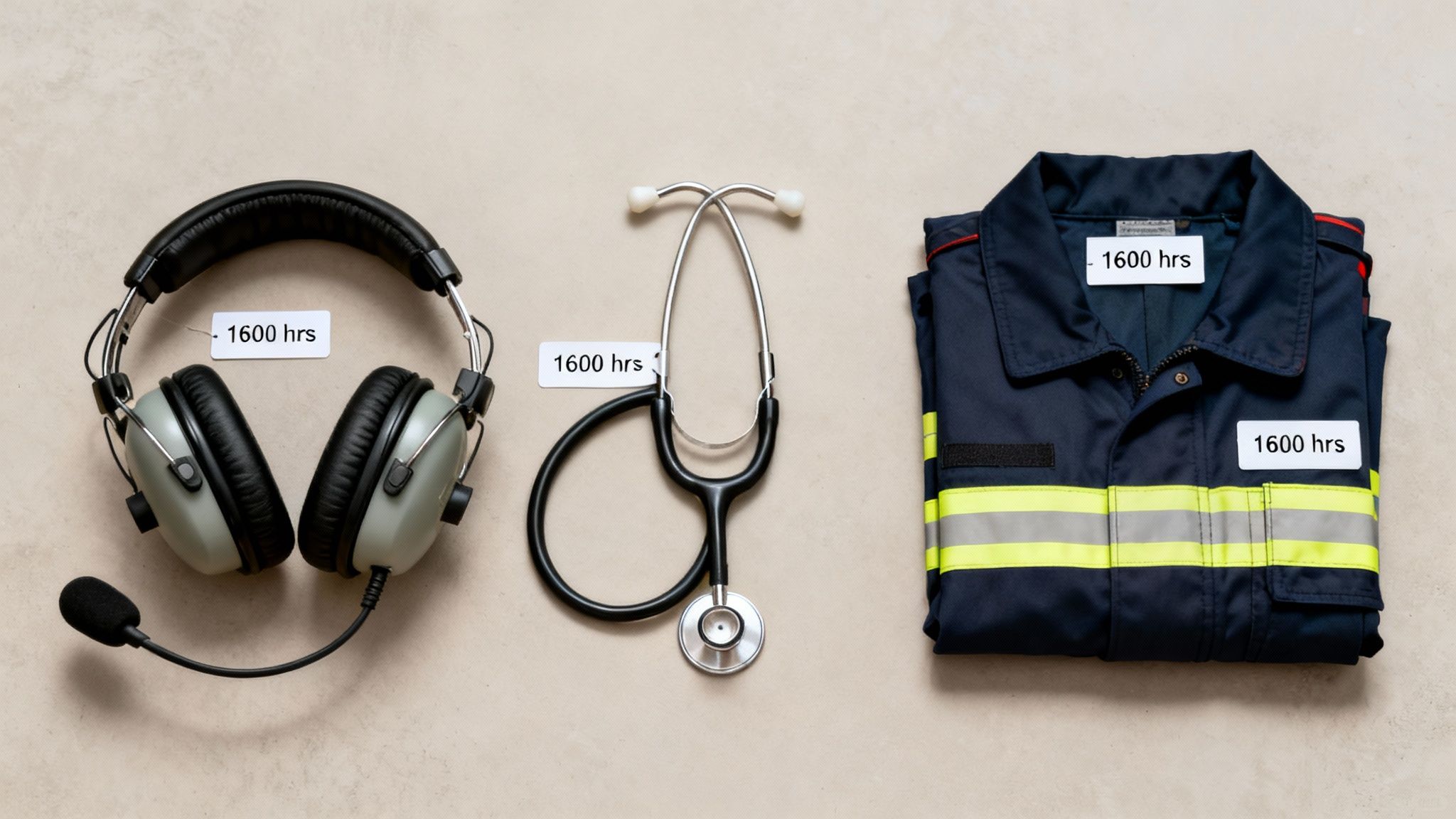
The 24-hour clock isn't just a military quirk. For a lot of high-stakes professions, it’s a critical tool for precision. In fields where a simple mix-up between AM and PM could be disastrous, military time cuts through the noise and provides total clarity. There's simply no ambiguity.
Imagine a pilot getting clearance to land at "eight o'clock." Is that bright and early, or after the sun has set? In aviation, 0800 and 2000 are worlds apart, and there’s absolutely no room for error. This is exactly why the system is non-negotiable for safety and operational success.
Real-World Clarity in Action
This need for precision isn't just for pilots and soldiers. In healthcare, a medication scheduled for "10 o'clock" could lead to a dangerous 12-hour mistake if someone gets it wrong. Emergency response teams live by it, too—every second and every detail in an incident log matters. A timestamp of 1600 marks an exact moment, not a fuzzy approximation.
The core benefit is unambiguous communication. When a schedule or log entry uses military time, it creates a single, verifiable point of reference that protects against misinterpretation, ensuring everyone is perfectly synchronized.
From an operational—and often legal—standpoint, a timestamp like 1600 is an ironclad record. It's why so many hospitals mandate 24-hour charting to prevent medication errors, and why military orders rely on it to specify exact times for execution.
Once you understand the "why," it’s clear that military time is a system built for ultimate clarity. This same logic holds true for later hours, as you can see in our guide on what 2100 in military time is.
Got Questions About Military Time? We Have Answers.
Let's clear up a few common sticking points. Once you've got the basics down, a few tricky questions always seem to pop up. We'll tackle them one by one to make sure you're totally confident using the 24-hour clock.
Do Minutes Change in Military Time?
Nope, they don't. Minutes and seconds are exactly the same. The last two digits in military time always represent the minutes past the hour, from 00 to 59.
So, a time like 1630 is just the 16th hour plus 30 minutes—or 4:30 PM. Easy.
What Is the Difference Between 0000 and 2400?
This is a classic one, but it's simpler than it looks. Think of 0000 as the official start of a new day. It’s the very first second.
You might occasionally see 2400 used to mark the precise end of the previous day. For practical purposes, like scheduling a meeting or logging an event, you’ll almost always want to use 0000.
Why Is There No Colon in Military Time?
You'll definitely see colons on digital clocks (like 16:00), but the standard, professional format is just four digits, like 1600. This isn't just a style choice; it's about consistency and clarity.
Keeping it to a simple four-digit block prevents formatting errors in logs, official documents, and schedules. There's no room for misinterpretation.
The core idea is consistency. Removing the colon ensures every timestamp follows the same four-digit structure, from 0000 all the way to 2359, making them easy to read and record quickly.
At TimeTackle, we believe clear time tracking is the foundation of productivity. Our AI-powered platform turns your calendar data into actionable insights, helping teams understand how time is spent without the hassle of manual timesheets. See how much time you can save at https://www.timetackle.com.