


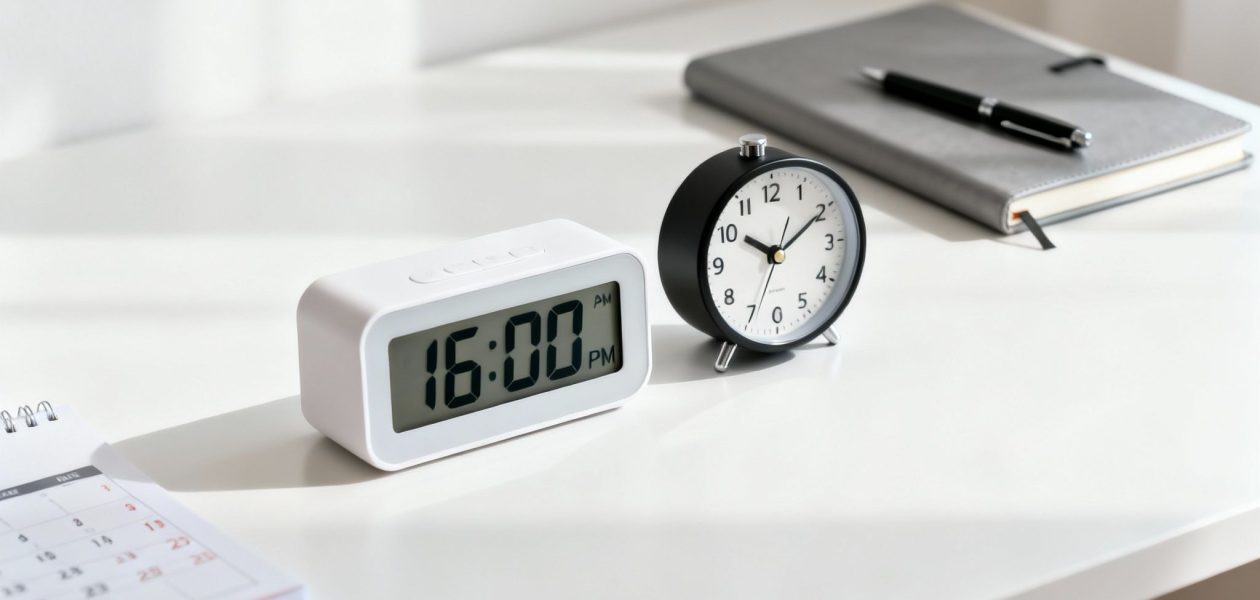
Let's get straight to it: 1600 military time is 4:00 PM. Simple as that.
The whole point of the 24-hour clock is to cut through the noise. It treats the day as one continuous 24-hour cycle, completely sidestepping the classic AM/PM mix-ups that can trip up even the most organized person.
Instantly Understanding 1600 Military Time
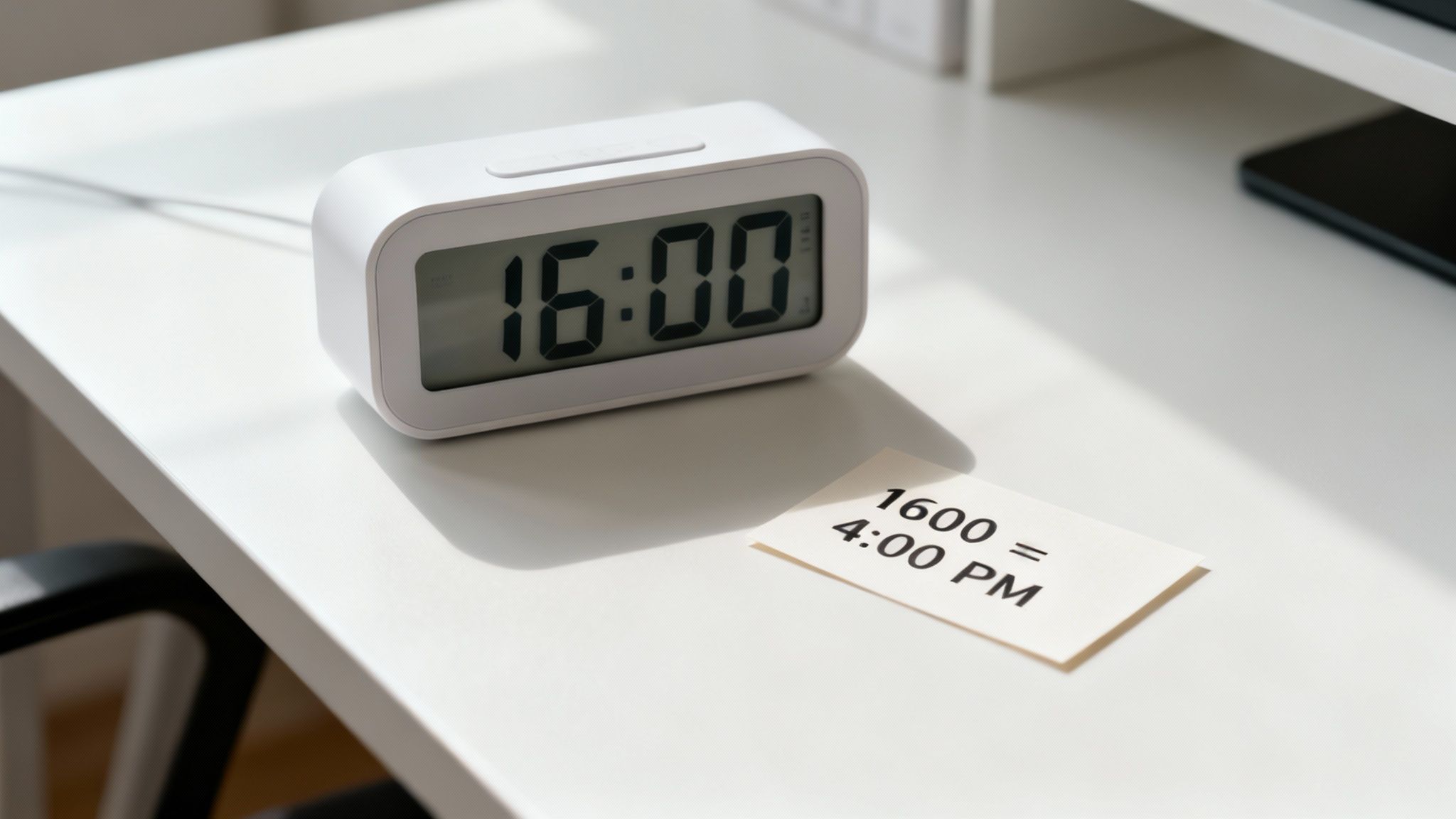
When you see a time like 1600, it's telling you it's the 16th hour of the day. Because every hour has its own unique number from 0000 (midnight) to 2359 (11:59 PM), there’s absolutely no guesswork. You know exactly when something is happening.
This isn't just a quirky preference; it's a system born from a need for total precision. The term "1600 military time" is what most people call 4:00 PM in 24-hour notation, a format adopted by armed forces around the globe to prevent catastrophic mistakes. In fact, the U.S. Army officially made the switch back in 1942 to eliminate any and all ambiguity from its operations. If you're curious, you can learn more about the global adoption of the 24-hour clock and its history.
To help this click, let's look at a few common time conversions. Think of this table as your go-to cheat sheet for translating military time back to the format you see on your phone every day.
Quick Military Time To Standard Time Conversion
This handy table breaks down some of the most common military time benchmarks into the familiar 12-hour format, along with how you'd typically say them out loud.
| Military Time (24-Hour) | Standard Time (12-Hour) | Common Pronunciation |
|---|---|---|
| 0900 | 9:00 AM | "Zero Nine Hundred" |
| 1200 | 12:00 PM (Noon) | "Twelve Hundred" |
| 1600 | 4:00 PM | "Sixteen Hundred" |
| 2100 | 9:00 PM | "Twenty-One Hundred" |
After a while, you start to get a feel for it and can do the math in your head without even thinking.
Key Takeaway: The real power of using 1600 instead of 4:00 PM is its unwavering clarity. In situations where mixing up morning and afternoon could lead to serious problems, "Sixteen Hundred" leaves zero room for interpretation.
The Two Simple Rules for Time Conversion
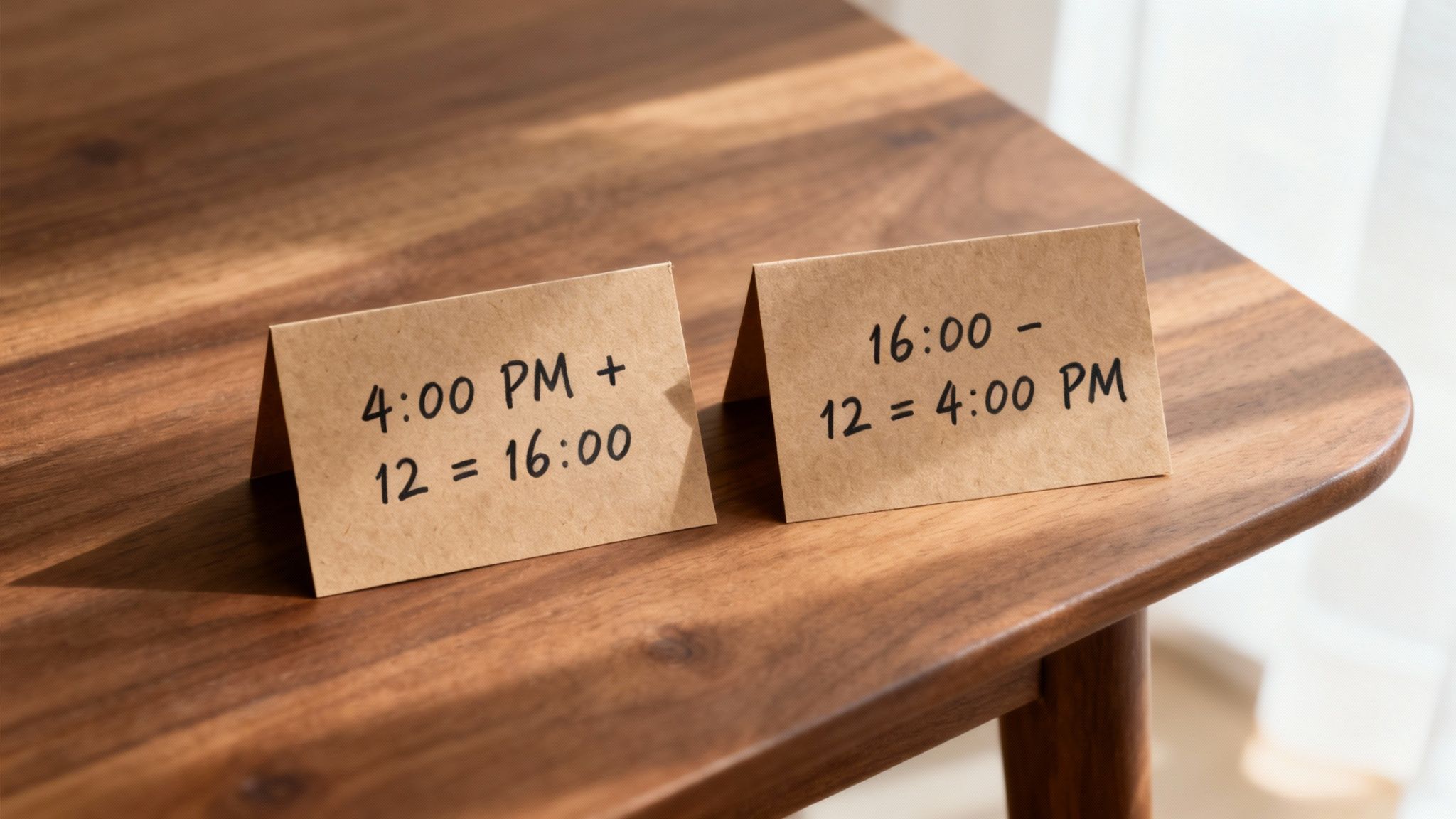
You don't need confusing charts or mental gymnastics to switch between standard and military time. It all boils down to two simple rules that handle pretty much any situation you’ll run into. Once these click, you'll be translating times in your head without a second thought.
The whole point of the 24-hour system is to bring clarity to the hours after noon. That’s where AM/PM mix-ups happen most often, and it's where military time really proves its worth.
Rule 1: From PM to Military Time, Just Add 12
For any time from 1:00 PM to 11:59 PM, the trick is to simply add 12 to the hour. This one step unlocks the entire system.
Let’s use this rule to figure out 1600 military time.
- Take the standard PM hour: 4
- Add 12 to it: 4 + 12 = 16
- Combine it with the minutes: 1600
That's it. A 2:30 PM meeting becomes 1430 because 2 + 12 is 14. A dinner reservation at 8:00 PM is 2000 because 8 + 12 is 20. Simple as that.
Sticking to this rule completely eliminates any confusion about whether a scheduled event is in the morning or the evening. It's precisely why industries like aviation and medicine depend on it for mission-critical scheduling.
Rule 2: From Military Time to PM, Just Subtract 12
Going the other way is just as easy—you just do the opposite. If you see a military time that's higher than 1200, simply subtract 12 from the hours to get the standard PM time.
Let's convert 1600 military time back to the 12-hour format we all know.
- Take the military hour: 16
- Subtract 12 from it: 16 – 12 = 4
- Tack on "PM" to make it clear: 4:00 PM
This works every single time. See 2100 on a schedule? That's 9:00 PM (21 – 12 = 9). A flight departing at 1945 is leaving at 7:45 PM (19 – 12 = 7). For teams that need to track their work with precision, knowing how to calculate hours to decimal format can make payroll and client invoicing even easier.
Why Precision Timekeeping Is Non-Negotiable
Ever wonder why systems like the 24-hour clock even exist? It wasn't just for show. This system was born from an absolute need for clarity in high-stakes environments, where a simple misunderstanding isn't just an inconvenience—it can be catastrophic.
Picture this: you're coordinating a critical military operation or an emergency response. Someone says a key event is scheduled for "four o'clock." Does that mean bright and early at 4:00 AM or late in the afternoon at 4:00 PM? That tiny bit of ambiguity introduces a massive risk when lives are on the line.
Eliminating Dangerous Ambiguity
The 24-hour clock solves this problem beautifully. By representing 4:00 PM as 1600, the system gets rid of AM and PM entirely. There's only one 1600 in any given day, leaving zero room for interpretation. Simple as that.
This isn't just about military tradition; it’s a practical, life-saving tool. In aviation, pilots and air traffic controllers depend on this precision to prevent mid-air disasters. In medicine, doctors and nurses use it to administer medication on a strict schedule, where a 12-hour mistake could be fatal.
The Core Principle: The 24-hour system is designed for unwavering precision. It ensures that when a time is communicated, everyone involved understands the exact same moment, every single time. Mistakes are not an option.
From a practical standpoint, seeing 1600 instead of 4:00 PM also reduces the mental gymnastics needed in high-stress situations. That’s why you’ll see official standards for armed forces and emergency services present time as four clean digits—because even a one-hour mix-up can cascade into total operational failure. You can explore more about the military's deep reliance on the 24-hour clock to see just how critical this need for clarity is.
How Military Time Shows Up in Everyday Life
You've probably seen the 24-hour clock more often than you realize. It’s not just for soldiers or pilots—it's the quiet force that organizes a surprising amount of our daily lives, especially when crystal-clear communication is non-negotiable.
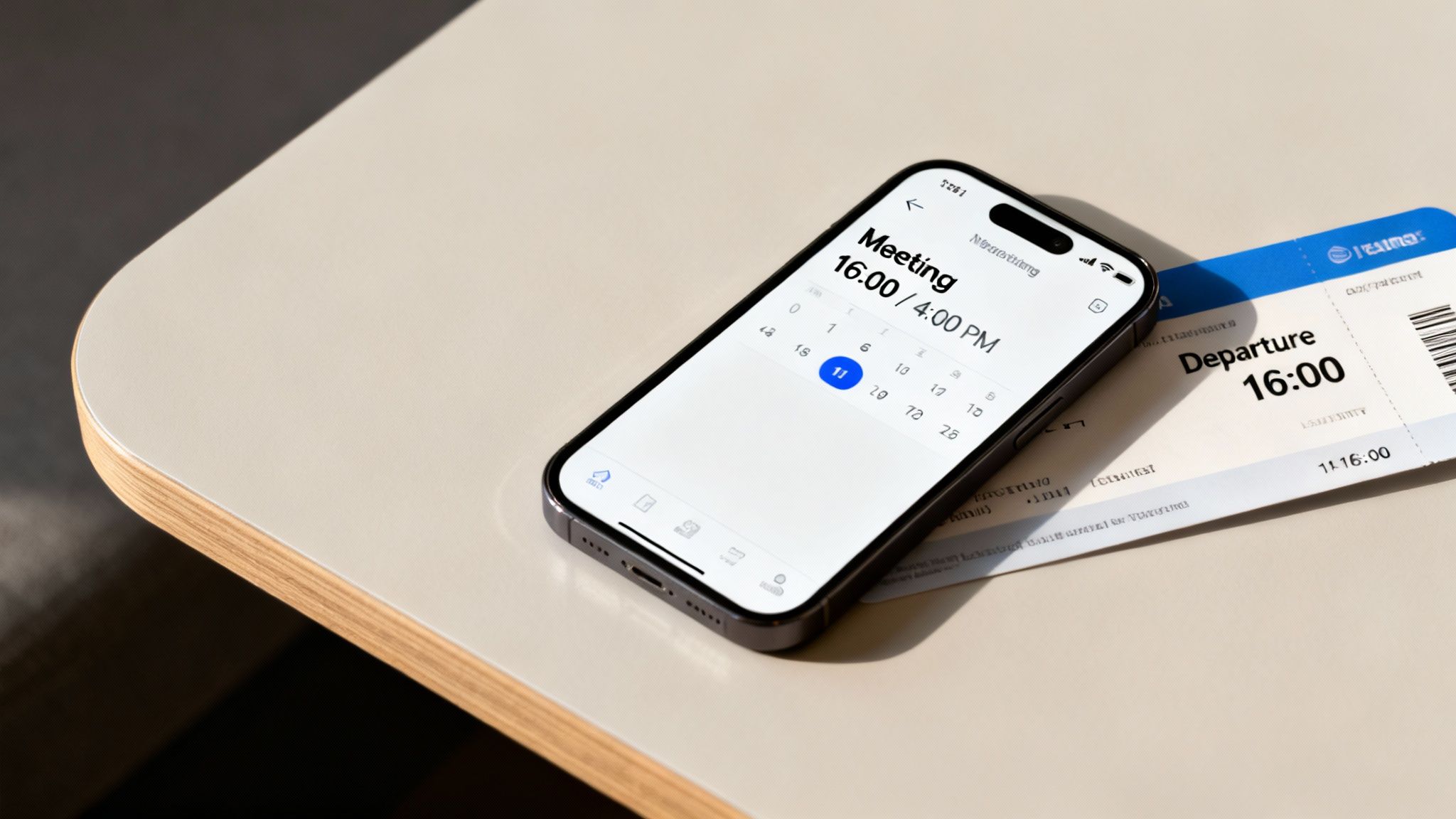
Think about the last time you booked an international flight. Travel itineraries almost always use the 24-hour format to avoid disastrous mix-ups. A departure time of 1600 means 4:00 PM, period. There's no room for doubt, ensuring you show up at the right time, regardless of your time zone. This simple precision is exactly why it's the global standard for transportation.
From Calendars to Global Teams
The 24-hour format has also found its way into the digital tools we rely on daily. Pop open your calendar app, and you'll likely find an option to switch to a 24-hour display. This isn't just a stylistic choice; for teams working across different continents, it’s a game-changer.
Imagine a project manager in New York setting a meeting for 1600 EST. Their colleague in Berlin immediately knows that’s 22:00 their time. The AM/PM confusion that can lead to missed calls and project delays simply vanishes. For busy professionals, managing appointments this way is critical, and knowing how to use tools like a Google Calendar calculator to sum hours can make planning even more seamless.
To really see the difference, let’s lay out a typical workday in both formats.
A Day Scheduled in 12-Hour vs 24-Hour Time
The table below shows just how a regular schedule translates from the familiar 12-hour clock to the straightforward 24-hour system. It’s a simple side-by-side that highlights the clarity military time provides.
| Activity | Standard Time (AM/PM) | Military Time (HHMM) |
|---|---|---|
| Team Stand-up Meeting | 9:00 AM | 0900 |
| Lunch Break | 12:30 PM | 1230 |
| Client Presentation | 2:00 PM | 1400 |
| Project Deadline | 4:00 PM | 1600 |
| End of Workday | 5:00 PM | 1700 |
As you can see, every part of the day gets its own unique number. This is what makes 1600 military time—and the entire 24-hour system—such an efficient and foolproof way to talk about time.
Common Mistakes to Avoid When Reading Time
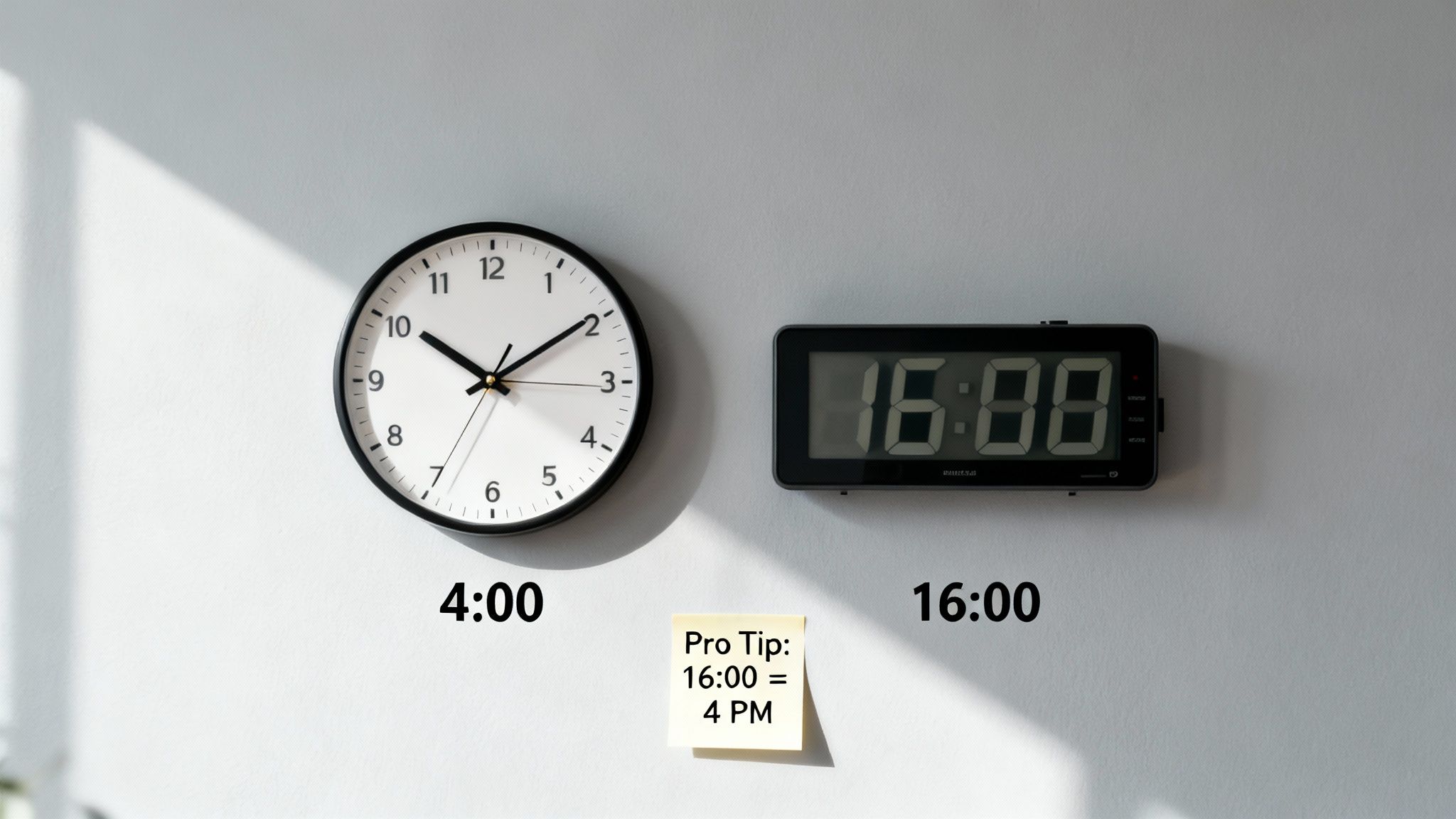
Even with straightforward rules, a few common slip-ups can catch you off guard when you first start using the 24-hour clock. Let's walk through these frequent errors so you can sidestep them and build your confidence until reading military time becomes second nature.
One of the most common mistakes is a simple math hiccup when converting PM hours. It happens. You see 1600, and your brain accidentally subtracts 10 instead of 12, landing you at 6:00 PM instead of the correct 4:00 PM. This usually happens when you're in a rush and the "subtract 12" rule momentarily slips your mind.
Pro Tip: If a military time is greater than 1200, it's always in the afternoon or evening. This simple mental check is a great safety net to prevent you from mixing up PM and AM hours.
Another frequent trip-up is how the time is spoken. While saying "one thousand six hundred" is technically correct if you're talking about a number, it's not how you say the time.
Proper Pronunciation and Other Pitfalls
Getting the pronunciation right is crucial for clear communication, especially in any professional setting. The correct way to say 1600 is "Sixteen Hundred." This two-digit pair format is the standard and helps avoid any confusion.
Here are a few other common errors to watch out for:
- Confusing Midnight and Noon: It's an easy mistake to make. Noon is 1200—the exact middle of the day. Midnight, on the other hand, is 0000 (or sometimes 2400 to mark the end of a day), representing the very start of a new one.
- Misinterpreting Minutes: A time like 1630 means "Sixteen Thirty," not "sixteen and a half." The last two digits always represent the exact minutes past the hour.
- Forgetting the Leading Zero: For morning hours before 10 AM, that leading zero is important. For example, 7:00 AM should always be written as 0700, not 700. This maintains the standard four-digit format and ensures clarity.
Where the 24-Hour Clock Came From
The 24-hour clock wasn't some grand invention for the military. It actually popped up out of a much more practical need: keeping the world from falling into chaos as things got faster and more connected.
Its story really starts with the Industrial Revolution and the birth of railways. Imagine trying to run a national train network when every town has its own local time. It was a recipe for disaster. To prevent collisions and keep schedules straight, a single, clear timekeeping system was absolutely essential.
The 24-hour clock's real moment in the spotlight came during the World Wars. Military forces embraced it to coordinate massive operations across different time zones, where a simple mix-up between AM and PM could have catastrophic results.
The Evolution of Precision
This obsession with precision didn’t happen overnight. The railway boom between the 1830s and 1880s forced the creation of standardized time zones and Greenwich Mean Time (GMT) just to coordinate events across huge distances. This new discipline laid the perfect groundwork for the military to adopt the system in the early 20th century.
Today, that same logic applies. Planners still use benchmarks like 1600 as a hard line for allocating resources or managing shift changes, proving its lasting value. You can discover more insights about its history and see how it went from an industrial fix to a global standard.
A Few Lingering Questions About Military Time
Still have a few questions? Let's clear up some of the most common points of confusion people have when they're first getting the hang of the 24-hour clock.
Is 1600 Hours Exactly 4 PM?
Yep, 1600 military time is precisely 4:00 PM on the dot. Think of it as the very first second of that minute. This precision is one of its biggest strengths—there's absolutely no confusion about whether you mean morning or afternoon.
Why Say Sixteen Hundred?
The phrasing "Sixteen Hundred" might seem a bit formal, but it’s all about eliminating errors. Especially over a crackly radio or in written orders, it’s a crystal-clear way to communicate the time, leaving zero room for misinterpretation.
How Do I Write Times With Minutes?
Easy. If you want to write a time like 4:30 PM, you just tack the minutes onto the hour. It becomes 1630.
The first two digits (16) always represent the hour, and the last two (30) are the minutes. This simple, consistent format is incredibly useful for all kinds of scheduling, even for things like Google Sheets time tracking on a complex project.
At TimeTackle, we automate time tracking to provide clear, actionable insights from your team's calendar data. See how TimeTackle can improve your operational efficiency.