

Let's be honest, a hybrid work schedule is about more than splitting time between the office and a home setup. It’s a strategic move that, when done right, gives your agency a mix of focused solo work and high-energy, in-person collaboration. For modern agencies, this isn't just a perk anymore—it’s a core part of how business gets done.
What a hybrid work schedule really means for your agency
Forget the textbook definition for a minute. A real hybrid schedule is a choice to get the best of both worlds. You get the deep-focus time that a quiet home office provides, plus the spontaneous brainstorming that only seems to happen when you’re all in the same room. For anyone in creative, consulting, or tech, this is the new standard.
The numbers don't lie. Gallup’s latest data shows that for jobs that can be done from anywhere, hybrid work schedules are the dominant model. A huge 52% of U.S. employees in these roles are now hybrid. That leaves just 26% working fully remote and 21% who are in the office full-time.
This isn’t just a management trend; it’s a direct response to what employees want. A solid six in 10 workers with remote-capable jobs say they prefer a hybrid setup. If you're an agency trying to attract and keep the best people, you simply can't afford to ignore that.
Moving beyond a one-size-fits-all approach
Think of hybrid work not as a single policy, but as a range of possibilities. The goal isn’t to force everyone into the same box. It’s to find a model that gives your team the autonomy they want while creating intentional space for the collaborative magic that drives great work.
For instance, a marketing agency might find its groove with two mandatory "collaboration days" in the office each week, perfect for client kickoffs and creative reviews. A software development team, on the other hand, might do better with a flexible model that gives them long, uninterrupted stretches at home to code.
The secret is to match the schedule to the work itself. This comes down to a few key things:
- Giving people the freedom they need for deep, individual work.
- Carving out structured time for group brainstorming and collaboration.
- Building a culture that celebrates results over simple physical presence.
- Having a clear plan for in-office versus remote tasks.
Nailing this flexibility is your ticket to attracting top-tier talent in a crowded market. A big part of making it all click is understanding the unspoken rules and nuances of scheduling etiquette. We'll walk you through how to turn this operational shift into a real, sustainable advantage for your agency.
Choosing the right hybrid model for your team
When it comes to hybrid work, there’s no magic formula. Picking the right schedule isn't about copying what you see another agency doing. Every team has its own rhythm.
A creative team might thrive with long, uninterrupted days for deep work, while your client-facing account managers need predictable in-office time to collaborate. The real goal is to find a structure that fits your agency's unique workflow, not fight against it.
This decision tree can help you get started by forcing you to answer one simple question: what’s our top priority? Is it maximizing in-person collaboration or offering the greatest possible flexibility?
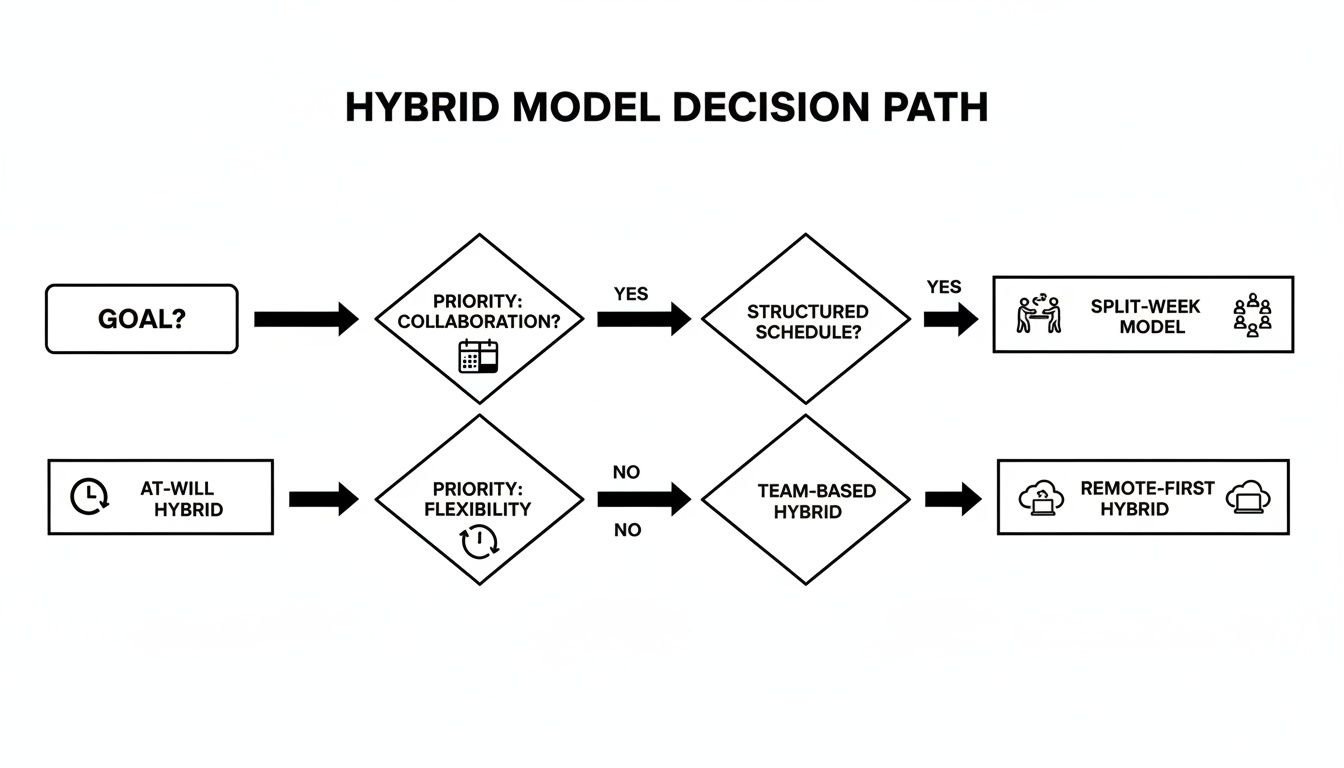
The path you take depends entirely on what your team needs to do their best work. It’ll point you toward models built for either structured teamwork or individual autonomy.
Comparing hybrid work schedule models
Let’s get practical and break down the most common hybrid models. Instead of just dry definitions, we'll look at how each one really works in an agency setting, including the good and the bad.
This table gives you a quick side-by-side to help you weigh your options.
Comparing hybrid work schedule models
| Model | How It Works | Best For | Potential Downside |
|---|---|---|---|
| Fixed | Employees have specific, unchanging days they must be in the office (e.g., every Tuesday and Thursday). | Teams that need predictable, recurring collaboration time for things like sprint planning or all-hands meetings. | Can feel rigid and may not accommodate personal appointments or last-minute needs, reducing overall flexibility. |
| Split-Week | The team is divided into groups (e.g., Group A is in Mon/Tues, Group B is in Wed/Thurs) to manage office density. | Larger agencies needing to control office capacity while still ensuring everyone gets some in-person time. | Risks creating "silos" where teams rarely interact with people outside their designated group, hurting cross-functional work. |
| Flexible | Employees are required to come in a certain number of days per month or quarter but can choose which days. | Roles that are highly autonomous and don’t depend on daily, in-person syncs, like content creation or development. | Can lead to "empty office" syndrome, where people come in on different days and miss opportunities for collaboration. |
| At-Will | The office is available, but there are no mandates. Teams come in as needed for specific projects or meetings. | Highly disciplined teams with strong remote communication practices that only need the office for occasional workshops. | Without clear guidelines, it can accidentally revert to a fully remote model, with the office becoming an expensive, unused asset. |
Think of it this way: the right model supports the work itself, not just an arbitrary number of days in the office.
The best hybrid schedules are built around the work, not just around a number of days. If your team's success depends on spontaneous whiteboarding sessions, a model with mandated collaboration days makes sense. If they need quiet focus, prioritize autonomy.
Ultimately, choosing the right hybrid approach is less about writing a policy and more about driving performance.
If you want to see how different teams put these ideas into practice, check out our guide with a real example work schedule to see these models in action. The key is finding that sweet spot—a balance that empowers your people without killing the collaborative spark that makes an agency great.
The true benefits and hidden challenges for agencies
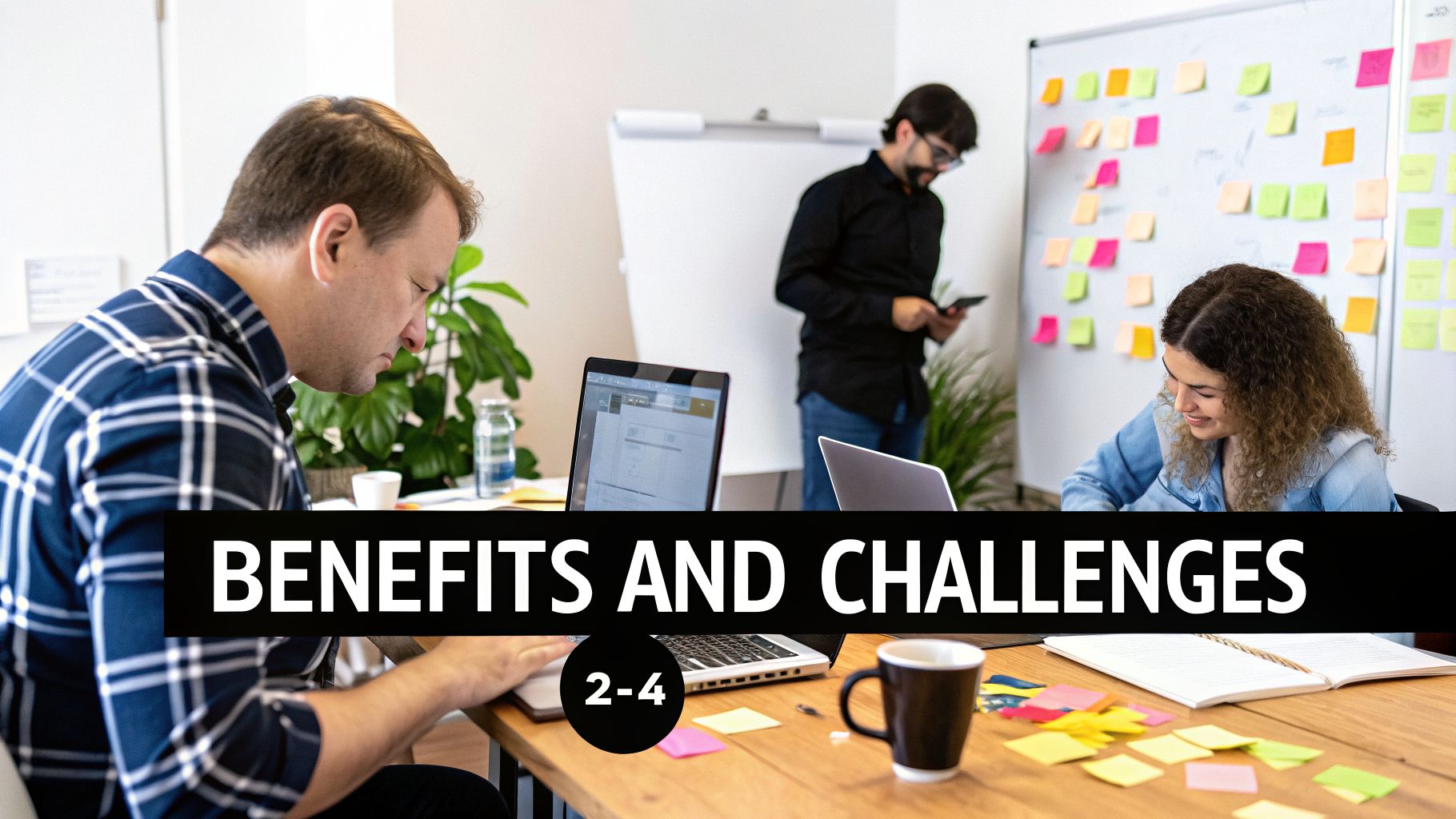
When you cut through all the noise, hybrid work schedules bring some very real, measurable wins to the table for agencies. The most obvious one? A serious productivity boost from focused, uninterrupted deep work.
When your designers, writers, and developers can ditch the commute and find their flow at home, you’ll often see project margins and client results follow.
The numbers don't lie. Research from McKinsey and Stanford shows hybrid teams are now outperforming both fully remote and fully in-office setups by about 5%. Across the globe, 72% of companies are reporting higher productivity than they saw pre-2020, and absenteeism has dropped by an incredible 40% in hybrid models.
But it’s not just about the raw output. A flexible schedule is a massive bargaining chip for attracting and keeping top talent. It shows you trust your people and gives them the autonomy to balance their work and their lives—a huge advantage in today's competitive hiring market.
The real-world hurdles you can’t ignore
Of course, going hybrid isn't a magic bullet. It brings a whole new set of tricky problems that can easily catch agency leaders off guard. If you aren't careful, you can accidentally create a two-tiered system where people in the office seem more engaged or get better opportunities than their remote colleagues.
While hybrid work offers flexibility, it also presents challenges in maintaining a unified workplace. Understanding strategies for fostering remote culture cohesion is key to mitigating potential downsides and ensuring all team members feel connected.
The biggest risk of a poorly managed hybrid schedule isn't an empty office—it's a fragmented culture. When visibility is low and communication is inconsistent, you create an environment where burnout thrives and trust erodes.
For anyone in operations or finance, the challenges are even more concrete. How do you manage resources you can’t physically see? How can you track utilization and project profitability when timesheets are a jumbled mess of data from different locations?
Here are the most common headaches we see agencies run into:
- Unequal access to information: Those spontaneous office chats can leave remote team members completely out of the loop on important decisions.
- Difficulty in mentorship: Junior employees often miss out on the informal coaching and guidance that happens naturally when you're sitting next to a senior colleague.
- Resource and capacity planning headaches: Without clear data, it’s nearly impossible to know who is drowning in work and who has the bandwidth to help out.
- Burnout from poor time tracking: Chasing down timesheets is a nightmare for everyone and leads to spotty data, turning financial forecasting into a guessing game.
Reaping the rewards of hybrid work schedules means tackling these challenges head-on. It takes a real commitment to clear communication, fair ways to measure performance, and tools that give you true visibility into how work gets done—no matter where your team is.
How to build a hybrid work policy people actually follow
A brilliant hybrid model on paper is worthless if nobody follows it. The truth is, moving to a hybrid work schedule isn't just about picking a model—it demands a formal policy that creates clarity and order, not confusion and headaches. This policy becomes your playbook for how work actually gets done.
Think of it less like a command from on high and more like a conversation. The best policies I've seen are built with real input from employees and are treated as living documents, always ready for a review and a tune-up. Your goal is to build a framework that offers flexibility while making sure everyone knows what's expected of them, from how they communicate to how they’re held accountable.
Start with the essentials
A solid hybrid policy has to cover a few non-negotiable bases. If you skip these, you’re inviting chaos. Start here by outlining the core components that will guide how your team operates day-to-day.
Your policy must clearly spell out:
- Eligibility and expectations: Who can participate in the hybrid schedule? Are there specific performance standards they need to meet? Be crystal clear about any core hours or mandatory in-office days so there are zero surprises down the line.
- Communication rules: Set the ground rules for how your team talks to each other. This means setting expectations for response times, keeping calendars up-to-date, and making sure decisions from quick, informal chats get documented. One of the biggest hurdles is running effective meetings; you can get ahead of that by implementing these 10 Hybrid Meeting Best Practices.
- Technology and equipment: What gear will the company provide for home setups? What are the security rules for personal devices connecting to company systems? Getting specific here prevents security nightmares and endless support tickets later.
- Performance measurement: How will you measure success and productivity? The focus has to shift from "time in a chair" to tangible outcomes and results. This keeps things fair and ensures everyone is aligned on what really matters.
Building a policy with buy-in
Whatever you do, don't write your policy in an echo chamber. A top-down mandate is the quickest way to create a set of rules that everyone secretly ignores. Instead, pull your team into the process from the very beginning to create a sense of shared ownership.
Your hybrid work policy is the foundation for trust and fairness. When people help build the rules, they are far more likely to respect and enforce them, turning a document into a shared cultural agreement.
Try running a few pilot programs with different teams to test-drive specific rules before you roll them out to the whole agency. Use surveys and casual team check-ins to get honest feedback on what’s working and what’s causing friction. When your employees feel heard, they stop being spectators and start being partners in the model’s success.
Finally, remember that your first draft is never the final one. A hybrid work schedule is an evolving strategy, not a one-and-done decision. Plan to review your policy every quarter or at least twice a year. Use real data—like office attendance figures, project outcomes, and employee feedback—to make smart, informed adjustments and guarantee your policy keeps supporting your agency's goals.
Using calendar data to see what your team is really doing
Here's the elephant in the room with most hybrid work schedules: a complete lack of visibility. When half your team is in the office and the rest are at home, how can you possibly know what’s getting done?
The old-school answer was always timesheets. But let's be honest, they’re a disaster. They're a pain for employees to fill out, and the data they generate is notoriously unreliable. People forget what they worked on, guess how long it took, and you’re left with a spreadsheet mess that tells you nothing about project health or team capacity.
A successful hybrid model isn’t about knowing where people are sitting. It’s about knowing what they’re working on.
Your calendar is the real source of truth
There's a much better way to get that clarity, and it doesn't involve driving your team crazy with more admin work. The answer is already right there in front of them: their work calendar.
Your team’s Google or Outlook calendar is a living record of their entire workday. It’s where every client call, internal huddle, and block of focused work is already planned out and recorded. This is the ground truth.
This is exactly where a tool like TimeTackle shines. It plugs into your team’s calendars and automatically logs their activities. No more nagging about manual entries or chasing down late timesheets. The calendar becomes the single source of truth for how everyone's time is actually spent.
The goal isn't just to track time—it's to understand it. By using the calendar as your data source, you get an accurate, real-time picture of your agency's efforts without adding a single minute of administrative work for your team.
From there, you can use simple, automated rules to tag and categorize that time. For example, any event with "Client A" in the title can automatically be bucketed under that project. Any meeting with a specific internal group can be labeled as "Admin."
The screenshot below shows how calendar analytics can instantly surface key metrics.
A dashboard like this gives you an immediate, visual breakdown of where your team's energy is going, showing key metrics like billable vs. non-billable hours without anyone having to lift a finger.
From data to decisions
Once this data is flowing, you can build dashboards that give you a complete, real-time pulse on your agency’s health. Suddenly, you can answer important business questions in seconds, not weeks:
- How many billable hours did we actually spend on that last campaign for Client X?
- Is our design team getting bogged down in too many internal meetings?
- Which of our projects are the most profitable, based on the real time we’ve invested?
- Who on the team genuinely has the bandwidth to take on a new project next week?
This is how you bring true, meaningful visibility to hybrid work schedules. You get the clarity you need to make smart, profitable decisions without burdening your team with tasks they hate. It's the key to making a flexible work model both productive and profitable.
If your team lives and breathes in Google Calendar, we’ve put together a full guide on time tracking with Google Calendar that breaks down exactly how to get started.
Answering your top questions about hybrid schedules
Once you've decided a hybrid model is the way to go, the real work begins. The "how" questions start piling up fast. Let's dig into the most common ones we hear from agency leaders and get straight to the practical, real-world answers.
How do I ensure fairness between in-office and remote staff?
This is the big one, isn't it? The core of the issue is moving your entire agency's thinking away from rewarding presence to rewarding output. Fairness doesn’t mean treating everyone the exact same way. It's about giving everyone an equal shot at success and measuring them by the same stick, no matter where their desk is.
Here's how to start standardizing your approach:
- Run inclusive meetings: Every single meeting should be "remote-first." This means even people sitting in the office join on their own laptops. You'll use a shared digital whiteboard, and all notes are captured and posted in one central spot afterward.
- Over-communicate decisions: Got a great idea during a spontaneous office chat? Fantastic. But now you need a new rule: that decision isn't official until it's documented and shared on a company-wide platform like Slack or Teams.
- Standardize performance reviews: Build your reviews around clear, pre-defined goals and measurable results. This kills the "I saw them working late" bias and brings the focus back to what actually got done.
How do we keep our company culture strong?
A great culture doesn't just spring up around the coffee machine. You have to be deliberate about building connections that include everyone. It’s less about forced happy hours and more about designing shared experiences.
For example, you could designate in-office days specifically for high-value collaborative work—think team-building workshops, big project kickoffs, or celebratory lunches. Then, for remote days, build virtual rituals like a "water cooler" channel for non-work chats, pairing people up for virtual coffee, or shouting out big wins on company-wide channels.
A hybrid culture thrives on intentionality. You can't rely on random hallway conversations anymore. You have to consciously design moments for connection, both in-person and online, to keep your team feeling like a single, cohesive unit.
How can I manage performance when I can't see my team?
If you're asking this, it might be a sign you're leaning on some older management habits. In a healthy hybrid model, managing performance isn't about supervision. It's about trust, clarity, and accountability.
Your job as a leader is to set crystal-clear expectations and then get out of the way. Define what success looks like for every role using specific, measurable goals (KPIs). Then, schedule regular, structured check-ins to talk about progress, clear away roadblocks, and offer support. Trust me, using tools that show you outcomes—like project completion rates or client satisfaction scores—is far more powerful than just seeing who has a green light on Slack.
The move to hybrid work schedules is also completely changing how agencies attract and keep top talent. When 83% of workers say they’d turn down a job that didn't offer flexibility and some studies show it can cut turnover by up to 33%, you know this is no longer optional. You can explore more hybrid work statistics on archieapp.co to see just how big this trend has become.
Ready to bring true clarity and effortless accuracy to your hybrid team's time tracking? TimeTackle uses your team’s existing calendar data to provide real-time insights into project profitability, team utilization, and operational efficiency—no manual timesheets required. See how it works at https://www.timetackle.com.