



Managing time and priorities isn't just about personal productivity hacks; it's a core business strategy. It’s about building a deliberate system to know what's truly important versus what's just making the most noise.
For agencies, this is the difference between proactively steering the ship toward growth and constantly plugging leaks in a reactive frenzy. It means aligning your team's most valuable assets—their time and talent—with the work that actually grows the bottom line.
The Hidden Costs of Unmanaged Time in Your Agency
Let's get real. The daily chaos from poor time management isn't just stressful; it's a silent killer of agency profitability. When there's no clear system for setting priorities, teams naturally slip into firefighting mode, chasing the loudest client request instead of the most critical task. This reactive cycle hits your business right where it hurts.

Ironically, the traditional timesheet, which was supposed to bring clarity, often makes things worse. It’s a tedious, after-the-fact chore that leads to guesstimates and burnout. Instead of illuminating where time goes, it becomes another administrative headache that obscures the true cost of your work.
The Real Price of Disorganization
Without a solid framework, you're losing much more than a few minutes here and there. This is a systemic issue with a hefty price tag.
A jaw-dropping 82% of people admit they don't use a formal time management system, which is a recipe for chaos. In an agency environment, that chaos can lead to teams wasting up to 60% of their day on "work about work"—things like unnecessary emails, searching for information, or low-impact admin tasks.
This inefficiency manifests in a few painful ways:
- Vanishing Billable Hours: Every minute spent on non-billable admin or internal back-and-forth is pure revenue erosion.
- Sinking Team Morale: Nothing burns a team out faster than constant context-switching and the feeling of being perpetually behind.
- Flawed Project Quotes: When you're just guessing on estimates, you end up with unprofitable projects and unhappy clients.
The root of the problem is a total lack of visibility. If you can't accurately see where time is being spent, you can't align it with what you want to achieve. This gap between intention and reality is where profits leak and frustration festers.
Here's a quick look at how these issues cascade across an agency.
Impact of Poor Time Management on Agency Operations
| Challenge Area | Direct Business Impact | Solution Sneak Peek |
|---|---|---|
| Project Profitability | Projects run over budget due to inaccurate time estimates and scope creep. | Data-driven forecasting based on historical time data. |
| Resource Allocation | Top talent is wasted on low-value tasks; teams are either overworked or underutilized. | Calendar analytics to visualize team capacity and workload balance. |
| Team Burnout | Constant "firefighting" and lack of focus lead to high stress, low morale, and employee turnover. | Time-blocking and calendar hygiene to protect deep work time. |
| Client Relationships | Missed deadlines and inconsistent communication erode trust and lead to client churn. | Clearer project timelines and transparent reporting on progress. |
Failing to get a handle on these areas means you're not just inefficient—you're actively undermining your agency's stability and growth potential.
Uncovering Deeper Inefficiencies
The obvious costs are bad enough, but think about the subtle drains on your resources. All those manual inputs, for instance. Exploring topics like the hidden cost of typing shows just how much time is lost to mundane data entry that could be automated. Every minute your team spends filling out a timesheet is a minute they're not spending on creative strategy or client service.
Ultimately, ignoring these fundamental problems in time management is not a sustainable path forward. For any operations leader or COO, the goal has to be creating a system where managing time is an organic, seamless part of the workflow, not another box to check. That means moving beyond manual tracking and embracing a structure that gives you clear, immediate insights into where your team’s time—your most valuable asset—is really going.
Choosing Your Prioritization Framework
Without a system, deciding what to tackle first often feels like a battle between the loudest client and the most overdue internal task. Effective time management isn't about working harder; it's about having a deliberate framework to cut through the noise.
This isn't about rigid, bureaucratic rules. It’s about creating a shared language for your team to evaluate and rank tasks logically, so everyone is on the same page.
Two frameworks are particularly great for the fast-paced world of professional services: the classic Eisenhower Matrix and the more data-informed RICE model. The right one for you really depends on what you're trying to prioritize.
The Eisenhower Matrix for Daily Triage
Think of the Eisenhower Matrix as your go-to for quick, daily decision-making. It’s brilliant in its simplicity. It forces you to categorize every single task by asking two questions: Is it urgent? And is it important?
This instantly sorts your to-do list into four clear quadrants:
- Urgent & Important (Do): These are the fires you have to put out now. Think a major client crisis or a project deadline hitting today.
- Not Urgent & Important (Decide): This is where real, strategic work lives. We're talking long-term planning, relationship building, or developing that big new business pitch. This quadrant is where growth happens, but it’s often the first to get pushed aside.
- Urgent & Not Important (Delegate): These tasks create a false sense of productivity. Responding to non-critical emails the second they arrive or sitting in optional meetings often falls here. If you can delegate them, do it.
- Not Urgent & Not Important (Delete): Pure distractions. Get rid of them.
The real power of this matrix is its simplicity. It's a mental filter that helps you and your team instantly see the difference between just being busy and actually being productive. Adopting this simple method can have a massive impact; some studies show that just using a framework like this helps around 50% of users feel more in control of their day.
The RICE Model for Project-Level Decisions
When the stakes are higher—like deciding which internal project to fund or which new service offering to develop—you need something more objective than a gut feeling. That's where the RICE model comes in. It scores potential initiatives based on four factors:
- Reach: How many people will this impact in a set timeframe? (e.g., number of clients, team members)
- Impact: How much will this actually move the needle on our goals? (Assign a score: 3 for massive, 2 for high, 1 for medium)
- Confidence: How sure are we about our estimates for Reach and Impact? (100% for high confidence, 50% for a bit of a guess)
- Effort: How much time will this really require from the team? (Measure this in person-months)
You run the numbers, and the final RICE score helps you compare wildly different ideas on a level playing field. It forces a data-backed conversation, moving decisions away from personal bias and toward strategic alignment.
When it comes to selecting the best approach, understanding various essential prioritization techniques can make all the difference. Choosing the right framework transforms prioritization from a source of stress into a tool for clarity and focused execution.
Turning Priorities Into Action With Your Calendar
A brilliant prioritization framework is only as good as its execution. You can map out the most strategic plan in the world, but if it doesn't translate into daily action, it’s just a nice idea. This is where your team’s calendar stops being a simple scheduling tool and becomes the command center for your entire agency.
Think about it: a reactive calendar, choked with back-to-back meetings and vague appointments, is a perfect reflection of a team being pulled in a dozen different directions. A proactive one, however, acts as the single source of truth for what you’re all committed to achieving. By intentionally blocking out time for what matters, you turn abstract priorities into scheduled, non-negotiable commitments.
From To-Do List to a Concrete Weekly Plan
The trick is to treat your calendar like any other finite resource—like your budget. Every hour needs a job. One of the most powerful ways to do this is through time-blocking, where you carve out specific, protected blocks of time for the deep work your most important tasks demand. These are the very tasks you identified using frameworks like Eisenhower or RICE.
Instead of staring at a long, overwhelming to-do list, your team gets a visual roadmap for their day and week. Let's be honest, a two-hour block on Tuesday morning labeled "Draft Q3 Client Strategy" is far more likely to get done than a lonely item floating on a list somewhere.
This diagram shows a simplified flow for turning those strategic choices into actual scheduled work.
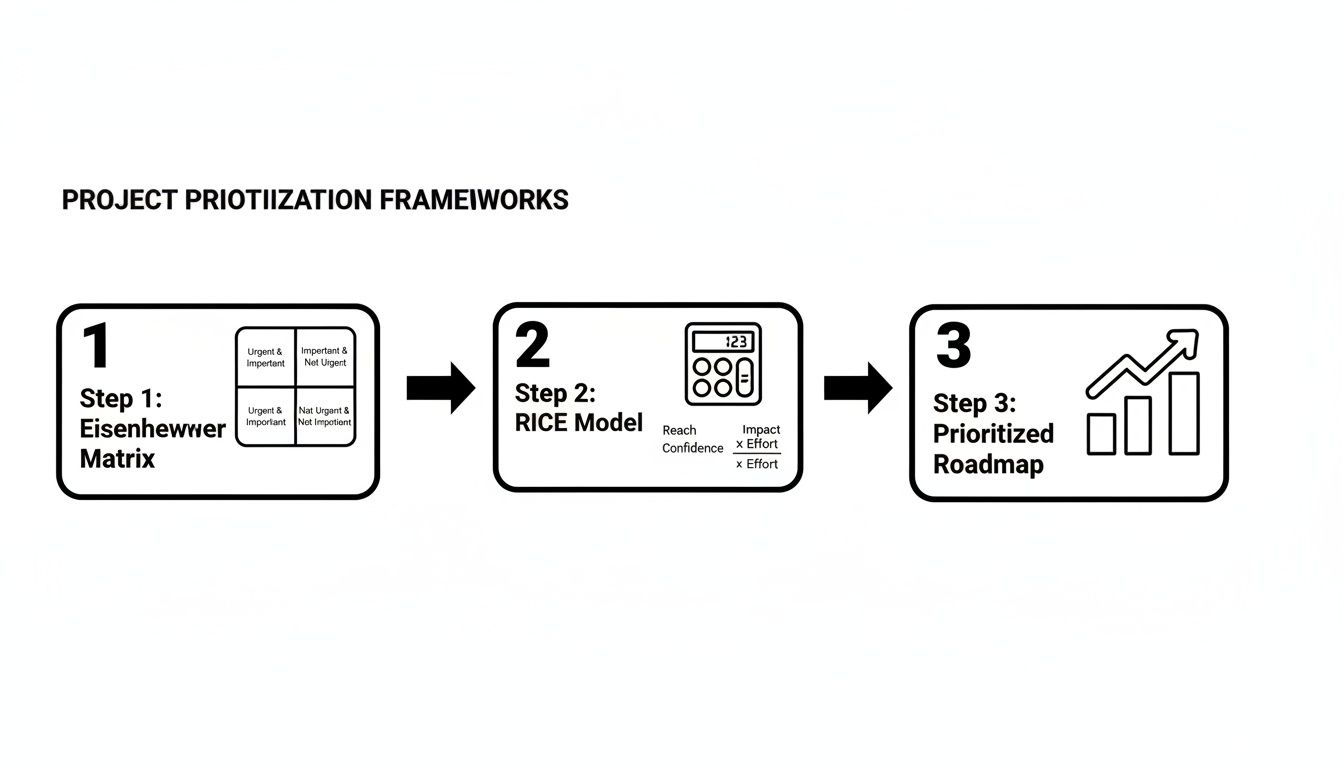
As you can see, the frameworks give you the 'what,' but the calendar provides the 'when.' It creates a direct, unmissable path from decision to action.
Practical Calendar Hygiene for Agency Life
To make this system stick, you need to establish some ground rules for how the team manages their calendars. These aren't about micromanagement; they're simple habits that prevent chaos and protect everyone's focus.
- Color-Code Everything: Assign specific colors to different clients, project types (billable vs. non-billable), or even activity types (deep work vs. meetings). This gives you an instant, at-a-glance overview of how time is being spent across the agency.
- Set Firm Meeting Rules: Institute "no meeting" blocks—maybe every Wednesday afternoon—to guarantee everyone has a solid chunk of time for uninterrupted work. It's also a good idea to require a clear agenda for any meeting invitation to put a stop to pointless gatherings.
- Use Descriptive Event Titles: Vague titles like "Catch Up" are productivity killers. A title like "Final Review: Project Phoenix Wireframes" provides immediate context and ensures everyone shows up ready to contribute.
By transforming your calendar from a passive record of appointments into an active plan for execution, you are building the operational muscle for managing time and priorities effectively. This proactive approach ensures that your most important work gets the time it deserves.
For more hands-on strategies, our detailed guide on effective calendar management and scheduling tips is a great next step. Putting these techniques into practice will help your team reclaim control of their schedules and start driving much more meaningful results.
End Timesheet Fatigue by Automating Time Tracking
Even if you’ve nailed your prioritization frameworks, one huge bottleneck plagues most agencies: the dreaded manual timesheet. It’s a tedious, inaccurate chore that teams hate and leaders can’t really trust. All that time spent looking backward drains energy that should be going into high-value, client-facing work.
The good news? This entire soul-crushing process can be almost completely automated. Modern, calendar-driven tools are built for this exact problem, freeing your team from the grind and turning time tracking from a chore into a source of powerful business intelligence.

This is what it looks like in practice. Tools like TimeTackle hook directly into your team's existing calendars, capturing activities as they happen without anyone needing to lift a finger. This passive data collection is the secret to getting a real-time, accurate picture of where your agency's most valuable resource—time—is actually going.
From Manual Guesswork to Automated Reality
The core idea is simple but incredibly powerful. By connecting your team’s Google or Outlook calendars to an intelligent platform, every single scheduled meeting, client call, and deep-work block gets logged automatically. This isn’t just about shaving a few minutes off everyone's week; it’s about building a dataset that reflects reality, not faulty memory.
This approach has become essential as our workdays get more chaotic. With remote and hybrid models, distractions are at an all-time high, making the challenge of managing time and priorities feel impossible. A Microsoft survey of over 31,000 users found that 68% feel they don’t have enough uninterrupted focus time. Their days are just a mess of meetings, pings, and emails. Learn more about these time management statistics and their impact.
When you automate how you capture these activities, you get a true, unfiltered picture of the workday—distractions included. This objective data lets you have real conversations about productivity and focus, instead of just going off of feelings.
Setting Up Smart Rules for Effortless Categorization
The real magic kicks in when you add rule-based automation. Forget manually tagging every hour. You can set up simple rules that do all the heavy lifting for you, creating a system that understands the context of your work.
Here are a few ways this plays out in a typical agency:
- Client-Based Rules: Any calendar event with "Client A" in the title or on the invite list is automatically tagged as billable work for that specific client. Simple.
- Project Keyword Rules: Events that mention keywords like "Project Phoenix" or "Q4 Campaign" get funneled into those project buckets automatically.
- Internal vs. External Logic: Meetings that only include internal company emails? Tagged as non-billable admin time, no questions asked.
These rules just run quietly in the background, sorting and categorizing work as it happens. It’s a massive win that eliminates the admin burden while ensuring your data is consistent and accurate across the entire team. With data you can finally trust, you get a clear view of utilization, enable precise billing, and empower your team to focus on the strategic work that actually grows the business. Our guide on how automated timesheets change the way you manage time dives even deeper into these benefits.
Measuring What Matters for Agency Growth
You can't fix what you can't see. Once you have accurate, automated time tracking in place, the soul-crushing work of data collection is done. Now you can focus on what really matters: turning that raw data into powerful business insights. This is where leaders stop being time-trackers and start becoming strategists for their agency's future.
The goal is to get way beyond a simple "billable vs. non-billable" split. You need to start asking the tough, strategic questions. How profitable is this client relationship, really? Which team members are constantly in the red, putting them on a fast track to burnout? Where are the hidden time sucks on this project? The answers are sitting right there in your team’s calendar data, waiting to be found.
Beyond Billable Hours to True Utilization
Real insight doesn't come from just counting hours. It comes from understanding your utilization rates—a metric that shows how much of your team's capacity is spent on productive, billable work. With the data handled automatically, you can slice and dice this information any way you want without getting lost in a sea of spreadsheets.
- By Team: Are your designers hitting 80% billable time while your account managers are stuck at 50% because of endless internal meetings? That's a bright red flag signaling a process bottleneck.
- By Individual: You can immediately spot the overachievers who are shouldering too much and the folks who might have bandwidth for that new project you've been wanting to start.
- By Project: See exactly where the hours are going within a specific project to make sure it's tracking with the original quote and scope.
This level of detail turns resource planning from a guessing game into a data-driven strategy. You finally have what you need to get the right people on the right tasks, every single time.
By analyzing where time is actually spent, you can have honest, objective conversations about workflow, capacity, and the real cost of internal meetings versus client-facing work. It’s the foundation for sustainably managing time and priorities at scale.
Surfacing the True ROI of Client Relationships
Every agency has them: the clients who seem profitable on paper but drain an incredible amount of team energy behind the scenes. Dynamic dashboards can finally reveal the true return on investment (ROI) by visually stacking the total time invested in a client against the revenue they bring in.
You might be shocked to discover that your highest-paying client is actually your least profitable once you account for all the extra calls, last-minute revisions, and hand-holding meetings.
This is the kind of insight that drives smart decisions. It helps you identify your most valuable partnerships and recognize which clients might need a pricing adjustment or a change in their service level. And this goes straight to the bottom line. While 62% of companies now measure productivity, many can't connect it to actual outcomes. This is especially true for agencies, where teams report spending up to 60% of their time on low-value tasks without good systems in place. You can find more data like this in these 2023 time management statistics.
By linking automated time data directly to revenue, you build an undeniable picture of your agency's financial health. It empowers you to put your energy and resources where they’ll generate the biggest return.
Got Questions? We’ve Got Answers.
Switching up how your agency manages time and priorities is a big deal. It touches on long-standing habits and workflows, so it's natural for questions to pop up. Here are a few of the most common ones we hear from operations leaders and project managers who are navigating this change.
How Can Our Agency Start Without a Massive Overhaul?
This is the big one, right? Nobody wants to blow up the entire system overnight. The key is to start small and prove the concept.
Don't try to force a massive process change on day one. Instead, pick a single, manageable experiment. For example, ask just one team to try the Eisenhower Matrix for a week. Their only job is to categorize their main tasks into the four quadrants—no complex software, no massive training session. Just a simple framework.
While they're doing that, you can use a tool that quietly gathers calendar data in the background, without anyone having to change their behavior. At the end of the week, you can sit down and compare the team's intended priorities (from the matrix) with where their time actually went (from the calendar data). This creates an instant, data-backed snapshot of the gap between intention and reality.
The goal is to demonstrate value fast, not to disrupt the whole agency. A small, successful pilot project is your best bet for getting team buy-in and building momentum.
What's the Biggest Mistake Agencies Make With Time Tracking?
Hands down, the biggest mistake is treating time tracking like a surveillance tool instead of a business intelligence asset. The moment your team feels like they're being watched, you've lost. They'll start filling out timesheets with what they think management wants to see, and your data becomes useless.
The real purpose of tracking time is to get a clear picture of project profitability, client ROI, and team utilization so you can make smarter business decisions. When you automate time capture directly from the calendar, you shift the focus from manual, often subjective data entry to objective analysis. It builds trust and gives leaders the real insights they need to steer the ship.
How Does Automated Time Tracking Improve Project Quoting?
Guesswork is expensive. Automated, calendar-based time tracking gives you an accurate, historical record of how long specific tasks and projects actually take to complete.
When you're quoting a new project, you can stop relying on gut feelings or overly optimistic assumptions. Instead, you can pull hard data from similar past work to build a data-driven estimate. This dramatically lowers the risk of underbidding, which is a fast track to unprofitable projects and a burned-out team.
Even better, once a project is wrapped up, you can compare the final time investment against the quote to calculate its true profitability. This helps you figure out which types of clients and projects are your agency's real money-makers, so you can focus your business development efforts where they'll have the biggest impact.
Ready to stop guessing and start knowing where your team's time is going? TimeTackle provides the automated, calendar-driven insights your agency needs to improve profitability, utilization, and focus. Learn more and see how it works.