


Most agency leaders already have a plan. It’s in a slide deck, a Notion page, or a PDF from the annual offsite. The problem isn’t that the plan doesn’t exist. The problem is that nobody can tell, on a normal Tuesday, whether the team’s time matches it.
That’s where long term planning usually breaks. The leadership team talks about new service lines, better margins, stronger delivery, and smarter hiring. Then the week starts. Client calls pile up. Internal meetings multiply. People jump between accounts. By Friday, everyone feels busy and nobody feels sure they moved the strategy forward.
I’ve seen this pattern enough times to stop treating long term planning as a vision exercise. For agencies, it’s an operating discipline. If you can’t connect future goals to the work showing up in your team’s calendar, you don’t have a plan. You have a wish list.
Beyond the annual offsite what long term planning really means for agencies
A lot of agencies mistake planning for documentation. They run an offsite, agree on priorities, write them down, and assume the hard part is over. Then the document sits untouched while account teams keep doing what the week demands.

That failure is usually operational, not intellectual. Most leadership teams can name the next few big bets. Fewer can show how those bets should change staffing, meeting patterns, sales activity, delivery capacity, or manager focus next month.
Planning is a system, not a yearly event
Long term planning works when it behaves like an engine. It takes in real operating data, turns that data into decisions, and keeps running through the year. Agencies already produce a lot of that data. Calendars show where leadership attention goes. Delivery meetings show where work gets stuck. Sales and pre-sales meetings show where growth effort is real versus performative.
If you’re trying to tie strategy to cash flow and resourcing at the same time, this guide on your business financial roadmap is useful because it frames planning as a practical management tool rather than a boardroom artifact.
A better model is continuous workforce and capacity planning. The mechanics matter more than the rhetoric. This is why I like operational approaches such as strategic workforce planning in practice, because they force the question agencies often avoid. What work should consume team time if the strategy is real?
Plans fail quietly when nobody can trace a strategic priority to a recurring pattern in the week.
What changes when you treat planning as operations
Once you stop treating long term planning as a document, a few things become obvious:
- Strategy needs a time signature. If a priority matters, it should appear in calendars, staffing choices, and delivery reviews.
- Resource trade-offs have to be visible. Taking on a new vertical, service, or market always means saying no to something else.
- The operating cadence matters more than the workshop. Quarterly review beats annual enthusiasm.
- Data beats memory. Most agencies think they know where time goes until they inspect it.
That shift is uncomfortable, because it removes the usual escape hatch. You can’t say a strategic priority matters if nobody spends time on it.
The agency planning gap from vision to utilization
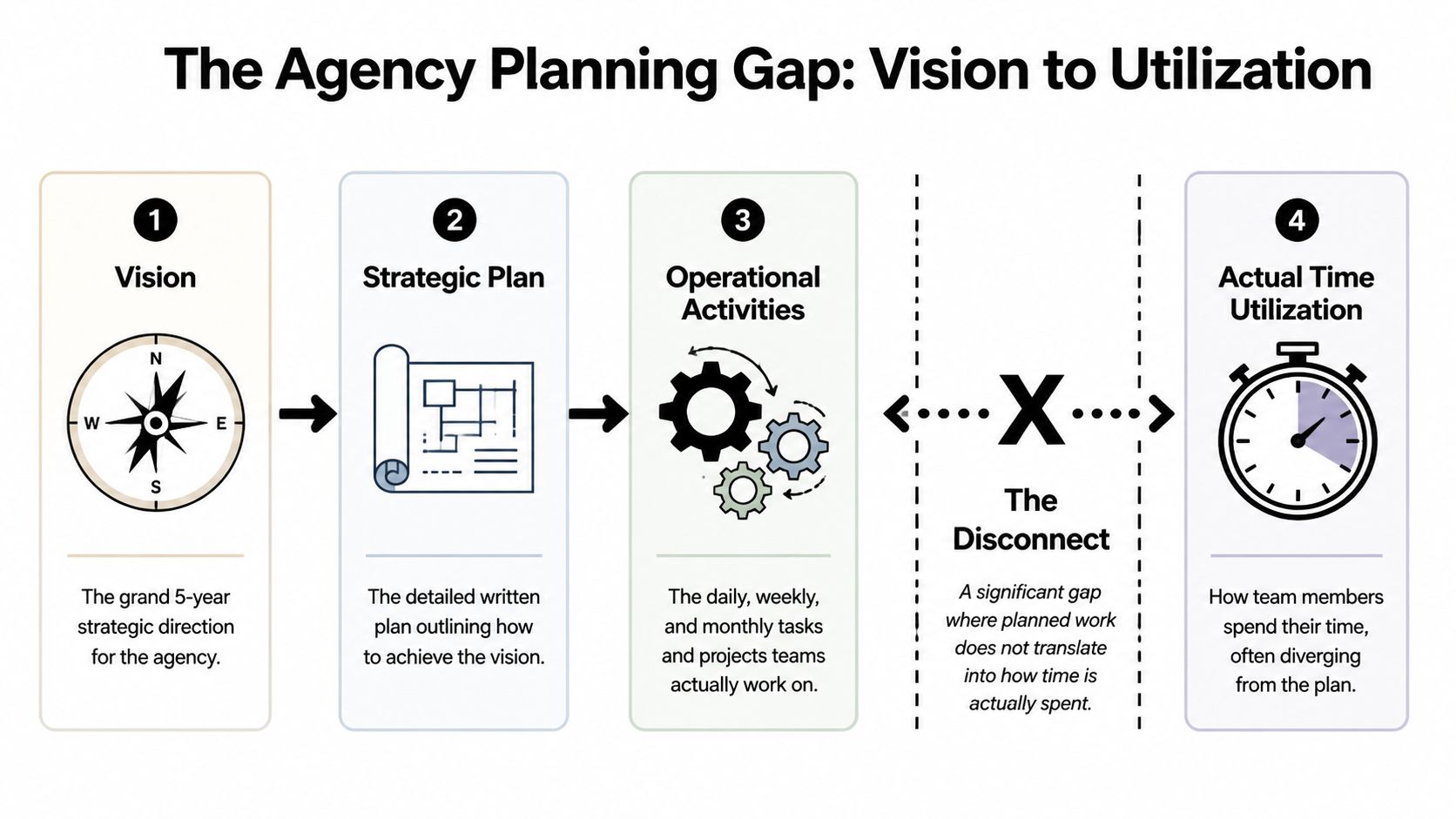
The gap isn’t between ambition and effort. It’s between strategy and time.
Agencies often have strong goals. Grow a new vertical. Improve margin quality. Move from one-off projects to retainer work. Build a consulting layer on top of execution. Those are all sensible aims. But the true test is whether the team’s actual hours reflect them.
Having a plan isn’t the same as executing one
There’s a hard truth in the data. According to Harvard Business Review, 95% of employees do not understand their company’s strategy. Yet, a study in the Journal of Management Studies found that companies with written business plans grow 30% faster than those without, as cited by Funding for Good’s strategic planning statistics roundup.
That tells you two things at once. Writing the plan matters. Leaving it at the leadership level does not.
In agency terms, this is why so many firms end up reactive even when they have a clean strategic narrative. The founders know the direction. Department heads know fragments. The delivery team knows what’s urgent. Nobody can see how this week’s work stacks up against the longer goal.
Utilization is where strategy becomes visible
If you want proof that strategy has entered operations, look at utilization. Not just whether people are busy, but what they are busy on.
A team can look fully loaded and still drift away from the plan. You see it in work that feels productive but has no strategic value. Internal coordination expands. Client maintenance crowds out service development. Senior people spend too much time rescuing delivery instead of building future capacity.
That’s why agencies need a cleaner read on where time goes. If you need a baseline, this guide on how to calculate utilization rate is useful because it gives you a concrete starting point for reading team capacity instead of guessing at it.
A strategy nobody can map to time allocation won’t survive contact with client work.
What the disconnect looks like in real life
You can usually spot the planning gap through a few recurring symptoms:
- Leaders say one thing, calendars say another. Growth is the stated priority, but most senior time goes to delivery cleanup.
- Teams stay busy without moving the business. Hours get consumed by recurring work that protects the present but doesn’t build the future.
- Hiring gets reactive. Agencies recruit to relieve pressure, not to support a defined long-range direction.
- Reviews stay vague. Instead of asking whether a strategic initiative got enough focused time, leaders ask whether people “feel stretched.”
This is why long term planning for agencies has to include utilization logic. Otherwise, the plan lives in one system and the work lives in another.
A practical framework for dynamic long term planning
Long term planning breaks down when strategy, staffing, and daily work live in separate conversations. Agencies need one model that links all three. The framework I use is Goals, Objectives, Initiatives, and Activities. GOIA is simple enough to use in leadership meetings and specific enough to hold up when you look at actual calendars.

Start with a goal that changes how the agency operates
A Goal is a long-range business outcome. It should affect what you sell, who you hire, where senior attention goes, and which work gets protected on the calendar.
Examples are straightforward. Build a healthcare vertical. Raise the share of retainer revenue. Reduce dependence on founder-led sales. Each one points to real operational consequences.
If a goal does not change time allocation, it is not a planning input. It is a slogan.
Define an objective that leadership can inspect
An Objective is the measurable result that shows the goal is progressing. In agencies, this usually sits on a 6 to 12 month horizon. That is close enough to manage and long enough to shape hiring, pipeline decisions, and delivery priorities.
Here is what that looks like in practice:
| Level | Example |
|---|---|
| Goal | Build a serious healthcare vertical |
| Objective | Win a defined set of healthcare clients over the next year |
| Initiative | Run targeted outbound, partnerships, and thought leadership this quarter |
| Activity | Sales calls, proposal work, case study creation, sector research, campaign reviews |
This structure removes a common source of wasted debate. Teams do not need to argue about whether something feels strategic. They can check whether the work supports a current initiative and whether that initiative supports an active objective.
Separate planning horizons before they blur together
Agencies get into trouble when annual direction, quarterly priorities, and weekly delivery all get discussed in the same room. The result is familiar. Leaders drift into task management, and managers leave without clear priorities.
Keep the horizons distinct:
- Strategic horizon: the 1 to 2 year direction, capability bets, positioning choices, and revenue mix you want to build
- Tactical horizon: the next quarter or two, including offers, campaigns, hiring moves, partnerships, and service development
- Operational horizon: the current week, including staffing decisions, client delivery, internal meetings, and execution risk
The separation matters because each horizon needs a different level of evidence. Strategic planning needs a view of where the business is headed. Tactical planning needs capacity assumptions. Operational planning needs a live read on who is spending time where.
That is where a resource layer matters. Good resource planning for projects turns strategic priorities into staffing choices, workload expectations, and timing constraints instead of leaving them as leadership intent.
Build initiatives that can be seen in the work
An Initiative is where planning becomes testable. It is a defined body of work with an owner, a time window, and expected activity. If a leadership team says a priority matters but cannot name the initiatives attached to it, the priority is not ready to run.
For agencies, initiatives usually fall into a few categories:
- New business development in a target segment
- Service line buildout
- Hiring and capability development
- Retention and account growth
- Operational improvement, such as reducing delivery drag or improving margin discipline
Each initiative should produce visible activity in the tools the team already uses. Meetings appear on calendars. Proposal work shows up in blocks of focused time. Hiring creates interview loops and scorecard reviews. Training creates recurring sessions. That visibility matters because it gives you a way to verify whether the plan is happening without relying on late timesheets or memory.
Track activities at the level managers can act on
An Activity is the observable work. Calls. Reviews. Planning sessions. Recruiting interviews. Proposal development. Internal training. Delivery checkpoints. This is the level where long term planning usually breaks, because the strategy looks clean in a slide deck but disappears once the week fills up.
The fix is operational discipline. Every meaningful activity should map upward:
Operating rule: Every activity should connect to an initiative. Every initiative should connect to an objective. Every objective should support one real goal.
That rule sounds basic. It is also where agencies find out whether a plan can survive contact with client work.
What GOIA fixes in practice
GOIA works because it gives each layer a job.
- Goals set direction.
- Objectives define progress.
- Initiatives organize investment.
- Activities show whether the investment is real.
That solves four recurring agency problems.
- Vague priorities. If leaders cannot translate a priority into initiatives, it is still a talking point.
- Random work intake. Managers have a clear basis for saying yes, no, or not now.
- Reactive staffing. Hiring can be tied to planned initiatives instead of current pain.
- Weak review cycles. Leadership can inspect whether strategic work received time, not just whether people stayed busy.
The value of the framework is not the acronym. The value is that it can be checked against actual work patterns. If the calendar does not reflect the plan, the plan is not running.
From plan to calendar how to operationalize your strategy
Monday starts with a leadership meeting about next quarter. By Thursday, the same people are buried in client escalations, interviews, proposal calls, and internal reviews. If the strategy only lives in a planning doc, it loses to the calendar every time.
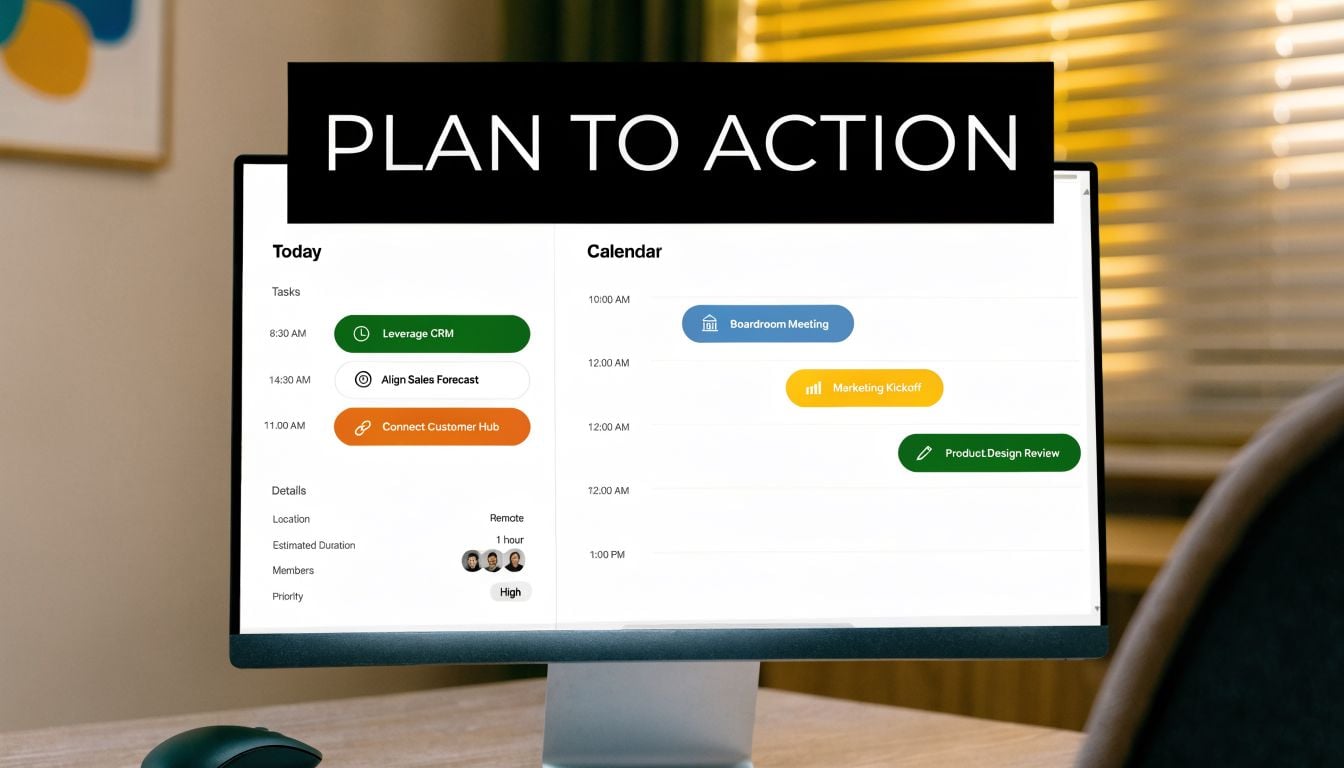
That is why operationalizing strategy has to happen inside the systems your team already uses. For agencies, the calendar is usually the cleanest place to start. It captures work as it happens, without asking people to reconstruct their week from memory or fill out timesheets nobody trusts.
Use tagging rules instead of chasing compliance
Agencies already generate a steady stream of operational data. Sales calls, delivery reviews, planning sessions, standups, recruiting interviews, training blocks, proposal meetings, and leadership check-ins all leave a trace on the calendar. The problem is not missing activity. The problem is that the activity is rarely categorized in a way leadership can use.
Manual reporting breaks here. People enter time late, pick inconsistent labels, or skip the step when client work gets busy. Then leadership reviews bad data and calls it a planning problem.
A better setup uses tagging rules tied to the work itself. If a meeting includes a client name, project code, pipeline stage, owner, or recurring title pattern, the system should classify it automatically. That lowers admin load and gives agency leaders a more reliable view of where time is going.
A workable setup for agencies
Keep the taxonomy small enough to survive real operations. In practice, four tag groups cover most agency planning needs:
- Client delivery tags. Separate core billable work from maintenance, rework, and senior intervention.
- Growth tags. Mark new business calls, proposals, partnerships, and market-specific campaigns.
- Capability tags. Track hiring, onboarding, training, process improvement, and service development.
- Management tags. Capture forecast reviews, staffing meetings, internal planning, and operational overhead.
Small beats clever here. If your team needs a training session to understand the tagging model, it is too complex.
Then build rules around fields that already exist. Calendar titles, attendee lists, CRM records, project names, meeting owners, and recurring event names usually give you enough signal to classify a large share of activity without extra effort from the team.
What this looks like in practice
A calendar-based planning system usually runs in five steps:
- Set the active initiatives for the quarter.
- Translate each initiative into tags that show up in daily work.
- Apply rules based on event names, client accounts, CRM stages, or project references.
- Review unmatched events weekly so edge cases do not pile up.
- Report time by initiative, team, and client to see whether actual effort matches the plan.
Agency planning starts to feel less theoretical when a leadership team can see, for example, whether the new service line is getting consistent time from senior staff, whether account leads are spending too much time on rescue work, or whether recruiting effort matches the headcount plan.
One option in this category is TimeTackle, which connects Google or Outlook calendars and CRMs, applies rule-based tagging, and turns captured activity into dashboards for utilization, project, client, and team analysis.
The best planning data comes from work people are already doing, not from a Friday reminder asking them to recreate the week.
Why calendars work better than memory
Calendars are not perfect. Deep work sometimes goes unblocked, and bad meeting hygiene can distort the picture. But for most agencies, calendar data is still more useful than retrospective timesheets and far cheaper than building a custom tracking process people will ignore.
It also exposes trade-offs that strategy decks hide. If managers say growth matters but all senior time is tied up in delivery meetings, the issue is visible. If capability building is a priority but training time keeps disappearing, the calendar shows that too.
That is the point. Long term planning gets real when leadership can compare stated priorities with scheduled behavior, then adjust staffing, meeting load, and investment before the quarter is gone.
Tracking progress with KPIs and calendar analytics
Monday morning is when weak planning shows up. The quarterly plan says build a new service line, improve margins, and reduce delivery fire drills. Then the calendar shows senior people spent last week in status meetings, client rescues, and internal approvals. That gap is what KPIs should expose.
The point is not to build a prettier dashboard. It is to give leadership an operating view of whether time is going where the plan says it should go.
Track effort before outcomes show up
Revenue, margin, retention, and sales still matter. They are just late signals. By the time those numbers move, a quarter is often gone.
Calendar analytics give agencies earlier warnings. If strategic work keeps losing time to support, rework, or internal churn, that shows up before the P&L does. If business development is supposed to be a priority but account leads have no protected prospecting time, leadership can see the conflict while there is still time to fix it.
A practical planning dashboard should answer a small set of questions:
| KPI type | What to track |
|---|---|
| Leading indicators | Time spent on strategic initiatives, time spent on new business activity, time spent on capability building, variance between planned and actual effort |
| Lagging indicators | Revenue mix, margin quality, client retention, new service sales, delivery performance |
That split matters because agencies do not fail long-term plans only through bad ideas. They fail them through allocation drift.
Keep the dashboard small enough to use
A useful dashboard is boring in the right way. Department heads should be able to look at it and know what decision needs to happen this week.
For most agencies, that means reviewing effort and allocation every week, then looking at business outcomes monthly or quarterly. Weekly review catches drift while it is still operational. Monthly and quarterly review shows whether those allocation choices are producing the commercial result you wanted.
Manual tracking usually breaks here. People forget what happened, reconstruct the week badly, or code time based on what sounds acceptable rather than what occurred. That is why calendar data is so useful. It captures work close to real time, with less admin and less revisionist history.
If a KPI takes too much effort to maintain, people will keep filling it in long after they have stopped believing it.
What to review in the leadership meeting
Leadership does not need twenty charts. It needs a short operating review tied to decisions.
Use the meeting to answer questions like these:
- Did strategic initiatives receive the hours they were supposed to receive?
- Where did planned time get pulled into reactive work?
- Which leaders are spending too much time inside current delivery instead of future growth?
- What recurring meetings or approvals are consuming capacity without improving outcomes?
- Does the current staffing pattern support the business model for the next 12 months, or only the pressure of this week?
One practical move is to review these questions by role, not just by department. Agency plans often fail because senior specialists, team leads, and principals all get dragged back into delivery. Calendar analytics make that visible fast.
If you are using a platform such as TimeTackle to tag calendar activity and roll it into reporting, the value is not the dashboard itself. The value is that leadership can compare planned priorities against actual time use without waiting for manual timesheets to be cleaned up at month end.
Common pitfalls and how to avoid them
Monday starts with a leadership meeting about growth. By Thursday, the same leaders are approving rush requests, filling delivery gaps, and wondering why the strategic plan keeps slipping. That pattern usually comes from a few operating mistakes, not a lack of ambition.
Planning for full utilization
The first mistake is building the plan around perfect capacity. Agencies do this all the time on paper. Every billable role looks fully allocated, every initiative gets staffed, and nobody accounts for approvals, internal reviews, client wobble, sick days, or the fact that creative and strategic work both degrade under constant context switching.
For complex client work, teams need slack. Earlier in the article, I noted the common benchmark of planning below full utilization. The exact percentage matters less than the discipline behind it. Leave room for real work to happen, or your plan will fail the first week it meets reality.
A practical rule is simple. If a team is booked solid, it is already overcommitted.
Use calendar data to test this instead of arguing about it. If senior people spend large blocks in recurring internal meetings, client escalations, and unplanned support, they are not available for the strategic initiatives they were assigned to.
Treating adoption as a software problem
Another failure point is assuming a new tool will fix a weak planning process. It will not.
Teams stop using planning systems when the categories feel arbitrary, the data disappears into a dashboard nobody discusses, or the only visible outcome is more scrutiny. I have seen agencies buy a cleaner interface and get the same bad behavior because they never answered the basic questions. What are we tracking. Who reviews it. Which decisions change because of it.
Hireclout’s discussion of team structure and long-term velocity points to a familiar issue. Shared vision and day-to-day adoption usually break down together, not separately. That is exactly what happens in agencies when leadership talks about strategic priorities, but the calendar still rewards reactive work.
Make the link explicit. Show people how tagged time affects staffing, hiring plans, meeting cuts, account load, and leadership attention. If you use calendar tagging in a tool such as TimeTackle, the benefit is not employee monitoring. The benefit is a cleaner record of where time went, so managers can fix the system instead of debating opinions.
Making the model too complicated
The third mistake is overdesign. Leaders want precision, so they create too many categories, too many exceptions, and too many reporting views. The system becomes harder to maintain than the decisions it is supposed to support.
Keep the model boring enough to survive contact with the week.
- Use a small set of categories. Billable delivery, internal operations, business development, strategic initiatives, and management overhead are often enough to start.
- Tag work at the level of a decision. If no leadership decision depends on the distinction, do not create the category.
- Review the model on a fixed cadence. Quarterly is usually enough to clean up drift without retraining everyone every month.
- Show examples of action taken. Cut a standing meeting, rebalance account ownership, or protect focus time for a growth initiative, then point back to the data that supported it.
A planning system should make trade-offs easier to see and easier to act on.
Perfection is not the goal. A stable operating view is. If your calendar data can show where strategic work loses time, which roles are overloaded, and where leadership attention keeps getting pulled back into delivery, you have enough to plan well.
Frequently asked questions about agency long term planning
How often should an agency review its long-range plan
Review the long-range direction quarterly. Review active initiatives monthly. Review team activity and workload weekly. If you only look once a year, you’ll spot drift too late to fix it without a scramble.
What’s the biggest mistake agencies make
They plan around revenue targets without a matching resource plan. That creates a fantasy strategy. If you want a new service line, market, or client mix, you need to show where team time, leadership focus, and hiring capacity will come from.
We don’t have a formal process yet. Where should we start
Start small and keep it operational.
- Pick one real business goal. Not ten.
- Define the current initiatives that support it.
- Tag calendar activity against those initiatives for one team or department first.
- Review the data weekly for a month and clean up the categories.
That first pass usually exposes more than another strategy workshop will. You’ll see what work eats capacity, where strategic effort is thin, and which recurring meetings nobody would defend if they had to justify them.
Do we still need timesheets
Some agencies will, especially for billing or compliance. But for planning, forecasting, and resource decisions, calendar-based capture is often a cleaner source because it reflects work as it happens instead of asking people to reconstruct the week later.
If you want to make long term planning less theoretical and more visible in day-to-day work, TimeTackle is worth a look. It helps teams capture calendar activity, categorize work with rules, and turn that data into dashboards you can use for utilization, forecasting, and strategic follow-through.