



You review the month-end numbers and something feels off.
The team worked late. Clients got answers. Nobody looked idle. But one account still ran over budget, another slipped, and your project leads can't explain where the time went without digging through calendars, Slack threads, and half-finished timesheets. Finance says margins are thin. Delivery says the scope changed. Account management says the client was “high touch.” Everyone is probably telling part of the truth.
That's what poor time management looks like inside an agency.
It rarely shows up as one person being disorganized. It shows up as a business that confuses motion with control. Work keeps moving, but capacity is unclear, reporting is delayed, and profit leaks out through small decisions nobody can see in real time. The result is familiar. Teams feel pressed, leaders feel blind, and clients feel the wobble before the agency does.
If you run a service business, time is not a soft issue. It is the operating system behind delivery, pricing, staffing, and margin. If you can't see how your team spends time, you can't separate useful effort from avoidable overhead. That's why the split between billable and non-billable work matters so much. It's not an accounting detail. It's the line between healthy operations and quiet loss.
Your agency isn't “busy” it's burning cash
A lot of agency leaders describe the same post-mortem.
The project looked fine at kickoff. The estimate passed the gut check. The team stayed engaged. Then delivery stretched, revisions multiplied, internal coordination grew, and by the time the work closed, nobody could say with confidence whether the account was profitable. The project manager felt underwater. The creative lead felt interrupted all week. The client noticed delays and asked for more visibility.
That is not a motivation problem. It's an operating problem.
What this looks like in practice
Poor time management inside an agency usually hides behind respectable language:
- “We've just been slammed.” The team is working hard, but hard work alone doesn't tell you whether time went to client delivery, internal churn, or admin cleanup.
- “The scope got messy.” Sometimes it did. Sometimes the bigger issue is that nobody tracked where extra effort started piling up.
- “Timesheets are always late.” That usually means your reporting method fights the way people work.
I've seen agencies blame margin pressure on pricing when the underlying issue was invisible labor. Meetings multiplied. Status updates expanded. Senior people got pulled into routine decisions. Work crossed too many tools before it reached the client. On paper, everyone stayed productive. In reality, the agency paid for a lot of effort it never priced, billed, or learned from.
Poor time management is expensive because it turns labor, your biggest delivery cost, into a guessing game.
Why leaders misread the problem
Leaders often spot the symptoms first. Burnout. Missed deadlines. Client frustration. Low confidence in reports.
What they don't always spot is the shared cause. The business lacks a system that captures how time is used, where effort drifts, and when work leaves the plan. So the agency keeps treating recurring operational failures like isolated incidents.
If that sounds familiar, you do not need another speech about personal discipline. You need a clearer operating model.
The warning signs of a time management crisis
The mess usually shows up long before the P&L makes it obvious. You can spot it in team behavior, reporting quality, and how often managers have to “chase” information.

Sign one: timesheet battles never end
If your managers spend part of every week reminding people to log time, fixing missing entries, or reconciling vague blocks like “client work,” your system is already failing.
Late or weak time data does more than annoy finance. It blocks basic operating decisions. You can't trust utilization. You can't review project drift early. You can't explain margin changes without a manual investigation.
Sign two: interruption becomes the default mode
In many agencies, people rarely finish one piece of work before another request lands. That sounds normal until you attach a cost to it. The average office employee is interrupted 11 times per hour, and each interruption takes about five minutes to recover from. That consumes roughly 50% of an average workday and costs U.S. businesses $588 billion annually, according to these time management statistics.
That number matters because agency work depends on attention. Strategy, creative review, implementation, QA, and client communication all get weaker when the day breaks into fragments.
Operational rule: If your team lives in reaction mode, your delivery plan is fiction.
Sign three: projects look fine on paper, bad in the room
Some accounts technically “close” on time, yet everyone involved feels like they lost. The team looks drained. The client needed repeated follow-up. Leaders had to step in more than they should have. Those are signs that the agency used too much unplanned coordination to get the work over the line.
That kind of project often survives because the cost is buried across calendars, messages, and internal meetings rather than attached cleanly to the account.
Sign four: nobody can tell where service starts and operations ends
This one matters a lot in hybrid delivery teams. When requests arrive through email, chat, meetings, shared docs, and ad hoc pings, your service model gets muddy. If you're trying to sort that out, it helps to compare help desk and service desk models, because the structure behind incoming work changes how teams spend time and how much triage overhead they absorb.
A quick diagnostic table
| What you see | What it usually means |
|---|---|
| Late timesheets and corrections | Your capture method adds too much friction |
| Constant context switching | Work intake and prioritization are weak |
| Margin surprises after project close | Estimates and actual effort are disconnected |
| Managers acting as traffic controllers | The system depends on manual intervention |
Poor time management rarely arrives as one dramatic failure. It arrives as a pile of small delays, small misses, and small workarounds that become normal.
Why “trying harder” isn't working
Teams often don't fail because they don't care. They fail because effort is carrying a system that should have been doing more of the work.
That matters, because a lot of agencies still respond to poor time management with pressure. They ask people to be more disciplined, update timesheets faster, prioritize better, and avoid distractions. Some of that advice is fine at the personal level. It just doesn't fix the operating conditions that created the problem.
Most people are working without a system
Research shows that 82% of people lack a dedicated time management system, and many are held back by unconscious obstacles like perfectionism, a need for control, or taking pride in being overworked, according to these findings on time management habits.
That tracks with what shows up inside agencies. People use inboxes as task lists. They keep work in their heads. They rely on memory at the end of the week to reconstruct what happened. Then leaders wonder why reporting is inconsistent and planning is unreliable.
The issue isn't that your team needs more reminders. It's that informal habits can't support a business that sells time, judgment, and responsiveness.
The culture can make it worse
Agencies often reward the wrong signals.
The person who responds instantly looks committed. The lead who joins every call looks accountable. The manager who never seems “offline” looks dependable. But those behaviors often create the exact conditions that ruin good time management: constant interruption, weak delegation, and no protected time for deep work.
Here's the harder part. Some people resist visibility because it feels threatening. They worry time tracking will expose inefficiency, reduce autonomy, or invite second-guessing. Others resist structure because they believe being overloaded proves their value.
If your culture treats overwork as status, no tool will fix the problem on its own.
What “trying harder” usually leads to
When agencies push effort without fixing structure, they get a familiar cycle:
- More manual cleanup: Project leads chase data after the fact.
- More heroics: Senior people step in to rescue work that drifted.
- More resentment: Teams feel watched, but not supported.
- Less learning: The business repeats the same estimation and staffing mistakes.
That's why poor time management is not just a productivity topic. It is a change management issue. People need a way of working that is clear, low-friction, and fair. They also need leaders to stop treating visibility as surveillance and start treating it as shared operational truth.
How to diagnose the problem with data
You cannot fix what you only describe with words like “busy,” “chaotic,” or “behind.” You need evidence that shows where time goes, where plans break, and where admin work is crowding out delivery.
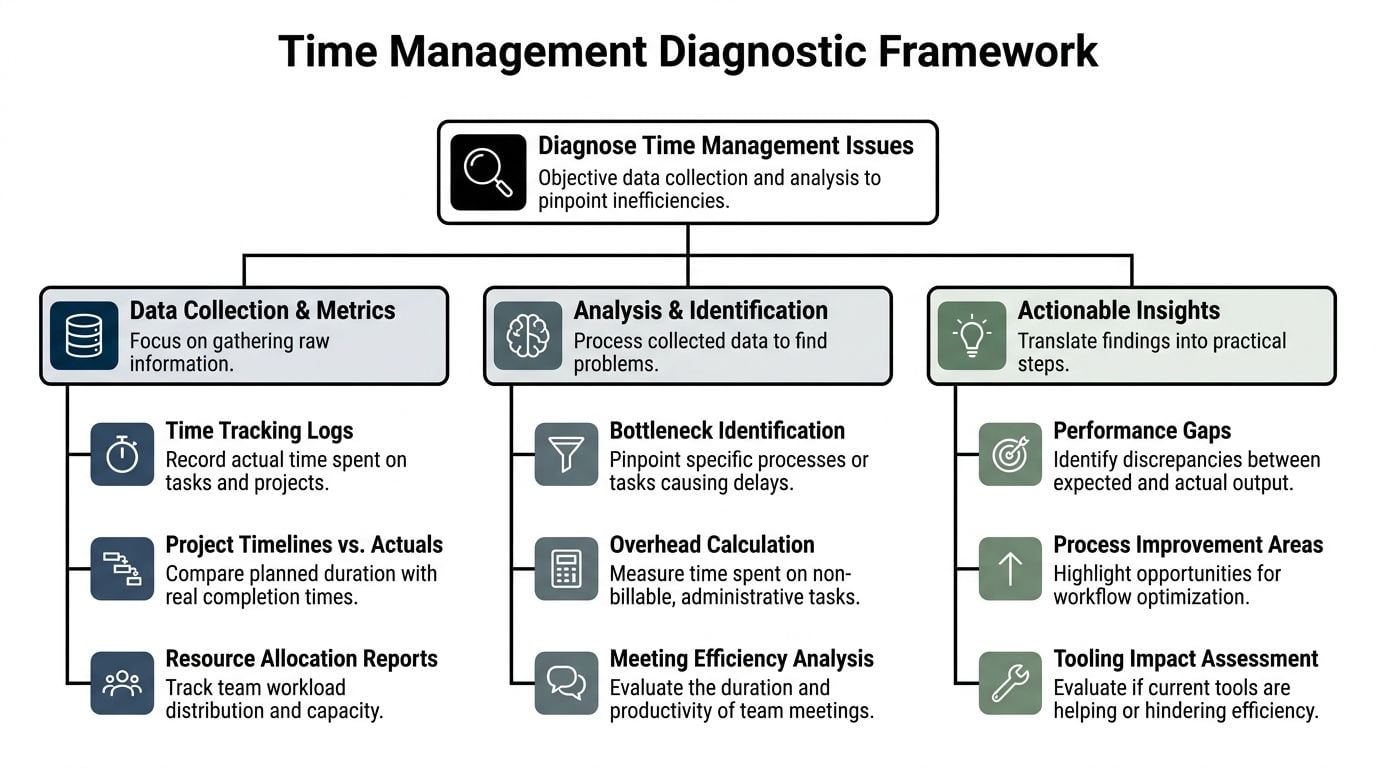
A good place to start is a structured time audit process for teams and leaders. The point is not to produce perfect records on day one. The point is to replace opinion with visible patterns.
Start with a baseline audit
Pull a short window of real work and examine it closely. Look at calendars, meetings, delivery blocks, internal admin, project coordination, and unplanned requests.
You want answers to questions like these:
- Where does work happen? In scheduled focus blocks, meetings, inboxes, or constant chat interruptions?
- How much effort is invisible? Client prep, internal handoffs, revisions, reporting, and approval loops often sit outside the original estimate.
- Who is carrying hidden coordination work? Project managers, department leads, and senior specialists often absorb time no one budgets for.
A useful audit does not start with blame. It starts with classification.
Compare estimates with actuals
Many agencies pinpoint a substantial source of inefficiency. Engineering teams typically underestimate project timelines by 20–40%, and a 100-hour estimate often requires 160+ hours in reality, according to this analysis of missed engineering deadlines.
Even if your agency is not an engineering firm, the pattern is familiar. Estimates usually cover visible production work better than integration, QA, revisions, internal review, and client coordination. That missing effort lands later as margin erosion.
Don't ask whether your estimate was wrong. Ask what work category was absent from the estimate.
Use a simple diagnostic view
| Diagnostic area | What to compare | What you're looking for |
|---|---|---|
| Capacity | Planned workload vs actual calendars | Overcommitment, idle pockets, or constant spillover |
| Utilization | Billable work vs internal/admin time | Whether delivery time is getting crowded out |
| Estimation | Quoted effort vs recorded effort | Repeat gaps by service line, client type, or team |
| Workflow | Planned tasks vs interruption-heavy days | Whether intake and approvals are breaking focus |
Look for repeated variance, not one-off errors
One late project tells you very little. A pattern tells you how the business runs.
If the same service line always needs extra internal review, that is a process issue. If certain clients always generate unplanned support work, that is a scoping or account-management issue. If managers spend every Friday rebuilding time records, that is a tooling issue.
The point of diagnosis is simple. You want enough clean data to say, with confidence, “where our time goes, where estimates fail, and where operational friction is costing us.”
A framework for fixing time management at the team level
Once you can see the problem, the fix is less about motivation and more about design. Teams need a working system that captures activity cleanly, reduces admin burden, and turns time data into better operating decisions.

The reason this matters is straightforward. Engineers and other technical professionals can spend up to 33% of their time on non-value-added tasks like searching for information and managing data. For a team of 100, that can equal over $15,000 in wasted labor costs per week, based on this breakdown of non-value-added data work. Agency teams hit the same trap when time capture, reporting, and work handoffs live in too many places.
Build around work capture, not memory
If people have to remember everything they did at the end of the week, your data will always be late and incomplete.
Start with the systems your team already uses every day. Calendar, CRM, project tools, and meeting records usually contain the raw signal. From there, create rules for how work gets tagged, reviewed, and approved.
What matters most is consistency. If one team logs by client, another by task, and another by vague categories, you'll get reports that look detailed but answer nothing.
A stronger setup usually includes:
- Standard categories: Client delivery, internal ops, business development, admin, management, and non-billable support all need clear definitions.
- Shared tagging rules: Teams should know how to classify meetings, prep time, follow-up, and revision work.
- Light review habits: Managers should correct patterns early, not clean up the whole month later.
- Connected reporting: Time data should flow into project review, staffing, and finance without manual rework.
Use the calendar as the operational backbone
For many agencies, the calendar is the most honest source of how time is really spent. Meetings, calls, reviews, internal check-ins, and focus blocks all leave a trace there, even when timesheets do not.
That is why calendar-based tracking often gets better adoption than blank manual entry. It starts from actual activity instead of asking people to recreate their week from memory. Tools in this category vary, but one option is business time management software built around calendar data, which connects calendars and related systems to categorize work with less manual entry.
Create a weekly feedback loop
Fixing poor time management requires recurring review, not one big rollout.
A practical weekly rhythm looks like this:
- Team leads review where time went by client, project, and internal category.
- Operations checks whether planned capacity matched actual effort.
- Finance or leadership spots accounts where service cost is drifting ahead of assumptions.
- Managers adjust staffing, scope, or workflow before the month closes.
If your team works in sprints or structured delivery cycles, this gets easier when planning and review are disciplined. A solid agile sprint planning guide can help teams think more clearly about commitments, buffers, and handoffs, especially when work crosses strategy, design, and implementation.
Good systems make the right behavior easy. Bad systems ask managers to police people into compliance.
The leadership move is not to demand perfect discipline from tired teams. It is to remove the friction that makes accurate time management feel like extra work.
Choosing tools that reduce friction not add it
A lot of agencies respond to poor time management by buying another tool. That often makes the problem worse.
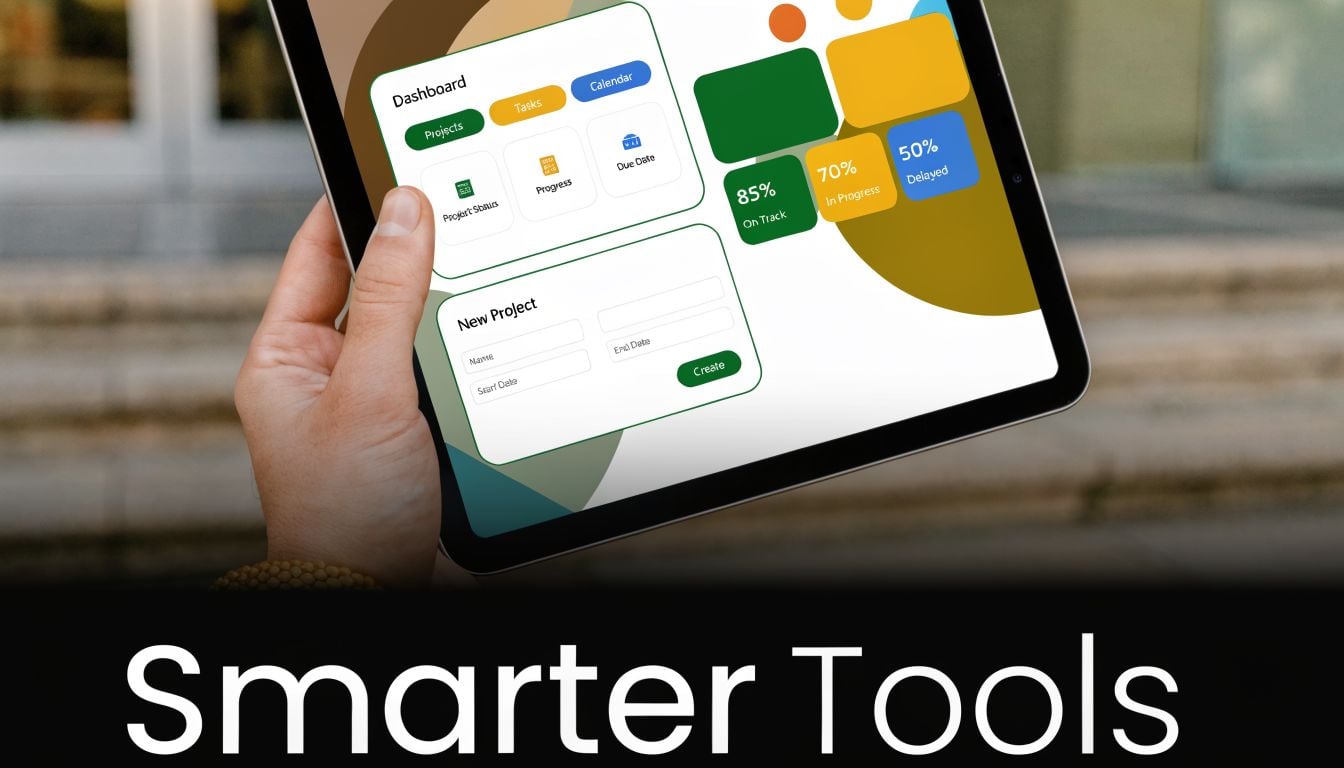
When professionals already juggle tasks across apps, messages, and emails, adding more disconnected software can create duplicate data entry and more cognitive load, as noted in this discussion of fragmented time management tools. The tool meant to create order becomes one more place work has to be updated.
What bad tool choices look like
You can usually spot tool overhead fast:
- People enter the same information twice. Once in the project tool, again in the timesheet.
- Managers export and reconcile data by hand. Reports exist, but nobody trusts them until someone fixes them.
- Notifications multiply. The team spends more time responding to systems than doing work.
- Adoption depends on nagging. If the tool only works when someone chases people, it's not a good operational fit.
A better way to evaluate software
Ask one question first. Does this tool reduce manual work for the team, or create more of it?
That sounds simple, but it rules out a surprising amount of software.
Here's a practical comparison:
| Tool pattern | Likely result |
|---|---|
| Manual timesheet first | Low adoption, weak accuracy, end-of-week reconstruction |
| Calendar and workflow connected | Better capture, faster review, less memory-based logging |
| Standalone reporting tool | More exports and reconciliation work |
| Integrated operational data | Clearer utilization, project review, and staffing decisions |
If your team already lives in Google Calendar or Outlook, start there. If sales and delivery data sit in a CRM, connect that too. If project status sits elsewhere, decide what the source of truth is before adding another layer.
A useful system should shrink admin effort, not move it around. It should also make review easier for operations and finance, instead of creating one more dashboard nobody owns.
Stop managing time and start leading your operations
Agency leaders often treat poor time management as a people problem. Someone needs better habits. Someone needs to log time faster. Someone needs to stop multitasking.
That framing is too small.
If the business depends on labor, then time is an operating asset. How you capture it, classify it, review it, and act on it shapes margin, staffing, delivery quality, and culture. When that system is weak, good people end up doing unnecessary admin, rescuing avoidable problems, and arguing over data nobody trusts.
The real leadership shift
You do not fix this by watching people more closely. You fix it by making work easier to see and easier to manage.
That means:
- Give teams fewer manual chores
- Set one clear method for classifying work
- Review time data as an operating signal, not a compliance exercise
- Treat recurring overrun patterns as system failures, not personal flaws
Agencies improve when leaders stop asking, “Why can't people manage their time?” and start asking, “Why is our system so hard to work inside?”
The agencies that get this right usually become calmer before they become faster. Managers spend less time chasing updates. Teams spend less time reconstructing the week. Finance gets cleaner visibility. Delivery gets earlier warning signs. Clients feel the difference because the work arrives with less scrambling behind it.
That is what good time management looks like at the business level. Not tighter control. Better operations.
If you want a practical way to reduce timesheet fatigue and get clearer visibility from the calendar systems your team already uses, TimeTackle is worth a look. It connects calendar and work data so teams can capture and categorize time with less manual effort, which gives operations leaders a cleaner view of utilization, project effort, and reporting without turning time tracking into another weekly battle.