


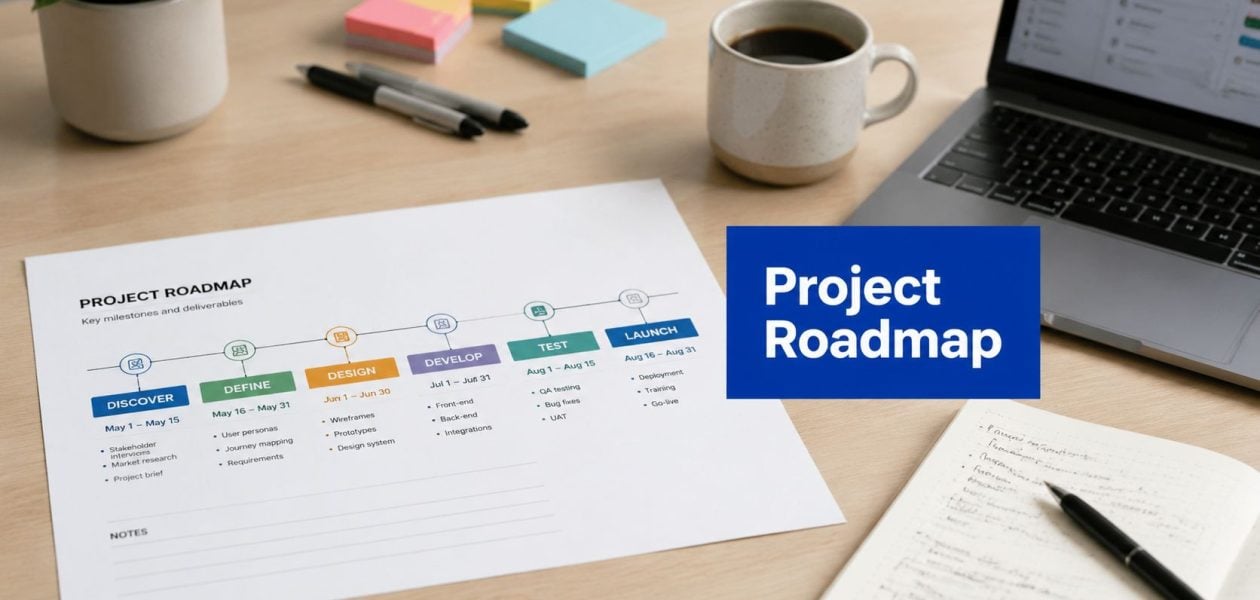
You're probably dealing with one of two versions of the same problem.
In the first, your client wants “a road map” and really means, “Show me when I'll get what I paid for.” In the second, your internal team already has a project plan, a pile of tasks in Asana, ClickUp, Monday.com, or Jira, and still can't answer a simple question in a status call: “Are we on track?”
That's where a good road map in project management earns its keep.
In agency work, the roadmap is the document that keeps strategy, timing, and staffing in the same conversation. It gives clients enough visibility to trust the plan, without dragging them into every subtask. It gives delivery leads a way to talk about progress in terms that matter: milestones hit, approvals secured, handoffs cleared, risks exposed, and capacity still available to do the work.
A bad roadmap is a pretty slide. A good one is a working agreement.
What a project roadmap is (and what it is not)
A project roadmap is a visual, strategic planning tool. Atlassian describes it as a way to outline a project's key components, milestones, and timelines, while giving stakeholders a high-level view of goals, deliverables, and progress indicators in one place, which is why it sits above the detailed execution layer rather than replacing it in day-to-day delivery work Atlassian on project roadmaps.
That distinction sounds small until you're in a client meeting.
If you put a task-level schedule in front of a client, they'll comment on everything. They'll ask why one designer task takes two days, why QA starts later than they expected, or why an internal review exists at all. You've moved the conversation down to the operating level, which is rarely where you want stakeholder decisions to happen.
If you put a roadmap in front of them, the conversation stays where it should be. Are we still on pace for design signoff? Is development blocked by content? Does the planned launch date still match the current scope?
What belongs in a roadmap
A roadmap should answer a short list of stakeholder questions:
- What are we trying to achieve: The business goal or outcome.
- What are the major checkpoints: Milestones such as discovery complete, design approved, build complete, testing complete, launch ready.
- When should each checkpoint happen: Rough timing, not hour-by-hour scheduling.
- What might affect timing: Dependencies, handoffs, approvals, or external blockers.
That's enough to guide decisions. It's not enough to run production, and that's fine.
What does not belong there
A roadmap is not your task board. It is not your sprint backlog. It is not the place to list every revision round, every internal note, or every task dependency at the subtask level.
For that, you need a separate execution tool and often a separate project management work plan. New PMs often try to merge both into one artifact because it feels efficient. In practice, it creates a document that is too detailed for stakeholders and too vague for the people doing the work.
Practical rule: If a line item only matters to one person doing the work, it probably belongs in the plan, not the roadmap.
A roadmap should stay readable in a few minutes. If someone has to zoom in, scroll sideways, or ask what half the acronyms mean, you've already lost the point of it.
Why agencies need this separation
Client-facing work has more approval loops, more handoffs, and more calendar pressure than many internal projects. A roadmap helps you show the shape of delivery without turning every status meeting into a debate over task management.
That matters because no project runs exactly as planned. Scope changes. Review cycles stretch. The client's legal team appears late. A key specialist gets pulled onto a fire drill. The roadmap gives you a stable frame for discussing those shifts without rebuilding the entire story each week.
The core components of an effective roadmap
A useful roadmap is simple, but it isn't vague. It needs enough structure to tell the truth about the project.
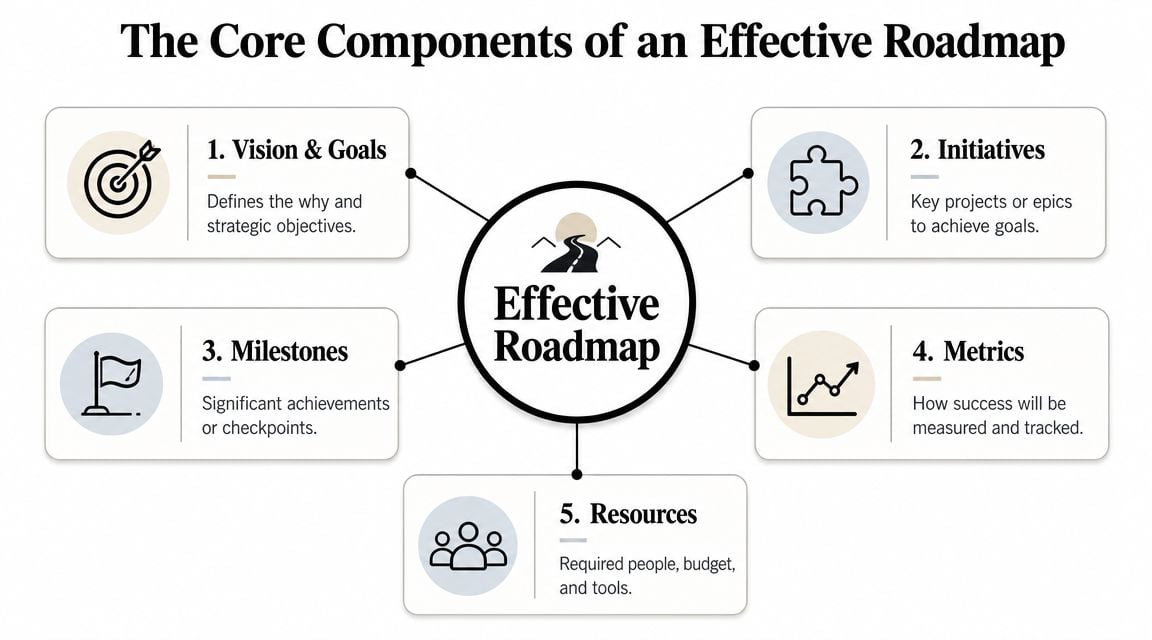
Notion's guidance gets this right. An effective roadmap should capture strategic goals, major milestones, deliverables, rough timing, and dependencies, while avoiding task-level detail because the roadmap is for prioritization and stakeholder alignment, and the detailed plan belongs elsewhere Notion's project roadmap guidance.
Here's the visual version first.
Start with outcomes, not activity
A lot of weak roadmaps begin with a list of things the team plans to do. That sounds reasonable, but it usually produces clutter fast.
Start with the outcome instead. For an agency project, that might be a site launch, a CRM implementation, a paid media rollout, or a reporting migration. Once the outcome is clear, the rest of the roadmap gets easier to shape because each milestone has to prove movement toward that result.
The five pieces that matter
Use these as the backbone:
- Goals: The business result the project is meant to create. If the goal isn't clear, every later timing discussion becomes a scope discussion.
- Milestones: Major checkpoints such as strategy approved, UX complete, build ready, user testing complete, launch approved.
- Deliverables: The tangible outputs tied to those milestones. A design deck, wireframe set, tracking plan, analytics setup, migration package, or campaign asset set.
- Dependencies: The work that must happen first, or outside inputs the team is waiting on; many agency roadmaps often become overly optimistic when accounting for these.
- Rough timing: Sequence and target windows. Enough to guide decisions, not so much that the roadmap turns into a daily schedule.
Why task detail makes it worse
When PMs first build a roadmap, they often worry that “high level” means “not useful.” So they add more. Then more. Then suddenly the roadmap has fifty rows, a color legend nobody remembers, and exact dates for tasks that are going to move anyway.
That's the wrong trade-off.
The roadmap should make trade-offs visible, not bury them. If design approval slips, the roadmap should show the likely effect on development start. If client content is late, the roadmap should make that dependency visible. If the only way to hold the launch date is to cut a phase or add staffing, the roadmap should make that discussion possible.
A roadmap should tell you where decision pressure is building. It should not try to document every motion inside the team.
A simple agency example
For a website rebuild, a workable roadmap might look like this:
| Component | Example |
|---|---|
| Goal | Launch the new site with approved content and tracking in place |
| Milestone | Discovery complete |
| Deliverable | Final requirements and site architecture |
| Dependency | Client stakeholder interviews completed |
| Timing | Early project phase |
That level is enough for most stakeholder reviews. Your production plan can carry the rest.
Four roadmap types for professional services
Not every roadmap should look the same. The right format depends on the question you're trying to answer and who's in the room.
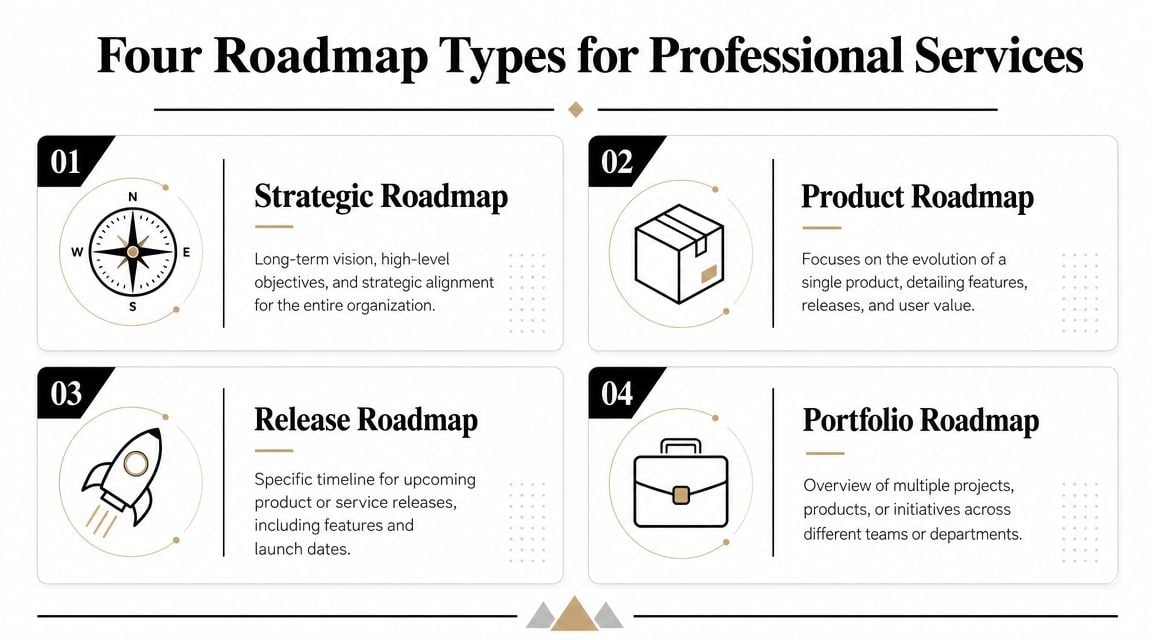
Strategic roadmap
Use this when leadership needs a top-level view of where the agency or practice area is going.
This works well for service line expansion, internal process changes, or a major operational shift like moving to a new delivery model. It's less about one project and more about direction. A COO, department head, or delivery director usually cares most about this version because it connects active initiatives to the broader business goal.
This is also the least useful roadmap for running client delivery. Keep it for leadership forums.
Product roadmap
Agencies sometimes need this when they're building a repeatable offer, software tool, data product, or packaged service.
If your team is creating a client portal, an analytics product, or a standardized implementation service, a product roadmap helps you show how the offer evolves over time. It's good for internal planning across operations, delivery, and commercial teams.
It becomes less helpful when used on a one-off client engagement, because client work usually depends more on approvals and delivery sequencing than feature evolution.
Release roadmap
This is one of the most practical options for agency work.
A release roadmap works when the client expects phased delivery. For example, a CRM rollout may go live in waves. A website may launch in stages. A campaign program may have a pilot, then a broader rollout. This roadmap tells stakeholders what gets released when, and what needs to be ready before each release window.
If your account team struggles to explain upcoming client-visible changes, use this format.
Portfolio roadmap
This one helps leaders manage across many active engagements.
For a services firm running multiple client accounts at once, a portfolio roadmap gives a view across projects, teams, and timing. It's useful when several projects are competing for the same specialists, or when leadership needs to spot delivery risk early.
If your agency is juggling implementation work, retainer work, and new launches at the same time, a portfolio view often reveals the underlying issue: not that one project is mismanaged, but that too many projects need the same people in the same week. Good time tracking for agencies helps expose that pressure before the roadmap turns fictional.
Which one to pick
Here's the short version:
- Strategic roadmap: Best for leadership direction
- Product roadmap: Best for evolving an offer or platform
- Release roadmap: Best for client-facing phased delivery
- Portfolio roadmap: Best for cross-project resource and timing decisions
A lot of agencies only use one format because it's familiar. That's usually a mistake. Different audiences need different views, and the road map in project management only works if the format matches the decision.
Best practices for building a realistic roadmap
Most roadmap problems don't start with bad intent. They start with optimism, speed, and missing capacity data.
A realistic roadmap is timeline-validated. Teamhood recommends turning objectives into measurable targets, placing milestones on a sequence-based timeline, and making interdependencies and resource constraints visible so teams can spot bottlenecks before rollout Teamhood on roadmap validation.
That's the right standard for agency work because delivery pressure usually shows up in calendars before it shows up in status notes.

Build the sequence first
Start by laying out milestone order, not dates.
That sounds backward, but it keeps the team honest. If the order is wrong, the dates won't save you. Most bad agency plans fail because someone assumes work can overlap when it can't, or because a client approval step was treated as instant when it never is.
Ask hard questions early:
- What must be approved before the next phase starts
- Which handoff carries the most risk
- Where are we waiting on the client
- Which specialist is shared across other projects
Those questions usually matter more than the first draft date range.
Pressure-test against real capacity
Once the sequence is sound, pressure-test it against actual availability.
Many PMs still rely on good intentions. They know who is “on the project,” but they don't know how much of that person's week is already committed. Agencies feel this pain all the time. The roadmap says build starts Monday. The lead developer has two other launches that week. The roadmap is now wrong before the week even begins.
A roadmap has to reflect calendar reality, not staffing theory.
Review weekly, not occasionally
Roadmaps go stale fast in client services. One delayed approval can shift three downstream dates. One scope change can create a hidden staffing conflict. One new urgent request can eat the team's review time for the week.
So review it every week. Not every quarter. Not only when there's a problem.
Working rule: If your roadmap isn't part of the weekly delivery rhythm, it's a document archive, not a management tool.
A good weekly roadmap review should cover four things:
- Milestone movement: What changed since the last review.
- Dependency risk: What is waiting on someone else.
- Capacity pressure: Who is overloaded or unavailable.
- Client-facing impact: What needs to be communicated now.
Get buy-in before the project gets loud
Roadmaps fail imperceptibly at the start and loudly at the end.
The quiet failure happens when PMs draft the roadmap alone, then circulate it as if it were already agreed. Delivery leads see unrealistic dates. Specialists know a handoff won't work. The client reads certainty where there should have been a condition. Nobody pushes hard enough early, so the conflict shows up later as delay.
A short review with the core team before formal rollout usually saves pain. That doesn't mean endless debate. It means asking the people doing the work whether the plan is believable.
If you want a tool layer for this, use what already fits your stack. Jira, Asana, Smartsheet, Airtable, and Microsoft Project can all support roadmap views. If you need the roadmap tied to real calendar and activity data, TimeTackle can pull work patterns from connected calendars and CRM activity, which helps ops teams compare planned timing with actual team availability and effort without relying only on manual timesheets.
Common mistakes that make roadmaps useless
Most useless roadmaps fail in familiar ways. They're too detailed, too static, too optimistic, or too disconnected from the way the team works.
ProjectManager makes a point that a lot of teams forget. Roadmaps are built around milestone-based progress, not continuous task tracking, and milestones mark major accomplishments like completing a phase or producing a key deliverable ProjectManager on milestone-based roadmaps.
That one idea explains a lot of roadmap failure.
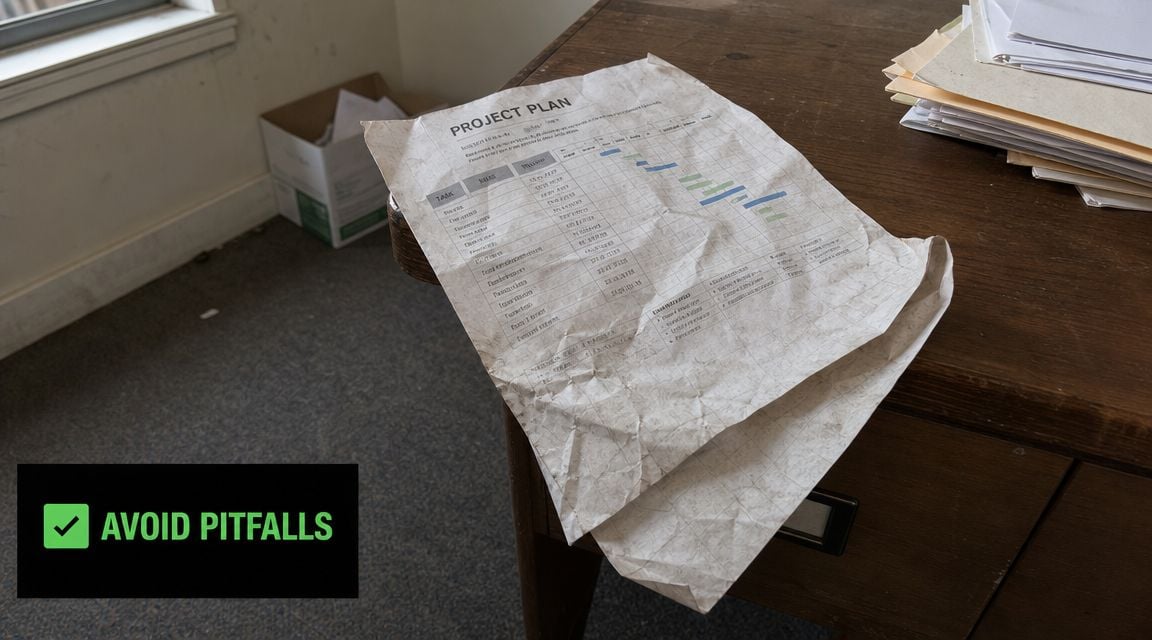
Mistake one: turning the roadmap into a task dump
This happens when the PM tries to make one document do everything.
The result is predictable. The roadmap becomes hard to read, impossible to maintain, and irrelevant the moment task timing changes. Clients stop looking at it. Internal leads stop trusting it. Nobody wants to update it because every change creates a cleanup job.
If your roadmap looks like a production board in disguise, cut it back.
Mistake two: creating it once and never touching it again
A stale roadmap is worse than no roadmap because it creates false confidence.
Teams often build a clean version at kickoff, present it proudly, and then let the project drift away from it. Weeks later, everyone is still referencing an artifact that no longer matches the sequence, dates, or risk profile of the work.
Use a simple status system and keep it current.
| Status | Meaning |
|---|---|
| Green | Milestone still looks achievable |
| Yellow | Risk is present and needs attention |
| Red | Timing or scope now needs a decision |
That's enough for most stakeholders. They don't need ten labels. They need a truthful signal.
Mistake three: hiding dependencies to keep the plan tidy
This is common in agency work because dependencies are messy.
Client content is late. Brand approval sits with another department. Analytics setup depends on platform access. Legal needs to review copy. Procurement has to sign a tool contract. PMs sometimes leave these out because they make the roadmap look less neat.
Don't.
If a dependency can move the milestone, it belongs on the roadmap even if it makes the timeline less comfortable.
Mistake four: using certainty where you only have assumptions
Some dates are firm. Others are conditional. A roadmap should make that difference obvious.
When PMs present assumption-based dates as committed dates, they set up a credibility problem. Clients hear promises. The team hears pressure. Then the first blocker arrives and trust drops fast.
Mark the assumptions, especially around approvals, external inputs, and shared specialist availability. That doesn't make you look weak. It makes you look competent.
How to measure and maintain your roadmap with real data
A roadmap gets useful when it becomes part of the weekly operating rhythm.
Run project syncs around milestones, not task recaps. Ask whether each milestone is still on track, what moved, what dependency is exposed, and whether current staffing still matches the next phase. That keeps the conversation decision-focused instead of turning into a reading of the task board.
Use a simple reporting layer to support that habit. Even basic status summaries work if they're consistent. If your team needs a starting point for cleaner stakeholder updates, these reporting templates for small businesses are a practical reference for structuring weekly reporting without overbuilding the process.
Real maintenance also means checking the roadmap against actual work patterns. Planned effort and real effort drift apart all the time in agency projects, especially when meetings, review cycles, and internal rework start eating hours that nobody budgeted for clearly. Tying roadmap reviews to project management metrics that show capacity and progress gives PMs a better way to spot trouble before a milestone slips in public.
The best roadmap reviews are short, honest, and regular. If a date moved, update it. If a dependency is now risky, mark it. If the team's available time no longer matches the plan, say so early. Clients can handle changed dates better than they can handle late surprises.
If your agency is trying to connect roadmap planning to real calendar time, client work, and utilization, TimeTackle is worth a look. It helps teams capture work from calendars and connected systems, then turn that activity into reporting that supports better staffing, cleaner status updates, and more believable delivery plans.