


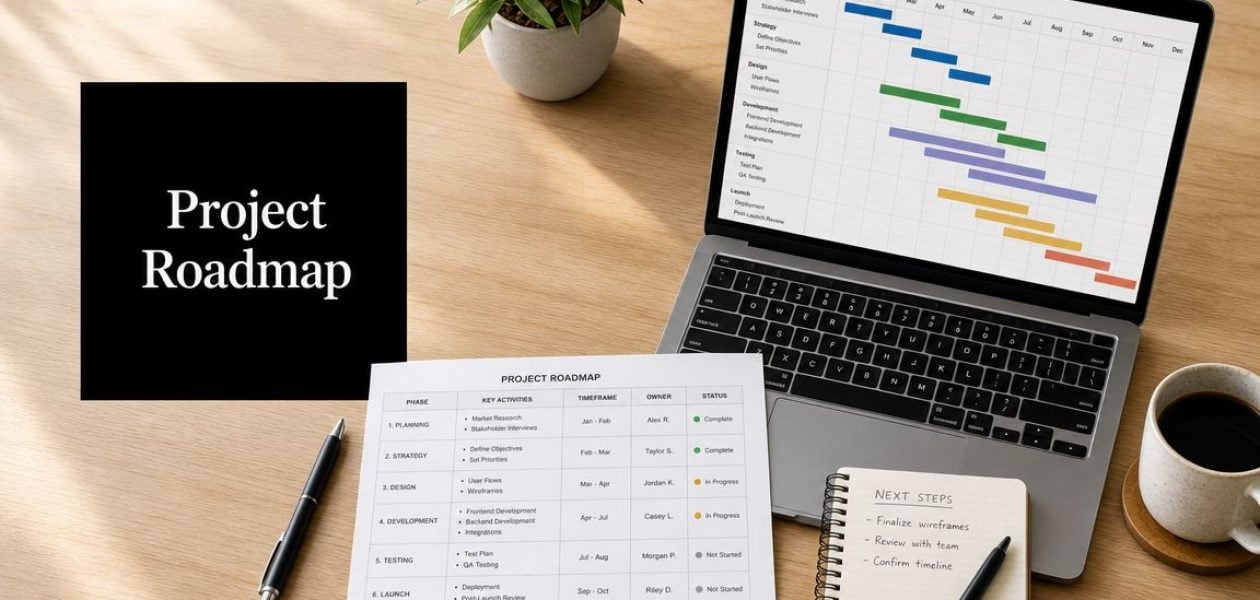
You can spot a shaky project before the deadline slips. The team looks busy, status meetings keep happening, and tasks move across the board. Then a client asks, “Are we still on track for the launch?” and the room gets quiet.
That usually means the work is being managed at the task level, but not at the direction level.
In agency work, that gap gets expensive fast. Designers keep designing, developers keep building, account leads keep reassuring the client, and nobody can clearly show how the moving parts connect to the outcome the client bought. A roadmap fixes that, but only if it's grounded in real delivery conditions. If it isn't, it becomes a polished version of wishful thinking.
That's the part many articles skip. They explain what a roadmap is, then stop before the hard bit. A roadmap only earns trust when the dates, milestones, and sequencing reflect actual team capacity, known dependencies, and the way work really moves through your shop.
Why your project needs a map, not just a task list
A task list can tell you what people are doing today. It usually can't tell you whether the project is still headed where it needs to go.
I've seen this happen on website rebuilds, CRM implementations, campaign launches, and internal process projects. The board looked healthy. Nothing seemed on fire. But once leadership asked whether the project would still hit the business goal, the answers turned vague. Someone would mention velocity. Someone else would point to completed tasks. None of that answered the core question.
The problem wasn't effort. The problem was missing context.
A roadmap gives the project a shared frame. It condenses the work into a high-level visual summary of goals, milestones, deliverables, timelines, dependencies, resources, and risks. That's why project-management guidance treats it as a standard strategic planning artifact, and why teams use it for stakeholder alignment and resource coordination in tools and guidance like Wrike's explanation of project roadmaps.
What changes when you have one
When the roadmap is clear, routine project questions get easier to answer:
- What are we trying to deliver
- What has to happen first
- Which milestone matters next
- Where the plan is fragile
- What the client should expect from us this month
That sounds basic, but basic is what breaks first in agency delivery.
A team can be busy and still be off course. A roadmap is what makes those two things visible at the same time.
A weekly plan still matters. Teams need operating rhythm, not just strategy. If you want a practical companion to roadmap thinking, this piece on why a weekly work plan is key to success is worth reading because it deals with the short-horizon planning that keeps the bigger picture honest.
Why task completion isn't enough
Tasks are local. A roadmap is directional.
If the task list says “build landing page,” “draft nurture emails,” and “QA forms,” that tells me work exists. It doesn't tell me whether those tasks still support the launch sequence, whether legal review is blocking the page copy, or whether the paid media team is scheduled before the analytics setup is ready.
That's where roadmap project management matters. It ties everyday activity back to the promise made to the client and the business logic behind the schedule.
What a project roadmap is (and what it isn't)
A client asks whether the launch can still happen this quarter. The team says yes because the task board looks busy and progress appears steady. Then you check who is available, how long similar work has taken before, and which approvals are still outside your control. Now the answer changes.
That gap is the reason project roadmaps matter.
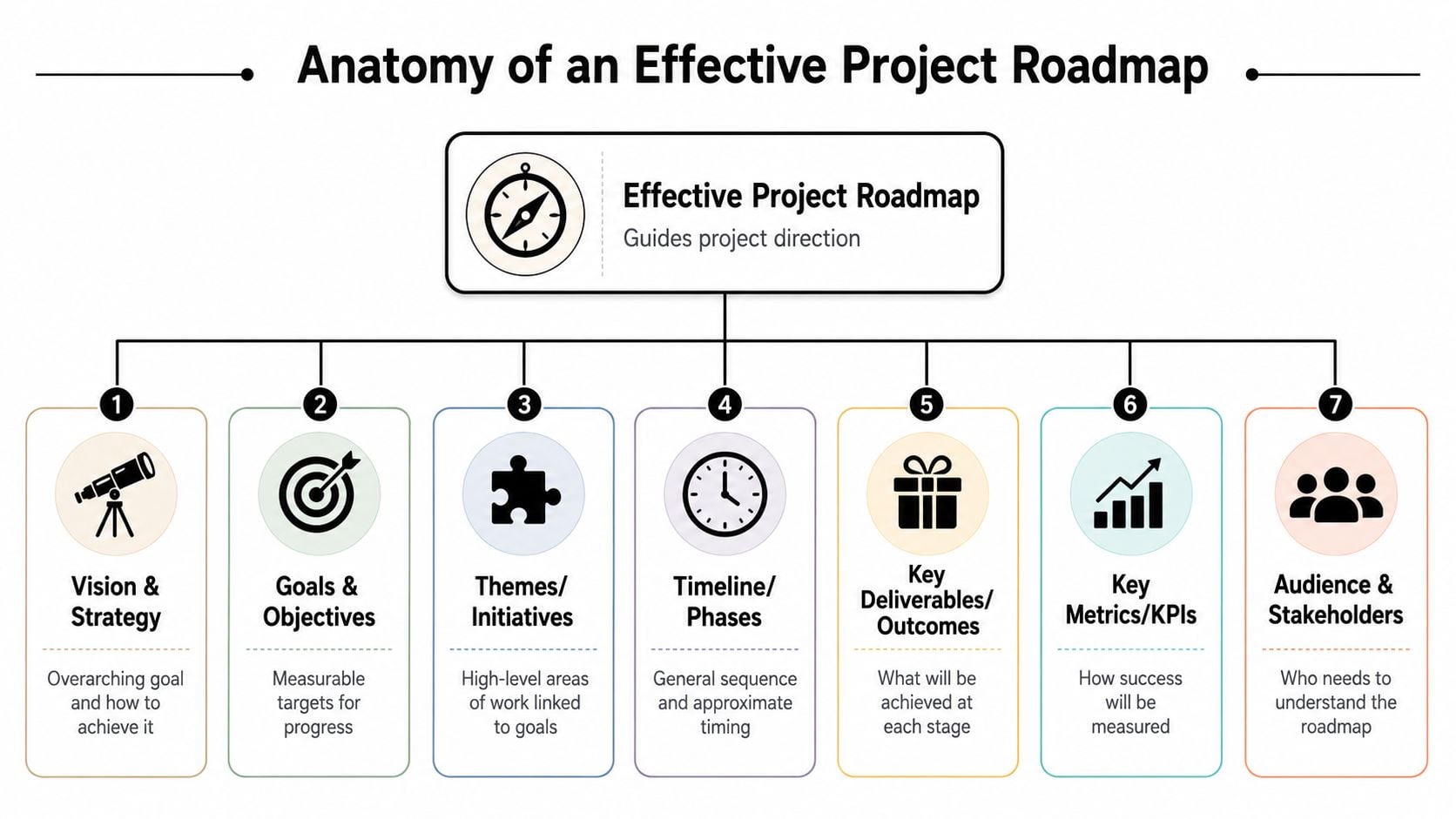
A project roadmap gives stakeholders a high-level view of direction, timing, and major commitments. It shows the outcomes the project is meant to reach, the milestones that prove progress, and the sequence that holds the work together. It exists so clients, department leads, and delivery teams can make decisions before small issues turn into schedule problems.
A useful roadmap also has boundaries. It should stay above the day-to-day execution layer. Task boards, sprint backlogs, and detailed schedules still matter, but they answer different questions. If someone needs to check every subtask, compare estimated hours, or review handoffs by role, they are already below roadmap level. For that kind of planning, it helps to understand the difference between a Gantt chart and PERT chart in project planning, because those formats handle detail and sequencing differently.
The job of the roadmap
A roadmap should help someone scan the project and understand the shape of it fast. In practice, that means answering a few management-level questions clearly:
- What outcome are we trying to reach
- Which major workstreams matter
- What milestones show meaningful progress
- How the big pieces are sequenced
- Where delivery risk is already visible
That last point gets missed a lot. A roadmap is not trustworthy because it looks polished. It becomes trustworthy when the dates and milestones can be traced back to delivery capacity, historical effort, and actual dependencies. A roadmap without real data is just a wish list.
Where new PMs usually go wrong
New project managers often overload the roadmap because they want it to feel complete. I get the instinct. A thin roadmap can look undercooked. But once it turns into a wall of tasks, nobody can read it, and nobody uses it to make decisions.
The failure usually shows up in one of four ways:
| What the roadmap turns into | What happens next |
|---|---|
| A task dump | Stakeholders stop scanning it because the signal is buried |
| A date promise built without delivery input | Clients lose confidence when timing shifts |
| A status artifact made only for leadership | The team updates it out of obligation, not because it helps |
| A polished slide with no link to actual effort | It looks aligned right up until the plan slips |
If you work across both delivery and product functions, audience matters too. A client-facing implementation roadmap and a product roadmap serve different decisions. A good product roadmap guide is useful because it shows how the format shifts when the conversation is about product direction rather than project execution.
Practical rule: If a stakeholder cannot understand the roadmap in a quick review, it is carrying too much detail.
The essential components of a good roadmap
A roadmap earns respect when it answers the obvious questions before people have to ask them. If it leaves out timing, ownership pressure points, or known blockers, it looks clean but acts weak.
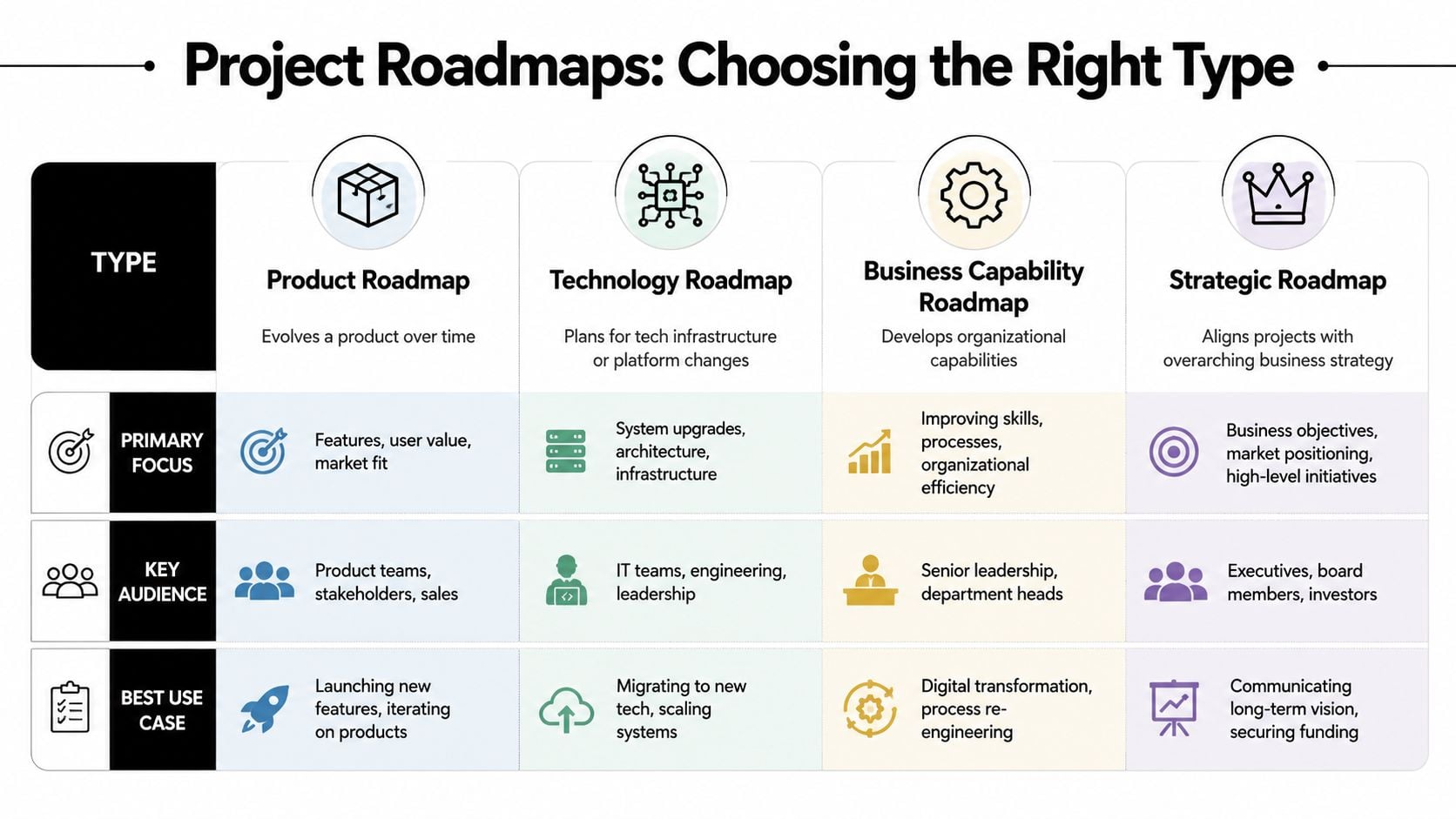
Atlassian's guidance is useful here because it gets specific. It says roadmaps need timelines, resource allocations, risks, and dependencies, and that these elements make the plan feasible. When teams can see constraints and sequencing early, they can arrange work more realistically and reduce schedule slippage, as outlined in Atlassian's project roadmap guidance.
The non-negotiables
Every roadmap doesn't need the same layout, but it does need the same backbone.
- Objectives that mean something. “Improve the website” is weak. “Launch the new site in a way that supports lead capture and sales handoff” gives the team a target they can reason from.
- Major deliverables. These are the visible outputs that show progress is real. Wireframes, approved messaging, migrated data, training complete, launch ready.
- Milestones with timing. Milestones are the checkpoints that matter to the client and leadership. They need real dates or realistic windows, not vague labels like “soon” or “phase two.”
- Dependencies and risks. If legal review, client content, API access, or data cleanup can hold up the whole plan, put that in the roadmap.
- Resource view. You don't need to list every person, but you do need a truthful picture of what kind of capacity the plan assumes.
The part people leave out
Most weak roadmaps leave out resource logic.
That's why they look convincing in kickoff meetings and start falling apart by week three. A roadmap without resourcing is just sequence without proof. The design phase may look tidy, but if the same creative director is split across six accounts, that phase is not available when the roadmap says it is.
A lot of PMs also confuse dependencies with notes. They aren't notes. They are control points. If one workstream cannot start until another finishes, that relationship belongs in plain sight.
If a dependency can move your delivery date, it belongs on the roadmap. If it can't, keep it in the plan.
Keep the high-level view clean
You still need separation between roadmap and execution detail. If you struggle with where that boundary sits, this comparison of Gantt chart vs PERT chart helps because it clarifies when you need broad sequencing versus detailed path analysis.
The test is simple. A strong roadmap lets an exec, client, and team lead all read the same page and come away with the same understanding of project direction.
Four types of roadmaps and when to use them
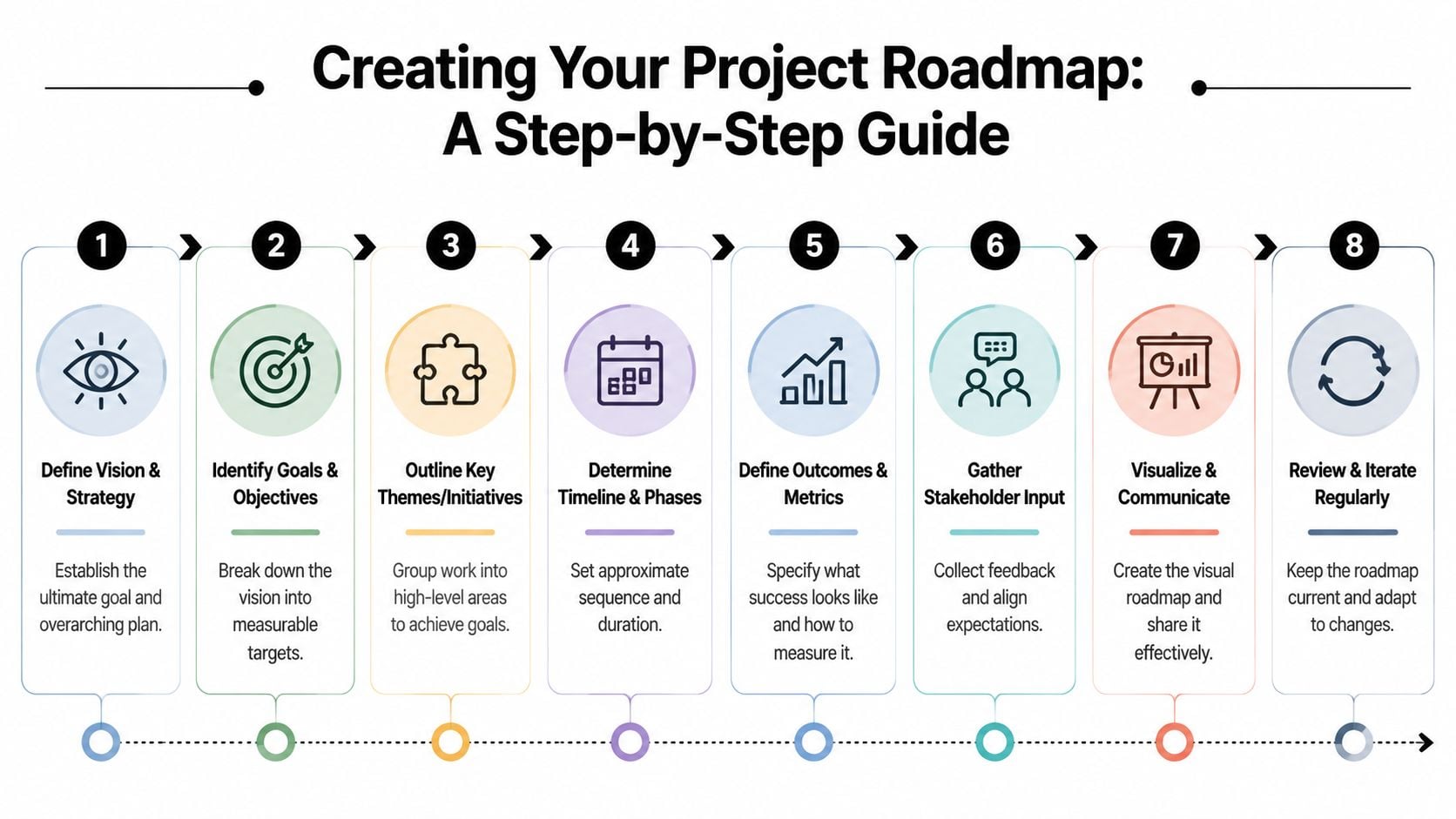
“Roadmap” is one of those words that means different things depending on who's in the room. That's not a problem unless you use the wrong format for the audience.
A client sponsor usually wants timing and confidence. A delivery lead wants sequence and pressure points. An executive team wants business outcomes and major commitments. Those are not the same need, so they shouldn't get the same roadmap.
A quick decision table
| Roadmap Type | Primary Focus | Best For… | Audience |
|---|---|---|---|
| Timeline-based | Dates, phases, milestone sequence | Client delivery, implementation work, launch planning | Clients, account leads, delivery managers |
| Outcome-based | Results, goals, business impact | Product work, internal improvement efforts, experimental programs | Leadership, product owners, cross-functional teams |
| Release roadmap | What ships and when | Software releases, phased launches, enablement planning | Product, engineering, customer teams, sales |
| Strategy roadmap | Big bets, priorities, direction | Portfolio planning, annual planning, executive review | Executives, department heads, investors |
Timeline-based roadmaps
This is the one agencies use most because clients usually buy against time, milestones, and deliverables.
If you're running a website launch, rebrand, CRM setup, or paid media rollout, a timeline-based roadmap gives the client something concrete. It shows discovery, approvals, production, QA, launch prep, and release windows in a format they can follow.
Use this when the date matters as much as the output.
A clear tell is when stakeholders keep asking, “What happens in what order?” If that's the pressure, use a timeline view.
Outcome-based roadmaps
Some projects don't succeed because they shipped on a date. They succeed because they changed something meaningful.
That's where an outcome-based roadmap works better. Instead of centering the plan around delivery stages, it centers the work around results such as reducing onboarding friction, improving reporting quality, or making handoffs between sales and implementation cleaner.
This is useful for internal operations projects and some product work, especially when the path may change but the result stays stable.
Release roadmaps
Release roadmaps sit between execution and communication. They work well when you need to show what is being released, what's included in each release, and how that affects internal teams or customers.
Agencies use them less often than software teams, but they still matter in implementation work. If your team is rolling out phases of a platform setup, a data migration, or a training sequence, a release roadmap can be cleaner than a broad timeline.
Strategy roadmaps
A strategy roadmap is what you use when the conversation is about priorities, not tasks and not even dates in a strict sense.
This works for leadership teams deciding which service lines to build, which markets to enter, or which capability gaps to fix first. It keeps the discussion at the level where trade-offs belong.
“We can do all of it” is usually a sign that nobody has built a real roadmap yet.
How to choose fast
If you need a shortcut, use these cues:
- Choose timeline-based when clients need date confidence and phase visibility.
- Choose outcome-based when the path may change but the result is what matters.
- Choose release when what ships, and in what batch, drives communication.
- Choose strategy when leadership needs a view of priority and direction more than delivery detail.
Good roadmap project management starts with choosing the format that matches the decision you need to support.
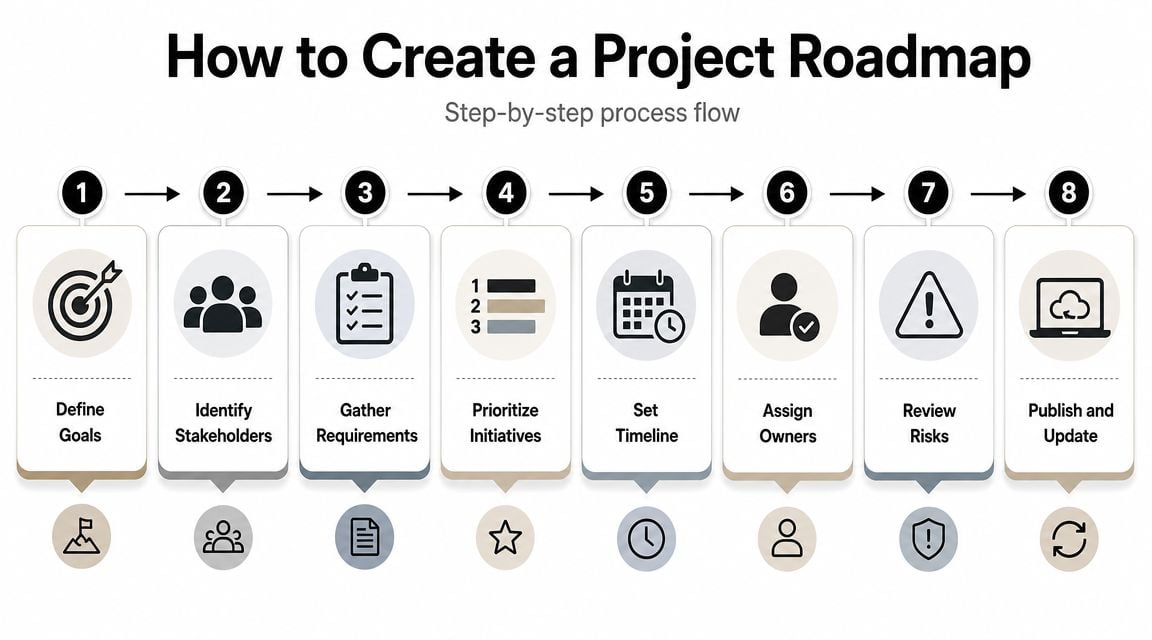
How to create a project roadmap step-by-step
A roadmap should come from synthesis, not from one PM filling boxes in a template. If you build it alone, you'll usually miss the delivery constraints that break confidence later.
That matters even more now because roadmaps have become part of how modern teams connect execution to strategy. PMO365 notes that 71% of organizations now report using Agile approaches, and it describes modern roadmaps as a tool for visibility and faster decision-making across teams in its guide to roadmaps in project management.
Start with the promise
Before you place a single milestone, write down the project promise in plain English.
What is supposed to be true when this work is done?
If that statement is fuzzy, the roadmap will be fuzzy too. “Launch the new client portal so customers can self-serve common support tasks” is a roadmap statement. “Deliver portal improvements” is not.
Build from constraints, not hope
Once the objective is clear, pull inputs from the people who know where the plan can break.
That usually means talking to:
- Delivery leads who know phase order and likely blockers
- Functional managers who know actual team capacity
- Client stakeholders who control approvals, content, or dependencies
- Commercial owners who know what was sold and where the assumptions are thin
This is also where staffing questions need honesty. If your roadmap depends on skills you don't currently have, that gap needs an answer before the date goes into the document. In some cases, teams look at outside support models such as Salesforce staff augmentation services when specialized implementation work exceeds internal bench strength.
Sequence the big work
After inputs are gathered, sketch the project at the level of phases and milestones, not tasks.
A workable order often looks like this:
- Set the objective and success conditions
- Group work into major streams or phases
- Mark milestone points that matter to stakeholders
- Map dependencies that can shift timing
- Check resource assumptions before sharing dates
- Simplify the visual so it reads fast
- Review it with the people doing the work
- Publish one version that everyone can point to
Pressure-test it before it goes live
This step gets skipped a lot, and that's why many roadmaps fail in public.
Review the draft with the team leads who will deliver it. Ask direct questions. Which date is weakest. Which dependency is missing. Which milestone assumes client behavior you don't control. Which phase ignores competing work.
Then remove false precision. If you don't know whether work lands in early or late month because upstream approvals remain open, don't pretend you know.
A roadmap gets stronger when you take unjustified confidence out of it.
Common roadmap pitfalls and how to avoid them
Most roadmap failures are easy to recognize once you've seen them a few times. They usually don't fail because the PM lacked effort. They fail because the roadmap was built for appearance, not control.
The wish list roadmap
This one looks ambitious in kickoff and painful in delivery.
It includes everything the client asked for, everything the account team wants to preserve, and every internal idea anyone was afraid to cut. It has motion, but no evidence that the team can absorb the load.
The fix is blunt. Tie every major item to a real capacity conversation. If nobody can explain who has room to do the work, the roadmap is carrying fiction.
The stone tablet roadmap
This roadmap gets approved once and then treated like it can't change.
That creates a bad kind of silence. Everyone knows the dates slipped or the sequence changed, but nobody updates the shared view because they don't want to trigger a bigger conversation. So the roadmap stops being the truth and turns into a relic.
Use a review rhythm. Monthly works for many agency projects. Higher-risk work may need more frequent checks. The point is simple. If the plan changed, the roadmap changes too.
The overstuffed roadmap
This is what happens when someone tries to combine roadmap, workback schedule, task tracker, risk register, and meeting notes into one page.
Nobody wants to admit they can't read it, so people nod through it and go back to asking for updates in Slack.
A roadmap needs restraint. Keep detail at the level of milestones, major workstreams, dependencies, resources, and risk flags. Push the rest into the project plan.
The stakeholder theater roadmap
Some roadmaps are built to calm people down, not to guide decisions.
You can spot them because every date looks neat, all workstreams move in straight lines, and no trade-offs appear. Real projects are messier than that. The roadmap should show enough tension to support good decisions. If there's a likely bottleneck, show it. If approvals are the weak point, say so.
Connecting your roadmap to reality with time and resource data
This is the part that separates a roadmap people politely admire from one they trust.
A roadmap promises timing and sequence. Real operational data tells you whether those promises make sense. If your team consistently spends more time in QA than expected, if client approvals always add drag, or if your implementation lead is split across too many accounts, the roadmap needs to reflect that. Otherwise you're managing presentation, not delivery.
For agencies, that means roadmap project management can't live in a slide deck alone. It has to connect to actual time, staffing, and utilization patterns. That's also why operations teams keep pushing toward joined-up systems. If you're thinking about service workflows and delivery planning together, this look at unifying ITSM and project delivery is a useful reference point.
What real data changes
When you connect roadmap assumptions to tracked work, a few things get easier:
- Capacity checks get more honest
- Future milestones become more believable
- Resourcing trade-offs show up earlier
- Client conversations get less defensive
- Course correction happens before the miss
A practical way to support that is with systems that capture work patterns from the calendar and turn them into usable reporting. For example, resource planning for projects becomes much easier when tracked activity, availability, and utilization sit close to the roadmap conversation instead of in separate spreadsheets. Tools like TimeTackle fit that use case by pulling activity from connected calendars and systems, then making project and team time visible enough to test whether the roadmap still matches reality.
If your roadmap says a team can deliver in six weeks, your time and capacity data should be able to defend that claim.
If your team is tired of building roadmaps on one side and chasing timesheets on the other, TimeTackle is worth a look. It connects calendar activity and reporting so operations leaders and PMs can ground plans in real team capacity, tracked work, and cleaner resource visibility.