



A project closes. The client is happy enough. Revenue came in. Then the post-mortem starts, and the room gets quiet.
Why did the margin fall apart? Why did the team log so much “miscellaneous support”? Why did account leads spend hours in internal syncs that nobody budgeted? Why did reporting take half a day every Friday when nobody priced it into the work?
Most agency leaders have lived this. The project didn't fail because people were lazy or because the estimate was wildly wrong. It failed because time moved through the business without a clean record, and untracked time always turns into hidden cost.
That's the part too many firms miss. The value of time isn't a motivational slogan. It's an operating number. If you can't see where time went, you can't explain margin, fix staffing, or defend scope. You're left arguing over feelings when you need evidence.
Your team's time is your most expensive asset
An agency owner I worked with had a familiar problem. Every month, one or two client accounts looked fine at the top line and ugly at the bottom line. The team had delivered the work, invoices were out, and the pipeline was healthy. Yet profit kept slipping.
The first instinct was to blame pricing. The second was to blame timesheet compliance. Both were partly true, but neither got to the root of it. The core issue was that the business treated time as an after-the-fact admin task instead of the raw material behind delivery.

When people fill in timesheets from memory, they smooth over the day. Ten minutes here, twenty minutes there, an extra internal review, a client call that ran long. None of those pieces looks dangerous alone, but together they change the economics of the account.
That's why your team's time is your most expensive asset. Salaries, contractor fees, overhead, and management attention all flow through hours. If those hours are misread, every downstream decision gets worse. Pricing gets loose. Staffing gets reactive. Forecasts turn into guesses.
Practical rule: If a project goes over budget and nobody can show where the time moved, you don't have a delivery problem first. You have a measurement problem.
The value of time matters because it turns vague frustration into something you can manage. Once you can see how time gets spent, you can separate profitable work from busywork, planned effort from spillover, and necessary coordination from avoidable drag.
For professional services teams, that shift is overdue. Time isn't just a cost to contain. It's the asset that creates revenue, absorbs scope creep, and sets the ceiling on capacity.
Defining the value of time for your business
People often reduce this idea to “time is money,” which is too blunt to help. In practice, the value of time inside a services business changes by role, task, project stage, and what that hour prevents or makes possible.
There's a useful economic starting point. The world gives each person a fixed budget of 24 hours per day, or 8,760 hours per year, and economists have treated time as something with measurable value since the 1960s, as summarized in this overview of value of time. That matters because it moves the conversation away from philosophy and into operations.
Not all hours carry the same business value
An hour from a senior strategist in a client workshop doesn't mean the same thing as an hour spent cleaning up CRM records. Both consume payroll. Only one may move delivery, revenue, or client trust in a meaningful way.
That difference shows up in a few ways:
- Opportunity cost means asking what the team could have done instead. If your delivery lead spends a morning building a manual status deck, that morning can't go to billable work, client escalation, or team coaching.
- Capacity cost is the cost of available time that gets used poorly. Idle time is one form of waste, but so is time that looks full on paper and produces little value because it's fragmented across low-quality work.
- Strategic value is harder to see, but it matters. Some hours maintain the machine. Others improve pricing, delivery design, account growth, or retention.
A simple way to think about it
Take a midsized agency with paid media, creative, and account management teams. If a paid media manager spends an hour on campaign optimization, that hour may contribute directly to client results and account retention. If the same person spends an hour chasing meeting notes and rebuilding what was already discussed, the payroll cost is the same but the business value is lower.
That's why treating all internal time as “non-billable” isn't enough. Some non-billable time is necessary and smart. Some is a warning sign.
A useful filter is to ask four questions:
- Did this hour produce client value?
- Did it protect delivery quality or reduce risk?
- Did it create future capacity or future revenue?
- Would I knowingly buy this hour again?
If the answer is no across the board, you've found time that erodes profit.
The value of time gets clearer when you stop asking, “What did this hour cost?” and start asking, “What did this hour make possible?”
That's the shift agencies need. Hours are not uniform units. They are economic inputs with different outcomes attached to them.
Four ways to calculate your team's time value
If you want to manage this well, don't force one formula to answer every question. Finance, operations, and delivery leaders need different views. I usually use four.
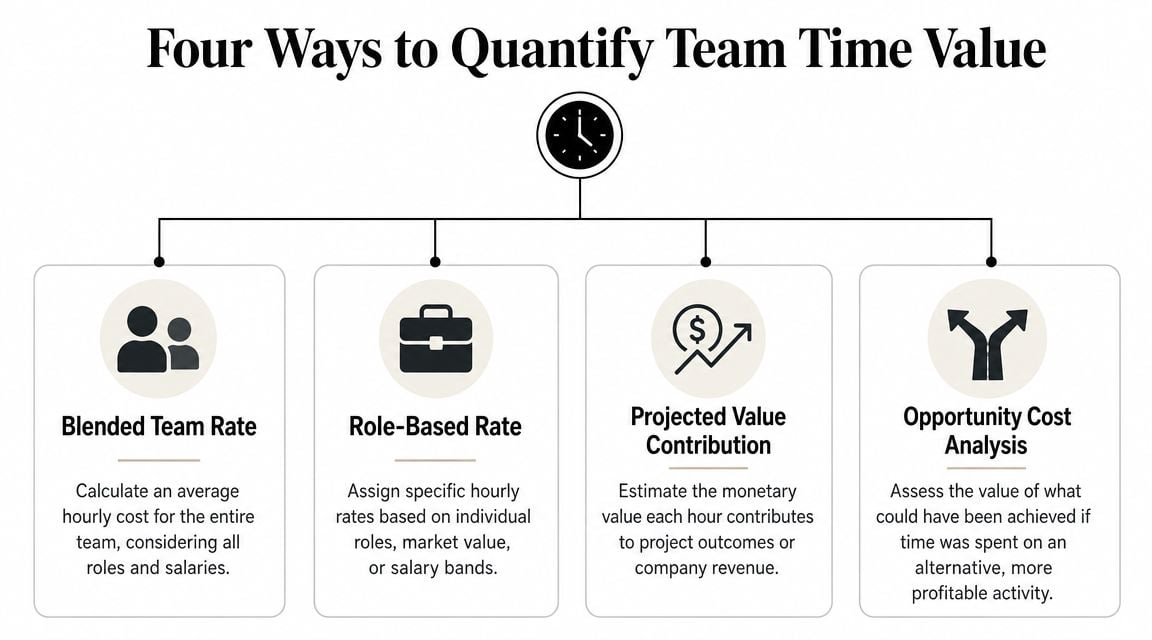
One point matters before the formulas. Time has no single fixed price. The economic literature makes this plain. As the NBER paper puts it, “time valuation cannot be undertaken independent of what a person wants to do with the time,” which is why context changes ROI so much in admin-heavy businesses. You can read that directly in the NBER working paper on time valuation.
Blended team rate
This is the fastest way to estimate the cost of time across a delivery team.
Formula
Blended team rate = Total team labor cost for a period / Total available working hours for that period
Use this when you want a broad operating view. It's useful in budgeting, rough pricing, and account margin reviews.
A blended rate helps when work moves across multiple roles and nobody wants to debate every salary band in the first meeting. It gives you a baseline cost per hour for the team as a unit.
What it tells you:
- Whether a project was priced against the actual cost base
- Whether your team mix is too senior for the work sold
- Whether internal support work is eating margin faster than expected
What it misses is role variation. A strategist hour and coordinator hour don't carry the same replacement cost, so don't stop here if you need staffing decisions.
Role-based rate
This is the next layer down and usually the one that changes behavior.
Formula
Role-based time cost = Hours by role x role hourly cost
This is better than a blended rate when you need to understand who is doing the work, not just how much work got done. If client communication keeps landing with expensive senior staff, this method will show it quickly.
A lot of firms learn the same lesson here. Margin problems often come from role drift, not from too little work. Senior people absorb cleanup, internal approvals, and client reassurance because the system is messy. The work gets done, but the cost structure gets distorted.
Revenue per hour
This is a clean operating metric because it connects time to what the business earns.
Formula
Revenue per hour = Recognized revenue for a period / Total hours worked in that period
Use it by client, project, team, or service line. Revenue per hour is especially useful when two accounts have similar billings but very different delivery patterns.
If one account needs far more calls, revisions, and internal coordination to earn the same revenue, you'll see that gap here. It won't explain why by itself, but it tells you where to investigate.
Opportunity cost of unbilled work
A considerable amount of hidden waste persists.
Formula
Opportunity cost of unbilled work = Unbilled hours x your chosen value benchmark
The benchmark might be a role-based rate, a blended rate, or the average revenue per delivery hour for that team. The point is not to pretend every hour could have been sold instantly. The point is to make trade-offs visible.
Good examples include:
- Proposal support that never gets priced into new business
- Manual weekly reporting
- Excessive internal approvals
- Client communication that should have been part of a retainer structure
This metric often sparks better conversations than utilization alone because it asks what the business gave up to support work that didn't earn back its cost.
A short comparison
| Method | Best for | Main caution |
|---|---|---|
| Blended team rate | Budgeting and broad margin reviews | Hides role differences |
| Role-based rate | Staffing and delivery design | Needs clean role mapping |
| Revenue per hour | Profitability by client or service line | Can hide quality issues |
| Opportunity cost | Exposing hidden admin and spillover work | Depends on sensible benchmark choice |
Don't argue about the perfect formula before you've built a useful one. Most teams need better visibility before they need better math.
Data quality matters here. If your reporting stack still depends on exported spreadsheets and week-late summaries, it helps to understand how data moves from source systems into reporting. This primer on data architecture resources by Streamkap is a solid way to think about when you need fresher operational data versus slower batch reporting.
Utilization belongs in this discussion too, because available hours only matter if they turn into productive capacity. If you want a more detailed operational framework for that specific metric, use this guide on how to calculate utilization rate.
From calendar to dashboard
Most firms already have the raw data they need. They just don't trust it because it sits in calendars, inboxes, CRMs, and meeting tools instead of one reporting layer.
That's why manual timesheets feel so frustrating. They ask people to reconstruct reality after the fact, even though the calendar already contains a large part of what happened. Meetings, client reviews, internal approvals, interviews, sales calls, implementation sessions, travel blocks, and focus time placeholders all leave traces.
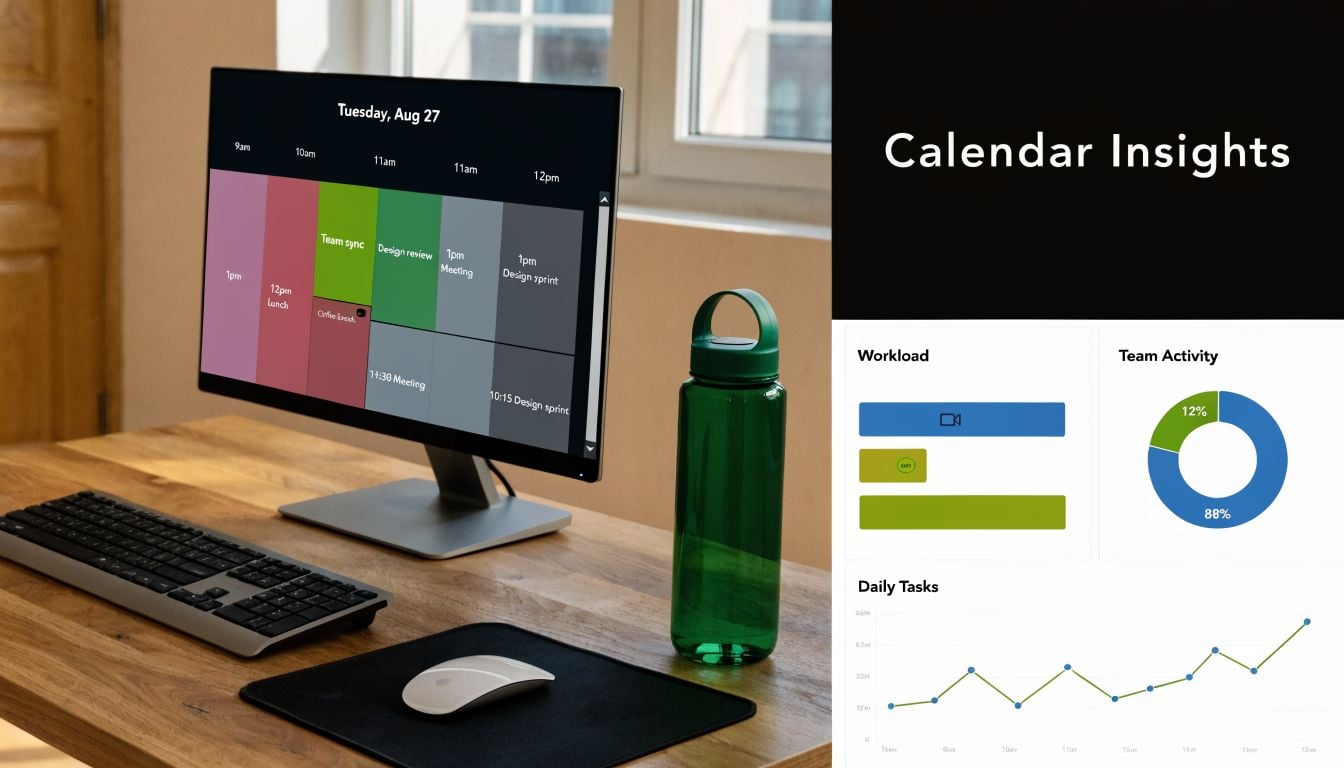
Start with capture, then classify
A workable system usually follows this path:
- Capture calendar events automatically
- Apply tags and properties
- Map time to clients, projects, and work types
- Feed that structure into a dashboard
The tags matter more than people think. “Meeting” is not a useful category on its own. You need distinctions like billable, non-billable, presales, account management, delivery, internal ops, hiring, or leadership. Without that layer, you can't connect time to economics.
Calendar-first tools can be useful. TimeTackle is one example. It pulls activity from Google Calendar or Outlook and lets teams apply rules, tags, and filters so the data can feed reporting without asking people to rebuild every day from memory.
What a useful dashboard should show
A dashboard built from calendar data should answer operating questions fast.
- Client mix. Which accounts absorb the most time outside the work sold?
- Role mix. Are senior people carrying work that should sit lower in the cost base?
- Meeting load. Which teams are overrun by coordination?
- Untracked support. Where is the team doing work that never enters the project budget?
- Capacity pressure. Which functions are overloaded even before new work lands?
There's a good reason to trust large, behavior-based datasets for this kind of analysis. A major U.S. study using Lyft data drew on more than 14 million observations and estimated the value of time at roughly $19 per hour, about 100% of the after-tax median wage rate, which supports the idea that time has real measurable economic cost in lived behavior, not just theory, as summarized by Resources for the Future on the Lyft-based value of time study.
That doesn't mean your agency should assign one universal dollar figure to every hour. It means large datasets can reveal the actual cost of delay, waiting, and low-value friction. Your own calendar data can do the same inside your business.
If you want to see where your team's time is going before redesigning reports, start with a calendar audit workflow. It's usually the fastest way to find the gap between how work is sold and how time is really spent.
Time value in practice for agencies, consultants, and product teams
The same principles show up differently depending on the business model. That's why generic advice often falls flat.
Agency account work
A creative or marketing agency often bleeds time in presales and client service spillover. The pitch deck gets revised one more time. The account lead joins “just a quick call.” Strategy adds unpaid thinking time because the brief was weak and nobody wants to upset the client.
None of that is unusual. The problem starts when leaders treat it as invisible. If you review actual billable versus non-billable patterns using a clean system for tracking billable hours, you can see which accounts consume time beyond the deal that was sold.
One agency pattern I see often is this: the account looks profitable if you count only delivery hours, but unpriced communication and approval work push the true cost much higher. That doesn't always mean the client is bad. Sometimes the scope is wrong. Sometimes the staffing model is wrong. Sometimes the team has trained the client to expect unlimited access.
Consulting teams
Consultancies face a different issue. A senior consultant's hour can unblock a client relationship, shape the recommendation, or close follow-on work. A junior analyst's hour may be perfectly useful, but the business value is different because the context is different.
That's where role-based valuation helps. If high-cost staff repeatedly handle scheduling friction, deck cleanup, and internal follow-up, the issue isn't productivity in the abstract. It's misallocation.
A lot of time waste doesn't look like waste. It looks like expensive people being dependable.
The fix is rarely to tell senior staff to “do less.” The fix is to redesign workflow, decision rights, and support coverage so their time moves back toward work only they can do.
Product and SaaS teams
For product teams, the value of time often shows up as time to value, not just labor efficiency. In product analytics, TTV is the elapsed time between a user's first interaction and a first meaningful outcome, and KISSmetrics recommends using the median TTV for a cohort because it gives a steadier signal than an average. Product School lays that out in this piece on time to value in product analytics.
That idea matters outside pure SaaS too. If onboarding, implementation, or customer success teams shorten the path from setup to first useful result, they improve adoption and retention. The time spent building that experience often has more business value than another internal status ritual.
To find what users need before they hit that first value moment, product and service teams can borrow methods from research. This Formbricks guide on user research is a practical reference when teams need better input than gut feel.
How to increase the value of your team's time
Once you can measure where time goes, the next job is shifting it toward work that pays back. Most firms do this badly at first because they focus on squeezing hours harder. That usually creates resentment, not better economics.
A better approach is to remove low-value time, protect high-value time, and make trade-offs visible.
Cut admin before you cut people
Manual reporting, copy-paste project updates, duplicate status meetings, and scattered expense handling consume a lot of good hours. They also create context switching, which lowers the value of the rest of the day.
The point of automation isn't just lower hourly cost. As discussed in the commentary on why your time might be more valuable than you think, a saved hour can be worth far more when it removes delays and frees up scarce managerial attention.
A practical place to start is the admin stack around finance and reimbursement. If teams still chase paper receipts and manual expense logs, even lightweight tools can remove annoying work. This roundup of free receipt scanner apps is useful if you want a low-friction fix for one common source of small but constant drag.
Protect focus blocks with the same discipline as client meetings
A lot of firms say they value strategic work, then schedule over every open hour. That guarantees shallow work, more rework, and slower delivery.
Try a few operating rules instead:
- Reserve maker time for roles that need deep work. Strategy, writing, analysis, and solution design break down when they are split into fragments.
- Reduce meeting sprawl by tightening attendee lists and separating decision meetings from status sharing.
- Batch internal approvals so the team doesn't chase signatures and comments all day.
- Name buffer time on calendars so reactive work doesn't eat every gap.
Move work to the right level
Many margin problems are staffing problems in disguise. Senior staff cover detail work. Delivery teams handle account issues that should sit elsewhere. Specialists spend time on repeatable tasks because nobody built a better process.
Use your time data to ask simple questions:
- Which tasks repeatedly land with the wrong role?
- Which client requests trigger avoidable handoffs?
- Which internal steps create waiting time without improving quality?
- Which work could be templated, automated, or reassigned?
Better operations beats heroic effort. You usually don't need people to work harder. You need the system to stop wasting their best hours.
Use time data in client conversations
Clients notice outcomes and responsiveness. They usually don't see the hidden labor behind unclear feedback loops, late approvals, or endless revision paths. If your reporting shows where time goes, account leads can have better scope conversations.
That changes the tone from complaint to evidence. Instead of saying, “This client is difficult,” you can say, “This account needs a different meeting cadence, a tighter review process, or a revised retainer because support work has expanded beyond the original model.”
The cleanest use of time data is not punishment. It's negotiation, planning, and better design.
Review time value every month
Most firms review revenue monthly and time reactively. That gap causes trouble.
A monthly operating review should look at:
- High-effort, low-return accounts
- Unbilled work by team and client
- Meeting-heavy functions
- Role drift in delivery
- Admin categories that keep growing
Keep it simple. You do not need a giant analytics project to start. You need enough structure to spot patterns early and act before they become “the way we work.”
If your team is tired of late timesheets, fuzzy utilization, and margin reviews built on guesswork, TimeTackle is worth a look. It uses calendar data to capture work automatically, apply tags and rules, and turn that activity into dashboards you can use for staffing, profitability, and reporting.