



You're probably staring at a proposal draft, a blank pricing field, or a client email and thinking the same thing most agency owners think at some point: How much should I charge?
That question sounds simple, but it usually shows up when the stakes are not simple at all. You need a number that covers payroll, software, management time, revisions, and all the work that never makes it onto an invoice. You also need a number a client will accept without turning the deal into a long argument about budget.
Most agencies get pricing wrong in one of two ways. They either pick a number that feels safe and end up undercharging, or they copy what another shop charges without checking whether their own delivery model can support it. Both mistakes hurt margin. Both create stress. Both get worse as headcount grows.
The fix is not one magic formula. Good pricing is a system. You need a model for the engagement, a financial floor, a market check, a way to package services, and enough confidence to hold the line when a buyer pushes back.
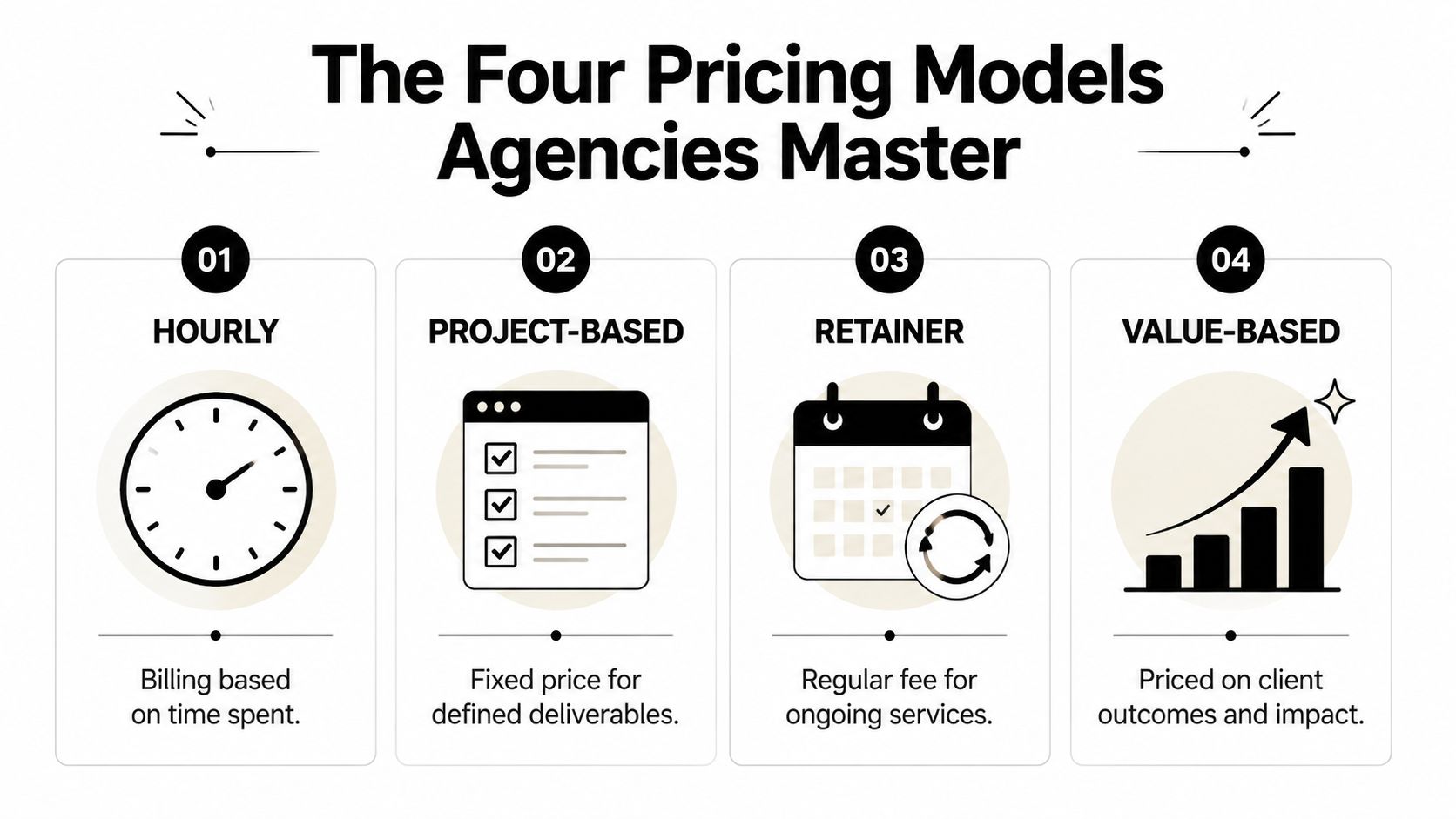
The four pricing models every agency should master
Pricing models are tools. If you use the wrong one for the job, even good work becomes hard to sell and harder to deliver profitably.
Hourly pricing
Hourly billing is the easiest model to explain. You track time, multiply by a rate, and invoice for the work done. It works well when scope is unclear, when clients want flexibility, or when you're handling advisory work that changes week to week.
The problem is obvious once your team gets good. Efficiency lowers revenue. A senior team that solves a problem fast can bill less than a slower team that takes longer. That makes hourly pricing useful for uncertain work, but weak as a long-term default.
Practical rule: Use hourly pricing when the client is buying access, troubleshooting, or a narrow slice of expertise. Don't use it as your only model for repeatable delivery.
Project-based pricing
Project fees work best when scope is defined and deliverables are clear. A website redesign, a brand system, an implementation sprint, or a fixed content package all fit this model well. Clients like it because they know the cost upfront, and agencies like it because they can protect margin if they manage production tightly.
What breaks project pricing is vague scope. If the statement of work is loose, the client hears flexibility while your team hears endless revisions.
A simple comparison helps:
| Model | Best use | Main upside | Main downside |
|---|---|---|---|
| Hourly | Unclear scope, advisory work | Easy to start | Punishes efficiency |
| Project-based | Defined deliverables | Predictable fee | Scope creep risk |
| Retainer | Ongoing service | Stable revenue | Capacity can get eaten up |
| Value-based | High-impact work | Strong upside | Harder sales process |
Retainer pricing
Retainers are strong when the client needs ongoing output or oversight. Think paid media management, SEO support, lifecycle marketing, RevOps, or ongoing design. This model gives the client continuity and gives the agency steadier revenue.
It also helps operations. Forecasting gets easier when you know what work is likely to recur next month. That matters if you're staffing account teams, planning utilization, or deciding whether you can take on another account. This discussion of SaaS versus productized services gets at the broader point. Predictability changes how you scale.
Value-based pricing
Value-based pricing is the hardest model to execute and often the most rewarding when you can. You price around business impact, not just labor input. If your work changes pipeline quality, conversion, expansion revenue, or implementation speed, then billing only for hours can leave money on the table.
That said, many agencies claim to do value-based pricing when they really mean “higher project pricing.” True value pricing needs a mature sales process, clear discovery, strong positioning, and enough trust that the client believes your work changes outcomes.
If you need a grounding in understanding cost plus pricing before moving into more strategic models, start there. Even agencies that sell on value still need to know their internal cost base.
Your foundational pricing formula to cover all costs
Before you think about premium positioning, you need a floor. If you don't know your floor, you're not pricing. You're guessing.
Start with total costs
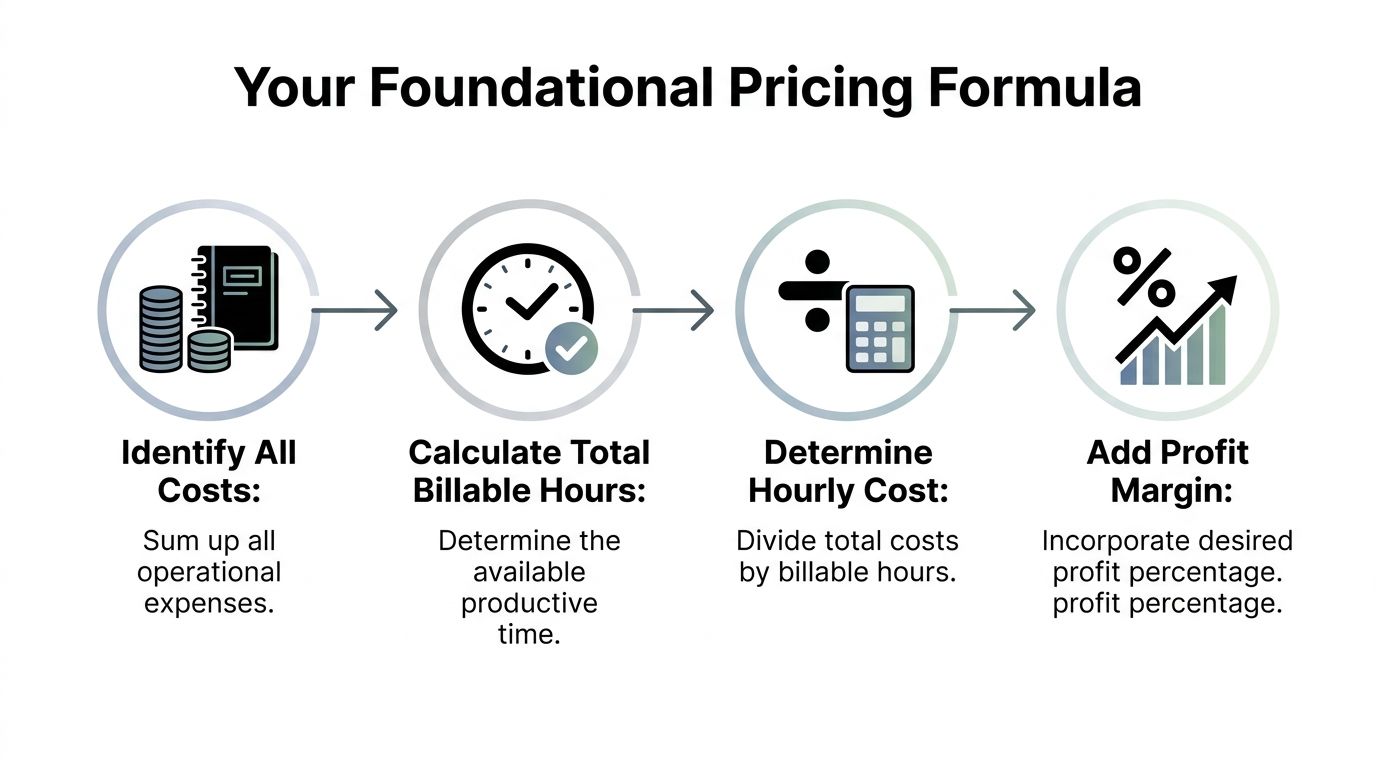
A foundational pricing rule is the Cost-Plus model. You add a markup to total costs, and for services a standard profit margin target for many small businesses is approximately 20%. The formula is Price = (Total Variable Costs) / (1 – 0.20), which means the final price covers costs and yields the target profit.
That sounds clean on paper, but agencies often leave out real operating cost. Don't just count salaries. Count management time, software, rent, insurance, recruiting, finance support, internal meetings, and business development effort that keeps the shop running.
A good pricing floor starts by grouping costs like this:
- Direct delivery costs include labor tied to client work, contractor fees, and production expenses.
- Operating overhead includes tools, rent, utilities, admin support, and non-client systems.
- Sales and account costs include proposal time, pipeline management, and client communication that supports delivery but may not be billed.
- Leadership load includes planning, quality control, and decision-making time that agencies often forget because nobody invoices it directly.
Turn annual cost into an hourly floor
Once you know total cost, you need realistic billable capacity. Many agencies commonly fool themselves in this area. They assume every working hour can be billed, then wonder why projects with “good margins” still feel thin.
Your team has meetings, internal reviews, rework, onboarding, and slack time between projects. So the right question isn't “How many hours are on payroll?” It's “How many hours turn into healthy revenue?”
If you need a structured way to build that number, this guide to the labor cost formula is useful because it forces you to connect labor expense to actual working capacity.
Charge from your real delivery capacity, not from the fantasy version of your calendar.
Add margin on purpose
Once you have hourly cost, apply your profit target deliberately. If your variable cost for a unit of service is known, the formula above gives you a base price that protects margin. That floor matters whether you sell by the hour, by project, or on retainer, because every model still draws from the same labor pool.
A lot of owners ask, “How much should I charge?” when what they really mean is, “How low can I go and still win?” That's the wrong framing. The better question is, “What price keeps the account healthy after delivery, management, revisions, and overhead?”
A short checklist helps before any quote goes out:
- Check scope against capacity. If the work needs senior oversight, price for senior oversight.
- Check hidden delivery time. QA, project management, and client comms count.
- Check margin after likely revisions. Don't assume the first draft is the last draft.
- Check whether the pricing model fits the work. The wrong model can wreck a good estimate.
When you know your floor, you stop making emotional pricing decisions. That alone improves the quality of almost every sales conversation.
How to adjust your rates for the market and your value
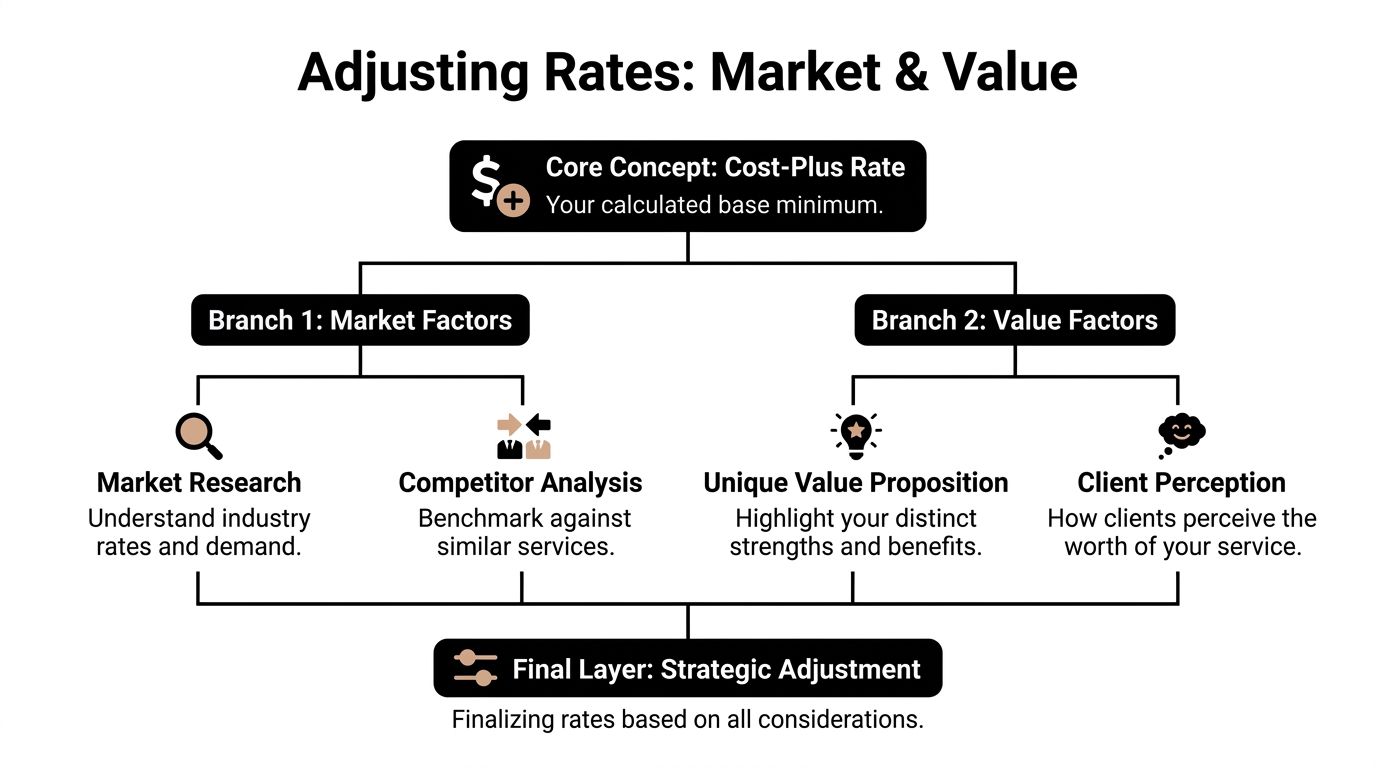
Your floor keeps you safe. The market tells you whether you're low, fair, or leaving money on the table.
Market data matters, but copying competitors is lazy
You should check what similar firms charge. You should not mirror those numbers without context. Two agencies can sell the same service name and have very different economics because one has stronger systems, better operators, cleaner scope control, or a more senior bench.
Good market research means comparing like with like. Look at service depth, buyer type, complexity, reporting burden, and how much strategic work sits behind the deliverable. A low quote from a shop that templates everything is not a benchmark for a team doing custom work.
The same logic applies to price testing. The pricing guidance in the verified data is clear that businesses should compare offers to similar products in the market and review pricing quarterly, and that tactics like charm pricing and anchor pricing can shape buyer behavior. For agencies, the practical takeaway is simple. Don't treat pricing as fixed forever. Test packaging, framing, and offer structure on a regular cycle.
The veteran expert problem
This is one of the biggest pricing errors I see. Someone has deep industry experience, leaves an executive role, starts consulting, and then prices like a beginner because they're “new to consulting.”
That logic makes no sense.
Existing guidance often lumps all new consultants together, but that misses the difference between someone with little experience and someone with decades of decision-making experience. Data from Consulting Success shows that a nonprofit consultant with 20+ years of prior experience charges an average of $186/hr, compared with the common “new consultant” bracket of $50–$100/hr. The premium comes from executive domain knowledge, not from the age of the consulting business.
If you spent years owning budget, hiring teams, fixing delivery problems, or leading a function, clients are not buying a rookie. They're buying judgment.
What clients actually pay up for
Clients don't pay more because your website says “premium.” They pay more when they believe your involvement lowers risk, shortens time to a good decision, or avoids expensive mistakes.
That usually comes from some mix of:
- Deep niche knowledge that lets you diagnose problems fast.
- Decision-level experience that turns advice into action.
- Operational maturity that keeps projects on track.
- Better communication so the client doesn't have to manage you.
A useful way to pressure-test your rate is to ask: if a buyer compares us with a cheaper option, what are they giving up? If the answer is vague, your price is vulnerable. If the answer is speed, clarity, lower oversight burden, and stronger strategic judgment, you have room to charge more.
Pricing isn't just a spreadsheet exercise. The numbers set the floor. Your market position and credibility decide how far above that floor you can go.
Structuring your services with tiers and retainers
A single offer forces every deal into the same box. That usually creates friction because buyers don't all have the same urgency, budget, or level of need.
Why tiers work
Tiered pricing works because it gives the client a decision framework. Instead of asking, “Do I want this agency or not?” they ask, “Which version fits us best?” That's an easier choice.
A simple tier structure also helps you control scope. You define what sits in each package, what response times look like, what level of strategy is included, and where custom work starts.
You don't need gimmicky names. Plain language works fine. Starter, Growth, and Strategic. Core and Expanded. Execution and Advisory. The point is clarity.
Here's what a healthy tier structure usually does:
- Entry option gives budget-sensitive buyers a way in without forcing you into custom low-margin work.
- Middle option is where you place the best operational fit for most clients.
- Top option includes senior access, faster turnaround, or broader strategic involvement.
- Custom option stays available for unusual deals, but it shouldn't be your default quote every time.
Retainers fix more than revenue
Retainers are not just a billing structure. They change how clients behave and how your team plans.
A retainer creates continuity. That means fewer stop-start handoffs, more context over time, and less sales pressure to replace one-off project revenue every month. It also gives clients a reason to think in terms of priorities and sequencing instead of random task requests.
That said, retainers only work when they're structured tightly. If you sell “ongoing support” with no service boundaries, clients will keep adding asks until your margins disappear. The retainer needs a defined service lane, a communication cadence, and a clear rule for work that falls outside the agreement.
A retainer should buy access to a defined service, not unlimited access to your team.
How I'd package agency work
For most agencies, the cleanest structure is a base recurring service with optional add-ons. The base covers the recurring engine. Add-ons cover campaign launches, deep audits, implementation spikes, or other work that doesn't happen every month.
That setup does two things well. It protects your team from random scope creep, and it lets the client increase spend without renegotiating the whole relationship. Operationally, that's much easier to manage than a giant all-in retainer that tries to cover everything.
How to justify your price and negotiate with confidence
The quote itself is only half the job. The rest is how you present it.
Clients rarely object to price in the abstract. They object to unclear value, weak framing, or fear that they're overpaying for something they don't fully understand. If your proposal reads like a task list plus a total, you've made that fear worse.
Sell the outcome, not your internal math
Most buyers do not care how you built your cost base. They should not be the audience for your internal spreadsheet. They care about what gets done, what changes as a result, how the work will run, and what they can expect from your team.
That means your proposal should focus on:
- The business problem you are solving.
- The operating plan for how the work gets done.
- The expected result in practical terms.
- The decision logic behind the recommended scope.
If you only explain hours, they compare you on hours. If you explain judgment, process, and business impact, the conversation gets better.
Stop discounting before anyone asks
This is one of the most expensive habits in service businesses. Many consultants, especially in the nonprofit sector, offer price reductions before a client even asks. As Funding for Good notes, this pre-emptive discounting erodes perceived value and profitability because it signals a lack of confidence in the original quote.
That applies far beyond nonprofit consulting.
If you quote a fee and immediately say, “But we can probably work something out,” you've told the buyer your first number wasn't real. You have also made the next conversation about concessions instead of value.
Quote. Then wait.
That sounds simple, but it takes discipline. A lot of undercharging starts in the silence right after the price lands.
Better responses to common pushback
You don't need slick lines. You need calm, direct language.
If the client says the price is higher than expected, you can say:
“I understand. The fee reflects the scope, the level of oversight required, and the pace you asked for. If budget is tight, we can reduce scope or phase the work.”
That response protects rate integrity. You're not arguing. You're giving them a choice.
If they ask whether you can do better on price, try this:
- Reduce scope rather than cutting price for the same work.
- Phase delivery if timing is driving the budget issue.
- Remove senior involvement only if the work can still succeed without it.
- Hold the number when the scope and risk already justify it.
A discount should buy something concrete. Smaller scope, longer timeline, lower service level, or narrower deliverables. Never give a lower price for the same work just to ease the tension in the call.
Confidence in pricing does not mean rigidity. It means you know what your number is built on, so you can change the package without collapsing the value.
Using accurate time tracking to protect your profit
Every pricing decision improves when your data gets better. Every pricing mistake gets harder to hide when your data gets better too, which is exactly why many agencies avoid looking closely.
Bad data leads to bad pricing
If your team estimates from memory, your quotes are weak from the start. You won't know how long onboarding really takes, how much revision time a project usually absorbs, or how much account management wraps around delivery. That makes it easy to underprice fixed-fee work and overpromise on retainers.
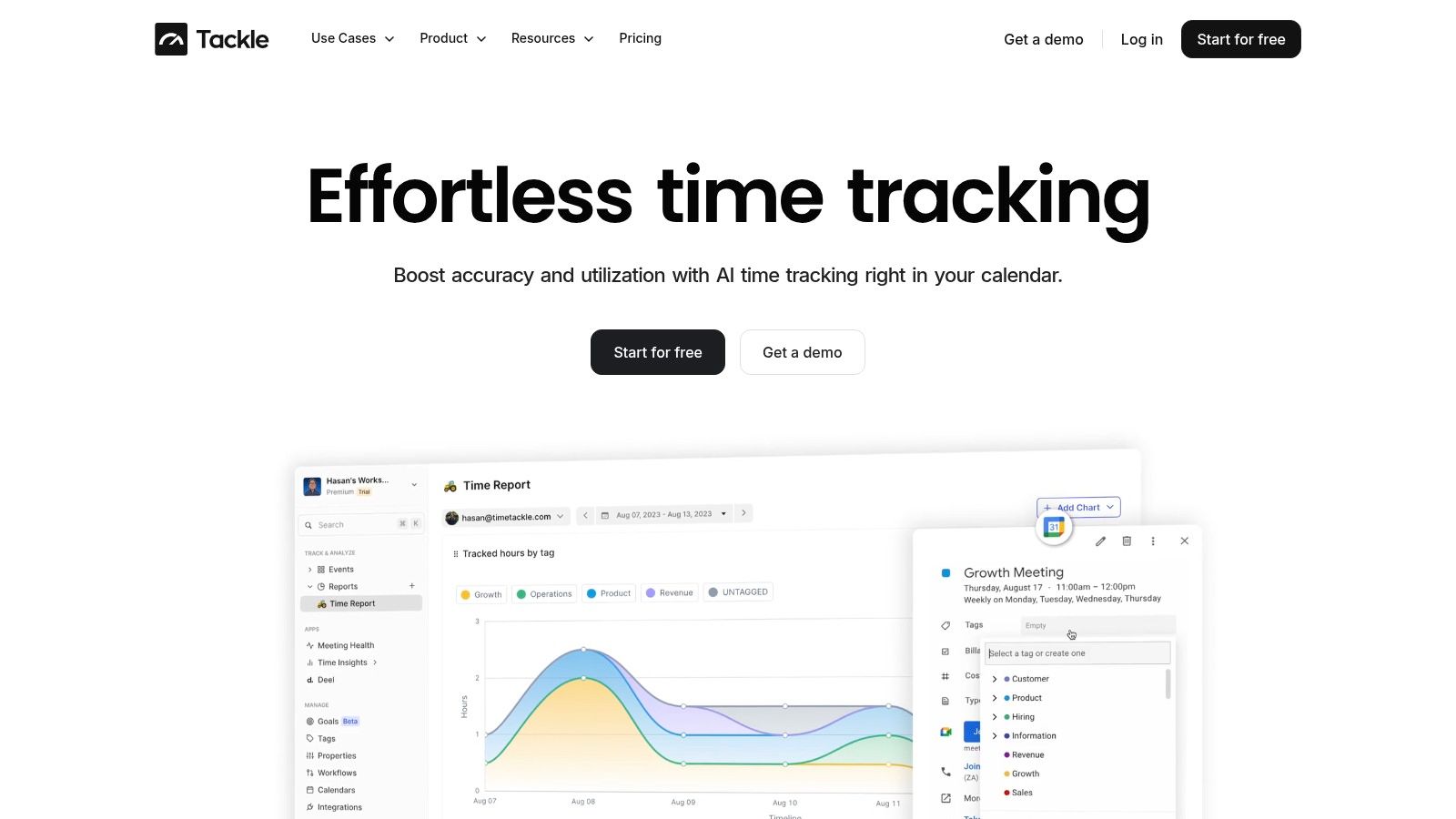
Good tracking fixes that. You can see where time goes by client, service line, team, and project stage. That makes future pricing more accurate because it comes from evidence instead of hope.
This matters even more for agencies with lots of meetings and calendar-driven work. If you want a practical look at systems built for that environment, this page on time tracking for agencies is useful.
What to look for in your own reporting
You don't need endless dashboards. You need a few answers you can trust.
Look for patterns such as:
- Which services run over even when the quote looked fine.
- Which clients consume management time far above what was planned.
- Which teams lose hours to internal coordination and rework.
- Which retainers stay healthy and which ones gradually decay.
A lot of pricing pain is really reporting pain. If you can't see the true cost of delivery, you can't defend your rates with confidence and you can't fix weak accounts early.
The agencies that price best are not guessing better than everyone else. They just track reality more accurately, then use that reality to reset rates, reshape scope, and tighten packaging over time.
TimeTackle helps agencies capture calendar-based work automatically, sort time by client and project, and turn messy activity data into reporting you can use. If you want cleaner utilization visibility, fewer manual timesheets, and stronger pricing decisions, take a look at TimeTackle.