


You've done the work. The project shipped. The client praised the result. Then the invoice slips past due, and now you're staring at accounts receivable instead of next month's plan.
That's where many organizations get messy. They send a vague “just following up” email, wait too long, then swing hard with a note that sounds like a legal threat. Neither approach works well. One gets ignored. The other strains a client relationship that may still be worth keeping.
A good letter requesting payment isn't just a piece of admin. It's part of an operating system for cash flow. If you run an agency, consulting team, or any service business, the goal isn't only to collect one invoice. The goal is to create a process that is clear, documented, easy to act on, and hard to ignore.
Why most payment request letters fail (and what to do instead)
The usual failure starts before the letter.
A team finishes work, sends the invoice late, forgets to confirm who owns payment on the client side, and only reaches out again when the bill is already old enough to make everyone uncomfortable. By then, the message carries stress. The client feels chased. Your team feels ignored. Finance has no clean paper trail.
I've seen this happen even in well-run agencies because people treat collections as an exception instead of a repeatable workflow. They rely on memory, tone, and goodwill. That's shaky ground when cash is tight.
The problem with generic follow-ups
Most weak payment requests have one of two problems:
- They're too soft. The note sounds apologetic, doesn't restate the invoice details, and gives the client no exact action to take.
- They're too emotional. The sender is frustrated, so the language gets sharp before the process has earned that tone.
- They're too vague. No invoice number, no due date, no attachment, no payment method, and no deadline.
- They arrive too late. The team waits until the issue becomes awkward, which makes every message feel heavier than it should.
That's why a letter requesting payment works best when it sits inside a billing process, not outside it. Your invoicing setup matters just as much as your wording, especially if your team still struggles with how work turns into billable output. Effective billing operations are therefore essential, and billing a client with a repeatable process makes the collection letter far easier to write and defend.
A payment reminder should never feel like a surprise to the client. If it does, something upstream is broken.
What works better
The better approach is simple. Treat every payment request as one step in a sequence.
That means you decide in advance:
- when the first invoice goes out
- when reminders go out
- what changes in tone at each stage
- when a polite reminder becomes a formal notice
- who owns the next step internally
When teams do this well, the letter stops being awkward. It becomes routine, which is exactly what you want. Routine messages get sent on time, include the right facts, and protect the relationship because they don't sound improvised.
The core components of any payment request
A payment request works when the client can read it fast, understand it fast, and pay fast.
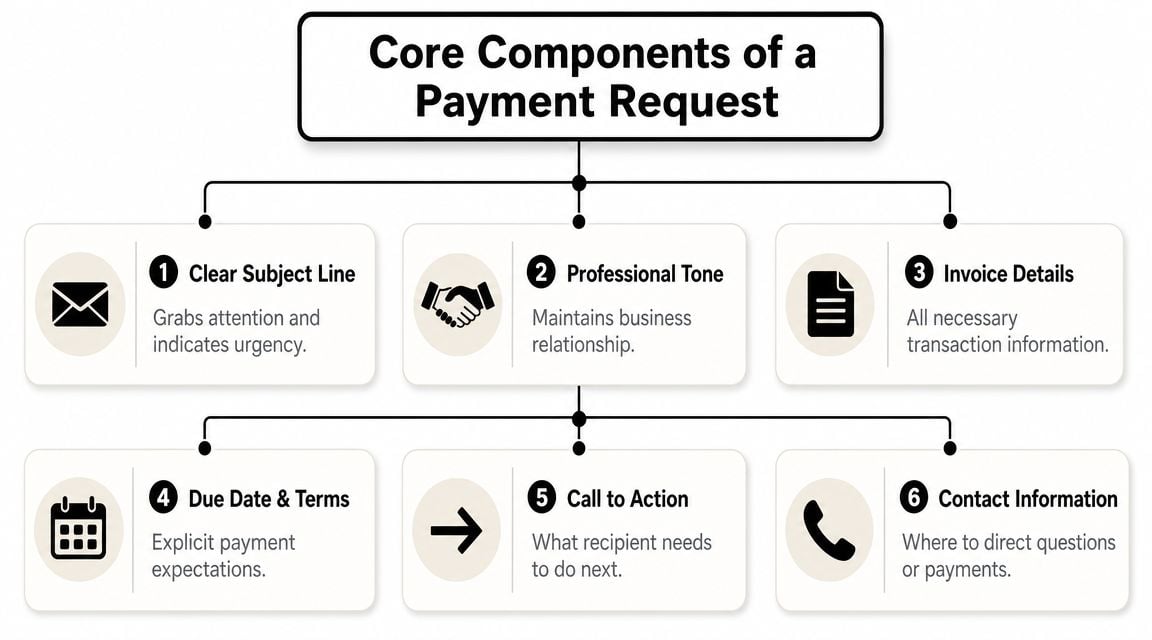
That sounds obvious, but a lot of letters bury the key details under too much politeness or too much backstory. Good collections writing is brief and complete at the same time. According to guidance summarized in this payment request structure reference, standard payment-request letters usually include a clear subject line, invoice reference, exact amount due, due date, payment methods, and a firm but respectful call to action. Modern guidance also recommends stating how many days overdue the invoice is and attaching a copy.
Start with the facts, not the feelings
If a client opens your message and has to hunt for the amount due, you've already added friction.
Use this checklist every time:
- Clear subject line. Make the topic obvious, such as invoice reminder plus the invoice number.
- Invoice reference. Include the invoice number in the body, even if it appears in the subject line.
- Exact amount due. Write the amount plainly so there's no ambiguity.
- Original due date. Don't make the client search old emails to find it.
- Payment method. Tell them how they can pay now.
- Direct call to action. Ask for payment by a specific date.
Add the context that removes excuses
A lot of overdue invoices stall because the client says they never saw the original bill, can't find it, or isn't sure what it covered. Some of that is real, some of it is delay, but either way the fix is the same.
Include supporting context in the message:
- attach the original invoice
- note when you first sent it
- mention the service delivery date if that matters
- include contact details for billing questions
Here's the trade-off. The more context you add, the safer the message becomes. But if you over-explain, the actual action gets buried. So keep the note short and put the detail in the attachment and the invoice itself.
Keep the tone firm and professional
You don't need legal language for a normal reminder. You need clarity.
A solid payment request sounds like this:
“Invoice 1048 for [service] was due on [date]. The amount due is [amount]. Please arrange payment by [date], and let us know today if there's any issue on your side.”
That tone works because it does four jobs at once. It states the debt, preserves dignity, gives a date, and invites a practical response.
A weak version usually fails because it asks a question instead of directing an action. “Just checking whether you've had a chance to look at this” is easy to ignore. “Please arrange payment by Friday” is much harder to sidestep.
Payment request templates for every client scenario
The best template is the one that matches the moment.
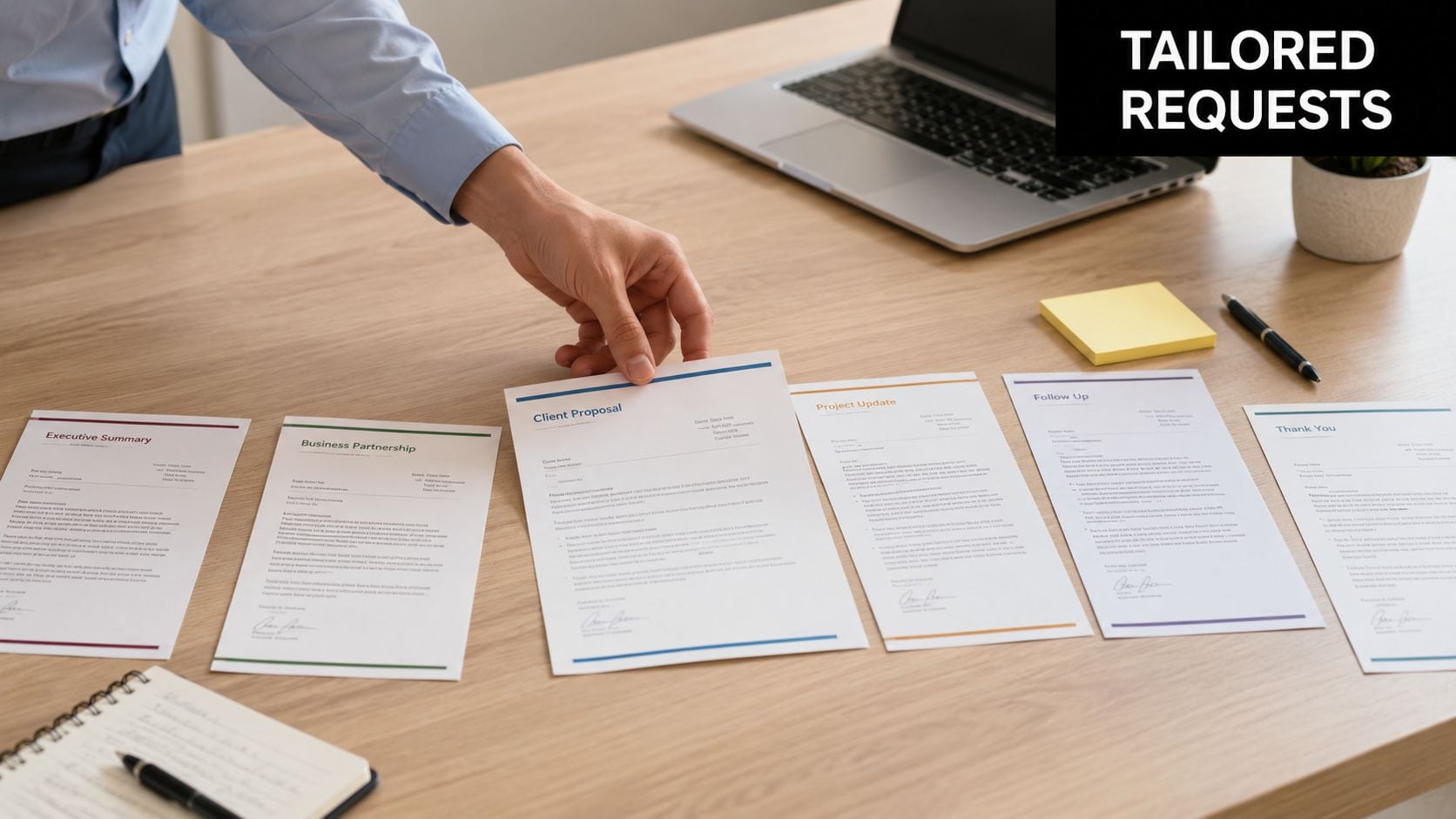
A friendly reminder before the due date should sound helpful. A note sent after repeated silence should sound formal and controlled. If you use the same wording for every stage, you either sound too timid too late or too stiff too early.
For email-based collections, a better structure is to keep one clear call to action, link to a secure payment portal, and offer self-serve options such as ACH or card, which reduces friction and confusion, as noted in this guidance on using email to collect payments. If you need cleaner billing inputs before you send anything, it helps to start from a reliable hours worked invoice template.
Template one: pre-due reminder
This works best for good clients and routine invoices.
Subject: Upcoming invoice due, Invoice [Number]
Hi [Name],
Just a quick reminder that Invoice [Number] for [service or project] is due on [Due Date]. The amount due is [Amount].
I've attached the invoice here for convenience. You can make payment via [payment method or portal].
If anything needs to be updated on your side before processing, let me know and we'll sort it out.
Thanks,
[Your Name]
Why this works: it gives the client an easy win before the due date passes. There's no accusation because none is needed.
Template two: slightly overdue reminder
Use this when the due date just passed and there's no sign of a payment issue yet.
Subject: Payment reminder for Invoice [Number]
Hi [Name],
Invoice [Number] for [service or project] was due on [Due Date], and the current balance is [Amount]. I've attached the invoice again here.
Please arrange payment by [New Date]. You can pay via [payment link or method].
If payment has already been sent, please ignore this note. If there's any issue with processing, reply here and copy in the right billing contact.
Best,
[Your Name]
Why this works: it assumes professionalism, but it still gives a date and a direct action.
Template three: firmer follow-up
This is the point where you stop sounding casual. You're still respectful, but the client should feel that the invoice is now a formal issue.
Subject: Overdue payment notice for Invoice [Number]
Hi [Name],
Invoice [Number] is now overdue. The original due date was [Due Date], and the outstanding amount is [Amount].
Please arrange payment by [Specific Date]. If there is any reason payment cannot be made by then, reply today with an update and expected payment date.
I've attached the invoice again for reference. Payment can be made through [payment method or portal].
Regards,
[Your Name]
Why this works: it sets a boundary. The message no longer asks whether they've “seen” the invoice. It asks them to pay or explain.
Practical rule: Every reminder should contain one action only. Pay by this date, or reply with a concrete issue. Don't ask five questions in one email.
Template four: final demand before escalation
Use this after prior reminders have been ignored or repeatedly pushed aside.
Subject: Final payment demand for Invoice [Number]
Dear [Name],
Despite previous reminders, payment for Invoice [Number] remains outstanding. The invoice was issued on [Issue Date], was due on [Due Date], and the amount currently due is [Amount]. The services were provided on [Service Date, if relevant].
Please make payment no later than [Final Deadline]. If payment is not received by that date, we may take further action in line with our agreement and internal recovery process.
A copy of the invoice is attached. If you believe this balance is disputed, reply in writing immediately with the reason.
Sincerely,
[Your Name]
[Company Name]
Why this works: it is factual, brief, and serious. No threats. No drama. Just a deadline and stated consequences.
A quick comparison of tone by stage
| Stage | Tone | Goal | What to avoid |
|---|---|---|---|
| Pre-due | Friendly | Prevent lateness | Sounding needy |
| Just overdue | Polite and direct | Prompt payment fast | Long explanations |
| Repeated follow-up | Firm | Force a decision | Emotional language |
| Final demand | Formal | Create leverage and record | Empty threats |
The most common mistake here is over-writing. A letter requesting payment should not read like a memoir of the project. It should read like a clean business record.
A follow-up timeline that actually gets invoices paid
The challenge for organizations isn't often a collections problem; it's a timing problem.
They wait too long, then bunch all the pressure into one message. That creates friction on both sides. A staged rhythm works better because it gives the client several chances to act while also building a clear record of your efforts.
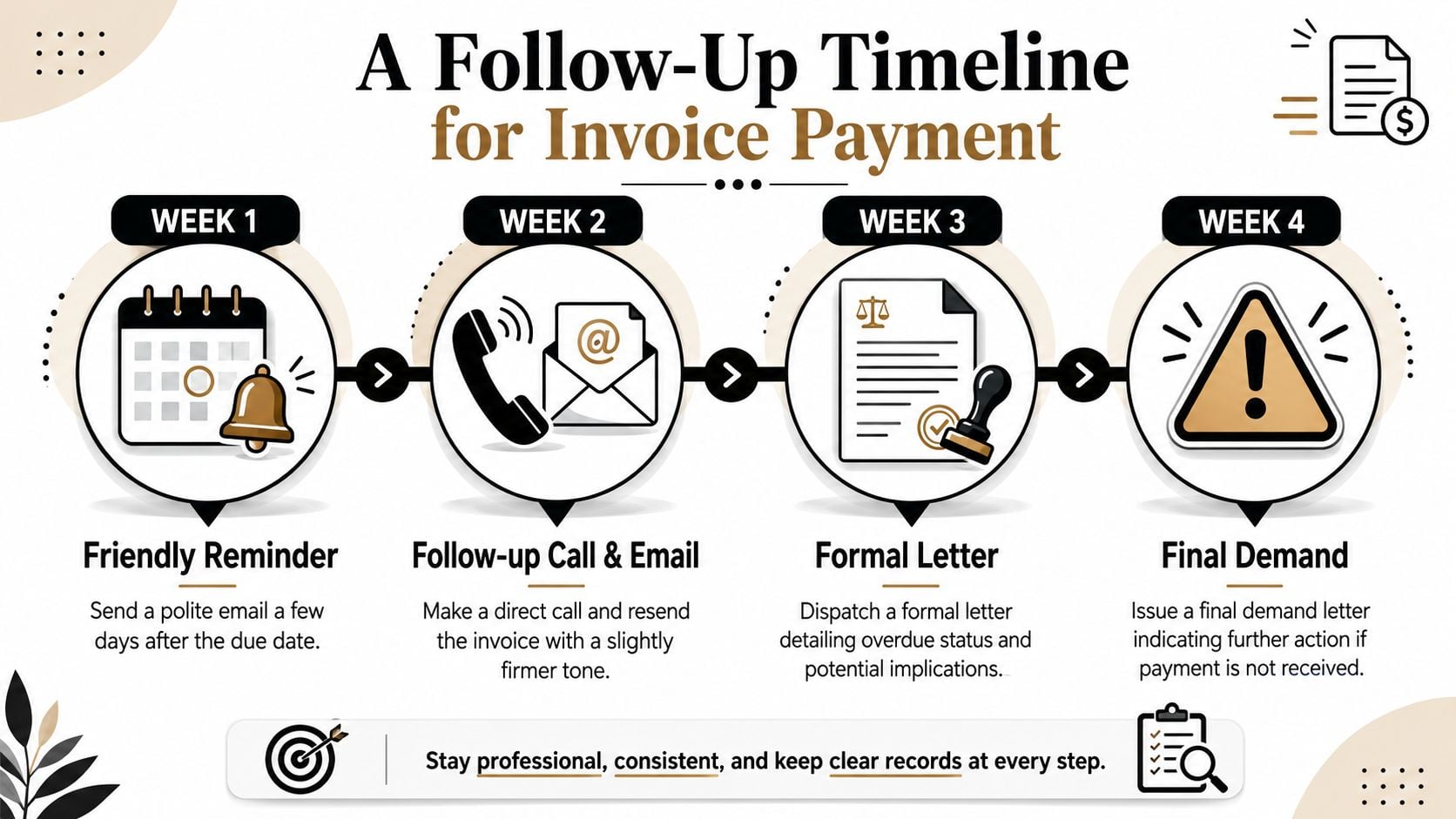
According to collections timing guidance, a widely used best practice is to send the first invoice at least 2 weeks before the payment due date, then follow with reminders on the due date, 1 week late, 2 weeks late, and 1 month late.
A simple cadence that keeps pressure steady
This schedule works because each step has a different job.
- First invoice at least 2 weeks before due date. Give accounting teams time to process it.
- Reminder on the due date. Useful for clients who batch approvals or forgot.
- Reminder at 1 week late. Shift from soft reminder to direct request.
- Reminder at 2 weeks late. Make the issue visible and ask for a firm update.
- Reminder at 1 month late. Move to formal notice territory.
Why this sequence works
A lot of payment delays aren't disputes. They're admin drift. The invoice went to the wrong person. The approver was on leave. Procurement needed a document your team forgot to attach.
That's why early reminders matter. They surface process issues while the account is still salvageable with a simple reply.
If a client is going to pay, they often tell you early. If they stop replying, the problem has changed.
By the time an invoice reaches the later stage, your goal is no longer just courtesy. Your goal is documentation. You want a record that shows you sent the invoice on time, followed up consistently, and gave the client clear chances to resolve the issue.
Who should send what
This part matters more than many teams think.
| Timing | Best sender | Best channel | Main purpose |
|---|---|---|---|
| Before due date | Account manager or finance | Keep it easy | |
| Due date | Finance | Confirm due status | |
| 1 to 2 weeks late | Finance plus account lead if needed | Email and call | Get a real response |
| 1 month late | Finance or leadership | Formal letter | Prepare for escalation |
If the account lead stays too involved too long, the client may treat the invoice as negotiable. If finance jumps in too hard too early, the note can feel cold. The handoff needs to be deliberate.
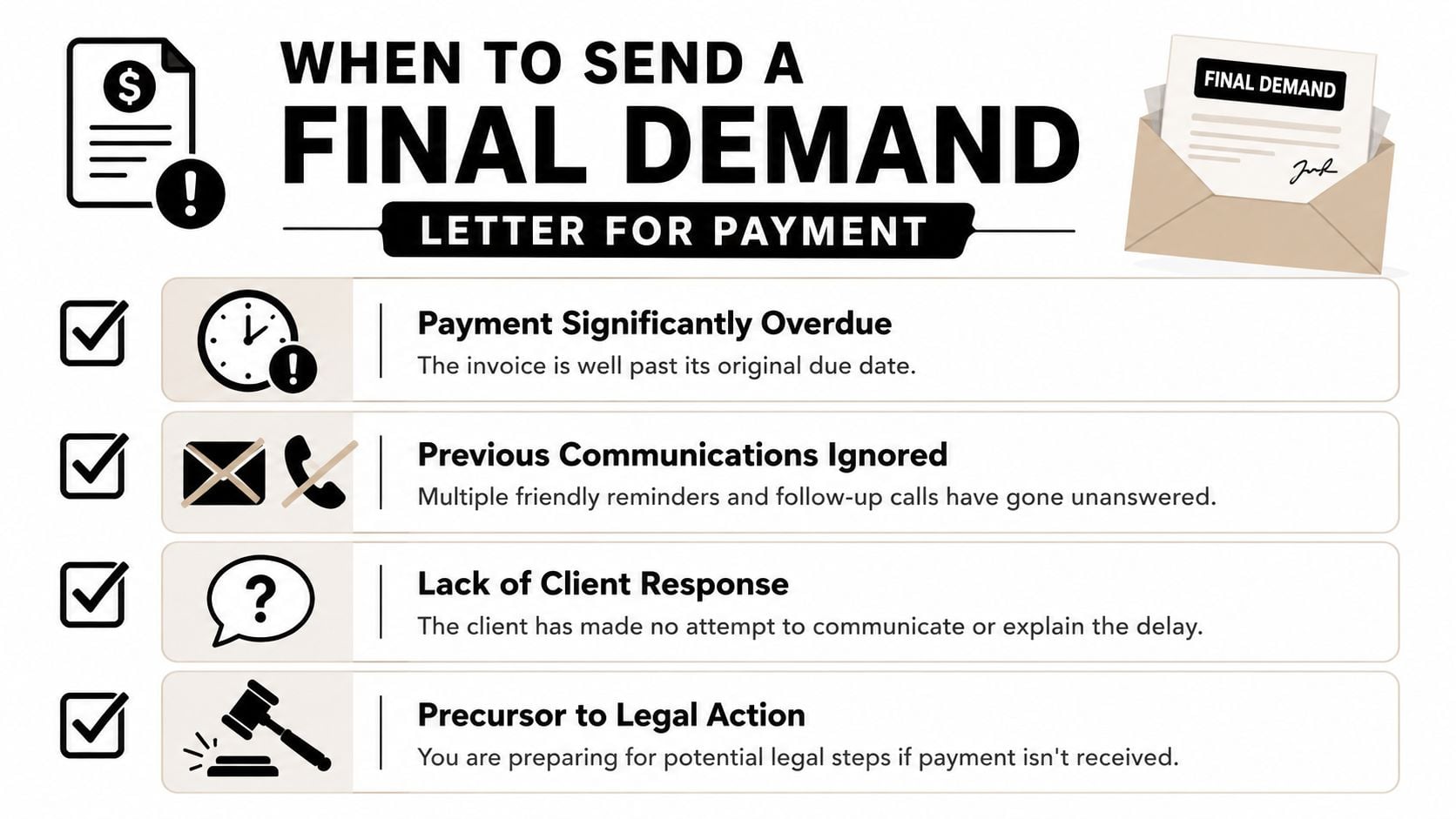
When to send a final demand letter for payment
A final demand letter is not your first move. It's what you send when the normal reminder cycle has run its course and the client still hasn't paid or engaged in good faith.
At that point, you need a different standard. You're no longer sending a nudge. You're creating a serious business record that can support the next step if the dispute grows.
What belongs in a stronger demand letter
For a legally stronger demand letter, guidance collected in this resource on creating a demand letter to collect payment recommends five technical elements:
- Identify both parties so there's no confusion about who owes what.
- Specify the debt date and transaction basis so the claim is tied to a real event or service.
- Cite the governing contract or agreement that created the obligation.
- Calculate the balance clearly, including any late fees or interest that your contract allows.
- Set a firm deadline with consequences if payment is not made.
That same guidance recommends using certified mail because proof of delivery may matter if the matter escalates.
When the tone must change
Send a final demand when the pattern tells you the account has moved beyond normal delay:
- prior reminders have gone unanswered
- the client has stopped giving dates they keep
- internal contacts are bouncing you around without resolution
- you are willing to act if the deadline passes
This last point matters. Don't send a final demand letter if you have no plan after the deadline. Empty escalation weakens your position.
A final demand letter should narrow the situation. It should not open a new round of vague discussion.
If your next step may involve counsel, a stronger pre-action approach matters. There's good practical value in understanding preventing disputes with pre-litigation letters, because the wording and documentation in that phase can shape what happens next.
What not to do
A final demand letter fails when it sounds theatrical.
Don't threaten criminal action. Don't insult the client. Don't make legal claims you can't support. Keep the letter short, factual, and tied to the contract and unpaid work. Serious tone comes from documentation, not bluster.
Adapting your payment strategy for agency clients
Agency collections are rarely just about one invoice.
The main issue is usually tangled up with project status, scope creep, retainer habits, and the human fact that you may still want the client next quarter. That's why agencies need more than a letter. They need decision rules.
Guidance on what happens when a demand letter is ignored points to a gap many articles miss. The hard part isn't wording the first request. The hard part is deciding what happens next while preserving your advantage and client relationships.
Good clients who pay late need a different response
If a good client is consistently late, don't jump straight to legal language. First, check the operating problem.
Maybe their AP team needs purchase order numbers. Maybe your invoice arrives after their payment run. Maybe your team keeps billing from loose timesheets and the client doesn't trust the totals. Such scenarios demonstrate how cleaner invoicing for consultants can reduce friction before the reminder stage even starts.
Use a simple internal test:
- Talk first if the client communicates and the relationship is healthy.
- Pause work if the balance grows and promises keep slipping.
- Escalate formally if they stop engaging or dispute without specifics.
- Review scope if payment delays started after delivery expectations changed.
In some sectors, demand letters sit inside broader dispute workflows. If you want a plain example from another area of practice, this guide on resolving Texas landlord disputes is useful because it shows how demand letters fit into a larger record-building process, not just a one-off message.
Protect the relationship without weakening your position
The key is consistency. Your best clients still need boundaries, and your hardest clients still deserve professional communication.
A letter requesting payment works best when it reflects a policy, not a mood. When your process is steady, clients don't read a reminder as personal. They read it as part of doing business with a team that runs a tight operation.
If your agency wants cleaner invoicing, less timesheet chasing, and better visibility into what should be billed and when, TimeTackle is worth a look. It helps teams capture work from the calendar, organize it into billable data, and reduce the manual reporting mess that often leads to invoice delays in the first place.