



A landmark study of 258 large projects found that nine out of ten went over budget, and cost increases of 50% to 100% are common. The same record includes the Sydney Opera House, which ran 1,400% over its original budget, a number so absurd it should make every agency leader stop treating overruns like a minor delivery issue and start treating them like an operating risk (Cato on megaproject cost overruns).
Agency teams often read numbers like that and assume they belong to rail tunnels, airports, and public works. They don't. The pattern shows up in agencies too, just in a quieter form. The budget doesn't explode all at once. It slips a little at a time through untracked revision rounds, internal Slack huddles, rushed status meetings, and the familiar fiction that the team will “make it up next week.”
Most advice on project cost overruns says the same thing. Scope better. Plan better. Control change requests. That advice isn't wrong, but it's incomplete. In agencies, the deeper problem is that teams often run projects with delayed, low-trust effort data. When people log time late, guess at hours, or avoid timesheets altogether, the system doesn't just report the overrun after the fact. It helps create it.
That's the operational trap. Leaders think they have a planning problem when they instead have a visibility problem. And once visibility breaks, estimation breaks with it.
That sinking feeling when a project goes off the rails
You know the moment. A fixed-fee project still looks healthy in the weekly status meeting. The client is happy enough. The team says they're “close.” Then finance checks the burn, project management asks for updated hours, and everyone realizes the job has already eaten most of its budget with weeks still left.
That moment feels sudden, but it rarely is.
The overrun started earlier, usually when the team relied on a rough estimate for work that was never going to move in a straight line. Creative review cycles stretched. Strategy changed after client feedback. Senior people jumped into calls that nobody tagged properly. Because the tracking system depended on people filling out timesheets later, no one saw the budget drift while there was still time to fix it.
Why this feels familiar in agencies
Agency work is full of non-linear tasks. Creative iteration, stakeholder review, workshops, troubleshooting, and client handling don't behave like factory work. They expand and contract based on people, timing, and decisions. That's why a spreadsheet estimate can look tidy on day one and fall apart by week three.
And the problem is bigger than one bad project. A lot of teams still manage work with stale data, which creates exactly the sort of blind spots that make common project management issues harder to control.
“We're on track” is often just another way of saying, “We don't have current data.”
The real issue isn't only planning
Poor planning gets blamed because it's easy to spot in hindsight. But the more practical explanation is this. Agencies often don't know the true cost of work until long after the work happened.
That delay changes behavior. Project managers keep promising recovery. Team leads keep reallocating staff based on incomplete effort logs. Leaders keep approving work because the dashboard still looks fine. By the time the numbers catch up, the agency has already done the expensive part.
This is why project cost overruns feel so frustrating in service businesses. The labor has already been spent. You can't put hours back on the shelf.
The true business impact of budget blowouts
The cost of an overrun is never just the write-off on one job. It hits margin, staffing, trust, and decision-making all at once. Agencies usually feel the financial pain first, but the cultural and operational damage lasts longer.
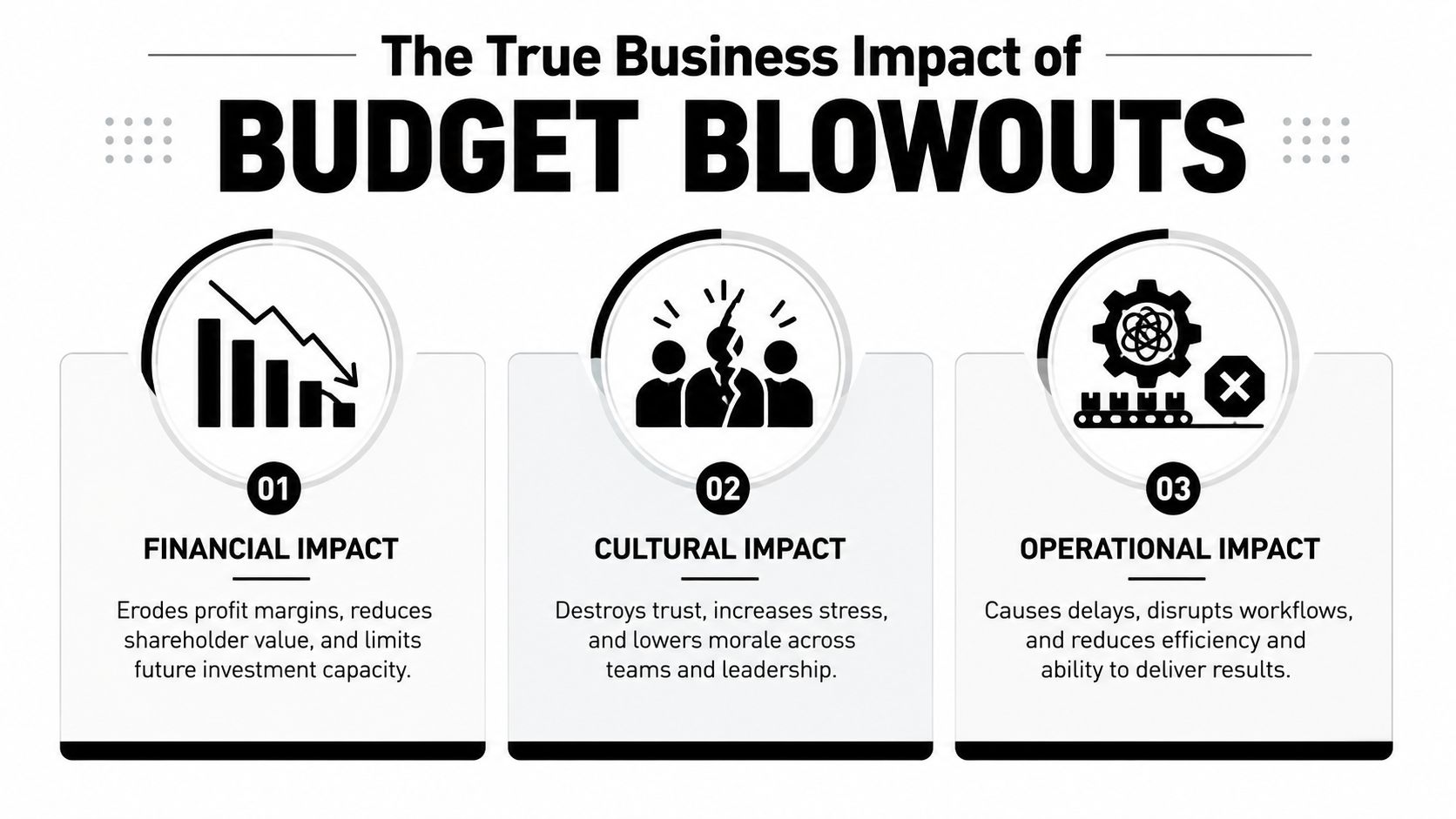
A useful benchmark comes from IT, which is close enough to agency work to be instructive. IT projects have an average cost overrun of 43%, 71% of all IT projects come in over budget, and the waste tied to that problem reaches $55 billion annually in the US (IT project overrun statistics). If you run implementation, digital, or retained client work, that should sound uncomfortably close to home.
Financial damage shows up first
An overrun cuts deeper than “less profit on this project.” It can hit several layers of the business at once:
- Margin loss: A fixed-fee project that burns extra unbilled hours turns healthy revenue into low-quality revenue.
- Cash flow strain: Teams keep working, payroll keeps moving, and the client invoice often stays the same.
- Growth delay: Money that could fund hiring, training, or tooling gets absorbed by rework and write-downs.
- Pricing distortion: When actual effort data is weak, the next proposal starts from the same bad assumptions.
That last one matters most. Agencies often think they lost money because a single project went sideways. In reality, they lose money because one bad data set pollutes the next estimate.
For teams trying to tighten this up, cost control in project management needs to sit closer to delivery, not only in finance.
Cultural damage is slower, but worse
Once overruns become normal, people change how they work. PMs start chasing hours instead of managing delivery. Team leads protect their departments instead of solving the client problem. Staff learn that estimates are political, not operational.
You can usually spot this pattern before anyone says it out loud:
| What leaders say | What teams hear |
|---|---|
| “We need better forecasting.” | “You'll be blamed when the budget misses.” |
| “Please update your timesheets.” | “Admin matters more than real work.” |
| “Can we absorb this one?” | “Free work is expected.” |
| “Let's push through.” | “Burnout is part of delivery.” |
Operating truth: If your reporting process feels like punishment, your data will rot.
Client trust erodes faster than most teams expect
Clients don't only react to billing surprises. They react to uncertainty. If a project team can't explain where time is going, why revisions are expanding, or what changed in the work mix, the client starts doubting the agency's control.
That doubt shows up in hard conversations. Scope gets challenged. Renewals stall. Referrals dry up. And once a client thinks your numbers are soft, every future estimate becomes harder to defend.
So yes, project cost overruns hurt the P&L. But they also weaken the operating rhythm of the agency, which is why fixing them takes more than tighter spreadsheets.
Why your project estimates are almost always wrong
Most agencies blame overruns on scope creep, difficult clients, or weak PM discipline. Those things matter, but they don't explain why even smart teams keep underestimating work they've done many times before.
The bigger issue is optimism bias. Teams assume work will move more cleanly this time than it usually does. They picture the best path through the project, then price and staff against that path.
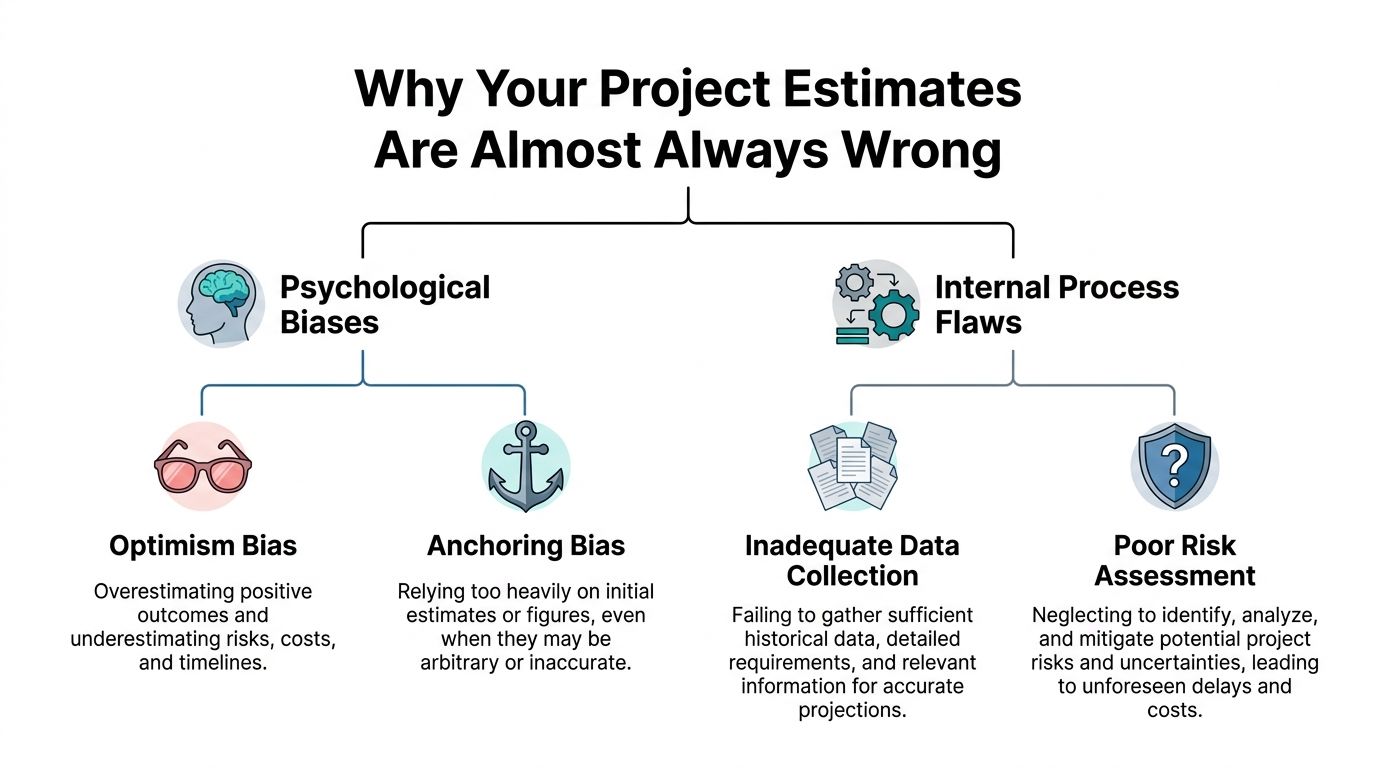
Research confirms that “optimism bias” and a “lack of realism in initial cost estimates” are primary drivers of overruns. It also points to a second problem that agencies know well: delays in acknowledging true costs get worse when real-time activity data is missing because teams rely on manual tracking (PMI on realism, optimism bias, and delayed cost recognition).
Estimation fails long before the budget fails
This is why agencies get trapped. The estimate is wrong at the start, but nobody can prove it early because the effort data arrives late and half-complete. A PM sees a project “roughly on track.” The delivery lead thinks the extra work is temporary. Finance won't see the issue until the team submits time, which may happen days later or after a reporting cycle.
That means the system protects the estimate from reality.
If you want a useful comparison, look at how disciplined cost estimation works in fields with expensive downside. A solid guide for fix and flip rehab costs is useful here because it treats cost assumptions as something to test against real conditions, not as a hopeful first draft. Agencies need the same posture, even if the asset is labor instead of property.
Manual timesheets make the bias worse
Manual tracking sounds harmless because it feels administrative. It isn't. It changes how people report work.
A designer logs time at the end of the week and rounds down a string of small revisions. An account lead forgets to record two client calls. A strategist books a block of time to whatever project is easiest to remember. None of this looks dramatic, but taken together it trains the agency on bad history.
That's why forecast quality matters so much. Good forecasting doesn't come from smarter guessing. It comes from feeding estimates with actual behavior patterns, which is exactly what is commonly overlooked. If you're trying to tighten planning at the operating level, ways to improve forecast accuracy usually start with cleaner activity data, not prettier templates.
Teams don't underestimate because they're careless. They underestimate because the system gives them no honest feedback loop.
Scope creep is real, but it isn't the whole story
Scope changes absolutely drive cost. Every agency should have a process for identifying, pricing, and approving them. But scope creep often gets treated as the villain because it lets the team avoid a harder truth: even the original scope was probably underpriced.
That's the part many agencies don't want to admit. If a team tracks effort poorly, it can't separate “the client added work” from “we guessed low and found out late.”
Those are two very different problems, and each needs a different fix.
How to spot overruns before they sink your budget
Project overruns often come to light through lagging signals. A gross margin report comes in ugly. The PM asks for extra hours. Finance flags a write-off. By then, the work is already done.
The better approach is to track leading signals that show budget stress while you still have options.
Four indicators worth watching weekly
- Budget versus actual hours: Compare planned effort for the full project and for the current phase against logged effort. If actual hours climb faster than planned progress, the team is burning hot even if deliverables still look on track.
- Estimated versus actual by task: Review the gap between expected effort and real effort at the task level. This shows where your estimating model is weak. It also separates one-off surprises from repeatable pricing errors.
- Resource utilization by project: Watch where people spend their week, not just total utilization. If senior staff keep dropping into a project without a corresponding plan, the job is probably carrying hidden complexity.
- Revision load and meeting load: If review cycles and client calls keep growing, labor follows. Agencies often ignore these because they feel small, but they are early warnings for budget drift.
What the numbers usually mean
A metric only matters if the team knows how to act on it. Here's a simple way to read these signals:
| Signal | What it often means | Best next move |
|---|---|---|
| Hours burning faster than phase progress | The estimate was light, or delivery is stuck in rework | Reforecast now and review scope |
| Task actuals keep beating estimates | Your pricing model is weak in a specific work type | Update future estimates using actual history |
| Senior people are over-involved | Complexity or client friction is higher than planned | Escalate staffing and reset margin expectations |
| Meetings and revisions keep rising | Hidden service work is accumulating | Make the extra effort visible to the client |
Practical rule: If a project needs heroics to stay “on track,” it is already off track financially.
Build a review rhythm that forces action
A dashboard alone won't save you. Teams need a cadence. I've found the most useful review pattern is short, frequent, and tied to decisions:
- Check live burn against phase budget.
- Review the largest variance by task or team.
- Decide whether to absorb, reassign, or re-scope.
- Record the decision so the next estimate gets smarter.
That last step matters. If your team spots overruns but never feeds that learning back into pricing, you're only getting better at post-mortems.
A modern playbook for preventing cost overruns
Agencies don't fix overruns with stricter reminders to fill in timesheets. They fix them by reducing the friction between work happening and work being recorded. Once that gap shrinks, estimating gets better, PMs can intervene sooner, and client conversations get cleaner.

A big reason this matters is that manual reporting creates a 2–4 week data latency gap, which forces managers to work from stale information. The same process creates timesheet fatigue, and that weakens the quality of the data needed for forecasting (NetSuite on data latency and timesheet fatigue).
Use historical effort, not team memory
Most agencies still estimate from memory plus confidence. That's unreliable. Build estimates from prior projects with similar scope, team mix, revision patterns, and client behavior. If you don't have that history in usable form, that's the first operational problem to solve.
A practical model should include task-level effort ranges, not just total hours. That gives PMs a way to see which part of the job is drifting.
Make change control visible and billable
A lot of agencies technically have a scope process, but nobody uses it until the project is already in trouble. Good change control is fast, ordinary, and tied to current effort.
Use a simple standard:
- Log the change: Record what shifted, who asked for it, and which team will absorb the work if it goes unpriced.
- Estimate the impact: Don't wait for a perfect answer. A directional view is better than silence.
- Get client confirmation: Turn hidden work into an explicit decision.
- Update the budget baseline: If the scope changed, the target has to change too.
This same logic shows up in other operational settings. Teams working to optimize maintenance budgeting rely on current condition data because budget control breaks when assumptions lag behind reality. Agency work is less mechanical, but the discipline is the same.
Replace manual entry with passive capture where possible
This is where modern systems change the game. Calendar-based and workflow-based capture removes a lot of the burden that causes poor compliance in the first place. Instead of asking busy teams to reconstruct their week from memory, the system starts with the work people already did, then lets them tag, review, and correct it.
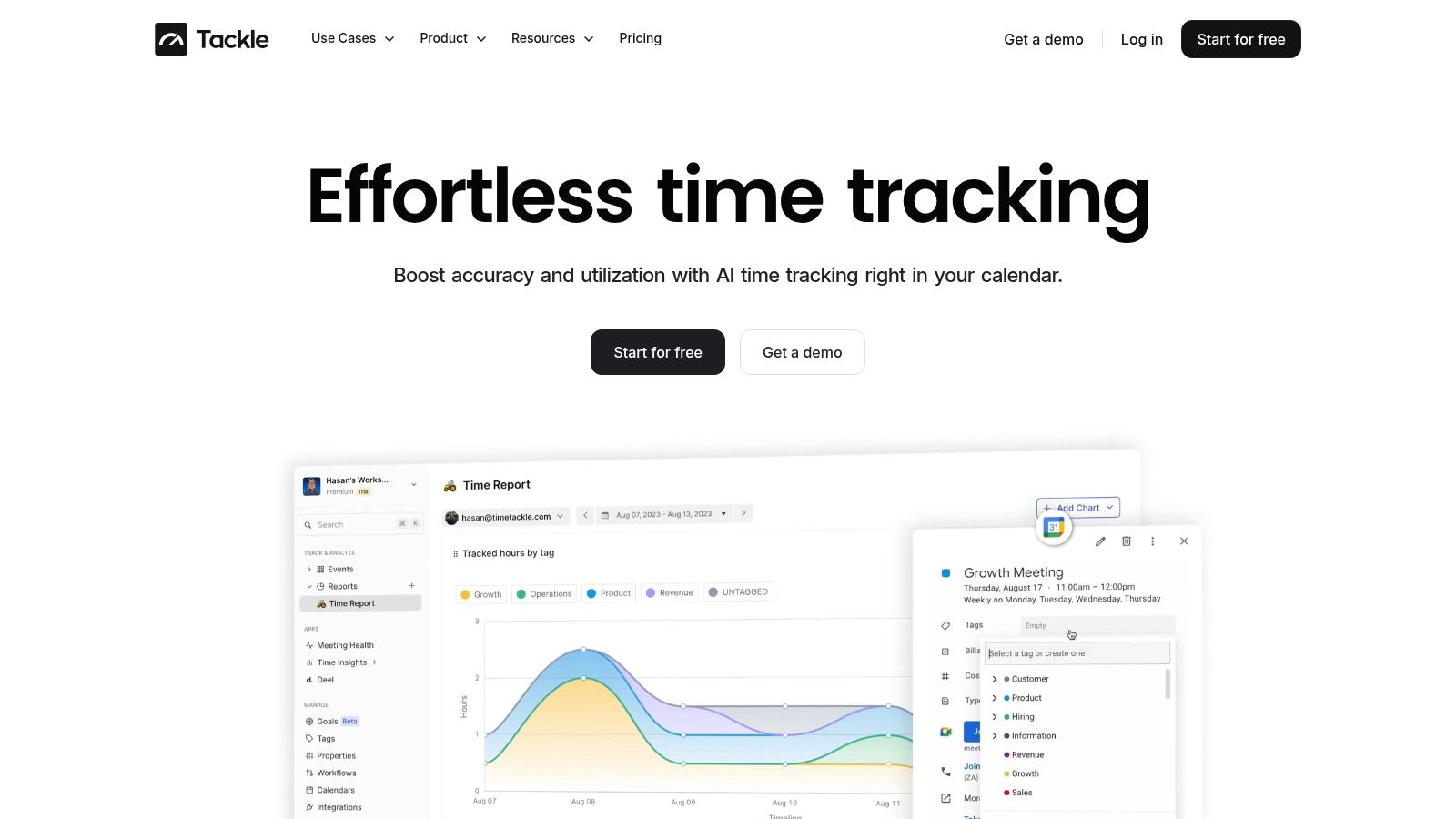
One tool in this category is TimeTackle, which connects calendar activity and related work data so teams can categorize effort with less manual entry and review utilization and project trends in dashboards. That kind of setup won't fix pricing discipline by itself, but it does remove one of the biggest sources of bad operating data.
The goal isn't to watch employees more closely. The goal is to remove guesswork from delivery economics.
Give PMs live variance, not monthly history
Most PMs can act on a problem if they see it early enough. They can't act on a spreadsheet that lands after the budget is gone.
So the operating playbook is simple. Capture effort with less friction. Review burn in real time. Escalate scope changes quickly. Feed the actuals back into the next estimate. Repeat until “surprise overruns” stop being normal.
Case study from budget chaos to profitable control
A 75-person creative agency I'll call Agency X had the usual symptoms. Project managers chased timesheets every Friday. Department leads debated utilization in Excel. Client services kept saying a project was “tight but manageable,” which usually meant the team had already done unbilled work and didn't want to admit how much.
The agency didn't have one big failure. It had dozens of small visibility failures. Meetings weren't logged cleanly. Revision work got buried in generic delivery buckets. Senior staff time disappeared into internal support. Every budget review turned into an argument about whose numbers were “real.”
What changed first
The leadership team stopped asking people to become better historians. Instead, they changed the capture process and the review cadence.
They started from existing work patterns: calendar activity, client-facing meetings, tagged project categories, and simpler weekly reviews tied to active decisions. PMs no longer waited for end-of-period reports to figure out whether a project was healthy. They checked current burn against planned effort and escalated variance while there was still room to act.
The first real test came on a brand strategy engagement. Midway through delivery, the agency saw a clear pattern. Executive workshops and review cycles were consuming more senior time than the original scope assumed. Under the old system, that overrun would have become a write-off discovered after the work was done.
Instead, the team pulled current effort data, showed the client where the work had expanded, and proposed a revised statement of work for the extra rounds. The client signed because the agency could explain the change with specifics instead of hand-waving.
The practical result
The biggest gain wasn't magical efficiency. It was control.
Agency X got better at four things:
- Spotting margin risk early: PMs could see hot projects before the month closed.
- Pricing future work with more honesty: Estimates started using real task history, not team optimism.
- Reducing internal friction: Fewer hours were spent chasing, cleaning, and disputing timesheets.
- Protecting client trust: Scope conversations moved from apology to evidence.
The cultural shift mattered too. Once the team believed the system reflected reality, the blame game cooled off. People stopped treating time data as a compliance chore and started using it to make delivery calls.
That's usually the turning point. Agencies don't become more profitable because they suddenly work less. They become more profitable because they stop lying to themselves about what the work costs.
Your calendar data is a strategic asset
Most agencies still treat time tracking as an ugly back-office task. That mindset is expensive. If your team's activity data lives in calendars, meetings, project systems, and CRM touchpoints, then that data can do far more than support invoicing.
It can improve pricing. It can show which clients consume senior attention without paying for it. It can reveal where project managers rely on heroics instead of process. And it can tell you which services look profitable in the proposal but become labor-heavy once delivery starts.
What good activity data lets leaders do
When agencies capture work with less friction and review it in context, they can answer better questions:
- Which service lines are predictably profitable, and which ones only look good on paper
- Which clients create hidden effort through meetings, revisions, and decision delays
- Which teams are overloaded, underused, or misallocated across accounts
- Which estimate assumptions should be retired because actual work keeps disproving them
That's why calendar data matters. It reflects how work really happens, not how the template said it would happen.
Better time intelligence changes the quality of management decisions. It doesn't just tidy up reporting.
Stop treating tracking as surveillance
The wrong way to frame this is “we need more oversight.” People hate that, and they should. Agencies don't need more administrative theater. They need cleaner evidence.
The right way to frame it is simpler. If the business sells time, judgment, and expertise, then effort data is part of its operating system. Teams need a way to capture that data without adding friction, and leaders need to use it to make better calls about pricing, staffing, and scope.
Project cost overruns are rarely a mystery. Most of the time, the agency just didn't have honest data early enough to act.
If your agency is tired of chasing timesheets, arguing over hours, and discovering margin problems after the damage is done, TimeTackle is worth a look. It helps teams capture work from the calendar, categorize it with less manual effort, and review utilization and project trends in real time so operations leaders can make decisions before budgets slip.