



If you run a mid-sized agency, this choice usually lands on your desk later than it should. Payroll starts as an HR setting, then it turns into an operations problem. Suddenly finance is asking why labor reports never line up with monthly P&Ls, project managers are chasing late timesheets, and team leads are fielding complaints about odd paycheck timing.
That’s why semi monthly vs bi weekly pay isn’t just an accounting preference. It changes how cleanly you can track labor, how often payroll has to reconcile exceptions, and how easy it is for employees to trust both their paycheck and the reporting built on top of it.
For agencies with a mix of salaried strategists, account managers, hourly coordinators, and production staff, the wrong schedule creates friction in places you don’t expect. Not just cash flow. Profitability reporting, capacity planning, overtime handling, and timesheet compliance all move with it.
A quick side-by-side view makes the trade-offs easier to see.
| Pay schedule | Pay periods per year | Typical cadence | Check size on a $50,000 salary | Best fit in practice |
|---|---|---|---|---|
| Semi-monthly | 24 | Fixed dates such as the 15th and 30th | $2,083.33 | More straightforward for salaried exempt teams |
| Bi-weekly | 26 | Every 14 days, often every other Friday | $1,923.08 | Usually easier for hourly non-exempt teams |
The core numbers: 24 vs. 26 paychecks explained
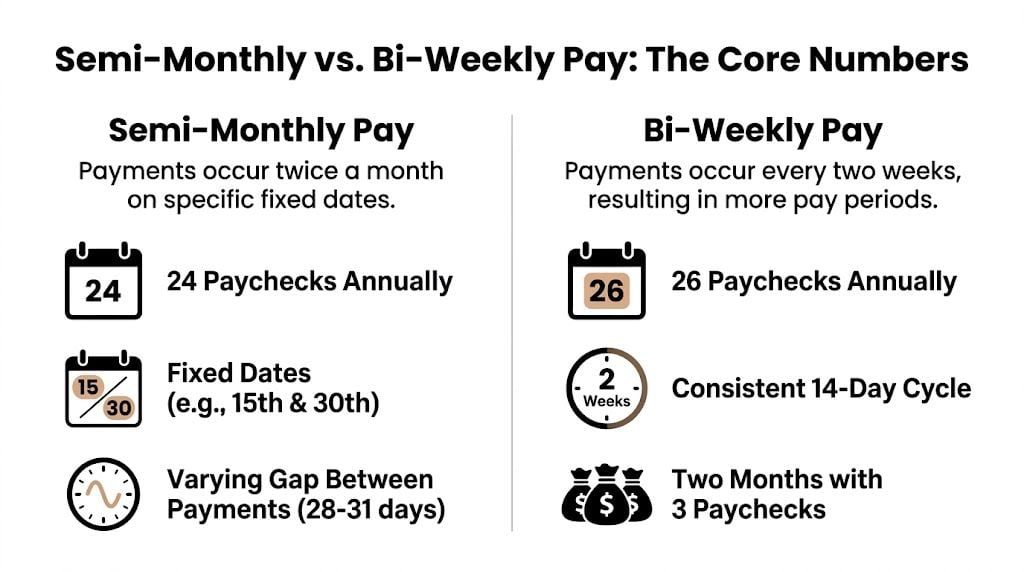
The first difference is simple. Semi-monthly pay means employees get paid twice a month, usually on fixed dates such as the 15th and 30th. That creates 24 paychecks per year. Bi-weekly pay means employees get paid every two weeks, which creates 26 paychecks per year and usually two months with three paychecks instead of two, as explained in Patriot Software’s breakdown of biweekly vs semimonthly payroll.
What the paycheck math looks like
If you pay someone an annual salary of $50,000, the math works like this:
| Schedule | Formula | Gross pay per check |
|---|---|---|
| Semi-monthly | $50,000 ÷ 24 | $2,083.33 |
| Bi-weekly | $50,000 ÷ 26 | $1,923.08 |
Nothing about total annual pay changes. What changes is the rhythm. Semi-monthly produces larger checks because you divide the same salary across fewer pay periods. Bi-weekly produces smaller checks, but employees receive them more often.
That rhythm matters more than many leadership teams expect. It shapes how people budget, but it also shapes how your internal reporting behaves. If your agency tracks work weekly or every two weeks, bi-weekly often maps more neatly to the way teams already log time and review output.
Practical rule: Don’t treat payroll cadence as a payroll-only setting. It becomes part of your reporting system the minute you allocate labor by pay period.
Why agencies feel this difference fast
Semi-monthly follows the calendar. Bi-weekly follows the workweek. That sounds minor until you start reconciling labor against project timelines, staffing plans, or sprint-based delivery.
For example, agency leaders often ask why labor cost reports feel “off” at month-end even when payroll is correct. One common reason is that the pay schedule doesn’t match the way work is tracked. Calendar dates and working weeks are not the same thing, which is why a simple question like how many work weeks are in a year turns into a planning issue once you forecast utilization and staffing.
There’s also a market signal worth noting. According to February 2023 data from the U.S. Bureau of Labor Statistics, 43.0% of U.S. private establishments pay employees biweekly, compared with 19.8% semimonthly, which makes biweekly the more common schedule in the U.S. private sector according to the BLS pay period data.
The impact on your team’s budget and morale
Employees rarely talk about pay schedules in abstract terms. They talk about whether their bills line up, whether deductions feel predictable, and whether a paycheck arrives when they expect it. That’s where semi monthly vs bi weekly pay becomes a people issue.

How semi-monthly feels to employees
Semi-monthly can feel clean on paper. Fixed dates are easy to explain, and the larger paycheck amount often looks better at a glance. For salaried staff, that can work well because monthly rent, mortgage payments, and recurring bills often sit on a monthly cycle too.
But there’s a catch. The day of the week moves around. A paycheck may land early one period and later the next, depending on the calendar and holidays. Employees who budget tightly often notice that more than leadership expects, especially if they’re watching account balances closely before rent or loan payments clear.
For some teams, fixed calendar dates feel stable. For others, they feel uneven because real life happens by weekday. Childcare, transit top-ups, and automatic withdrawals don’t always care that payroll is tied to the 15th and 30th.
How bi-weekly feels to employees
Bi-weekly usually feels more routine because payday lands on the same day of the week. Every other Friday is easy to remember, so people build habits around it. That consistency reduces the “when exactly am I getting paid?” questions that payroll teams hear more often than they’d like.
The other morale factor is the extra paycheck month. Bi-weekly creates two months with three paychecks instead of two. That doesn’t increase annual pay, but employees often experience it as breathing room. Some use it to pay down debt. Some save it. Some just feel less squeezed that month, which matters in a labor market where small points of friction stack up.
Teams don’t judge payroll by the policy document. They judge it by whether their money shows up when they expect and whether they can plan around it without surprises.
What leadership often misses
This choice also affects trust. If employees don’t understand why a paycheck amount changed after a schedule switch, they assume something is wrong. Even when payroll is technically correct, poor communication makes the change feel like a reduction.
When agencies change schedules, the weak point usually isn’t math. It’s explanation. People need to know:
- Why the amount changed: Their annual pay didn’t drop. It’s just split across a different number of checks.
- What stays the same: Salary, agreed compensation, and core deductions still follow the same underlying pay terms.
- What will feel different: Budgeting patterns change, especially in the first few cycles.
- Who benefits most: Hourly staff may value cleaner overtime handling, while salaried staff may care more about fixed-date predictability.
That last point matters for morale because mixed workforces don’t all want the same thing. What feels simple to finance can feel awkward to employees, and what feels employee-friendly can create hidden cleanup work for operations.
The employer’s burden: overtime compliance and admin overhead
Once you have hourly or non-exempt staff in the mix, payroll frequency stops being a simple preference. It becomes a compliance workflow. Agencies feel this most when account coordinators, production staff, support teams, and other non-exempt roles submit hours that don’t fit neatly inside calendar-based pay periods.

Why bi-weekly is usually easier for hourly payroll
The operational case for bi-weekly is straightforward. A bi-weekly cycle matches two full workweeks, which makes overtime easier to calculate because the pay period rarely cuts across the middle of a workweek. By contrast, semi-monthly pay periods average 15.2 days, often split weeks, and can complicate overtime handling. Juicebox summarizes that trade-off in its comparison of semi-monthly vs bi-weekly payroll.
The same source notes that semi-monthly payroll has 24 fixed pay periods annually, while bi-weekly has 26, so semi-monthly reduces administrative cycles by 13.6% compared with bi-weekly. That sounds appealing until your team has to untangle weekly overtime inside a pay period that follows the calendar instead of the workweek.
If you manage exempt and non-exempt roles together, classification matters before schedule design. A plain-English resource on exempt vs nonexempt employee classifications is worth sharing with HR and operations leads because the pay schedule question gets much easier once everyone understands which roles trigger overtime rules.
Where admin overhead shows up
Most leaders think of payroll overhead as “number of payroll runs.” That’s only part of it. In agencies, the messier burden is exception handling.
You see it in places like these:
- Split workweeks: Payroll has to separate regular and overtime hours when a semi-monthly period lands midweek.
- Late approvals: Managers approve time after payroll cutoffs because the period boundary doesn’t match normal weekly review habits.
- Manual adjustments: Finance or HR has to carry corrections into the next run, then explain them to employees.
- Holiday drift: Fixed-date schedules bump into weekends and holidays, which creates more judgment calls and more questions.
Manager note: Fewer payroll runs do not always mean less payroll work. If each run carries more manual exceptions, the “savings” disappear fast.
What works for agencies and what doesn’t
For mostly salaried, exempt teams, semi-monthly can work fine. The process is stable, payroll dates are fixed, and finance likes the regularity. But agencies with a blended workforce often underestimate how quickly that neat setup breaks once overtime, shift changes, or project crunch periods enter the picture.
Bi-weekly tends to hold up better when labor varies week to week. Timesheets close on a natural cadence. Managers review complete weeks. Payroll can process cleaner data, and that reduces the number of side conversations after payday.
If your team frequently asks how to handle premium pay rules, rest days, or extended shifts, you already know payroll details spill into operations. Even specialized calculations like double time rules and calculations become easier to manage when the pay cycle follows the structure of the work itself.
How your pay schedule affects agency reporting and profitability
Most agencies choose a pay schedule for payroll reasons, then live with the reporting side effects for years. That’s a mistake. Labor is your largest cost line in most service businesses, so the way payroll periods map to working time changes how clearly you can read project health.

Why finance and operations read the same month differently
Finance closes by month. Delivery teams work by week, sprint, campaign phase, or retainer cycle. When payroll follows semi-monthly dates, labor cost often lands in chunks that don’t map cleanly to the way client work happened.
That creates familiar reporting noise. A month-end profitability report can look weak or strong for reasons that have more to do with period boundaries than project performance. Then someone in finance adjusts accruals, someone in operations questions utilization, and team leads lose confidence in the numbers because they don’t see their lived week reflected in the report.
Bi-weekly usually produces cleaner operating data for agencies because work, approvals, and labor capture tend to happen in weekly blocks. If your project managers review capacity on Mondays and your department heads approve time weekly, a two-week pay cycle fits the motion of the business better than fixed mid-month cutoffs.
Where semi-monthly creates reporting drag
Semi-monthly isn’t wrong. It just creates more reconciliation work when you rely on time-based reporting.
Common pain points include:
- Labor cost allocation by project: One pay period may contain partial weeks from two different reporting cycles.
- Utilization reviews: Teams compare weekly capacity against payroll periods that don’t match.
- Retainer analysis: Monthly client revenue is fixed, but labor input may be split awkwardly across calendar dates.
- Resource planning: Staffing decisions get made from reports that need extra normalization before they’re trustworthy.
- Timesheet compliance: Employees are more likely to submit time late when approval rhythms and payroll cutoffs don’t line up.
This is one reason agency COOs and CFOs end up talking about payroll in meetings that were supposed to be about margin. Schedule design changes reporting quality, and reporting quality changes decisions.
The second-order effect on profitability
Project profitability doesn’t break because your payroll team ran the wrong math. It breaks because leaders make staffing and pricing decisions from labor data that needed manual cleanup first.
If your agency already struggles with cash timing, this issue sits next to a broader operations discipline. A practical primer on managing cash flow for small business is useful here because payroll timing and reporting timing often collide in the same month-end review.
The fix is usually less glamorous than leaders want. Pick a payroll cadence that reduces reporting distortion, then keep labor calculations simple enough that finance trusts the export and delivery trusts the story behind it. If you’re modeling project cost, gross margin, or capacity, a clear labor cost formula only helps when the underlying pay periods and timesheet windows are coherent.
Clean profitability reporting starts upstream. If labor capture, approvals, and payroll periods don’t fit together, your margin report is doing cleanup, not analysis.
A decision checklist for agency leaders
A payroll calendar looks like an HR setting until it starts distorting job cost reports, delaying approvals, and creating avoidable questions from staff. Agency leaders should treat the decision like an operating model choice, not an administrative preference.
Start with the points where payroll touches delivery.
Questions worth asking before you change anything
- How much of your team is non-exempt or paid from approved hours? A larger hourly population raises the cost of split weeks, overtime reviews, and corrected entries.
- How do timesheets get approved in your agency? If account leads review hours weekly but payroll closes on a semi-monthly cycle, someone is reconciling mismatched periods by hand.
- Where do labor reporting errors show up today? Look at the last few margin reviews. If finance had to adjust labor allocation after payroll closed, your schedule may be part of the problem.
- What matters more to employees: fixed dates or fixed weekdays? Salaried staff often prefer predictable calendar dates. Teams that budget around weekly routines may care more about a consistent Friday payday.
- How much manual process can your payroll and finance team absorb? A schedule that works in theory can still create extra approvals, off-cycle corrections, and month-end cleanup.
One practical test helps. Pull the last two payroll cycles and ask three managers how long it took to get approved time that finance could trust. If the answer includes chasing people, editing exports, or reallocating hours after the fact, the schedule is affecting more than payroll.
Use the market as a benchmark, not a command
As noted earlier, bi-weekly is more common than semi-monthly across private employers. That matters for one reason. Payroll systems, employee expectations, and manager habits are often built around common patterns, so unusual setups tend to create more exceptions.
Still, copying the market is not the goal. The better question is whether your schedule fits how your agency prices work, reviews utilization, and closes the month.
A simple decision lens
Choose semi-monthly if your agency is mostly salaried, overtime exposure is limited, and leadership wants cleaner month-end forecasting with fixed pay dates. This can reduce calendar noise for finance, but it also asks more from teams that track hours by week.
Choose bi-weekly if your operation depends on weekly timesheets, supervisor approvals, or non-exempt labor. It usually produces cleaner week-based records, which helps payroll accuracy and project costing, even though some months carry an extra paycheck run.
For a mid-sized agency, the best choice is usually the one that reduces correction work across payroll, resource planning, and profitability reporting. If managers can approve time on the same rhythm that payroll uses, finance gets cleaner labor data, delivery leaders get faster visibility into project margin, and employees get a schedule they can understand without surprise.
Frequently asked questions about pay schedules
Are there always two three-paycheck months with bi-weekly pay
In a standard bi-weekly pattern, employees receive 26 paychecks per year, which creates two months with three paychecks instead of two. The exact months depend on your payroll calendar and payday.
Is semi-monthly better for salaried staff
Often, yes. Semi-monthly gives salaried employees fixed pay dates and the same gross amount each pay period. That can feel easier to budget around if someone structures bills on a monthly cycle.
Is bi-weekly better for hourly staff
In many agencies, yes. It usually makes time review and overtime handling cleaner because managers approve complete workweeks instead of partial ones.
Can an agency use different schedules for different employee groups
Some do, especially when exempt and non-exempt groups have very different needs. But mixed schedules increase process complexity, so leadership should only do that if payroll, HR, and reporting systems can handle it cleanly.
What happens when someone starts or leaves mid-period
You’ll usually need prorated handling based on your company policy, payroll setup, and the hours or salary earned in that period. This is where documentation matters. If your onboarding and offboarding process is loose, payroll errors show up quickly.
Which option tends to work best for reporting-heavy agencies
If your agency tracks utilization, client profitability, and labor by week or by sprint, bi-weekly often fits those workflows better. If you report mostly at the monthly finance level and have a largely salaried team, semi-monthly can still be perfectly workable.
What’s the biggest mistake leaders make when changing schedules
They explain the mechanics but not the reason. Employees can handle a schedule change. What they hate is seeing a different paycheck amount without clear context.
If your agency is tired of timesheet chasing, messy labor reports, and profitability numbers that need too much cleanup, TimeTackle can help you capture time from calendars, categorize work with less manual effort, and turn activity data into reporting your finance and operations teams can use. For agencies deciding between payroll rhythms, that cleaner labor view makes the downstream impact much easier to manage.