


You hire your eleventh employee, add a second location, and suddenly simple HR questions stop being simple. Someone asks whether a canceled shift still has to be paid. A supervisor wants to push heavy overtime for two weeks to cover vacations. Another employee asks how paid leave works when their schedule changes every week.
That's where Maine employment laws catch a lot of owners off guard. Federal rules still matter, but Maine adds its own thresholds, pay rules, leave rules, and enforcement tools. For a mid-sized service business, the risk usually isn't one dramatic mistake. It's a stack of small workflow misses in scheduling, payroll, and recordkeeping.
An introduction to Maine's unique labor law landscape
Maine is a practical state to study because the labor market is tight and the rules have real day-to-day effects. The Maine Center for Economic Policy reported that the state's minimum wage law affects around 100,000 Mainers annually, and that while real median earnings for women working full-time rose 9% between 2019 and 2023, women still earned 85% of men's wages according to its State of Working Maine 2024 report. That tells you two things at once. Pay compliance reaches a lot of people, and pay equity questions don't disappear just because wages move up.
For employers, that creates a bigger operating issue than most handbooks admit. You're not just trying to avoid a wage claim. You're trying to run a place where employees trust the math, managers understand the rules, and payroll can explain decisions without improvising.
Why Maine feels more complex than federal-only compliance
A new business owner often starts with a federal mental model. Minimum wage, overtime after forty hours, anti-discrimination rules, final pay, done. Maine rarely leaves it that simple.
The state has separate moving parts that interact with each other:
- Indexed wage floors: Your wage planning can't stay static because the minimum wage changes with inflation.
- Scheduling-sensitive pay rules: A canceled shift can become a payroll issue, not just a staffing issue.
- Threshold-based leave rules: Eligibility can change based on employer size and worker patterns.
- Tighter operational controls: Overtime exposure can come from scheduling, not only from underpaying.
Practical rule: If your payroll system and your scheduling process don't talk to each other, Maine compliance gets shaky fast.
That's especially true for agencies, hospitality groups, home services, clinics, retailers, and other service employers with variable shifts. A static handbook won't solve that. You need clean rules for time capture, manager approval, leave tracking, and final review before payroll closes.
What works in practice
The businesses that handle Maine employment laws well usually do a few boring things really well. They define which manager can change a shift. They keep written reasons for schedule changes. They audit pay codes. They don't let “we've always done it this way” drive payroll decisions.
What doesn't work is copying a generic fifty-state template and assuming your payroll provider will catch everything automatically. Software can calculate. It can't fix a bad setup or a sloppy process.
Decoding wage, overtime, and payroll practices
Most Maine wage problems start in ordinary situations. A tipped employee works part of a shift on side work. A manager asks someone to stay late at one location and open at another. A schedule gets cut after people already show up. None of that feels unusual. It becomes expensive when payroll treats those hours casually.
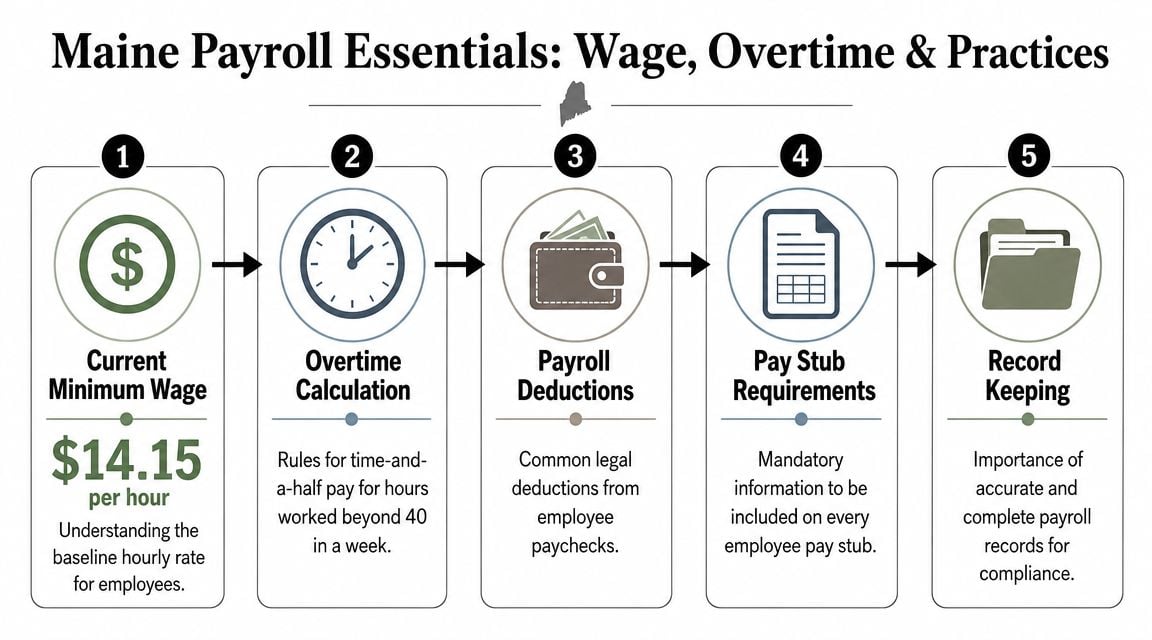
Maine's wage floor is one place to start. A 2024 overview reported the state minimum wage at $14.15 per hour, and service employees had to receive at least $7.08 per hour under Maine law. The same overview notes that the minimum wage is indexed to inflation, which means your budget assumptions need annual review, not a one-time setup.
Build payroll around actual work patterns
For a variable-schedule business, compliance starts before payday. It starts when someone posts the schedule.
Maine's overtime rule has a detail many managers miss. Employers may not require an employee to work more than 40 hours in a week unless they pay 1.5 times the regular rate for all hours over 40, and they also may not require more than 80 overtime hours in any consecutive two-week period under the state framework described in Baker Donelson's Maine guide. That second rule matters because a schedule can create risk even when no one manager notices the full pattern.
Here's the practical issue. If one branch manager only sees week one and another only sees week two, nobody may spot a biweekly overtime problem until after the fact. That's why I push employers to review projected hours before publishing schedules, then review actual hours again before payroll finalizes.
A useful operating setup includes:
- Pre-schedule review: Flag employees who are close to overtime before shifts are posted.
- Cross-location visibility: Combine hours across departments, branches, or client teams.
- Post-payroll audit: Check actual hours worked against approved schedules and exceptions.
- Manager signoff: Require a short written reason for unplanned overtime.
If you're tightening your overtime process, this guide to overtime and holiday pay rules is a good internal reference point for building cleaner payroll workflows.
Canceled shifts are a payroll event
Maine's “report to work” rule is easy to miss because managers often treat it like a scheduling problem. It's not. It changes pay.
For businesses with 10 or more employees, if a worker reports for a scheduled shift and is sent home, the employer must pay the lesser of two hours of pay at the regular hourly rate or the pay the employee would have earned for the scheduled shift. Maine law also includes exceptions, such as adverse weather, natural disaster, civil emergency, the employee's own illness or workplace injury, and documented good-faith efforts to tell the employee not to report. Noncompliance can lead to fines of $100 to $500 per violation under the Vorys explanation of the report-to-work law.
That means your timekeeping system has to separate several different events that many employers lump together:
| Event | Why it matters |
|---|---|
| Employee reports, then gets sent home | May trigger report-to-work pay |
| Shift canceled before arrival | Records need to show notice was given |
| Employee misses shift due to illness | Different pay result |
| Work stops due to weather or emergency | Exception may apply |
A lot of wage claims come down to records, not memory. If the system can't show why someone was sent home, payroll usually has to guess.
What actually reduces wage risk
Good payroll compliance in Maine is less about legal theory and more about setup discipline.
Use a small rule set:
- Review wage rates before each calendar-year update.
- Treat every schedule cut as a coded payroll event.
- Aggregate hours across all locations and roles.
- Keep manager notes when hours change after posting.
That gives you a record, and in Maine, the record is often what saves you.
Navigating earned paid leave and family medical leave
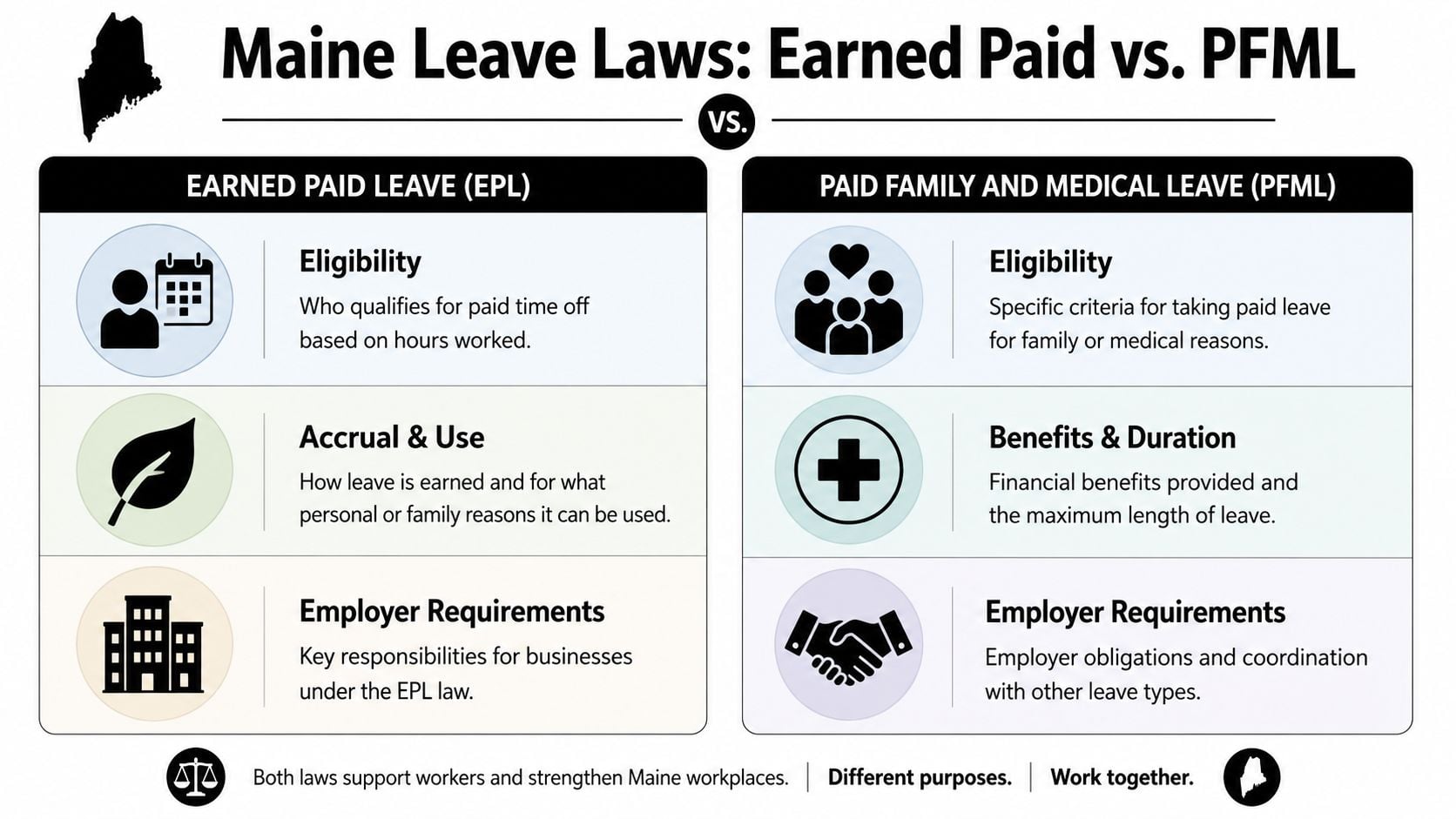
Leave administration gets messy when employers mix together laws that work differently. In Maine, that happens all the time. A manager hears “paid leave” and assumes one rule covers everything. It doesn't.
The first mistake is treating earned paid leave and paid family and medical leave like they're the same benefit with different names. The second is assuming part-time or mixed-schedule workers are easy to slot into a standard accrual model. They aren't.
The real problem is threshold management
Maine's leave rules create a patchwork of employer-size thresholds. The earned paid leave law applies to employers with more than 10 employees, while other rules such as health care continuation apply to even smaller businesses, which is one reason Paylocity's Maine law overview points to eligibility and accrual tracking as a problem for part-time and variable-hour workers.
That patchwork matters most when you have:
- employees who float between departments
- workers with changing weekly schedules
- staff who split time across multiple locations
- seasonal or near-seasonal patterns that don't fit your default setup
A fixed leave spreadsheet usually breaks under those conditions. Someone forgets to count an employee in the right threshold. Another person uses scheduled hours instead of actual hours. A manager approves time off without checking whether the leave bank is the right one.
Compare the two leave buckets by how you administer them
For owners, the easiest way to think about Maine leave is not legal first, but operational first.
| Leave type | Main admin question |
|---|---|
| Earned paid leave | How are you accruing and tracking ordinary paid time across changing schedules? |
| Paid family and medical leave | How do you identify qualifying longer absences and coordinate them with job protection, notice, and payroll handling? |
That framing matters because the data burden is different. Ordinary accrued leave lives in your payroll and timekeeping system every pay period. Family and medical leave often needs a more formal intake process, document handling, and communication trail.
Manager note: Don't let supervisors decide leave categories on the fly. They should escalate the request, not classify it.
What works for variable-hour teams
I've seen mid-sized service employers get into trouble by using one leave rule for everyone because it feels fair. It may feel fair, but it often produces the wrong accruals or the wrong eligibility calls.
A better setup looks like this:
- One ownership point: Put one person or team in charge of leave coding.
- Actual-hours tracking: Use hours worked, not guessed averages, where your policy and law require precision.
- Separate request paths: Routine paid time off requests should not share the same workflow as family or medical leave.
- Quarterly threshold check: Review headcount and worker status so your assumptions don't drift.
Where employers usually stumble
The failure points are predictable. They don't show up in the statute text. They show up in operations.
Common trouble spots include inconsistent accrual methods, manual carryover errors, and managers promising leave before HR checks eligibility. Final-pay issues can also get tangled with unused leave if your written policy isn't clear and your payroll codes are messy.
If your workforce has mixed schedules, don't assume a generic payroll default will handle Maine correctly. Test it. Run sample employee histories through the system and see whether the result matches your policy and your legal obligations.
Understanding meal breaks and scheduling rules
Meal break compliance sounds basic until you try to enforce it during a slammed service day. Then the pressure starts. A supervisor says everyone was “too busy to clock out.” Another says people ate at the desk. Payroll is left sorting out whether time was relieved from duty.
Maine requires an unpaid 30-minute meal break for an employee who works more than six consecutive hours, with limited exceptions. For employers, that means the issue isn't just whether a break policy exists. It's whether the workday is built to allow the break to happen and whether the records show it.
Break policy fails when staffing is too thin
A lot of businesses write a legal break rule and then schedule in a way that makes compliance unrealistic. If one employee is covering phones, front desk, and walk-ins alone, an unpaid uninterrupted meal period may not be realistic. When that happens often, the problem isn't employee discipline. It's shift design.
Use a simple review approach:
- Check long solo shifts: These are the first places where missed breaks show up.
- Review edits to timecards: Repeated manual meal deductions deserve a second look.
- Ask what happened operationally: If breaks keep getting missed on the same daypart, scheduling is the problem.
- Train managers on relief from duty: Eating while still answering calls usually doesn't solve the issue.
A practical reference on break administration is this overview of break compliance workflows. It's about another state's break law, but the timekeeping habits it describes are useful for Maine managers too.
Documentation matters more than policy language
An employee handbook paragraph won't carry much weight if your records show constant missed breaks and no follow-up. You need a trail.
That usually means:
- Employees record actual break times.
- Managers confirm exceptions in writing.
- Payroll reviews patterns, not just isolated edits.
- HR investigates repeat misses by team or location.
If your records show automatic meal deductions but your operations depend on people working straight through, you've built a compliance problem into payroll.
The wider point is that scheduling and wage compliance aren't separate topics. They're connected. If breaks fail, pay risk often follows.
Correctly classifying your workforce
Classification mistakes are expensive because they multiply. One bad call can affect overtime, payroll taxes, leave handling, benefit eligibility, and termination risk at the same time.
For Maine employers, the danger usually sits in two places. First, someone is labeled exempt because they're salaried, even though their job duties don't support that label. Second, a worker is treated like an independent contractor because that feels administratively easier.
Salary alone doesn't make someone exempt
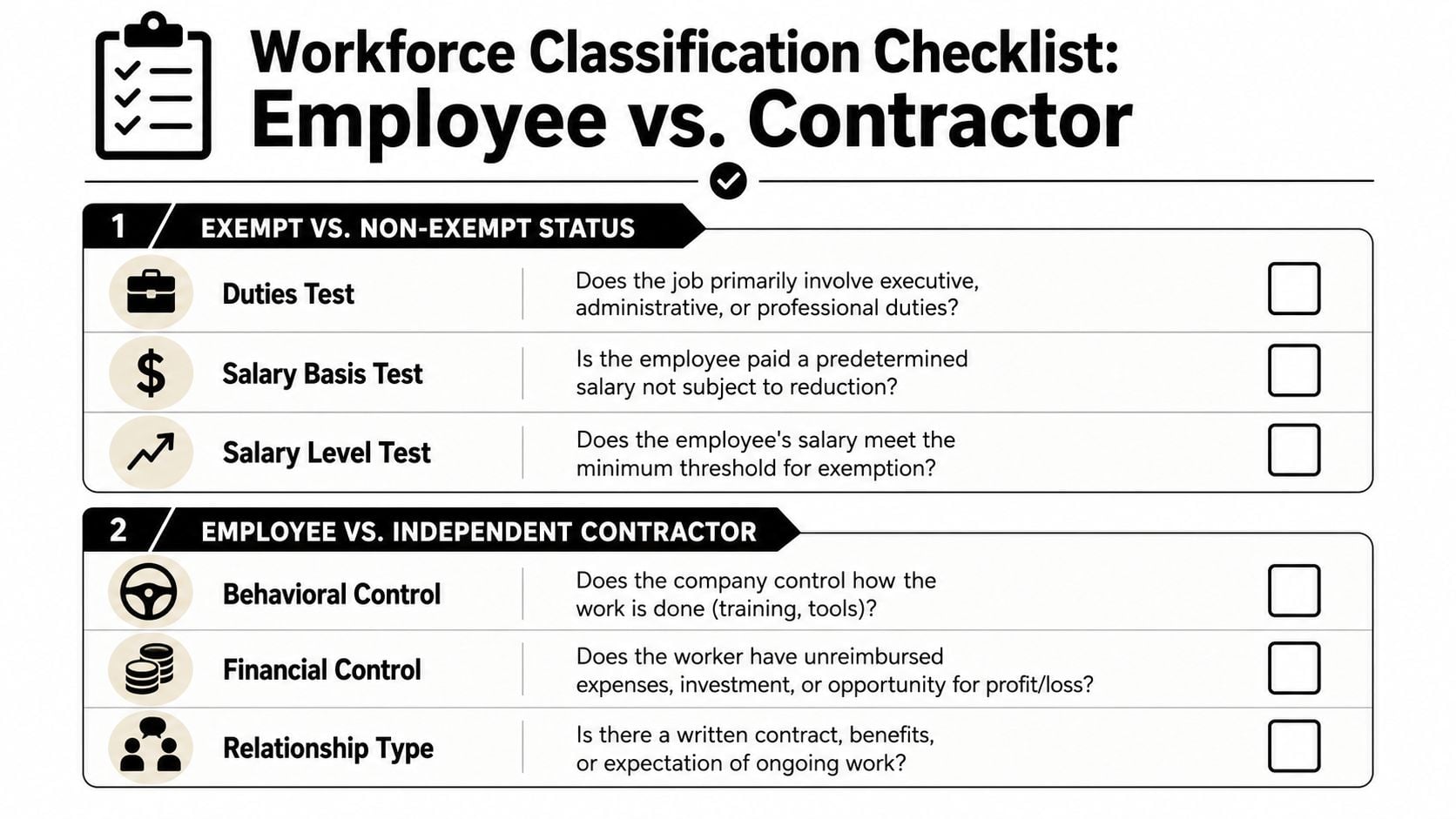
In practice, many owners still use a shortcut. If someone gets a salary and has a professional-sounding title, they mark the role exempt. That's risky.
The safer review starts with the work itself:
- What does the person do most days?
- Who controls how the work gets done?
- Does the role involve genuine executive, administrative, or professional duties?
- Is the salary basis handled correctly?
Titles muddy the water. Job duties clear it up. An “account manager” who spends most of the week following detailed scripts, logging routine tasks, and handling production support may not fit an overtime exemption just because the title sounds senior.
Contractor status gets abused when flexibility is the goal
The contractor question creates a different kind of problem. Owners often want flexibility, especially for creative work, implementation support, field services, and short-term client projects. The business case may be real. The legal classification still has to hold up.
A practical review usually starts with a few hard questions:
| Question | Why it matters |
|---|---|
| Do you control when and how the work is done? | Heavy control points toward employee status |
| Does the worker use your systems, tools, and process? | Integration into daily operations matters |
| Is the relationship ongoing instead of project-based? | Long-running arrangements raise risk |
| Does the worker look independent to outsiders? | Branding, invoices, and client-facing role matter |
If the worker appears fully woven into your business, contractor treatment gets harder to defend. That's especially true when managers set schedules, require meetings, assign tools, and expect continuous availability.
Classification audits work best when you review real behavior, not contract language. A polished agreement won't rescue a bad fact pattern.
How to run a useful internal audit
Don't start with every worker. Start with the roles that tend to drift:
- salaried coordinators
- working supervisors
- freelance creatives on long retainers
- implementation staff who act like employees but invoice monthly
Then compare the written status with day-to-day reality. Ask managers how the role works. Review time records, approvals, communication channels, and whether the person could realistically refuse work or use a substitute.
That kind of audit won't answer every edge case, but it will surface the obvious trouble before a complaint or investigation does.
Preventing discrimination and handling termination
Termination problems often start months before anyone gets fired. They start when managers ignore accommodation requests, apply rules unevenly, or document performance only after the relationship has already broken down.
Maine is stricter than many owners expect because the Maine Human Rights Act applies to all employers, not just larger ones, and Maine also has meaningful leave protections. That means a small or mid-sized business can't assume federal size thresholds will save it from state-level exposure. A 2024 Maine overview also notes that the state's paid family and medical leave law provides eligible employees up to 12 weeks of leave per year for qualifying reasons.

Prevention starts with manager behavior
The most effective anti-discrimination work isn't a policy file. It's manager training tied to actual decisions.
Focus on a few things:
- how supervisors respond to complaints
- how they handle medical or pregnancy-related issues
- whether discipline is consistent
- whether performance concerns were documented before protected activity appeared
That matters because a lot of cases are built from timing and inconsistency. If an employee raises a concern, asks for leave, or requests accommodation, and only then starts receiving negative write-ups, your documentation may look reactive even if the underlying problem was real.
Termination discipline needs a checklist
Maine is generally an at-will employment state, but at-will doesn't mean careless. A termination should still go through a structured review.
Use a checklist that asks:
- Did the employee recently request leave, accommodation, or report misconduct?
- Is the reason supported by earlier records?
- Has the same rule been enforced the same way for others?
- Are final pay, benefits, and notice steps ready before the meeting?
That process slows managers down, which is good. Fast terminations often create facts you can't clean up later.
“Would I be comfortable explaining this decision with documents alone?” If the answer is no, pause the termination.
Mass layoffs and closures trigger separate duties
Most employers won't face a covered layoff often, but when they do, the stakes rise quickly. Under the Maine Severance Pay Act, employers with 100 or more employees must provide at least 90 days' notice and pay severance of one week's pay for each year of service if they close a facility or conduct a mass layoff, as summarized in Brightmine's Maine employment law overview.
That's not something to figure out after the decision is public. If your business is restructuring, involve employment counsel and payroll planning early, because severance exposure and notice timing affect budgets, communications, and employee relations all at once.
What respectful handling looks like
A compliant termination process is also a cleaner business process.
Good practice usually includes:
- one final review by HR or counsel for sensitive cases
- a prepared final-pay process
- a script for the meeting that stays factual
- written follow-up that matches what was said
What doesn't work is mixing legal reasons with emotional ones, improvising in the room, or arguing with the employee. The goal is clarity, not debate.
Recordkeeping, Enforcement, and Handling Penalties
A Maine Department of Labor inquiry usually starts with a simple question. Show the hours worked, the pay issued, and the reason for any exception. For a mid-sized service business with rotating shifts, split locations, and manager-made schedule changes, that is where problems surface fast.
Maine enforcement has become more direct. A 2026 law, LD 1587, will take effect on July 14, 2026 and will authorize the Maine Department of Labor to issue violation notices, assess monetary penalties, order payment of unpaid wages, and add up to $1,000 per day in extra penalties if fines remain unpaid after appeals, as noted earlier in this article. The law will also require some employers to post violation notices or notify affected workers directly. That raises the cost of a payroll mistake beyond back pay alone.
Records are your first line of defense
In practice, investigators compare systems, not just policies. They look at whether your time records, payroll registers, schedule edits, leave documentation, and manager notes tell the same story.
That is where variable scheduling creates risk. A front-line manager shortens a shift by text. Payroll changes a pay code at week's end. The employee remembers working through a meal period. If those facts are not tied together in one clear record trail, your business is left explaining gaps instead of proving compliance.
Keep documentation that answers operational questions without guesswork:
- who changed the schedule
- when the employee was notified
- what hours were worked
- why a pay code or time entry was edited
- who approved the exception
- whether the change affected overtime or leave accrual
The core operational problem is threshold management. Maine compliance often turns on small triggers, such as when hours push someone into overtime, when a missed break creates a pay issue, or when leave tracking stops matching payroll. If your team handles those thresholds manually, errors tend to repeat across locations and pay periods.
That is also why I advise employers to look at records from the employee's point of view. Workers who believe they were underpaid or treated inconsistently often look for outside help before they file a complaint. This plain-English resource on guidance for suing an employer is a useful reminder of the claims employees may explore and how your documentation may look on review.
Weak records create expensive, avoidable disputes
Poor records do more than slow down an audit. They create facts you cannot verify later.
For example, an auto-deduct meal break may be lawful in theory, but if employees regularly answer calls or cover a desk during that period, your records need a clean process for reversing the deduction. The same issue shows up with travel time between job sites, last-minute call-ins, and after-hours messages handled by supervisors. Service businesses run on exceptions. Your recordkeeping process has to capture them.
If you are tightening controls, start with the mechanics of time capture and approval. This guide on how to track hours worked is a practical reference because it focuses on the parts of the process that usually break first.
Use one standard. Managers should not keep schedule changes in texts, payroll should not rely on memory, and HR should not have to reconstruct leave decisions from email fragments months later.
Put recordkeeping on the operations agenda
Recordkeeping is not clerical cleanup. It is part of payroll control, leave administration, and dispute prevention.
For Maine employers, the safest approach is simple. Decide where time changes must be entered, who can approve edits, how missed breaks are reported, how leave is coded, and how long supporting notes are retained. Then test the process against a messy week, not an ideal one. If your system holds up during callouts, shift swaps, and late payroll corrections, it is much more likely to hold up during an investigation too.
Your practical Maine compliance checklist and resources
If you want a clean starting point, review these items this week:
- Audit pay setup: Confirm wage rates, tipped pay setup, overtime rules, and canceled-shift handling.
- Review scheduling controls: Make sure managers document changes and payroll can see why they happened.
- Test leave administration: Check how you track eligibility and accrual for part-time and variable-hour employees.
- Check classification decisions: Review salaried roles and long-term contractors against actual job facts.
- Tighten termination review: Use a short pre-termination checklist for leave, complaints, accommodation, and consistency.
For health-plan questions that often overlap with leave, continuation coverage, and small-employer obligations, this guide to understanding health insurance for small businesses is a useful companion read.
Then pull current forms, posters, and agency guidance directly from the Maine Department of Labor and the Maine Human Rights Commission. State agencies update practical materials more often than many handbooks do, so use them as your live reference point.
If your team is still chasing hours through spreadsheets, calendar guesses, and end-of-week timesheet reminders, TimeTackle is worth a look. It helps teams capture time from calendars, organize work by client or project, and produce cleaner reporting with less manual effort, which makes payroll review, utilization analysis, and audit prep much easier.