



Payroll closes in an hour. You're scanning timesheets, Slack pings, and calendar entries, trying to work out whether that “quick Saturday prep session” turned into overtime. Someone on salary logged extra hours. A project lead jumped between client work and internal planning. A designer picked up late-night revisions after the client changed direction.
That's the point where overtime stops being a simple math problem.
For agencies, time and a half pay sits right at the intersection of payroll, project delivery, margins, and compliance. Get it right and payroll runs cleanly. Get it wrong and you risk underpaying staff, overpaying labor, or carrying a bad process that keeps breaking every pay period. The hard part usually isn't the multiplier. It's knowing which employees qualify, which hours count, and what pay needs to go into the regular rate before overtime is calculated.
That sinking feeling during payroll approval
Most agency owners know this moment.
An account manager logs a long week because a client presentation moved, the team worked through revisions, and someone gave up part of a weekend to get the deck over the line. Payroll lands on your desk, and the questions start stacking up fast. Is this employee exempt or non-exempt? Does being salaried change anything? Do those Saturday hours count? If they earned a performance bonus in the same period, does that change the overtime rate too?
None of those questions are academic. They change what you owe people, and they also change how exposed you are if your process is sloppy.
Why agencies get tripped up
Agency work is messy by nature. Time doesn't always happen in neat blocks. People jump from meetings to production work, from client calls to revisions, from internal planning to last-minute delivery. If your records come from memory-based timesheets filled out on Friday afternoon, you're already working from bad inputs.
The risk gets worse when roles look “professional” on paper but don't cleanly fit an exempt classification. A salaried creative employee can still be non-exempt. A project coordinator who keeps jobs moving can still qualify for overtime. Salary is not a safe shortcut.
When payroll teams make overtime mistakes, they usually don't fail on arithmetic. They fail on classification, tracking, and regular-rate inputs.
What a solid process looks like
A workable overtime process for an agency does four things well:
- Classifies roles carefully: It checks actual job duties, not just titles.
- Captures all work time: It counts all hours people worked, including short after-hours tasks.
- Calculates the regular rate correctly: It pulls in required pay elements before overtime is computed.
- Handles state rules cleanly: It doesn't assume one federal rule solves every location.
If you fix those four pieces, payroll approval stops feeling like guesswork.
What time and a half pay is exactly
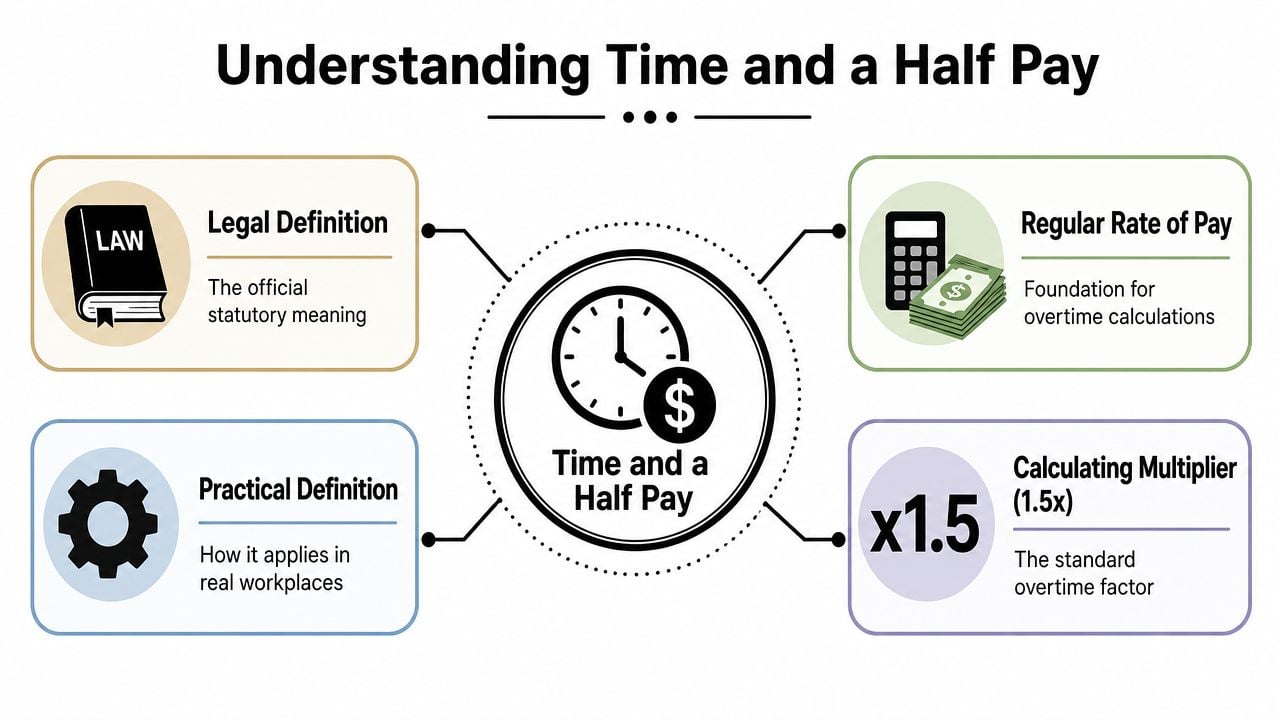
At the federal level, time and a half pay comes from the Fair Labor Standards Act. Under the U.S. Fair Labor Standards Act, overtime pay is set at not less than time and one-half the regular rate for hours worked over 40 in a workweek, and the U.S. Department of Labor says there is no federal cap on the number of hours employees age 16 and older may work in a week. That framework, established in 1938, made the 40-hour workweek the baseline for overtime eligibility (U.S. Department of Labor overtime guidance).
That sounds simple until you hit the phrase that matters most: regular rate.
The regular rate is the real starting point
A lot of managers think overtime means “hourly wage times 1.5.” Sometimes that works. Sometimes it underpays people.
Under federal overtime rules, the premium is tied to the employee's regular rate, not just the base hourly number. The Department of Labor's overtime fact sheet states that covered employees must receive overtime pay at “not less than time and one-half their regular rate” after 40 hours in a workweek, and payroll guidance often expresses that as multiplying the regular rate by 1.5 (Department of Labor fact sheet on overtime pay).
That matters because the regular rate can move.
If a non-exempt employee gets nondiscretionary bonuses, certain shift differentials, or commissions, those amounts can raise the regular rate used for overtime. In practice, that means payroll can't always grab the base rate from the HR system and call it done.
A simple example
If someone earns $20/hour, qualifying overtime is $30/hour. If someone earns $30/hour, qualifying overtime is $45/hour. Those examples match the federal framework described by the Department of Labor in its overtime guidance.
Now add a bonus that payroll must include in the regular rate. The overtime basis may increase, which means the time and a half pay goes up too. The exact amount depends on how that compensation applies, but the key point is practical: payroll has to calculate the regular rate first, then the overtime premium.
Practical rule: If pay varies, don't approve overtime from memory or from a base wage field alone. Check what compensation belongs in the regular rate for that workweek.
Why agency owners should care
Agencies often have compensation setups that trigger this issue. Think client-retention bonuses, production incentives, sales commissions, shift premiums for odd-hour support, or mixed-rate work across different functions. On paper, each item seems small. In payroll, they can change the overtime math.
That's why time and a half pay is not just a multiplier. It's a compliance calculation.
Who gets overtime and who doesn't
Many agencies create expensive problems for themselves. They assume salary means exempt, or they classify by job title because it feels clean. Neither approach holds up well when someone asks what the employee does all day.
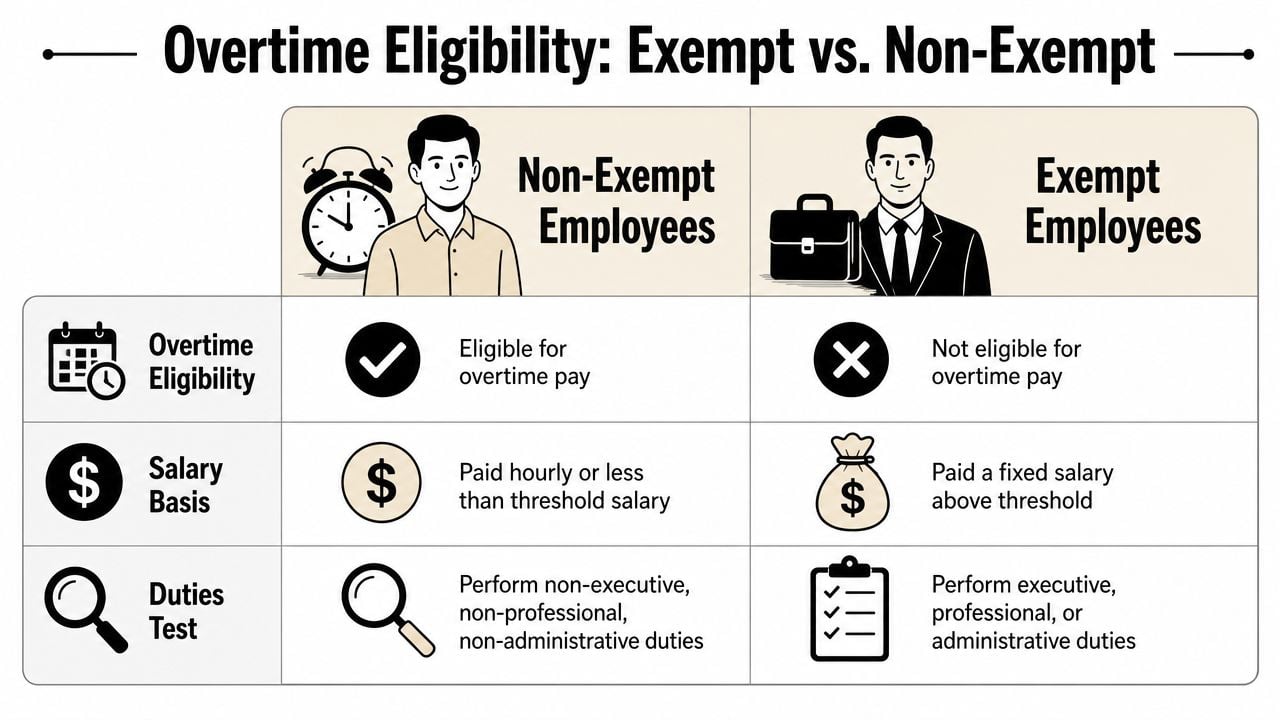
The basic split is between non-exempt employees, who are generally eligible for overtime, and exempt employees, who generally are not. But the answer turns on more than how someone is paid.
Titles don't decide this
An agency can have job titles that sound senior and still belong in a non-exempt bucket. “Strategist,” “coordinator,” “designer,” or “producer” don't answer the legal question by themselves. You need to look at duties.
A practical way to think about the duties test is this: does the employee exercise the level of independent judgment and role responsibility needed for an exemption, or are they mainly executing defined work under established processes? Agencies often blur that line because client work is collaborative and fast-moving.
Here's where I see mistakes most often:
- Creative roles: A designer may do skilled work, but skill alone doesn't settle exemption.
- Project and account roles: Coordinating deliverables, moving deadlines, and handling client communication can still fall short of an exempt standard.
- Junior technical roles: A developer or implementation specialist may work on complex tasks while still operating within tightly directed parameters.
- Operations support roles: Salary and trust don't remove overtime obligations if the role is non-exempt.
Multi-state agencies need stricter logic
Federal law sets a baseline, but agencies with remote teams can't stop there. State rules may be stricter, and payroll has to follow the rule that applies.
For example, California generally requires overtime after 8 hours in a day and double time after 12 hours, while federal law uses the workweek baseline. The Department of Labor also notes there's no federal limit on hours worked for employees 16 and older, which makes state-level rules even more important to track correctly (state overtime example and federal baseline).
That difference matters a lot for agencies because agency schedules often bunch work into deadline days. An employee may not cross the weekly threshold but can still trigger overtime under a stricter state rule.
A useful way to review roles
If you're auditing classifications, don't start with payroll codes. Start with actual work.
| Question | Why it matters |
|---|---|
| What does this employee do most days? | Exemption depends on duties, not title |
| How much independent judgment do they really use? | Routine execution is different from high-level discretion |
| Are they paid on salary but still tracked like hourly production staff? | That often signals a mismatch |
| Which state rules apply to where they work? | Remote teams create location-based overtime issues |
If you want a practical companion on overlapping premium rules, overtime and holiday pay rules for employers is worth reviewing because the underlying problem is often not one overtime trigger, but several.
A clean classification file beats a polished org chart. Payroll needs the first one, not the second.
How to calculate time and a half step by step
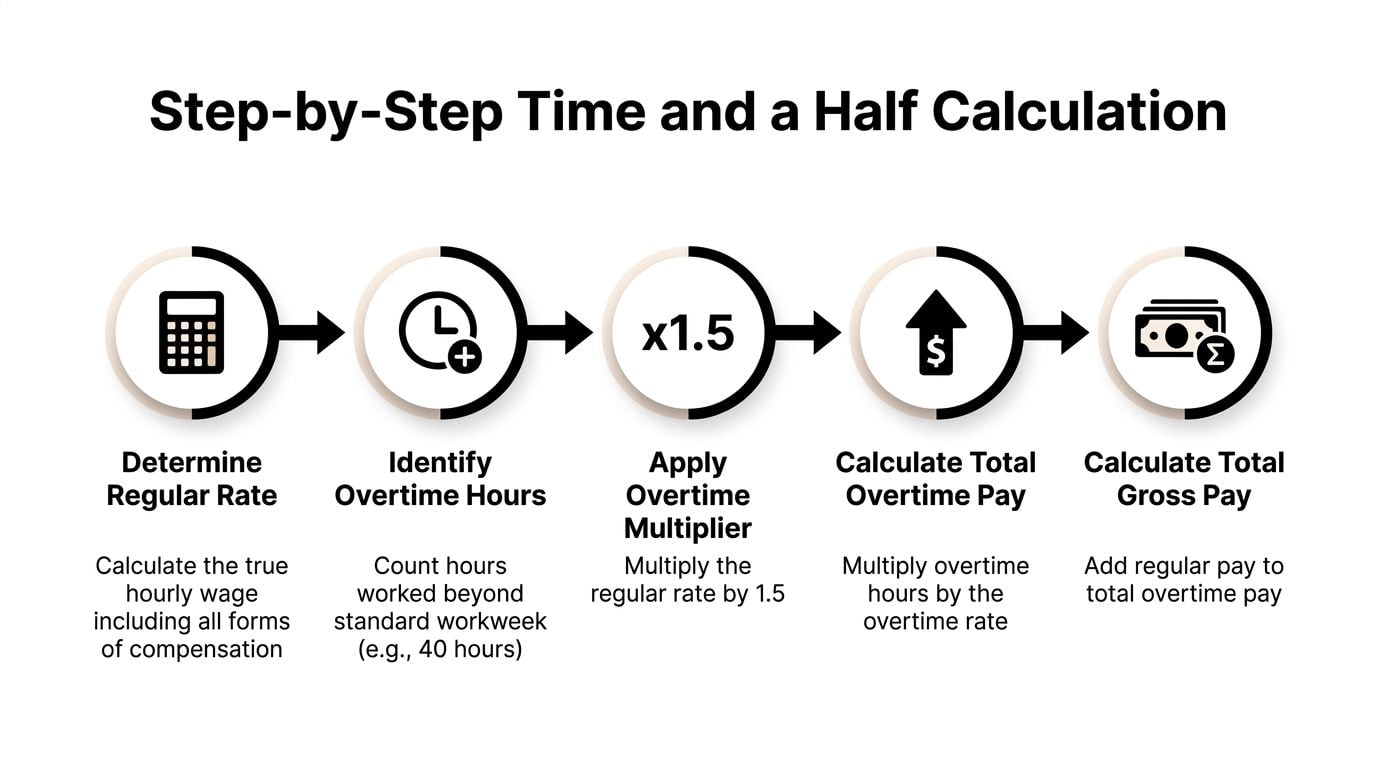
Once you know the employee is eligible for overtime, the calculation should follow a repeatable sequence. In agency settings, the challenge is not just hourly staff. It's salaried non-exempt employees, mixed pay rates, and bonus periods that change the regular rate.
Start with the regular rate
For a straightforward hourly employee with no extra compensation included in the regular rate, the math is easy.
- Find total hours worked in the workweek.
- Separate regular hours from overtime hours.
- Calculate the overtime rate as 1.5 times the regular rate.
- Add regular pay and overtime pay.
Example:
- Regular hourly rate: $20
- Hours worked: 45
- Overtime hours: 5
- Overtime rate: $30
- Regular pay: 40 × $20
- Overtime pay: 5 × $30
That example follows the federal overtime framework already covered above.
Salaried non-exempt employees need a conversion step
A common point of error for agency payroll teams is that a salary does not automatically remove overtime liability if the employee is non-exempt. For salaried non-exempt employees, the practical approach is to convert salary to an implied hourly rate, then apply time and a half to overtime hours. Payroll references commonly explain this as dividing the weekly salary by the employee's fixed hours, and if the salary is based on a 40-hour schedule, dividing by 40 to get the hourly rate (Workforce guide to calculating time and a half).
So if you have a salaried non-exempt employee, the sequence is:
- Step one: Identify the weekly salary.
- Step two: Divide by the fixed hours the salary covers.
- Step three: Use that implied hourly figure as the regular rate.
- Step four: Multiply that rate by 1.5 for qualifying overtime hours.
This matters in agencies because many employees are salaried for predictability, but their roles still do not meet an exemption.
Mixed duties can create blended-rate problems
Agencies also run into weeks where one employee works at different rates. That can happen when someone splits time across functions, temporary assignments, or pay codes.
When pay varies across the week, payroll can't just grab one default rate and multiply it. The regular rate may need to reflect the employee's combined earnings across total hours worked. In plain terms, you need a method that accounts for all eligible compensation before you apply the overtime premium.
A practical checklist looks like this:
- Check whether multiple pay rates applied: Don't assume one role code tells the whole story.
- Review all earnings in the workweek: This includes pay that belongs in the regular-rate calculation.
- Confirm which hours triggered overtime: Weekly rules may differ from state daily rules.
- Document the method used: If someone asks later, payroll should be able to show the logic clearly.
If an employee touched two rates, a bonus, and overtime in the same period, manual spreadsheets become fragile fast.
Bonus periods change the math
Nondiscretionary bonuses can raise the regular rate. In agency terms, think of a promised production bonus, an earned retention incentive, or a measurable performance payment that isn't just a surprise gift. Once that kind of compensation belongs in the regular rate, overtime calculations can change for the affected workweek.
That doesn't mean every bonus changes overtime. It means payroll has to know the difference between payments that count and payments that don't.
Keep state rules separate from federal math
The overtime formula may be familiar, but the qualifying hours can differ by jurisdiction. A weekly-only setup is not enough if part of your team works in states with daily overtime rules. If you have California employees, it helps to review a practical state-specific reference like how California overtime is calculated in real payroll scenarios, because the operational issue is often hour qualification, not just multiplication.
A practical order of operations
If you want one simple sequence your payroll team can follow, use this:
| Order | What to do | Common failure point |
|---|---|---|
| 1 | Confirm the employee is overtime-eligible | Misclassification |
| 2 | Gather all compensable hours worked | Missing after-hours work |
| 3 | Build the correct regular rate | Ignoring bonuses or differentials |
| 4 | Identify overtime-triggering hours under the right rule set | Using only federal logic |
| 5 | Calculate premium pay and store the workpapers | No audit trail |
That order won't solve every edge case, but it prevents the most common errors.
Common payroll mistakes that cost agencies money
Most overtime problems don't start as fraud. They start as shortcuts. A payroll admin assumes salary means exempt. A manager ignores small amounts of after-hours work because “it only took a few minutes.” Someone uses a base rate even though other pay should have been included.
The cost isn't just legal exposure. It hits margins, trust, and cleanup time.

Mistakes I see most often
- Misclassifying salaried staff: Agency owners often treat salaried creatives or coordinators as exempt without testing duties closely.
- Missing off-the-clock work: Email replies, late edits, deck prep, and weekend revisions still count if they are work.
- Using the wrong regular rate: Payroll may ignore nondiscretionary bonuses, commissions, or differentials that belong in the overtime basis.
- Applying one rule to every state: Remote teams break this habit fast.
- Treating unauthorized overtime as unpaid time: You can discipline policy violations, but worked time still creates pay obligations.
Why these errors matter financially
Overtime isn't a side issue for workers who earn it. In a Resolution Foundation analysis of UK data, overtime pay typically made up 12% of total earnings for employees doing overtime in April 2016. In the U.S., the Bureau of Labor Statistics reported that in 2024, 25% of full-time wage and salary workers with one job only had weekly earnings of $840 or less, which helps explain why overtime premiums matter so much to take-home pay (Resolution Foundation analysis with BLS reference).
If your agency undercalculates overtime, employees feel it directly. If you overcalculate because your process is inconsistent, your labor costs drift upward and project profitability gets harder to trust.
Payroll errors are expensive twice. First in wages, then in the time it takes to reconstruct what happened.
If your team also has to deal with higher-rate scenarios beyond standard overtime, a practical guide to double-time calculation can help payroll leads think through premium pay before problems pile up.
Best practices for tracking overtime without the headache
Manual timesheets create most of the pain agencies blame on overtime itself. People forget what they did, round hours to neat blocks, or log time late. Managers approve based on partial context. Payroll then has to turn fuzzy records into exact pay decisions, which is a bad handoff.
The fix is not reminding people harder. The fix is capturing work closer to when it happens.
Why manual tracking keeps failing
Agencies run on calendars, meetings, client calls, task blocks, reviews, and fast switches between projects. That work already leaves a trail in Google Calendar, Outlook Calendar, CRM activity, and team workflows. When timesheets ask people to recreate the week from memory, quality drops immediately.
That's where automated, calendar-based time capture helps. It gives operations and payroll teams a more defensible record because the source data is tied to actual scheduled and completed work, not just recollection. For overtime, that matters because disputed hours are often short, scattered, and easy to miss manually.
What a better setup looks like
A practical agency setup should do these things well:
- Capture activity from systems people already use: Calendar and meeting data are stronger than end-of-week guesses.
- Tag work by client, project, and internal category: Payroll needs total hours. Operations also needs to know where those hours went.
- Preserve an audit trail: If a manager questions a long week, you should be able to review the underlying activity.
- Separate scheduling from pay rules: Tracking should collect accurate time first. Payroll rules can then apply the correct overtime logic by location and employee status.
That separation matters. Time tracking should answer “what happened?” Payroll should answer “what is owed?” Mixing those steps too early causes errors.
Compliance and efficiency usually improve together
Good overtime tracking is not just a legal control. It also helps agencies run better. When you can see where extra hours come from, you can spot chronic scope creep, poor staffing, recurring approval delays, and clients who keep pushing work into evenings or weekends.
For teams tightening their processes, a good primer on understanding payroll regulations helps frame why recordkeeping, classification, and pay rules need to work together. Agencies often treat those as separate admin tasks when they're really part of one operating system.
A clean time record helps payroll pay people correctly. It also helps agency leaders price work, staff jobs, and defend invoices with more confidence.
Your top questions on overtime pay
A few overtime questions come up every pay cycle because they sit in the gray areas of daily operations, not in policy manuals.
Can a private-sector agency give comp time instead of overtime pay
Usually, no. Private employers generally shouldn't assume they can swap overtime wages for informal time off. If a non-exempt employee worked overtime hours that require premium pay, payroll should treat that as a wage issue, not a scheduling favor.
Do part-time employees get overtime
They can. Part-time status doesn't block overtime by itself. If a non-exempt employee works enough hours to cross the applicable threshold, overtime rules can apply. The fact that someone was “only supposed to work part time” doesn't erase hours already worked.
Does weekend or holiday work always mean time and a half pay
Not always. Working on a weekend or holiday does not automatically create a federal overtime premium if the hours do not push the employee past the qualifying threshold for the workweek. The details can change under state law, company policy, or union rules, but don't assume “holiday” automatically means overtime.
What about unauthorized overtime
If a non-exempt employee worked the time, payroll usually still has to pay for it. The management issue and the pay issue are separate. You can address the policy breach with the employee or manager, but you should not solve it by leaving hours unpaid.
What's the best way to reduce disputes
Keep cleaner records. In practice, that means less reliance on memory, more consistent approval habits, and better attendance systems. If you want a broader operations view, this HR leaders' guide to modern attendance is a useful read because attendance data, scheduling, and overtime controls tend to break in the same places.
Overtime gets easier when the underlying time record is trustworthy.
If your agency is tired of chasing timesheets, correcting hours, and defending payroll decisions after the fact, TimeTackle is worth a look. It helps teams capture time from the calendar and daily workflow, which gives operations and payroll a cleaner record to work from. For agencies dealing with salaried non-exempt staff, mixed project work, and constant deadline pressure, that kind of visibility can reduce overtime mistakes before they hit payroll.