



A client project can feel healthy right up until it doesn’t.
The team says the work is “moving.” Hours keep landing in the timesheet system. The account lead says the client is happy. Then finance pulls the numbers and asks a simple question: if we’ve spent this much already, why are we still this far from done?
That gap is where most agencies get hurt. Not because people are careless, but because they track activity better than they track value. A calendar full of meetings and a pile of logged hours can tell you people were busy. They can’t tell you whether the project is on pace to finish on budget.
That’s where earned value comes in. If you’ve ever asked “what is earned value management” and then bounced off a dense, defense-contractor explanation, the short version is this: it’s a way to compare what you planned to complete, what you completed, and what it cost you to get there.
For agencies, that matters because margin slips long before a project looks obviously broken. Earned Value Management, or EVM, gives you a way to see that earlier, using data you probably already collect.
The project health mystery you need to solve
A lot of agency reporting sounds fine until you ask one more question.
A PM says the website redesign is “about halfway there.” The strategist says discovery is done. Design is “mostly done.” Development has started. The client hears “on track” in the weekly call, so nobody panics.
Then someone looks at labor cost.
You’ve already burned through more time than expected, but the work isn’t at a clean approval point yet. The designer thinks the project is close. The developer thinks the hardest part is still ahead. Finance sees cost rising. Leadership sees a report with green checkmarks and vague language like “progressing well.”

Why status updates break down
The problem usually isn’t effort. It’s measurement.
Teams often track a mix of:
- Hours logged: Useful for payroll, billing, and rough burn tracking.
- Tasks completed: Useful if tasks are sized consistently, which many agency tasks aren’t.
- Manager sentiment: Fast, but full of optimism and blind spots.
- Client perception: Important, but not the same as internal project health.
None of those alone answers the question owners care about. Are we getting the amount of progress we expected for the money and time we’ve spent?
Subjective reporting breaks first on projects with fuzzy scope, moving priorities, or creative work that looks “nearly done” for weeks.
The cost of guessing
When agencies miss the signal early, they usually react late. That means one of a few things happens:
- Margin disappears: You keep staffing the job because nobody wants to upset the client.
- Timelines drift: The team works harder, but the finish line keeps moving.
- Client trust drops: The project feels less predictable, even if nobody says it out loud.
- Forecasting gets messy: Revenue looks fine on paper, but delivery reality tells a different story.
This is EVM's primary function. It replaces gut-feel status with a harder question: what value have we earned so far?
What is earned value management in simple terms
A client asks whether the project is on track. The account lead says the team is busy, the designer says the hard part is nearly done, and finance says the budget is burning faster than expected. Earned value management gives you one way to reconcile those conflicting signals.
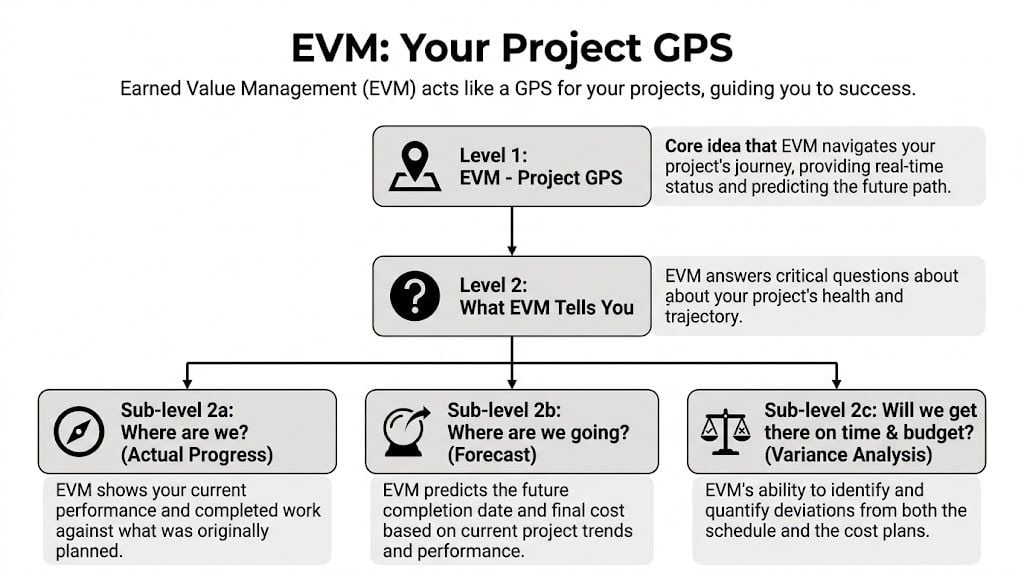
In simple terms, earned value management compares three things at the same checkpoint: what you planned to complete, what you completed, and what it cost to get there.
For a creative or digital agency, that matters because project trouble rarely shows up in one place. Hours can look fine while milestones slip. Tasks can look busy while margin erodes. EVM pulls schedule and cost into the same frame, which is why it remains a useful discipline even outside the formal environments described in Epicflow’s explanation of earned value management.
| Term | What it means | Plain-English version |
|---|---|---|
| Planned Value (PV) | Budgeted value of work scheduled by a certain date | What you expected to have completed by now |
| Earned Value (EV) | Budgeted value of work actually completed | What you’ve truly finished, measured in budget terms |
| Actual Cost (AC) | What you’ve actually spent | What the work has cost you so far |
The three numbers that matter
Planned Value
Planned Value starts with your delivery plan. If a website project is supposed to finish discovery, sitemap, and initial wireframes by the end of week two, the budget assigned to that completed portion is your PV at that date.
This is a planning number tied to time. It gives you the baseline for whether progress is arriving when it should.
Earned Value
Earned Value is the budgeted value of work that is complete.
That distinction matters. Agencies often blur "in progress," "almost approved," and "done." EVM is stricter. If the client has not approved the wireframes, or the landing page is still cycling through revisions, you usually should not count the full value yet. In practice, that discipline is what makes EVM useful. It forces honest progress measurement instead of optimistic status language.
A lightweight agency version works well here. Use the budget you assigned to each phase or deliverable, then multiply it by the percentage completed. If a $20,000 strategy and design phase is 50% done, the earned value is $10,000.
Actual Cost
Actual Cost is what you have spent so far to produce that work. In a services business, that usually comes from timesheets, labor cost rates, freelancers, software tied to the project, and any direct expenses.
If your time-tracking is inconsistent, AC becomes unreliable fast. That does not make EVM useless. It means the quality of the method depends on the quality of your operating data. Agencies that already review project management metrics usually have most of what they need.
Why agencies use it
EVM helps answer a practical question. Are we getting the amount of completed work we expected for the time and cost already invested?
That makes it more than a finance exercise. It is an operating discipline for delivery teams, account managers, and owners who need early warning before a project turns into a write-off.
For agencies, the trade-off is straightforward. Full formal EVM can be too heavy for fast-moving client work, especially when scope changes weekly. A lighter version is usually enough. Define the budget by phase, decide what counts as complete, pull actual cost from timesheets, and review it at a steady cadence. Combined with basic project budget management tools, that gives you a much clearer read on project health and profitability than hours burned alone.
The point is simple. EVM is not just for massive defense contracts. A modern agency can use a lighter version, powered by the time-tracking data it already has, to replace guesswork with a measurable view of progress, spend, and margin risk.
Calculating and interpreting the key performance indicators
Once you have PV, EV, and AC, the next step is reading the signals.
The two ratios most agency leaders care about are Cost Performance Index (CPI) and Schedule Performance Index (SPI). They tell you whether the project is using money and time efficiently against the plan.
The formulas you actually need
The core math is straightforward:
- Schedule Variance (SV) = EV – PV
- Cost Variance (CV) = EV – AC
- SPI = EV / PV
- CPI = EV / AC
Humphreys & Associates explains these measures clearly, including the point that positive variances are favorable and negative variances are unfavorable. Their example shows that if a $200,000 project completes 45% of total scope, then EV = $90,000. If 50% of time has elapsed, PV = $100,000, so the project shows a $10,000 schedule variance, which immediately exposes delay that a vague status update might miss (source).
A simple agency example
Let’s use a website redesign because it’s familiar and has clear phases.
Assume this project has a Budget at Completion (BAC) of $50,000.
By a review point in the middle of the project, your original plan says you should have completed 60% of the total scope. That means:
- PV = $30,000
Now look at the actual work. After checking approvals and deliverables, you determine that only 45% of the full project scope is complete. That means:
- EV = $22,500
Then you pull labor cost from your time data and finance records. So far, the project has cost:
- AC = $28,000
Now run the ratios.
What CPI tells you
CPI = EV / AC
In this example:
- CPI = $22,500 / $28,000 = 0.80
That means for every $1 spent, you’re earning $0.80 of planned value.
That’s the sentence I use with agency owners because it lands fast. A CPI below 1 means your project is costing more than the value you’re earning. A CPI above 1 means you’re earning more value than you’re spending.
| CPI result | What it means |
|---|---|
| 1.00 | You’re on budget for the work completed |
| Below 1.00 | You’re over budget relative to progress |
| Above 1.00 | You’re under budget relative to progress |
What SPI tells you
SPI = EV / PV
In this example:
- SPI = $22,500 / $30,000 = 0.75
That means you’ve only completed 75% of the work you planned to complete by this point.
An SPI below 1 means you’re behind schedule. Above 1 means you’re ahead.
| SPI result | What it means |
|---|---|
| 1.00 | You’re on schedule |
| Below 1.00 | You’re behind schedule |
| Above 1.00 | You’re ahead of schedule |
Why ratios matter more than raw spend
A lot of agencies already watch burn. That’s useful, but incomplete.
If you only look at actual cost, you might say, “We’ve spent $28,000 of a $50,000 project. That doesn’t look terrible.” But CPI and SPI tell the complete story. You’re both over budget for the amount of work done and behind the planned pace.
That’s when action becomes possible.
You can:
- Reduce scope: Cut low-value items before the margin gets worse.
- Reset staffing: Move stronger people onto blocked work.
- Change sequencing: Finish approval-heavy milestones sooner.
- Escalate earlier: Have a client conversation while there are still choices.
If you want better operational context around this kind of tracking, these project budget management tools give a useful overview of how teams connect budget visibility to delivery decisions.
For a closer look at the measures that sit around earned value and project reporting, this guide to project metrics is also useful: https://www.timetackle.com/metrics-for-project-management/
A project can look calm on the surface while CPI and SPI are already telling you it needs intervention.
Where teams go wrong
The failure point usually isn’t the formula. It’s the input.
Common mistakes include:
- Counting in-progress work as complete: “Almost done” gets too much credit.
- Using time elapsed as progress: A task that took two weeks isn’t automatically two weeks’ worth of value.
- Ignoring acceptance: Drafts are not finished deliverables.
- Reviewing too late: Monthly reporting can hide fast-moving problems.
EVM works when the earned value side stays disciplined. If your EV is soft, your CPI and SPI are soft too.
The benefits and limitations for creative agencies
Most agency owners don’t need another reporting method. They need one that makes hard conversations easier.
That’s where EVM can help. It gives delivery, finance, and leadership a common language. Instead of arguing over whether a project “feels close,” you can compare planned progress, earned progress, and cost in one place.

Where agencies get real value from it
In practice, EVM helps agencies in a few specific ways.
- Cleaner internal reporting: “Almost done” stops carrying so much weight.
- Earlier budget warning signs: Margin problems show up before final invoicing.
- Better client conversations: You can point to completed value, not just team effort.
- More honest forecasting: Revenue and delivery stop living in separate universes.
There’s also a cultural benefit. Teams start defining completion more clearly. That alone fixes a lot of reporting noise.
Where it gets awkward
Creative and consulting work isn’t a factory. Some tasks are easy to measure. Others are not.
A dev task may be done when code passes review and ships. A brand concept can sit in review rounds for days while everyone argues over whether it’s “basically finished.” If you don’t define acceptance well, EV becomes slippery.
That’s one reason agencies resist EVM. Another is workflow style.
According to PMI’s resource on agile and earned value, 71% of organizations have adopted agile, but most EVM material still centers on traditional waterfall planning rather than practical hybrid use (source). Agencies feel that mismatch because they work in iterations, revisions, and client feedback loops.
The trade-offs you have to accept
EVM is useful, but it has limits.
| Agency reality | What that means for EVM |
|---|---|
| Scope moves during delivery | You need disciplined baseline updates |
| Creative work can be subjective | You need milestone-based definitions of done |
| Agile sprints change priorities | You may need lighter, more frequent resets |
| Teams hate admin | Manual reporting will kill adoption |
That last point matters most. If you ask people to maintain a heavy compliance-style system, they won’t. Or worse, they’ll update it just enough to keep leadership quiet.
For agencies trying to get better control of delivery economics, this breakdown of project costs is useful because it connects labor, overhead, and delivery choices in a way finance and ops can both use: https://www.timetackle.com/project-management-costs/
EVM works best when you scale the method to the business. If you import a government-style process into a mid-sized agency, the team will reject it.
What works better in agency settings
A lighter model usually works better than formal EVMS compliance.
Use clear project phases. Tie value to accepted milestones. Review weekly. Keep the math simple enough that delivery leads can explain it without a slide deck.
What doesn’t work is pretending subjective work has objective progress when nobody has agreed on the rules. If “done” changes by person, client, or department, EVM will expose the inconsistency but it won’t fix it for you.
That part still needs management.
A practical guide to implementing EVM with your time-tracking data
Most agencies do not need a full formal EVMS.
They need a version they can run. That means simple structure, clean inputs, and a review rhythm the team will stick to. The good news is that lightweight EVM is a real option. A Hexagon resource on earned value management notes that mid-sized firms using a formula-only approach saw 18% efficiency gains while avoiding the 40% setup overhead associated with full EVMS.
Step 1: break the project into real deliverable phases
Start with a basic Work Breakdown Structure, but don’t overbuild it.
For an agency project, the WBS can look like the phases already written into the proposal:
- Discovery
- Strategy
- Design
- Development
- QA and launch
Inside each phase, add only the work packages that matter for control. If you track every tiny task, the system becomes administrative noise.
A simple rule helps here. If a task is too small to change the project story, don’t give it its own earned value line.
Step 2: assign budget to each phase and create the baseline
Next, map the agreed budget across those phases. This becomes your Performance Measurement Baseline. In agency language, it’s the approved plan for what value should be completed over time.
Here’s a simple example structure:
| Phase | Budget value | Planned completion point |
|---|---|---|
| Discovery | Part of total project budget | Early project |
| Strategy | Part of total project budget | After discovery |
| Design | Part of total project budget | Mid-project |
| Development | Part of total project budget | Late project |
| Launch | Part of total project budget | End of project |
The exact amounts come from your SOW, estimate, or pricing model. The important part is that budget and schedule now connect.
If scope changes later, don’t absorb it. Update the baseline deliberately, or your EVM numbers will compare current reality to an old promise.
Step 3: get actual cost from time data you trust
For most services teams, Actual Cost comes from labor.
That means your time data has to be accurate enough to trust. Not perfect, but trustworthy. If people batch-enter a week of time on Friday from memory, AC becomes more like fiction than reporting.
This is why agency EVM lives or dies on time capture discipline.
A good starting point is to pull:
- Logged hours by person
- Internal cost rate or loaded labor rate
- Project and phase tags
- Any direct project expenses
If your team is still fighting timesheets, this guide on agency time tracking is worth reviewing because it gets into the operational side of clean labor data: https://www.timetackle.com/time-tracking-for-agencies/
Step 4: choose an earned value method that fits the work
Agencies usually overcomplicate things at this stage.
You do not need advanced EV techniques on day one. You need a consistent rule for how work earns value.
A few practical options work well:
- 0/100 for short tasks: No value until the task is fully complete. Good for approvals, launches, and fixed deliverables.
- 50/50 for short two-step work: Half the value at start, half at completion. Useful when a task clearly begins and ends within a short reporting window.
- Milestone weighting: Assign portions of value to checkpoints like “wireframes approved” or “homepage design signed off.”
- Percent complete for well-defined production work: Use carefully, and only where completion can be judged objectively.
What to avoid
The biggest trap is vague percent-complete reporting.
“Design is 80% done” sounds specific, but it usually isn’t. If there are still rounds of feedback, missing screens, and unresolved client comments, that number doesn’t mean much.
A better approach is to tie EV to acceptance points:
- Wireframes approved
- Final design approved
- CMS configured
- Content loaded
- QA passed
- Launch complete
That makes EV harder to inflate.
If your team can’t agree whether something is done, don’t use percent complete for it.
Keep the reporting cycle short
Weekly is usually enough for agencies. Longer than that, and small delivery issues turn into expensive surprises.
At each checkpoint, review:
- What value should have been completed by now.
- What value was completed.
- What it cost to get there.
- Whether CPI and SPI are improving or slipping.
You don’t need a PMO to do this. A delivery lead, finance partner, and account owner can run the review together if the data is clean.
Start with one project, not the whole agency
Most rollouts fail at this point. Leadership gets excited, tries to standardize everything at once, and the team treats it like another admin initiative.
Pick one active project with:
- clear phases,
- a known budget,
- decent time data,
- and a PM who won’t fake progress.
Run EVM-lite there first. Learn what “done” needs to mean in your business. Then scale it.
Streamlining EVM reporting with TimeTackle
Agencies rarely struggle with EVM because the formulas are difficult. They struggle because the inputs are messy.
If time is logged late, tagged inconsistently, or reconstructed from memory on Friday afternoon, Actual Cost is already suspect. If project activity is not mapped to the same phases and milestones used in the plan, reporting turns into spreadsheet cleanup instead of project control.
A calendar-based time capture tool makes a lightweight EVM model usable for a services business.
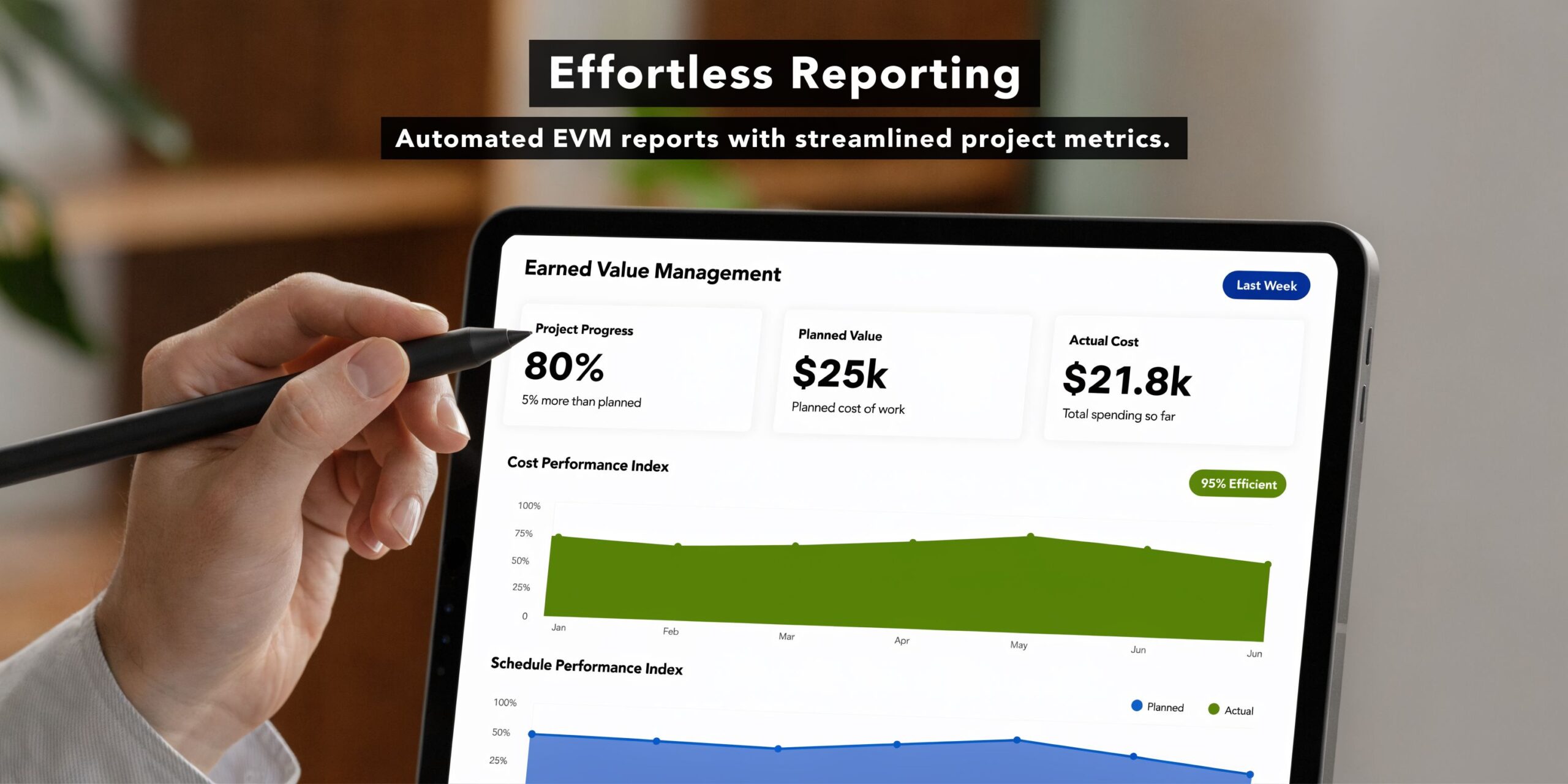
What automation fixes first
TimeTackle pulls time from connected calendars, then applies tags and rules so teams are not rebuilding their week from memory. For EVM-lite, that matters because cleaner time data produces cleaner AC.
It also gives ops teams a practical way to line up cost with delivery structure. If meetings, work blocks, and client activity are tagged by client, project, and phase, labor cost can roll up to the same work breakdown used for planned value and earned value. That is the part many agencies miss.
Automation does not solve the judgment call inside EV. Creative work still needs clear milestone rules, and somebody still has to decide when a deliverable counts as earned. What the tool removes is the manual chore of collecting and organizing the cost side of the model.
Why this matters for project control
Once tagging is consistent, the reporting gets much more useful. Ops and finance can compare planned budget by phase, labor cost consumed in that phase, milestone completion, and utilization patterns that explain why margin is tightening.
That is where lightweight EVM starts to work for an agency. It stops being a monthly reporting ritual and becomes an early warning system.
According to Deltek, mature EVM systems can reduce overruns by 20 to 30% through earlier corrective action (source). Deltek also notes that API-connected systems can automate parts of planned and earned value reporting, which is the same operating principle calendar-sync tools use. For agencies running staged, sprint-based, or hybrid delivery, that reporting layer can sit alongside broader SDLC project management frameworks without replacing the delivery model itself.
What a practical setup looks like
In a mid-sized agency, the setup is usually straightforward:
- Calendar events capture labor activity
- Rules tag work by client, project, and phase
- Times and cost rates feed Actual Cost
- Milestone completion updates Earned Value
- A dashboard compares plan, earned progress, and spend
That is enough to answer the questions agency leaders ask. Which accounts are burning hours faster than value is being delivered? Which phases look busy but are not producing approved output? Which teams are fully utilized yet still missing margin targets?
Good EVM reporting needs cleaner input data and stricter definitions of done.
That is the value of a tool like TimeTackle. It does not make earned value management automatic. It makes it maintainable.
Moving from guesswork to predictable project delivery
The fundamental shift with EVM is not technical. It’s managerial.
You stop treating project health as a matter of opinion. You stop accepting “we’re close” as a status update. You ask what was planned, what was earned, and what it cost. Then you decide while there’s still time to change the outcome.
That’s why earned value is useful far beyond big government programs. In a modern agency, it’s a practical control system for margin, delivery risk, and client confidence.
It also fits with other project structures. If your work runs through staged delivery models, sprint cycles, or hybrid delivery, it helps to think about EVM as a reporting layer over the top, not a replacement for your process. Teams looking at delivery structure may also want to compare it with broader SDLC project management frameworks to see where phase-based control and iterative execution can work together.
A few final rules make this stick:
- Start small: One project is enough to learn the method.
- Define done clearly: No earned value without acceptance rules.
- Keep it light: Use enough structure to see risk, not enough to slow the team down.
- Review often: Short feedback loops beat beautiful monthly reports.
If you’ve been asking what is earned value management, the practical answer is simple. It’s a way to know whether a project is healthy before the budget is gone and the deadline has slipped past recovery.
That kind of visibility is hard to overvalue in an agency.
If you want to test this approach without adding more timesheet admin, TimeTackle gives teams a way to capture calendar-based work, tag activity by project and phase, and turn time data into reporting you can use for delivery control.