



TL;DR: Time theft shows up in two directions. The obvious version is paid time that was not worked. The less obvious version is unpaid, untracked work that employees still do to keep client deadlines, projects, and internal requests on track. Both distort your numbers. Both hurt margins. Both come back to the same operational failure: poor visibility into how time is really spent.
One estimate often cited in this discussion puts the annual cost to U.S. businesses in the hundreds of billions. Agency owners do not need a national statistic to feel the problem, though. They see it in write-offs, weak utilization, inflated payroll against thin delivery, and teams who say a project was "fine" right up until burnout or a missed margin target says otherwise.
For agencies, time theft is not just an HR issue. It sits inside operations, forecasting, billing, and capacity planning. If the timesheet is inaccurate, every decision built on it gets worse. Pricing drifts. Estimates miss. Client profitability gets blurred. High performers absorb extra work that never appears anywhere, so leaders undercount effort and repeat the same staffing mistake on the next project.
That is why the better question is not only what time theft is, but what your systems make visible and what they hide. In practice, the problem is rarely one bad actor. It is a mix of soft timesheet padding, vague entries, calendar drift, forgotten admin time, off-the-clock fixes, and after-hours work that no one records. Agencies that address it well stop treating time tracking as a compliance exercise and start using it as an operating system for cleaner billing, healthier workloads, and more accurate decisions.
The silent profit killer hiding in your timesheets
Small time-entry errors can erase more profit than agency owners expect. The loss rarely comes from one blatant case. It shows up in dozens of ordinary decisions that nobody questions at the time, then compounds into payroll leakage, billing disputes, and bad capacity plans.

In practice, time theft means you are paying for hours that were not worked as recorded. Reverse time theft cuts the other way. Employees do real work that never gets logged, billed, or recognized. Agencies deal with both at once, and both come from the same root problem: poor visibility into where time went.
What time theft means in an agency
Agency leaders usually picture time theft as intentional padding. That happens. More often, the issue is sloppier and harder to spot. People fill out timesheets from memory on Friday, leave vague entries in place, copy yesterday’s hours, or log a clean eight when the day was fragmented by errands, context switching, and idle time.
It tends to surface in patterns like these:
- Client work logged longer than the work took
- Recurring meetings left on the books after they were skipped
- Generic admin time with no clear internal purpose
- Full-day entries that do not match calendars, deliverables, or output
The reverse pattern matters too. Team members answer client messages after hours, fix small issues between meetings, or handle unplanned internal support without recording it. That looks harmless until you price the next job off bad history and ask the same people to repeat an invisible workload. Burnout is a quiet killer of your company's profits, and inaccurate time data helps create it.
Practical rule: If time gets reconstructed after the fact, you are managing estimates, not operating from reliable records.
Why this hurts margins faster than owners expect
The financial drain is not only payroll waste. Dirty time data breaks the systems that depend on it. Job costing gets softer. Utilization reports look better or worse than reality. Account leads defend overruns with weak evidence. Finance writes off hours that should have been scoped, billed, or challenged earlier.
I see this trade-off often. Agencies either tolerate fuzzy entries because they do not want to annoy the team, or they clamp down with heavy monitoring and create resentment. Neither fixes the core issue. The better move is to reduce manual guesswork with tools that capture work as it happens, then use that record to clean up billing, staffing, and workload planning. A calendar-based approach to billable hours tracking is one practical way to get there without turning time tracking into a policing exercise.
How time theft quietly drains your bottom line
U.S. employers lose around $11 billion annually to paying for unworked hours, according to Toggl. For an agency owner, that is not abstract HR trivia. Payroll is your biggest cost, and time is what you sell.
The obvious loss is paying for hours that did not happen. The larger problem is what bad time data does after that. It pushes pricing off target, hides delivery issues, and makes weak utilization look normal.
Small misses turn into margin problems
A few padded entries rarely look dramatic on their own. A rounded-up meeting here. Admin time added to fill a gap there. An approved entry nobody questions because the project is already busy. Over a month, those habits can turn a healthy-looking account into one that needs write-offs to close.
Buddy punching is the clearest version in businesses that use clock-based systems. In agencies, the equivalent usually shows up in softer forms. One person logs on behalf of another, a manager approves vague blocks without context, or hours get reconstructed from memory at the end of the week. The behavior changes. The financial effect does not.
Rounding causes a similar problem. Small increments feel harmless, but repeated across a team, they inflate payroll and distort job costing. Then the bad record gets reused. Future estimates are built on inflated history, and underpriced work starts to look like a delivery problem instead of a data problem.
If time gets entered late, approved loosely, and used for billing anyway, your timesheet is acting more like a story than a record.
What this does to agency economics
Time theft hurts in two directions. One is traditional employee time theft. Logged hours exceed actual work. The other is reverse time theft. People answer client messages after hours, fix issues between calls, or handle internal support without recording it.
Both create the same management problem: lost visibility.
When reported time is too high, you overpay and overestimate effort. When reported time is too low, you underbill, under-scope, and overload reliable people. Agency owners often focus on the first problem because it feels like misconduct. The second one is just as expensive because it hides the true cost of serving clients.
That hidden load is one reason turnover becomes a quiet killer of your company's profits. Strong performers end up carrying work that never shows up in the system, while leaders make staffing decisions from incomplete records.
The operational fallout is predictable:
- Pricing gets weaker because past project data is inflated, incomplete, or both.
- Capacity planning breaks down because available hours on paper do not match real workload.
- Client billing gets harder to defend when entries do not line up with calendars, deliverables, or actual progress.
- Managers spend time policing entries instead of fixing scope, staffing, and process issues.
I see the same trade-off in a lot of agencies. Leaders either accept fuzzy time because they do not want to irritate the team, or they add approvals and audits that create friction without improving accuracy. A better fix is to reduce manual reconstruction. A billable hours tracking approach tied to the actual workday gives you a cleaner record for payroll, billing, and workload decisions.
What does not fix it
Denial does not fix it. Neither does heavy surveillance.
If small discrepancies are ignored, they become standard behavior. If every discrepancy triggers more monitoring, people protect themselves with defensive logging and low-trust habits. The better approach is tighter visibility with less manual effort. Capture work closer to when it happens, compare timesheets to real activity, and use the record to coach, scope, and bill more accurately.
The many faces of time theft and how they show up
Time theft isn’t one behavior. It’s a set of habits that look different depending on role, schedule, and how loose your tracking system is.
That matters because most agency leaders don’t spot it as “theft” at first. They see odd utilization, delayed projects, weird timesheets, and a nagging sense that reported effort doesn’t match output.
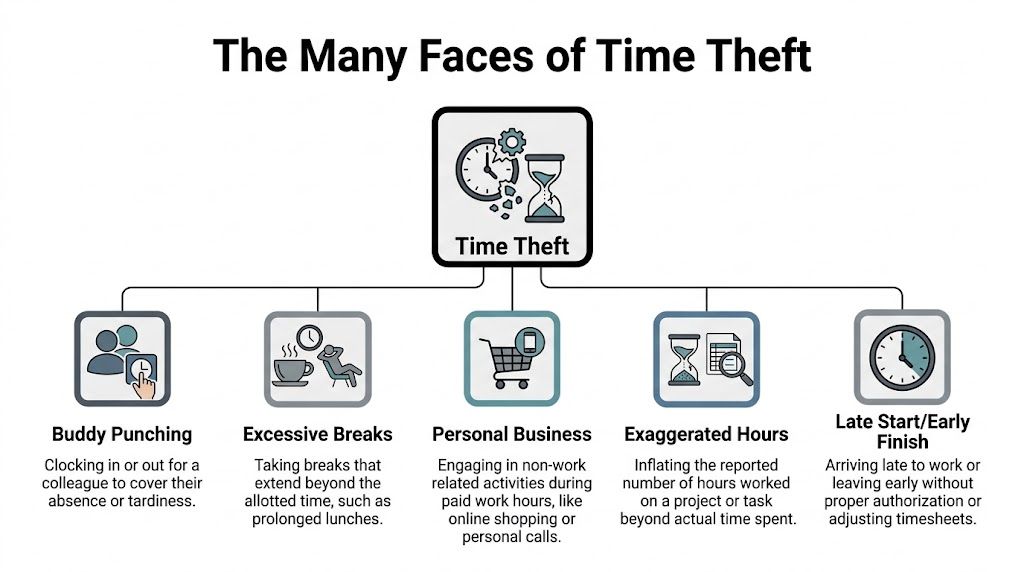
Survey data shows this is widespread. Between 49% and 75% of U.S. employees admit to some form of workplace time theft. More specifically, 43% say they pad timesheets, and 25% admit to falsely reporting their hours between 76% and 100% of the time, according to The Interview Guys.
The obvious version
The clearest form is direct falsification. A team member logs time they didn’t work, extends a task after it ended, or rounds up repeatedly because nobody checks.
In an agency, that can look like this:
- A strategist logs two hours for campaign planning that took one
- An account manager adds admin time to hit a daily target
- A consultant submits a full day after leaving early
- A teammate approves a peer’s entry without reviewing it
This kind of behavior is easy to label, but not always easy to catch if your system depends on memory and trust alone.
The normalized version
More often, time theft shows up as behavior nobody has named clearly. Long lunches become “just how this team works.” Personal calls drift into paid time. Social browsing slips into the afternoon lull. A remote employee stays active in chat but is doing household tasks, errands, or side work.
Agency leaders need some judgment. Not every non-work minute is a policy issue. Adults need breaks. People reset between meetings. Creative teams don’t operate like factory lines.
The problem starts when the gap between paid time and actual work becomes recurring and invisible.
Honest teams still need accurate systems. Trust and verification can exist together.
Digital presenteeism is its own category
A lot of firms still confuse availability with work. Someone is online, responds quickly in Slack, attends calls, and keeps their status green. That can look productive while hiding very little actual output.
This is one reason generic productivity policing rarely helps. Installing more monitoring software doesn’t tell you whether client work moved forward. It mostly tells you whether someone touched a keyboard.
If focus is a real issue on your team, practical tools matter more than guilt. Some managers point people toward apps designed to help procrastinators stay focused, not as a punishment, but as a way to reduce low-grade distraction before it turns into fake or vague time entries.
What managers usually see first
Managers rarely catch time theft by watching the act itself. They see patterns around it:
- Repeated time entries that cluster neatly at round numbers
- Timesheets submitted late with suspiciously complete detail
- Hours that rise while project velocity stays flat
- Calendar activity and logged work that don’t match
- One employee whose internal time always swells at week’s end
That doesn’t mean every inconsistency is fraud. Sometimes it means the person is overloaded and reconstructing the week from scraps. Sometimes the issue is poor tagging, a confusing billing model, or bad habits learned from prior managers.
Either way, you need a way to detect patterns without turning every manager into a detective.
Are your timesheets lying? How to detect time theft
Most firms still look for time theft the old way. A manager notices something odd, asks questions, reviews a few entries, then moves on because the process is tedious. That approach catches the occasional extreme case, but it misses the steady leakage that hurts margins more.
Good detection is less about policing people and more about spotting patterns early.
Manual review versus actual visibility
Manual audits have obvious limits. They depend on someone remembering what looked off, having time to investigate it, and being willing to challenge an employee over a discrepancy that may seem small in isolation.
Spreadsheet-based systems make that worse. When your team reconstructs the week in Excel or Google Sheets, they fill gaps from memory, and memory is unreliable. If you want a plain view of why that breaks down, this explanation of timesheet pros and cons in Excel or Google Docs is useful because it gets to the operational problem quickly.
A stronger method starts with comparisons your systems can make automatically.
The signals worth watching
Instead of asking, “Is this person stealing time?” ask whether the records make sense.
Look for things like:
- Calendar mismatch. Meetings happened, but no time was logged. Or time was logged for work with no calendar trace at all.
- Patterned rounding. Entries land on the same neat increments over and over.
- Late-entry behavior. Someone submits all time at week’s end with unusual confidence and detail.
- Output conflict. Logged hours rise while deliverables, utilization quality, or project movement stay flat.
- Repeat exceptions. The same person shows early clock-outs, vague internal time, or unexplained admin blocks.
These signals don’t prove intent. They show where a manager should ask better questions.
The goal isn’t to catch people in a lie. The goal is to stop making payroll, billing, and staffing decisions from records you can’t trust.
What modern detection looks like
The best systems pull from records people already create during work. Calendars, CRM updates, call logs, and project activity give you a much clearer picture than end-of-week recall. When those signals line up, the timesheet is probably reliable. When they don’t, you’ve found an exception worth reviewing.
This enables managers to work by exception instead of suspicion. They don’t need to monitor everyone equally. They need a short list of entries that deserve a second look.
What to do when you spot it
When you find a discrepancy, don’t start with accusation. Start with clarification.
A simple sequence works well:
- Check the record against other data such as calendar events, project updates, or client communication.
- Ask for context before you assume intent.
- Look for repeat behavior rather than treating one odd entry as a full character judgment.
- Fix the system if the pattern is widespread because repeated ambiguity is usually a process issue, not just a people issue.
That last point matters more than most leaders think. Sometimes the timesheet is lying because the system trained people to lie, guess, or clean up reality after the fact.
The untold story of reverse time theft and burnout
Agency owners usually watch for one kind of time leakage. Inflated hours, buddy punching, long lunches logged as work. The other kind is easier to miss and often more expensive over time: work your team does but never records.
That is reverse time theft. It shows up when people answer client emails before they clock in, clean up deliverables at night, or squeeze in project prep between meetings without tagging the time anywhere. The company gets the labor. The record does not.

The exact number varies by firm, but the pattern is common in agencies because work rarely happens in one clean block. Account managers respond between calls. Strategists review decks after hours. Creative leads rewrite scopes on Sunday so Monday does not explode. Much of that effort never reaches the timesheet, even though it affects delivery, margin, and workload.
What shadow work looks like in practice
Reverse time theft usually hides in the spaces between scheduled work:
- Inbox cleanup before the day officially starts
- Client follow-ups after a meeting ends
- Proposal edits outside the logged project block
- Internal prep, reviews, and handoffs with no clear category
I see three root causes again and again. The entry process is clunky. The activity does not fit the available codes. Or people believe logging every small task will make them look slow, expensive, or disorganized.
The result is a distorted operating picture. A project can look profitable because part of the effort never hit the ledger. A team can look fully staffed on paper while people are carrying unrecorded extra hours every week. Then leadership wonders why utilization looks fine but burnout and turnover keep rising.
Why reverse time theft matters to agency owners
This is still time leakage. It just runs in the opposite direction.
If traditional time theft causes you to overpay or overbill, reverse time theft causes you to underprice work, understaff accounts, and normalize unpaid effort. Both problems come from the same failure: poor visibility into where time goes.
That trade-off matters. Aggressive controls may catch padded entries, but they can also push people to record less if the system feels punitive or overly rigid. Loose systems avoid friction, but they leave too much important work uncounted. Good operators design for accurate capture, not just enforcement.
A timesheet that misses unpaid work is just as unreliable as one that inflates billable hours.
What fair operators do differently
Fair operators treat time records as an operational system, not a morality test. They want to catch over-reporting. They also want hidden work to surface early, before it becomes chronic overtime or quiet resentment.
In practice, that means looking for signs of invisible labor such as heavy calendar load with light time entries, frequent after-hours client activity, or teams that consistently hit delivery targets with suspiciously low logged effort. Those patterns usually point to broken capture, weak scoping, or unrealistic expectations.
Once that work is visible, better decisions follow. Pricing gets closer to reality. Staffing plans improve. Managers can separate a process problem from a performance problem. Just as important, employees can see that accurate tracking protects them too, not only the company.
Building a culture of accountability, not surveillance
A lot of firms respond to time leakage by tightening control. More approvals. More reminders. More manager oversight. More software that watches screens. That usually backfires because people read it as distrust, and distrust pushes behavior underground.
The better path is accountability with clear rules, simple capture, and visible logic.
Start with policy, but keep it practical
Your team should know what counts as work, what needs to be logged, and why the record matters. If those rules are vague, people fill the gaps themselves.
A workable policy usually includes:
- What must be tracked. Client work, internal meetings, admin time, business development, and non-billable support work.
- When it must be entered. Same day is better than end-of-week reconstruction.
- How exceptions get handled. Travel, interrupted days, client emergencies, and partial availability should have a clear path.
- Why accuracy matters. Not just for payroll, but for pricing, staffing, workload balance, and fair performance review.
The tone matters here. If the policy reads like a threat, people will comply just enough to get through it. If it reads like an operating standard that protects both the company and the team, adoption is much easier.
Manual timesheets versus automated calendar tracking
Here’s the trade-off most agencies run into:
| Attribute | Manual timesheets | Automated calendar tracking |
|---|---|---|
| Time capture | Entered later from memory | Captured closer to when work happens |
| Accuracy | Prone to guessing, rounding, and omission | Easier to verify against actual calendar activity |
| Employee effort | High friction and repetitive | Lower effort once rules are set |
| Manager review | Heavy, because entries lack context | Lighter, because anomalies stand out faster |
| Visibility into hidden work | Often missed | More likely to appear because meetings and blocks already exist |
| Trust impact | Can feel performative and annoying | Can feel fairer if rules are transparent |
This doesn’t mean calendars solve everything on their own. People still need to tag work correctly, review exceptions, and agree on definitions. But an automated record is a better starting point than a blank form filled out on Friday afternoon.
What actually builds trust
Trust doesn’t come from avoiding measurement. It comes from making measurement fair.
That usually means four things:
- Make the rules visible so nobody has to guess what good logging looks like.
- Use one workflow across teams instead of letting each manager invent their own standard.
- Review patterns, not personalities. Challenge repeated anomalies, not isolated weird days.
- Show employees the benefit. Better records lead to cleaner billing, fairer workload distribution, and fewer arguments about who is stretched.
If you skip that last part, the system will always feel one-sided.
What not to do
Some mistakes show up again and again:
- Don’t rely on memory-based entry and expect precision.
- Don’t dump all enforcement on line managers who already have delivery pressure.
- Don’t treat every discrepancy as dishonesty when the process itself is clumsy.
- Don’t install surveillance first and ask culture questions later.
The healthiest agencies are clear, not heavy-handed. They make accurate logging the easy path.
Let your calendar become the single source of truth
If you step back, the problem on both sides is the same. Inflated hours happen when people can invent or guess too much. Unpaid shadow work happens when the system misses real activity. That’s why calendar-first tracking works better than classic timesheets in many agencies. It starts from work that already happened.

Your calendar already holds a large share of the truth. Meetings, client calls, internal reviews, planning blocks, demos, interviews, and follow-ups are all there. When that record becomes the starting point, people spend less time recreating the week and more time refining what happened.
Why this model works better
A calendar-first system helps in a few concrete ways:
- It cuts recall bias because people review existing events instead of rebuilding the day from memory.
- It reduces padding opportunities because there’s a visible activity trail behind the entry.
- It surfaces hidden work because internal and external commitments already exist in the schedule.
- It makes exception review easier because unusual entries stand out faster.
Tools are essential. Some teams use native calendar reports plus CRM data. Some stitch together exports from Google Calendar, Outlook, and project tools. Others use software built for this workflow. For example, TimeTackle’s approach to time tracking with Google Calendar is built around connecting calendar activity to tagged, reviewable work records, which is one practical way to reduce both manual timesheet fatigue and missing context.
The operational shift that matters
The gain isn’t just cleaner timesheets. It’s better decisions.
When your calendar becomes the source record, you can see where time went by client, project, team, or type of work. That helps leaders answer the questions that matter: Are we underpricing strategy? Are account managers drowning in untracked client support? Are internal meetings eating delivery capacity? Are certain teams logging vague admin time because the categories are broken?
Once you can answer those questions accurately, time theft stops being a moral panic and becomes what it always should have been: a solvable operations issue.
Frequently asked questions about time theft
Is time theft illegal?
Deliberately falsifying hours can violate company policy and create payroll and recordkeeping problems. The practical question for most agency owners is less about criminal law and more about documentation, consistency, and fair enforcement. Get your records straight first.
Are small personal breaks time theft?
Not automatically. People take short breaks, reset between meetings, and handle brief personal matters during the day. The issue is repeated, unpaid-for time that becomes a pattern and is still recorded as productive work.
How should a manager address suspected time theft?
Start with the record, not the accusation. Compare the entry against calendars, project activity, and deliverables. Ask for context. If the issue repeats, fix the behavior and also check whether your system is pushing people into vague or late logging.
What’s the difference between time theft and poor time tracking?
Poor time tracking is a bad process. Time theft is being paid for time not worked. In practice, the two often overlap because weak systems make it easier for people to guess, round, hide, or omit.
Can better systems reduce both employee abuse and burnout?
Yes. Clearer records make over-reporting harder and hidden work easier to see, which gives agency leaders a fairer view of workload, billing, and staffing.
If your team is stuck with late timesheets, weak utilization visibility, and too much manual cleanup, TimeTackle is worth a look. It uses your calendar as the starting point for time capture, which can make billing, reporting, and workload visibility far more accurate without turning your operation into a surveillance exercise.