


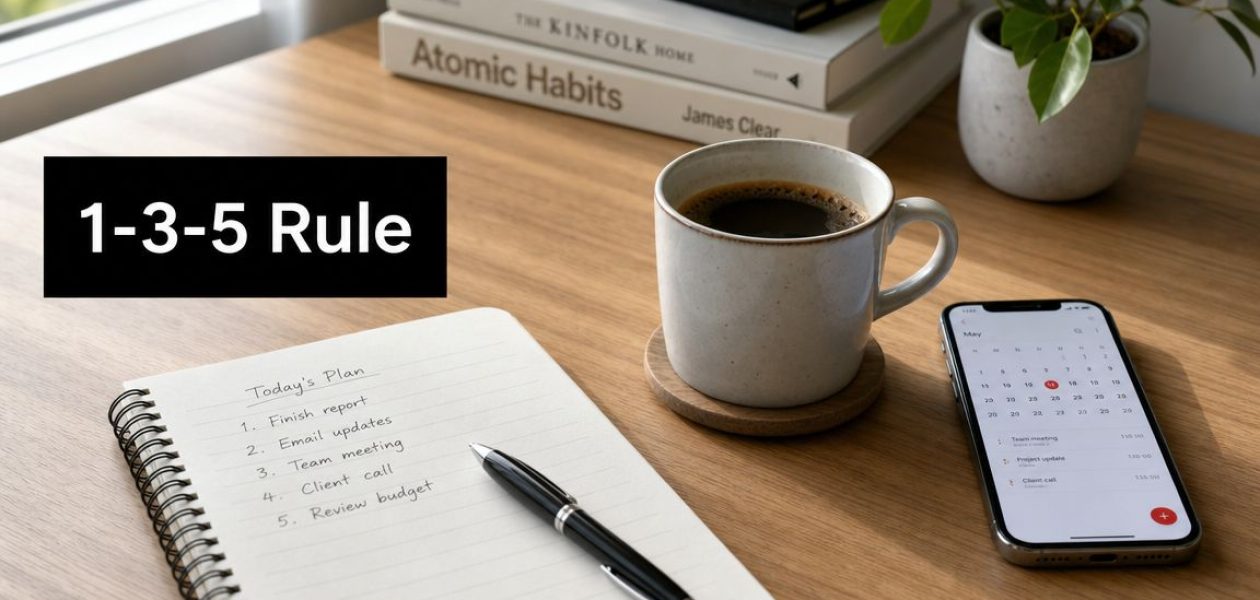
Monday starts before your team is ready for it. A client drops an “urgent” request into Slack. Two internal meetings were booked on top of each other. Someone needs feedback on creative. Someone else needs numbers for a status call. The work that is most important is still sitting there, untouched, while your task list gets longer by the hour.
That's normal in agency work. It's also why so many planning systems fail here. Most advice assumes you control your day. You usually don't. You control parts of it, if you're disciplined enough to protect them.
The 1 3 5 rule works because it doesn't pretend you have unlimited capacity. It forces a harder conversation. What gets your best attention today, what moves forward if there's room, and what only deserves a quick pass? For a mid-sized agency, that shift matters. It keeps account work, delivery work, and internal work from collapsing into one flat list where everything looks equally urgent.
Tired of the never-ending to-do list
An agency project manager sits down at 8:30 with a plan. By 9:10, the plan is gone.
A client wants revisions before noon. The creative director wants an update on a campaign that's already behind. Finance is asking for job coding cleanup. The inbox is full of small requests that each look harmless on their own, but together they eat the morning. By lunch, the team has been busy for hours and still hasn't touched the piece of work that would change the week.

Instead of addressing the core issue, people often lengthen their lists. They add more detail, more color coding, more urgency labels. None of that fixes the underlying problem, which is that the list has no ceiling. If your to-do list can keep expanding all day, it's not a plan. It's a record of incoming pressure.
What chaos looks like in a mid-sized agency
In a team of roughly 50 to 200 people, work rarely arrives in clean batches. It comes from clients, team leads, tools, and meetings. That creates a few predictable issues:
- Client work crowds out deep work because the loudest request gets handled first.
- Internal admin multiplies unnoticed through approvals, handoffs, and follow-ups.
- Meetings split the day apart so even capable people can't find a clean block for focused delivery.
- Everything feels urgent because nobody has agreed on what today can realistically hold.
Busy days don't break teams. Undefined days do.
The 1 3 5 rule gives you a way to cap the day before the day runs you. It won't stop interruptions. It will make you choose, early, what deserves real effort and what has to wait.
What exactly is the 1 3 5 rule
The 1 3 5 rule is a daily planning method with a hard cap of nine tasks: 1 big, 3 medium, and 5 small. For an agency team, that cap matters more than the categories. It forces a decision about what fits into a real day with client calls, approvals, Slack traffic, and at least some protected focus time.
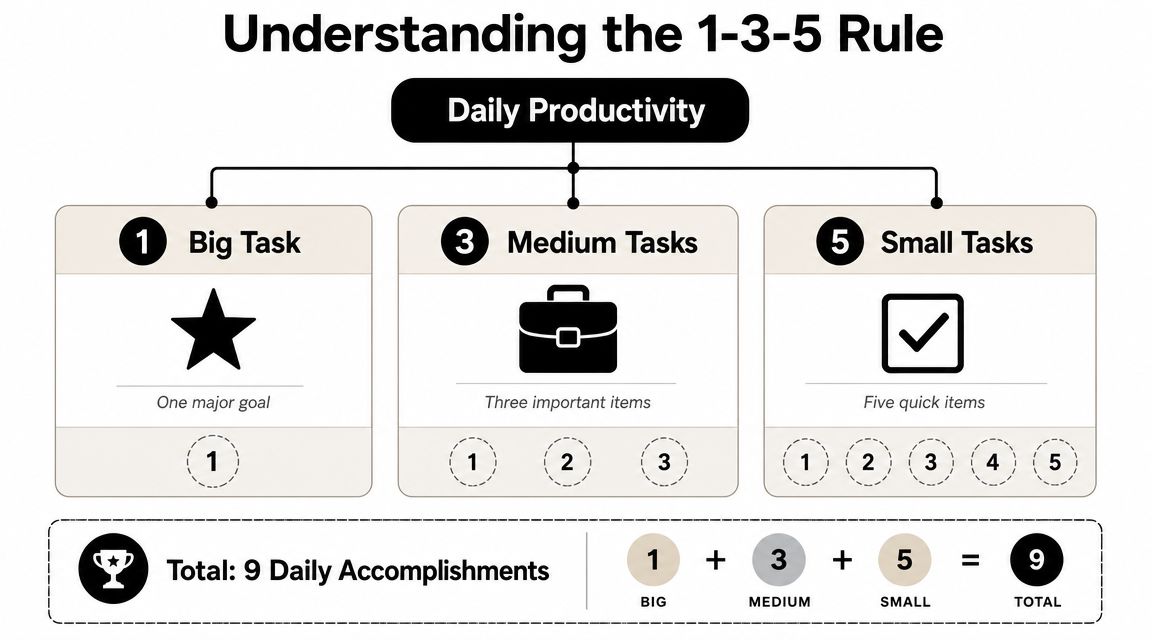
A big task is the piece of work that materially moves an account, deliverable, or internal project forward. A medium task takes meaningful effort but does not need your best uninterrupted block. A small task is short, necessary work such as approvals, quick replies, scheduling, or status updates. The method is simple on paper. The hard part is sizing tasks accurately, which is why many teams need stronger workload management strategies before the rule starts working consistently.
Packing the day in the right order
A workday behaves a lot like a badly packed suitcase. If your team fills it with easy, low-friction items first, the work that matters gets squeezed out.
The 1 3 5 rule fixes that by making you place the largest commitment first, then fit the rest around it. That is the operational value of the method. It turns planning from collection into selection.
Here is the practical breakdown:
- 1 big task. The work that would make the day count if it got done.
- 3 medium tasks. Important follow-through items that need attention but not a long stretch of deep work.
- 5 small tasks. Quick actions that keep delivery moving, such as approvals, replies, updates, or scheduling.
- A fixed ceiling. Everything else can stay in your backlog, project board, or task manager. It does not belong on today's list.
What this looks like in agency terms
A strategist's day might look like this:
| Task size | Example |
|---|---|
| Big | Draft the client messaging framework |
| Medium | Review ad copy, prep talking points for a call, send feedback on a landing page |
| Small | Approve a brief, answer a client email, confirm a meeting, log a note, send a follow-up |
The method works because it asks a harder question than “What needs doing?” It asks, “What can this day hold?”
That distinction matters in a mid-sized agency. If a task called “finish deck” really takes three fragmented hours across meetings, it is not medium work just because someone wrote it on a short list. Teams usually fail with the 1 3 5 rule because they underestimate size, not because the structure is wrong. That is also why some teams use the method alongside the original Todoist explanation of the method, then validate their assumptions later against actual calendar time instead of relying on guesswork alone.
Why this simple rule works for busy agencies
The 1 3 5 rule fits agency life because it respects a fact many planning systems ignore. Your team doesn't just manage priority. They manage attention.
A packed client schedule creates two kinds of damage. First, people keep deciding what to do next, which drains focus. Second, high-value work gets pushed into leftover time, which is usually fragmented and low quality. The rule cuts both problems at once because it narrows the decision set and gives the day a shape.
It reduces the number of choices
Teams often don't need another capture tool. They need fewer daily decisions.
When a planner opens the day with a list of 27 items, every spare moment turns into a sorting exercise. Should they answer the email, start the deck, review the brief, or prep for the call? That constant re-ranking is expensive, even if it feels normal.
With a nine-task cap, you make the hard decisions once. Then you execute. That matters even more in client services, where interruptions are guaranteed.
It works better when you match work to energy
The method is stronger when task size is tied to energy, not just importance. Guidance on the rule recommends placing the one big task in your highest-focus period, then using medium tasks to keep momentum and small tasks for low-friction work, as explained in this breakdown of energy-based planning.
That's a better fit for agency teams than a simple ranked list.
If your account lead does their best thinking early, put the proposal draft there. Don't waste that window on inbox cleanup. If your designer has a low-focus stretch after back-to-back meetings, save production tweaks and admin for then.
It creates a more realistic operating rhythm
Agency work is messy, but it doesn't have to be random. A rule like this helps teams build a repeatable day shape:
- Protected focus first for the task that needs clear thinking.
- Steady project movement through the medium items.
- Administrative cleanup in the cracks between calls and reviews.
- Conscious deferral when new work arrives.
If your team struggles with too much work in progress, these workload management strategies for teams fit well with the same idea. Limit what's active. Make tradeoffs visible. Stop pretending every request belongs in today.
A good daily plan doesn't remove pressure. It stops pressure from choosing your priorities for you.
Common pitfalls and how to adapt the rule
The 1 3 5 rule breaks when teams treat it like a neat little productivity trick instead of an operating constraint. The framework is simple. Real work isn't.
The most common failure is bad sizing. Someone labels a task “medium” because it sounds manageable, but it needs research, approvals, revisions, and a client check-in. Now the day is off course before lunch. The issue isn't the rule. The issue is that the team planned based on hope.
When the “1” is really a project
A weekly proposal, a campaign build, or a client migration isn't one task. It's a project. If you put “finish migration” in the big slot, you've already made the day unrealistic.
The fix is to define the big task as a bounded block of progress. For example:
- Bad version. Finish website redesign
- Better version. Write homepage copy draft
- Better version. Review design round and send consolidated feedback
- Better version. Work on migration checklist for a focused block
That changes the conversation. You're not claiming completion. You're committing to a meaningful unit of work.
When meetings eat the calendar
Some agency days are meeting-heavy by design. A client workshop day, review day, or leadership planning day won't hold the standard pattern cleanly.
That doesn't mean you abandon the method. It means you use it with judgment.
A few workable adjustments:
- Shrink the ambition of the big task if the calendar is already split into pieces.
- Treat meeting prep and follow-up as real work when they directly affect delivery quality.
- Drop tasks instead of stacking tasks when urgent work appears.
- Use the list as a cap, not a wish list. If a new client issue enters the day, something else leaves.
Practical rule: If you add an unplanned priority, remove a planned one. Otherwise the system becomes fake by noon.
When small tasks aren't small
Small tasks often hide the worst planning mistakes. “Reply to client” sounds tiny until the reply needs research, internal alignment, and a rewritten attachment. That's not a small task. That's a cluster of work disguised as one line item.
Watch for these signs:
| Warning sign | What it usually means |
|---|---|
| A small task keeps getting postponed | It isn't actually small |
| A medium task keeps expanding | The scope is unclear |
| The big task never finishes | It was too vague or too large |
| You complete the easy items first every day | The big task wasn't protected |
The rule should bend to reality, but it shouldn't bend so far that it loses meaning. If your team regularly misses the same category, that's a planning signal. Change how you size the work, not just how you describe it.
A practical guide to implementing the 1 3 5 rule
Most agencies don't need a complicated rollout. They need a daily habit that people can keep under pressure.
The best version is simple. Build the next day before the noise starts, and use the calendar as the guardrail. If your team only writes a list and never blocks time for it, the list will lose to meetings every time.
A daily planning rhythm that works
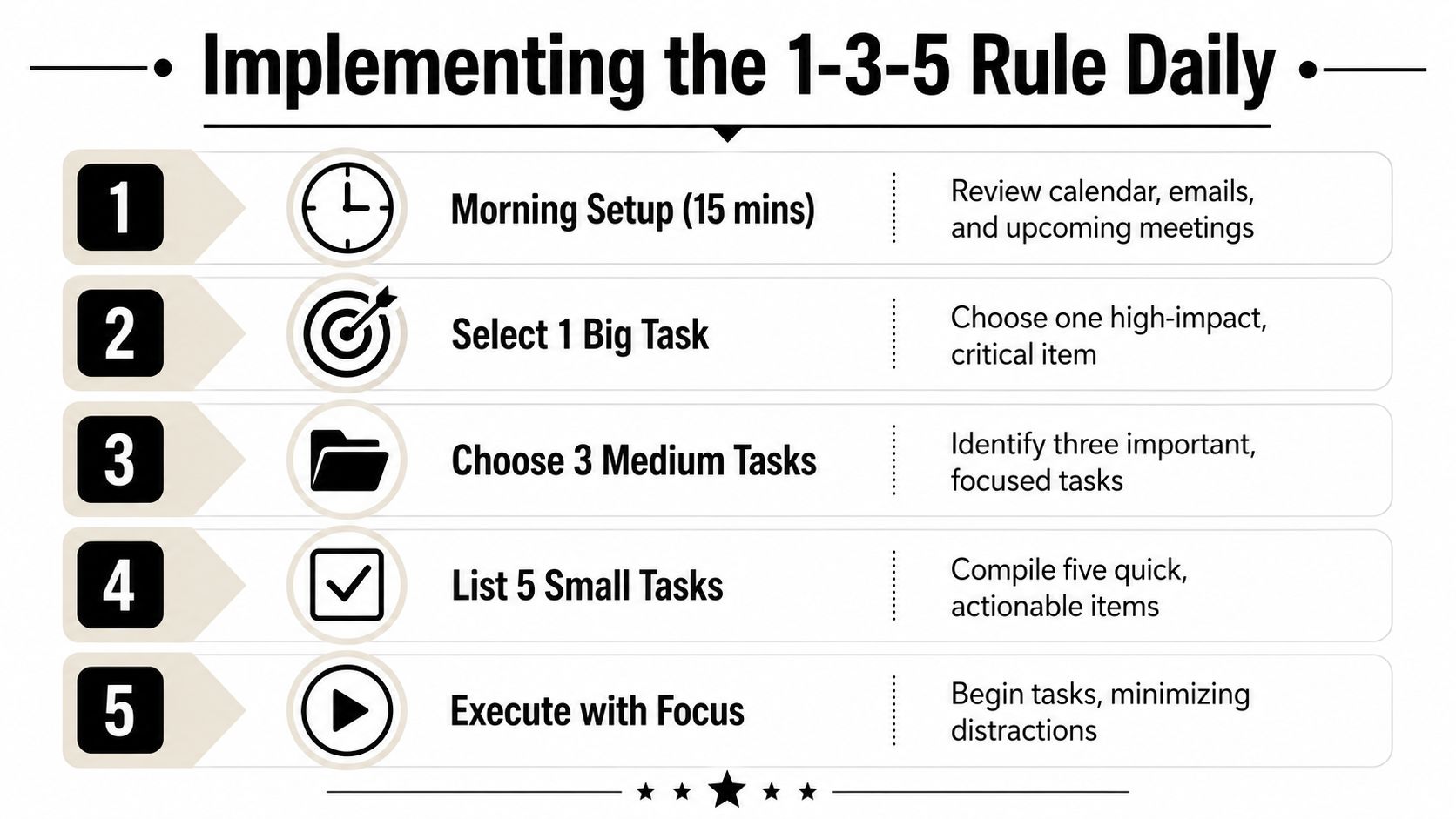
Use the last part of the day, or the first quiet part of the morning, to build the list. The sequence matters.
- Review your calendar first.
- Look at active client deliverables and deadlines.
- Pick the one task that most needs uninterrupted thought.
- Choose the medium items that keep important work moving.
- Fill the small slots with quick admin, follow-ups, and loose ends.
- Put the big task on the calendar before anything else takes the space.
If your team already uses calendar blocking, these time blocking techniques for focused work pair naturally with the method.
Use a simple planning template
Don't overbuild this. A basic table is enough.
| Category | Task Description | Status |
|---|---|---|
| Big | ||
| Medium | ||
| Medium | ||
| Medium | ||
| Small | ||
| Small | ||
| Small | ||
| Small | ||
| Small |
Weekly setup matters more than people think
Daily planning gets easier when the weekly backlog is clean. If everything sits in one pile, your team will keep picking what feels urgent instead of what matters.
A useful weekly check includes:
- Client deadlines that can't slip.
- Internal commitments like reviews, staffing, or reporting.
- Carryover work that still matters.
- Work to defer because it doesn't belong this week.
If a task can't fit into a real calendar window, it doesn't belong on today's list yet.
That discipline is what makes the method useful in agencies. You're not building a motivational system. You're building a credible daily operating plan.
Instrumenting the rule with TimeTackle
The weak point in the 1 3 5 rule is easy to miss. It assumes you can size work accurately.
In many agencies, that assumption falls apart fast. The “1” looks clean on paper, but in reality it overruns because the team underestimated review cycles, prep work, or meeting spillover. One of the clearest gaps in common advice on the rule is exactly this problem: most guides define big, medium, and small tasks, but they don't show how to calibrate them against actual calendar time. The rule starts to fail when the big task keeps taking longer than planned, as noted in TrackingTime's discussion of task sizing.
That's why calendar data matters.
Stop guessing how long your categories take
Teams often classify tasks by feel. That works for a few days. It doesn't hold up over a month.
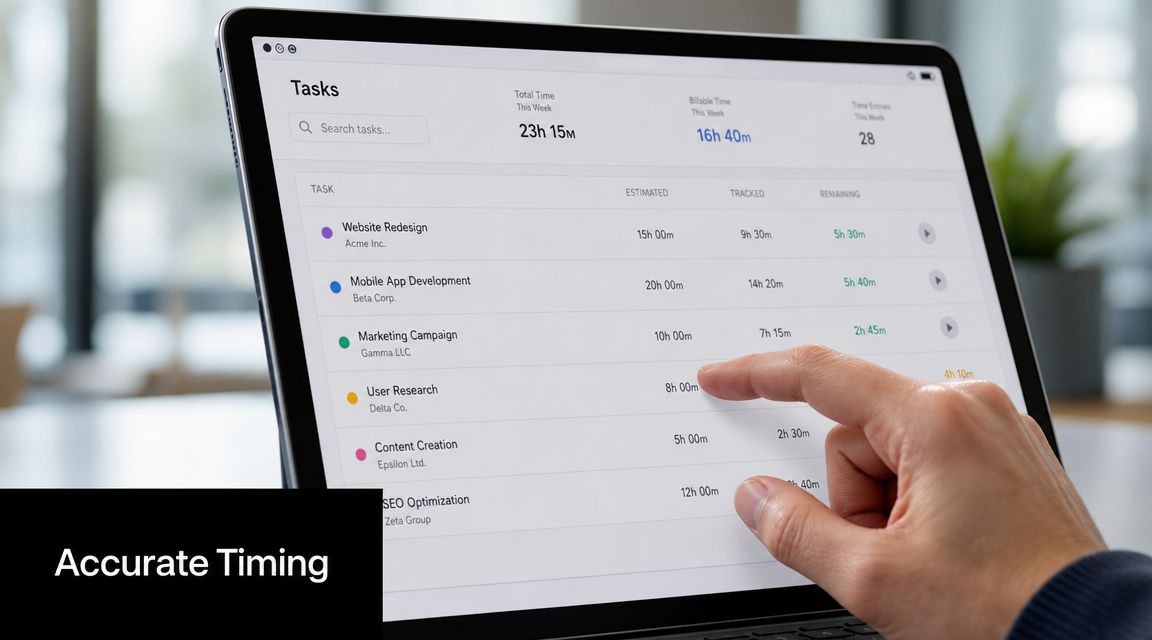
A better approach is to tag calendar blocks by task type and review what happened. If your team uses a calendar-based tracker like Tackle time tracker, you can label work consistently and compare planned task size against real time spent.
For example, teams often create simple tags such as:
- [1-Big] for focused priority work
- [3-Med] for meaningful but bounded tasks
- [5-Small] for quick admin and follow-ups
- Meeting tags for client calls, internal reviews, and standups
After a few weeks, patterns get harder to ignore. You may find that “small” tasks are swallowing whole chunks of the day, or that your so-called big tasks aren't being protected at all because meetings keep cutting into them.
What to look for in the calendar
The point isn't to create another reporting layer. The point is to make the rule honest.
Review the calendar for signs like these:
| Pattern | What it tells you |
|---|---|
| Big-task blocks keep moving | Your team isn't protecting focus time |
| Medium tasks spill across multiple days | The work is underscoped |
| Small tasks fill meeting gaps but expand | Admin is fracturing attention |
| Planned work differs from calendar reality | Your sizing model needs revision |
Agencies get real value. You can see whether account managers, strategists, designers, or delivery leads are planning in a way that matches their actual week. That helps managers coach the system without policing people.
Why this matters for teams with attention challenges
Some teams struggle less with planning the list and more with holding the plan once distractions start. For those cases, outside resources can help. Jan Kutschera's guide to best ADHD time management apps is worth reading if your team needs tools built around focus support, reminders, and friction reduction.
The broader lesson is the same. A planning method only works if it matches how people really work.
The calendar is the ground truth. If your task categories don't match the calendar, the categories are wrong.
Once you instrument the method, the 1 3 5 rule stops being a motivational idea and starts becoming a management system. You can validate task sizing, spot recurring planning errors, and make the next week more realistic than the last one.
A final thought on sustainable agency work
The best thing about the 1 3 5 rule is that it doesn't ask your team to become robots. It asks them to make better bets.
That matters in agencies because the work is never fully under control. Clients change their minds. Meetings expand. Internal requests appear at the wrong time. A useful system has to survive that reality. This one can, as long as you treat it as a framework for choosing, not a scorecard for perfect days.
What sustainable use actually looks like
Teams get value from this method when they do a few things consistently:
- Protect one meaningful block of focused work
- Keep medium tasks tied to active priorities
- Use small tasks to contain admin instead of letting admin spread everywhere
- Defer openly when the day changes
- Review patterns and adjust sizing over time
The real win
A strong day doesn't mean all nine tasks get done. Some days won't allow that. A strong day means your team knew what mattered, gave it the best part of the day, and made conscious tradeoffs when reality changed.
That's a much better standard for agency work. It reduces the feeling of constant reaction, and it gives people a way to finish the day with clarity instead of vague guilt about everything still open.
Sustainable productivity in an agency comes from limits, not from pretending your team can absorb infinite work.
If your agency wants a clearer view of how planned work compares with real calendar time, TimeTackle can help you turn daily planning into something measurable. It gives operations leaders and team managers a calendar-based way to see where time goes, where task sizing breaks down, and where focus keeps getting lost.