



Your leadership team had the offsite. The whiteboard was full. Everyone left with energy. Then Monday showed up, clients needed answers, managers filled their calendars with delivery work, and the strategy slid back into a slide deck no one opened.
That's the normal failure pattern.
Most agencies don't fail because they lack ambition. They fail because they never turn a strategic goal into something visible in daily work. If the plan doesn't show up in calendars, project tags, pipeline reviews, staffing choices, and weekly decisions, it isn't a strategy. It's a wish list.
That's the issue with how to set strategic goals. The writing part is easy. The hard part is building goals that survive contact with client work, changing capacity, and messy operational reality.
Choosing a framework that actually fits your team
Teams often get stuck before they start because they think they need to pick a perfect method. They debate SMART versus OKRs, read a dozen templates, and still don't decide. Meanwhile, nothing changes.
You don't need a perfect system. You need one your managers can explain in a few minutes and use every week.
Start with the kind of work your team does
If your team is trying to create something new, enter a new market, or test a new service line, OKRs usually fit better. They give you a clear objective and a few measurable results, but they leave room for learning. That matters when the path isn't fully known yet.
If your team needs tighter execution, SMART goals usually work better. The SMART framework requires goals to be Specific, Measurable, Achievable, Relevant, and Time-bound, with a quantifiable endpoint, a deadline, and named KPI owners tied to monthly tracking, as outlined in the SMART goal guidance from PARIS21.
A simple way to choose:
| Team situation | Better fit | Why |
|---|---|---|
| New service launch | OKRs | You need room to test and adjust |
| Agency turnaround | SMART | You need tighter definitions and deadlines |
| Operational cleanup | SMART | Ownership and measurement matter more than exploration |
| Innovation push | OKRs | Progress may come through iteration, not a fixed sequence |
Don't treat frameworks like doctrine
I've seen agencies copy a Silicon Valley OKR format that looked impressive and failed in weeks because nobody outside leadership understood it. I've also seen teams use SMART goals so rigidly that they locked themselves into plans that no longer matched the quarter.
Practical rule: Pick the lightest framework that still forces clarity.
For most agencies, a hybrid works best. Use a plain-language objective to describe what you're trying to change. Then apply SMART discipline to the measures, deadlines, and ownership so the goal can survive day-to-day execution.
That might look like this:
- Objective wording: Build a profitable retained services offering
- Measurement layer: Define the KPIs, data source, review date, and owner
- Execution layer: Break the work into near-term actions with dates
- Review layer: Recheck assumptions often enough to catch drift
If your planning process feels heavy already, a shorter operating cadence helps. A practical model is a lightweight planning rhythm, like the one described in this rapid planning method, because teams don't ignore strategy when it feels usable.
What works and what doesn't
What works is boring in the best way. One framework. Plain language. Clear owners. Measures people can check.
What doesn't work is the opposite:
- Too much jargon: Managers nod in the meeting and improvise later
- Method switching: Every quarter brings a new template, so nothing sticks
- Goal theater: Nice words, no dates, no owner, no operating link
- Overdesign: The planning system becomes harder to manage than the work itself
If your team can't explain the framework without a slide, it's too complicated.
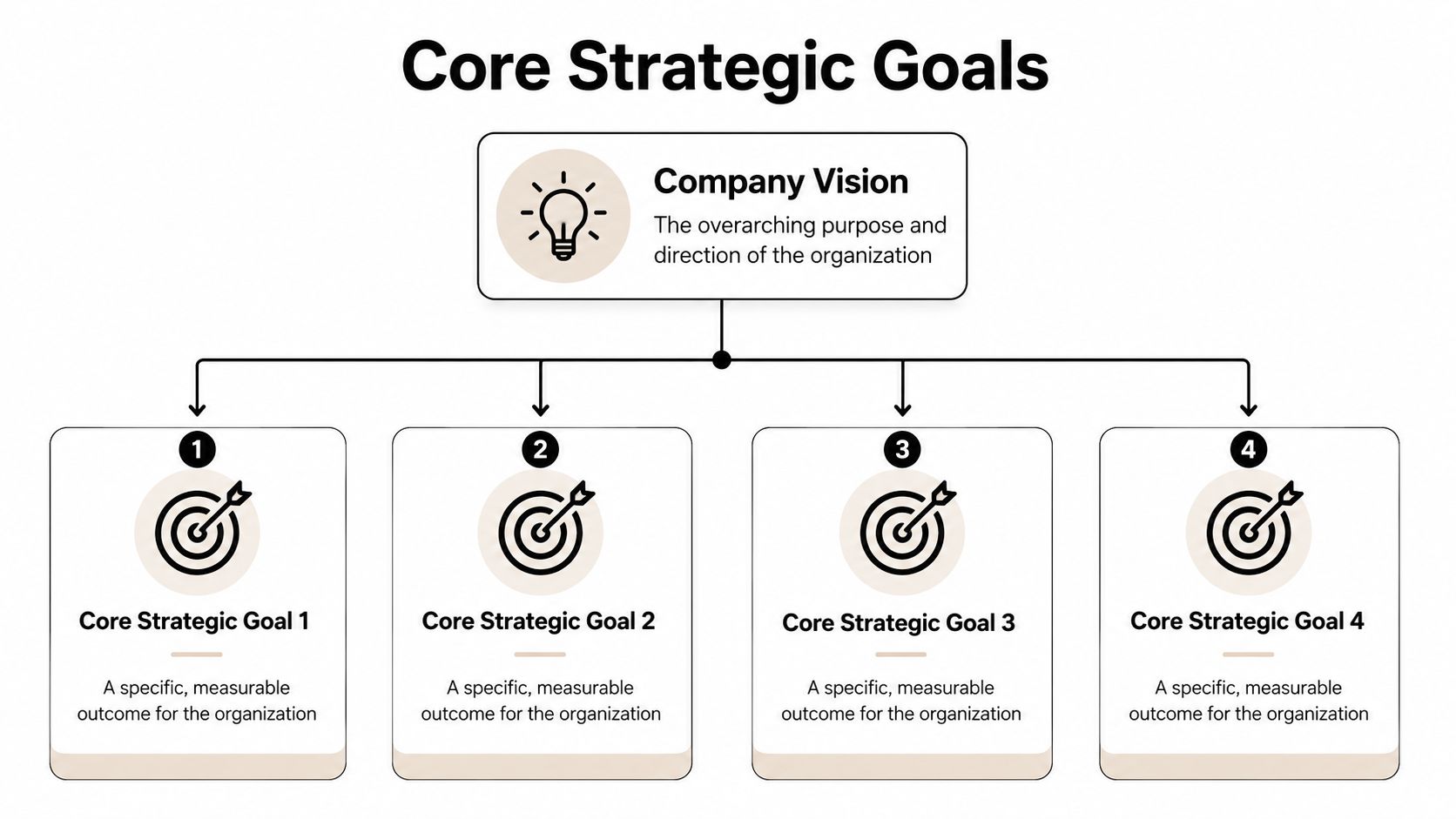
Defining your three to five core strategic goals
The fastest way to ruin a strategy is to call everything a priority. When leadership names eight, ten, or fifteen “top” goals, teams stop believing the list means anything. They go back to urgency, which usually means client delivery and internal fire drills.
Organizations that implement strategy well usually focus on exactly 3 to 5 strategic priority areas, because that level of constraint creates agreement and execution focus, according to SME Strategy's guidance on goal setting for implementation.
Cut from vision to a short list
Start with the company vision, but don't stop there. Vision is directional. Strategic goals need to say what changes this year or planning cycle.
A good test is whether each goal answers one of these questions:
- Revenue question: What must improve in the business model?
- Delivery question: What must get better in execution or margin?
- Market question: What position do we want to strengthen?
- Team question: What capability must exist to support the plan?
If two draft goals point at the same underlying issue, merge them. If a goal sounds like a project, move it down a level. “Implement new CRM workflow” is not a strategic goal. It may support one, but it isn't one.
Make each goal hard to misread
Most weak goals fail in the wording. They sound fine in a meeting, but every function hears something different.
Use SMART discipline to tighten them:
- Specific: Name the result, not the intention
- Measurable: Attach KPIs and a data source
- Achievable: Check whether you have the people, time, and budget
- Relevant: Tie it to the business problem, not personal preference
- Time-bound: Put a real date on it
Here's the difference:
| Weak draft | Better version |
|---|---|
| Grow the business | Increase revenue from retained service contracts by a defined deadline |
| Improve delivery | Reduce project overruns by a defined deadline with a named KPI owner |
| Build our brand | Increase qualified demand from a target segment by a defined deadline |
The exact number isn't the point here unless you've validated it. The point is that nobody should be able to read the goal and ask, “What does this mean in practice?”
Write goals so a department head can tell, in one sentence, whether the team is on track.
If your leadership team struggles to get from broad ambition to clear goal language, a prompt-based tool like Founder Connects' strategy generator can help get rough options on the page faster. The value isn't in accepting the first output. The value is forcing sharper choices.
A useful check is to compare your strategic goals with other common goal types. This breakdown of key types of goals is a good reminder that strategic goals should sit above projects, habits, and short-term tasks.
Prioritizing goals based on impact and effort
Once you've drafted your core goals, the actual work begins. A list is easy. Sequencing is hard.
Most leadership teams rank goals by preference, politics, or whoever speaks first in the meeting. That creates a fake sense of order, but it doesn't tell you what should move now. Prioritization needs a harder filter.
Before finalizing strategic goals, organizations should calculate the anticipated ROI for each operational objective so they can sort high-value work from lower-value work, as explained in Strategic Management Insight's guidance on strategic goals.
Use two filters, not one
Impact matters, but effort matters too. A goal with big upside may still be the wrong first move if a more basic bottleneck blocks it.
I use two screens:
- Business impact: If this works, what changes in revenue, margin, delivery quality, retention, or stakeholder value?
- Execution friction: What makes this hard right now? Capacity, skill gaps, tech debt, slow approvals, weak handoffs?
This usually changes the order fast. Teams often want to chase the visible growth goal first, but the obstacle sitting underneath is poor delivery discipline, weak pipeline quality, or bad reporting. Until that gets fixed, the growth push creates more strain than progress.
Try obstacle-first sequencing
There's a practical reason many plans feel scattered. Teams break goals into equal time blocks instead of dealing with the biggest barrier first. That's backward.
An obstacle-first approach asks a tougher question: what single problem stands between the current state and the goal? Solve that first, then reassess.
For example:
| Goal | Likely obstacle | Better first move |
|---|---|---|
| Launch a new service line | No clear owner and messy packaging | Define offer, owner, and sales motion |
| Improve profitability | Poor visibility into delivery effort | Fix project tracking and margin reviews |
| Increase enterprise deals | Sales team lacks proof points | Build case materials and qualification rules |
If a goal depends on five unresolved problems, the first goal is actually problem one.
Leaders must exercise discipline. Not every worthy initiative deserves equal space on the roadmap. Some need to wait because they depend on groundwork that hasn't been done.
A practical ranking exercise
Use a short workshop with your leadership team and score each draft goal in plain language.
- What changes if we achieve it
- What breaks if we ignore it
- What blocks progress today
- What evidence would prove it's moving
Then rank by sequence, not status. “Now, next, later” beats “high, medium, low” because it forces dependency thinking.
That's what good prioritization is. Not sorting ideas on a spreadsheet, but deciding what the business must solve first.
Connecting your strategy to daily work and real data
Most strategic plans often fail at this stage.
The leadership team agrees on goals. Managers leave with action items. Then the calendar fills with client calls, internal reviews, status meetings, admin tasks, and unplanned work. At the end of the month, everyone says strategy still matters, but nobody can show whether the team spent time on it.
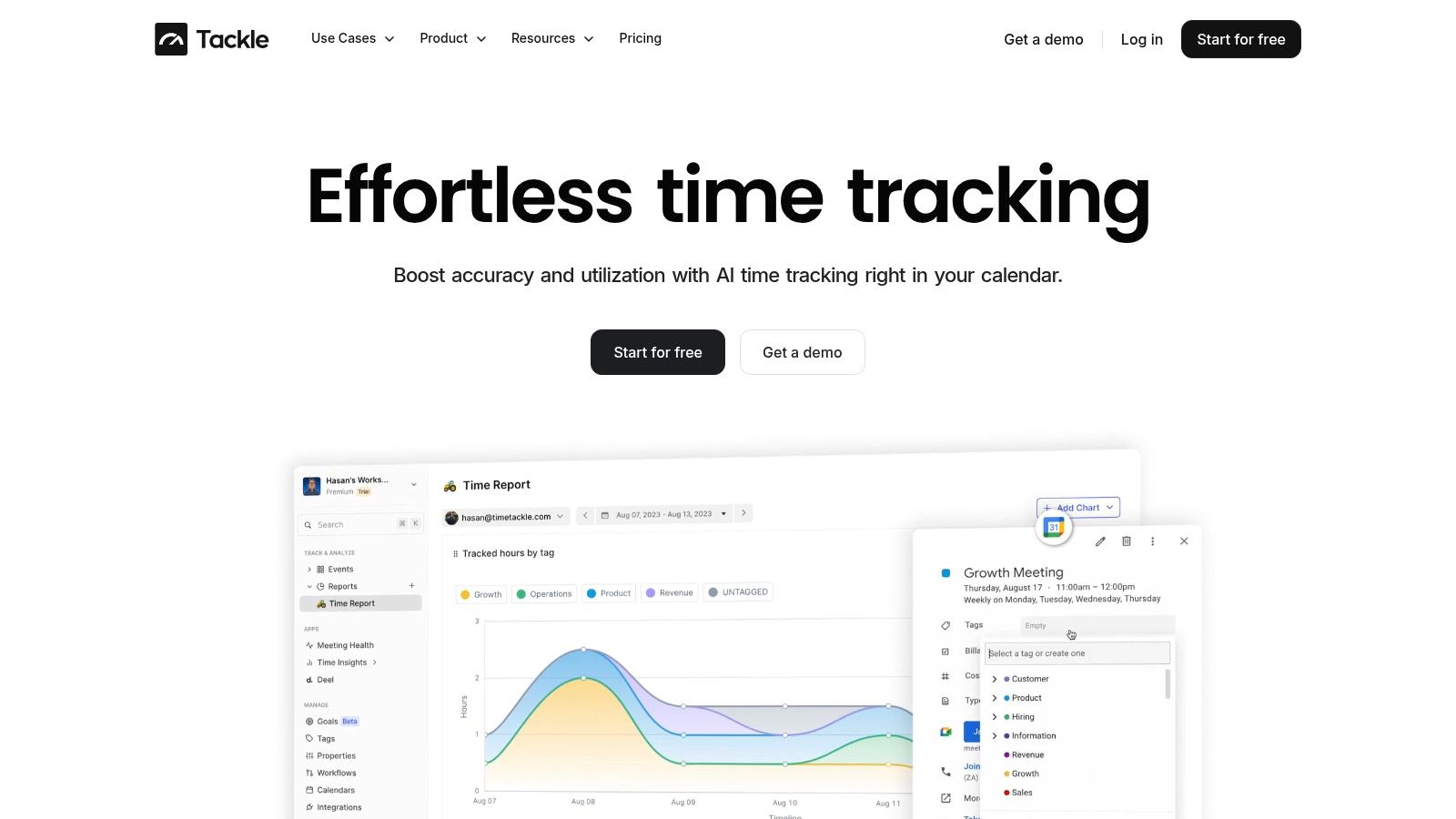
That gap is bigger than most planning advice admits. Most content treats strategic goals as a top-down planning exercise and leaves out how automated activity data, like calendar events and CRM logs, can validate whether daily work matches strategic outcomes, as noted in Asana's resource on strategic goals and objectives.
Translate each goal into observable work
A strategic goal should show up in behavior. If it doesn't, you can't manage it.
Say your agency sets a goal to grow a new consulting offer. That goal should connect to work patterns you can observe:
- Business development activity: Discovery calls, proposal reviews, pipeline meetings
- Offer development: Internal work sessions, pricing reviews, packaging decisions
- Delivery readiness: Training, playbook creation, process design
- Client execution: Actual project time on the new service line
If the goal is real, those activities should appear more often, with more consistency, and with the right people involved. If the calendar tells a different story, the strategy isn't happening yet.
Build a simple validation layer
You do not need a giant business intelligence project for this. You need a repeatable way to map time and activity to strategic categories.
A practical model looks like this:
| Strategic goal | Related activity | Data you can track |
|---|---|---|
| Grow retained revenue | Renewal calls, account planning, proposal meetings | Calendar tags, CRM stage changes |
| Improve delivery margin | Project reviews, scope control meetings, rework analysis | Time by project, meeting type, client |
| Launch new service line | Sales calls, packaging sessions, pilot work | Time by initiative, team, opportunity |
The point is not surveillance. The point is evidence.
If leadership says a goal matters, but the team spends almost no visible time on related work, one of two things is true. Either the goal isn't really a priority, or the work hasn't been translated into trackable execution.
Strategy gets real when you can compare stated priorities with actual hours.
That's why calendar analytics matter. They show where management attention goes, where specialists spend effort, and whether important initiatives are gaining traction or getting squeezed out by recurring client work.
For teams trying to make this visible without adding another manual reporting burden, a dedicated performance analytics dashboard helps connect activity, projects, and operational trends in one place.
What this changes for leaders
When you connect goals to work data, strategy reviews stop being abstract.
Instead of asking, “Are we making progress on our consulting expansion?” you can ask better questions:
- Are the right people spending time on the initiative
- Did business development effort increase
- Did delivery capacity follow the plan
- Did operational work crowd out the strategic work
That changes behavior fast. Teams stop reporting optimism and start reporting evidence.
It also gives you a way to adjust before the quarter disappears. If the plan says one thing and the calendar says another, the calendar is telling the truth.
Building a rhythm of accountability and adjustment
Monday starts with confidence. Leadership says the quarter is on track. By Friday, client work has swallowed the week, the strategic initiative has slipped again, and nobody can say exactly when it happened. That is what weak accountability looks like in practice. The plan exists, but there is no operating rhythm strong enough to protect it.
Written goals help because they create a fixed reference point for review. WorkBoard's goal-setting article makes that case clearly. The harder part is operational. Teams need named ownership, a review cadence that forces real decisions, and enough live work data to catch drift before the quarter is gone.
Give every KPI one owner
Shared ownership sounds fair. It usually produces delay.
Each KPI needs one person responsible for bringing the current result, explaining the gap, and proposing the next action. Other teams can contribute, but one owner has to carry the thread between meetings. Without that, reviews turn into status theater because everyone is involved and nobody is accountable.
A useful KPI review sounds like this:
- Owner states the current result
- Owner explains what changed since the last review
- Owner identifies the blocker or constraint
- Owner recommends a specific next move
- Leadership makes a decision in the meeting
That last point matters. If every issue gets deferred, the meeting becomes a reporting exercise.
Review often enough to correct course
Annual planning sets direction. Quarterly reviews test whether the strategy still holds. Execution needs a tighter loop.
In practice, I have found that a 6 to 8 week review cycle works well for agencies and service businesses. It is long enough to produce visible movement and short enough to correct staffing, pipeline, or delivery problems before they become quarter-end surprises. Shorter than that, teams often discuss noise. Longer than that, they explain misses that could have been fixed earlier.
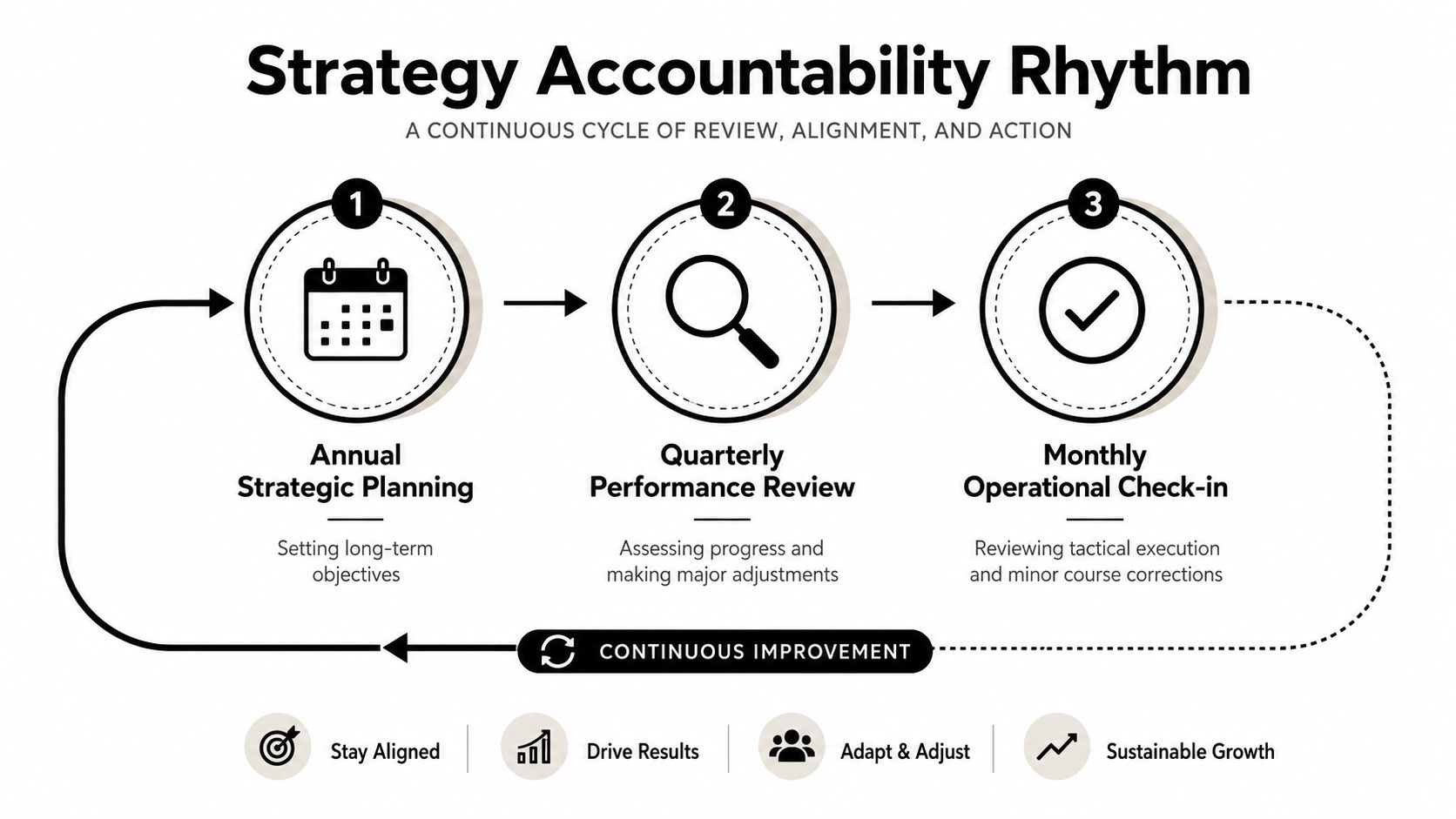
A clean rhythm usually has three layers:
| Cadence | Focus | Output |
|---|---|---|
| Annual | Strategic direction | Core goals and decision boundaries |
| Quarterly | Progress and resourcing | Reallocation and trade-off decisions |
| 6 to 8 week cycle | Execution health | Tactic changes, blocker removal, owner resets |
For a practical example of a structured review process, Advisor Momentum growth review is worth studying because it keeps the discussion tied to business performance.
Bring work data into the review
Many strategy reviews break down at this point. Leaders discuss goals at a high level, but they do not check whether time and attention moved.
Review meetings get sharper when you bring in current activity data alongside KPI results. Calendar patterns, project allocations, and meeting volume will not answer every strategic question, but they will show whether the organization behaved like the goal mattered. If a growth initiative has an owner, budget, and deadline, but almost no leadership time or specialist time appears around it, that is not a messaging problem. It is a prioritization problem.
Use the review to compare three things:
- Target result
- Current business metric
- Actual work pattern behind the metric
That combination changes the quality of the conversation. Teams stop saying, "we are still focused on it," and start showing whether focused work really happened.
Keep the meeting tight
Strong review meetings are short, specific, and decision-oriented. Pre-read the updates. Use the live meeting for judgment.
Cut anything that slows that down:
- Long recap decks: Send notes before the meeting
- Department-by-department updates: Focus on cross-functional issues tied to the goal
- Open discussion with no endpoint: End every topic with an owner, decision, and date
- Vanity metrics: Review only the measures tied to the strategic outcome
A strategy rhythm is only useful if it changes what people do next week. If the meeting does not reassign effort, remove a blocker, or reset a deadline, it was probably a status meeting wearing strategic language.
Common goal setting pitfalls and how to avoid them
A leadership team leaves the annual planning session with five strategic goals, a polished deck, and broad agreement. Six weeks later, client work has taken over, internal meetings are back on the calendar, and nobody can say which goal gained real operating time. That is how strategy usually fails. It does not collapse all at once. It gets crowded out by the default work pattern.
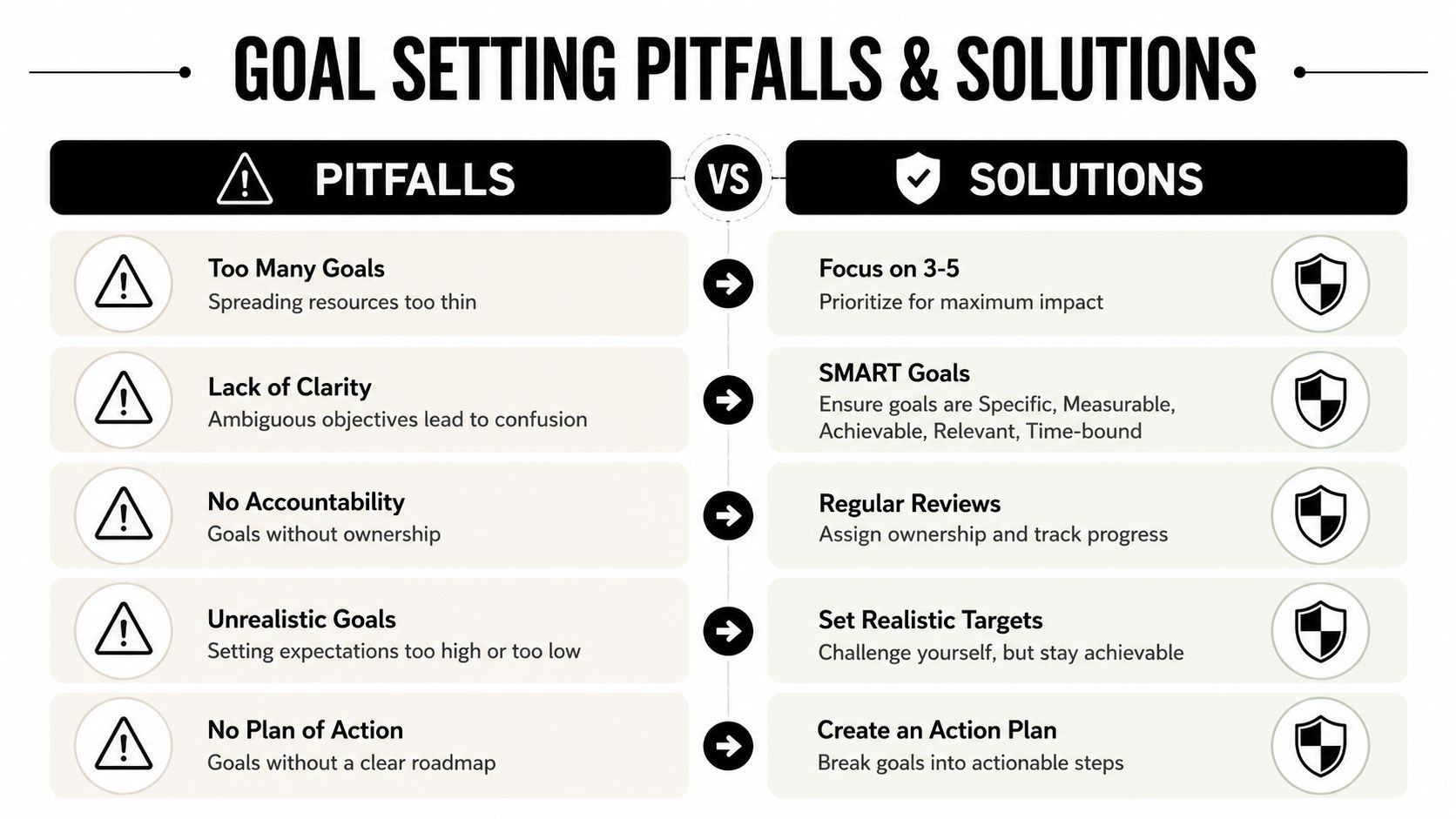
Pitfall one: the goal is too big to act on
Goals often fail at the translation step.
"Become the leading agency in our category" may be directionally useful, but it does not tell a delivery lead what to change on Monday. Teams need a goal they can convert into projects, decisions, and time allocations.
Break the goal into a short chain of concrete moves:
- Define the outcome: State the metric, the deadline, and the owner
- Identify the constraint: Name the bottleneck that is blocking progress now
- Choose the next actions: Assign the few actions that remove that constraint
- Set the review point: Pick a date soon enough to catch drift before the quarter disappears
If a goal cannot be broken into near-term work, it is still a slogan.
Pitfall two: no one can prove progress
A surprising number of teams still run strategy reviews on narrative alone. One leader says pipeline quality is better. Another says margin is still weak. A third says the team is working hard. All three may be right, and the meeting still goes nowhere.
Progress needs a measurable definition and a stable source for that measurement. It also needs evidence that the work behind the metric happened. That is the part many planning guides skip.
Use this check:
| Warning sign | Likely cause | Fix |
|---|---|---|
| People describe progress differently | The goal is vague | Rewrite the outcome in measurable terms |
| Reports arrive late or change weekly | Data source is unstable | Set one source of truth |
| Teams say the goal is a priority, but calendars and allocations show little time on it | The work never got resourced | Reassign capacity and reduce lower-value work |
| Teams blame each other | Ownership is blurred | Name one KPI owner |
That third row matters. A strategy can look healthy in a slide deck and still be starved in the actual workweek.
Pitfall three: accountability gets spread across the group
Shared ownership sounds collaborative. In practice, it often softens pressure at the exact moment pressure is needed.
Cross-functional goals still need one person who carries the number, runs the update, and asks for trade-offs when the work stalls. Other teams may contribute, but one owner needs clear authority to escalate blockers and force decisions. Without that, deadlines slip because everyone is waiting for someone else to push.
A strategic goal can involve many contributors, but one person must carry the number into the meeting.
Pitfall four: strategy never reaches the people doing the work
This failure shows up in execution long before anyone names it. Project teams stay busy, but the work mix does not change. Managers keep approving requests that conflict with the stated priorities. Internal coordination expands while strategic initiatives get whatever time is left.
The problem is not communication alone. It is translation. Staff need to know which projects move the goal, which metrics matter, and what work should lose priority.
Watch for these signs:
- Project choices do not match stated priorities
- Managers cannot explain why one initiative matters more than another
- Recurring meetings consume time that should be spent on strategic work
- Teams know the headline goal but not the operating changes behind it
In agency environments, I usually see this in calendars before I see it in KPI reports. If leadership says retention is a strategic priority but account leads spend their week on new business support and internal status meetings, the strategy has not reached the operating layer.
Pitfall five: the plan is rigid when the business is not
Annual goals are fine. Annual assumptions are usually wrong by spring.
Client demand changes. Hiring plans slip. Margins tighten. A channel that looked promising in January underperforms by April. Teams need room to adjust tactics without rewriting the strategy every month.
The practical fix is a shorter decision cycle. Keep the strategic direction steady, then review assumptions, resource allocation, and work patterns often enough to catch drift early. If a goal still matters, it should keep showing up in budgets, staffing, and calendars. If it does not, leaders should either recommit real capacity or stop pretending it is a priority.
If you want your strategy to survive the day-to-day workweek, you need evidence of where time goes, which initiatives get attention, and whether daily activity matches leadership priorities. TimeTackle helps teams turn calendar and activity data into usable operational insight, so strategic goals stop living in slides and start showing up in the work itself.