


Your agency probably doesn’t have a time problem. It has a planning problem.
The week starts with good intent. Account managers fill the calendar with client calls. Creatives jump between revisions. Delivery leads chase status updates. Everyone logs time, everyone looks busy, and by Friday the team feels wrung out. Then the monthly review lands, and the same questions come back. Why is the strategic retainer still slipping? Why did a big internal initiative stall again? Why do timesheets say the team worked hard while outcomes say otherwise?
I see this pattern often in mid-sized agencies. Activity is easy to measure, so teams build systems around activity. Hours booked. Meetings attended. Tasks closed. Those things matter, but they don’t tell you whether the team moved the business forward.
That’s where the rapid planning method changes the conversation. Tony Robbins developed RPM to shift focus from task completion to outcome achievement, built around result-oriented thinking, purpose-driven motivation, and massive action plans, rather than a rigid to-do list approach, as described in this overview of the framework. For an agency team, that shift is practical, not philosophical. It means planning work around client results, delivery milestones, margin protection, and team capacity instead of letting the week get eaten by reactive work.
The challenge is scale. Most RPM advice is written for individuals. Agencies need a team version. They need a way to turn outcomes into calendars, calendars into tracked activity, and tracked activity into operating decisions. That’s the missing layer.
Why being busy isn’t the same as being productive
A full timesheet can hide a weak week.
I’ve seen teams log every hour, answer every message, and still miss the work that mattered most. The problem usually isn’t laziness or lack of skill. It’s that the team is reacting to requests instead of working from a shared definition of success.
What busy work looks like in an agency
You can spot it fast:
- Meetings multiply: A project gets more check-ins because delivery feels shaky, but nobody makes a hard call on scope, owner, or deadline.
- Tasks pile up: People finish tickets all week, yet the main client deliverable stays unfinished because the tickets weren’t tied to the intended outcome.
- Reporting eats capacity: Managers chase updates in Slack, spreadsheets, and timesheets because there’s no single record of what the team planned and what they accomplished.
- Urgency wins every day: The loudest request gets attention, while strategic work keeps moving to “next week.”
That’s the trap. Teams confuse visible effort with progress because effort is easier to capture.
Busy teams often have a clarity gap, not a work ethic gap.
The rapid planning method forces a harder question. What result are we trying to produce this week? If the answer is fuzzy, the rest of the planning stack breaks. Your calendar fills anyway, but it fills with motion, not direction.
Why the old agency workflow breaks down
Traditional timesheet culture starts too late in the process. It asks people to record what happened after the work is done. RPM starts earlier. It asks people to define the result first, then build work around it.
That sounds simple, but it changes how managers lead. Instead of asking, “Did everyone stay busy?” they ask, “Did our work move the agreed outcome?” That’s a much better operating question because it pushes teams to decide what matters before the week gets crowded.
A lot of agency friction comes from skipping that step. Teams accept every task as equally real. They aren’t. Some jobs protect the client relationship. Some drive revenue. Some unblock delivery. Some are just residue from a weak process.
When a team doesn’t sort those things early, the quarter gets noisy. People feel productive because they were active. Leadership feels uneasy because the core goals still look far away.
The core principles of RPM for agency teams
Agency teams do not fail at planning because they lack tasks. They fail because the task list sits too far away from the result the client is paying for.
RPM fixes that by forcing three planning decisions before the calendar fills up. Define the result. State why it matters now. Identify the best actions that can move it. That structure comes from Tony Robbins’ RPM model of result-oriented thinking, purpose-driven motivation, and massive action plans, explained in this talk summary.
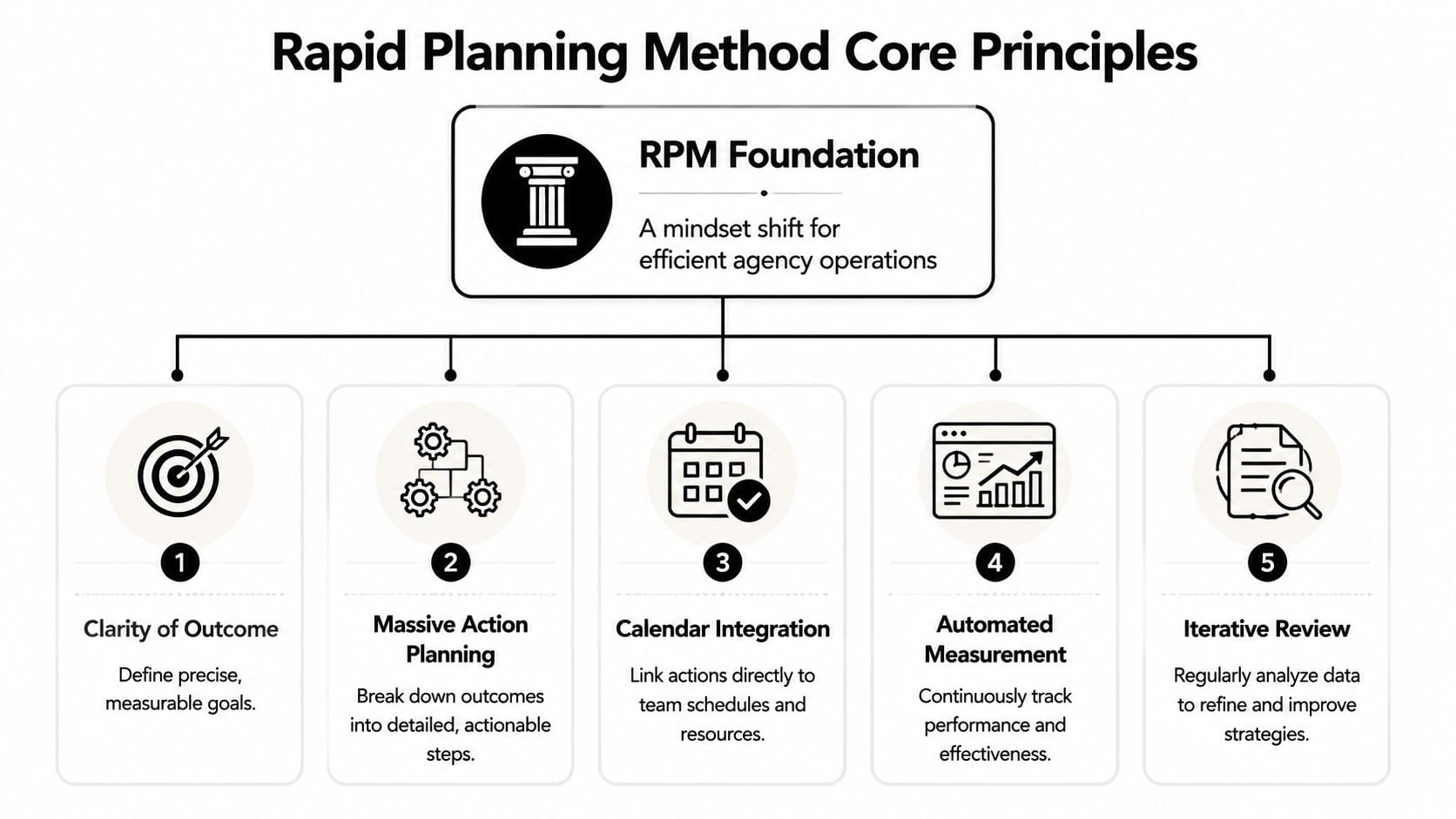
For an agency, the important shift is team-wide. RPM is often taught as a personal productivity tool. That is too narrow for delivery teams juggling retainers, project work, approvals, and utilization targets. The method gets real value when account leads, project managers, and specialists use the same planning language and push it into a shared system such as TimeTackle, where outcomes, time blocks, and actual execution can be compared.
Outcome first
Task language creates drift. Outcome language creates alignment.
“Finish landing page” sounds clear until design is waiting on copy, the client has not approved the offer, and paid media needs assets in a different format. The team stays busy, but nobody can say what done looks like. RPM fixes that by naming the end state first.
| Weak planning language | Better RPM language |
|---|---|
| Update campaign assets | Launch approved assets for client handoff |
| Prep weekly call | Resolve decision blockers before weekly call |
| Work on onboarding | Get the client to first live milestone |
That wording changes how a team works. People can challenge low-value activity faster, spot missing dependencies earlier, and decide what deserves protected time.
Purpose has to be operational
Purpose is not a motivational slogan on a slide. In an agency, purpose needs to explain why the outcome matters in business terms.
Use plain reasons:
- Client retention: This deliverable protects confidence on a high-value account.
- Margin control: Rework is eating hours, and this outcome reduces it.
- Team health: The change removes late-stage scrambling and weekend cleanup.
- Revenue timing: Hitting this milestone triggers the next invoice or expansion conversation.
If the owner cannot explain the reason in one sentence, the team will treat the work as optional the moment a louder request appears.
The MAP is a decision pool, not a promise
The Massive Action Plan, or MAP, is the working list of actions that could produce the result. It should be broader than the final schedule.
That distinction matters in agencies because plans change midweek. Client feedback arrives late. Legal blocks a claim. A developer finds a hidden dependency. A rigid task list breaks under that pressure. A MAP holds up better because the team can swap tactics without losing the intended result.
This is also where agency-wide RPM becomes practical instead of theoretical. The MAP lives at the planning layer. The calendar only gets the actions worth protecting. A weekly work plan that turns priorities into scheduled team time gives managers a clean handoff between those two layers.
Shared language matters more than perfect wording
Teams do not need poetic outcome statements. They need consistent ones.
I usually tell agency leaders to test every planned item with one quick check: can the team state the outcome, the reason, and the current best actions in under a minute? If not, it is still a loose intention. It is not ready for allocation, ownership, or measurement.
That is the core operating principle behind RPM at the agency level. One planning method. One shared vocabulary. One visible path from intended result to scheduled work to measured output.
How to run a time-boxed planning cadence
Most agencies don’t need longer planning meetings. They need tighter ones.
RPM works as a cycle, not a one-off workshop. It runs from weekly outcomes into daily execution, then back into review. Teams using structured RPM cycles with weekly outcome reviews and daily calendar blocking achieve 35 to 50% higher project delivery consistency than ad hoc planning, according to this RPM planning cadence reference.
The weekly outcome session
Keep this meeting short. Thirty minutes is enough if the prep is real.
The room should answer four questions:
- What outcomes matter this week: Limit the team to a short list of meaningful outcomes, not a giant project dump.
- What could block delivery: Surface dependencies, approvals, and client decisions early.
- Who owns each outcome: Shared work is fine, but one person still needs to own movement.
- What belongs on the calendar: Decide what work needs protected time, not just good intentions.
A weekly session falls apart when it turns into status theater. Don’t ask everyone to read updates aloud. Ask for decisions. Ask what changed. Ask what needs to be removed so the week stays realistic.
The daily huddle
The daily version is not another status meeting. It’s a calibration pass.
A good daily huddle takes about fifteen minutes and does two jobs:
- It checks whether yesterday’s work moved the current outcomes.
- It adjusts today’s calendar based on reality.
That second part matters most. Agency plans break when the team treats the original schedule as sacred. RPM is adaptive. If a client approval stalls, the team should shift to the next best action instead of pretending the old plan still fits.
This is where timeboxing becomes useful. Protected blocks force trade-offs into the open. You can’t say five priorities are urgent if the calendar only has room for two.
A simple cadence that works
Here’s a practical rhythm for a mid-sized agency team:
| Cadence | Focus | Output |
|---|---|---|
| Weekly planning | Choose team outcomes and owners | Outcome list with priorities |
| Daily huddle | Reconfirm actions and blockers | Updated calendar blocks |
| End-of-week check | Compare plan against execution | Kept, dropped, and deferred actions |
What doesn’t work is mixing planning with everything else. Don’t combine your weekly planning session with a full client delivery review, pipeline discussion, internal operations, and hiring updates. That’s how planning turns into noise.
The point of cadence is not to create more meetings. It’s to stop restarting the week every morning.
Teams that stick with this rhythm usually notice the same shift. Less scrambling, fewer duplicate updates, and better judgment about what should not get done.
Translating your plan into a shared action calendar
A MAP on its own is still theory. Agencies need to turn it into visible commitments.
That means the calendar becomes more than a meeting book. It becomes the operating layer where planned outcomes meet actual capacity.

Move from action list to calendar block
Once the team has chosen the highest-value actions, schedule them directly into Google Calendar or Outlook. Don’t leave important work in a project board while the calendar fills with meetings.
That means blocking time for things like:
- Client delivery work: Drafting, analysis, QA, build time
- Decision work: Review sessions that move a project forward
- Internal production support: Handoffs, approvals, dependency clearing
- Strategic work: Process cleanup, margin reviews, enablement work
This changes behavior fast because the team can see trade-offs. If client meetings consume most of the week, the missing delivery time becomes obvious. If senior people spend too much time in review loops, you can see it before the project slips.
Shared calendars expose hidden capacity issues
A project plan often looks possible until you map it onto real calendars. Then the cracks show.
One designer is booked on overlapping account work. An account lead has no thinking time between calls. The delivery manager is carrying too many coordination tasks that nobody named. The calendar reveals all of that without needing a long debate.
That’s why a shared calendaring system matters. If your agency still plans in one tool, schedules in another, and reports time in a third, people spend too much energy reconciling systems instead of doing the work. A guide to team calendaring is useful if you’re still treating calendars as personal rather than operational.
Where a calendar-based stack changes the game
This is also the point where a tool can remove a lot of manual admin. TimeTackle connects Google or Outlook calendars, applies tags and rules to activities, and turns calendar data into trackable work records. For an agency using RPM, that means the shared calendar can double as the source for time capture and analysis instead of relying on end-of-day timesheet memory.
That matters because a planning method only scales when the tracking burden stays low. If your team has to manually rebuild the week after the fact, the system won’t last.
What works is simple. Plan the outcome. Choose the best actions. Put those actions on the shared calendar. Then let the calendar create the record of execution.
Building your automated measurement engine
A shared calendar gives you visibility. It does not give you usable management data until every block of time can be tied back to an outcome, a client, and a type of work.
That is the point where agency RPM usually breaks. Teams plan well on Monday, then spend the rest of the week in meetings, Slack requests, revisions, and firefighting that all get recorded as generic time. At review time, leaders can see hours but cannot see whether those hours supported the right result.

Tag the work so the data means something
The tagging model needs to match how your agency operates. If it takes a training session to understand, people will ignore it or apply it inconsistently.
A practical structure usually includes:
- Client or internal initiative: who owns the budget or priority
- Project or workstream: the delivery lane
- Outcome tag: the RPM result the work is meant to move
- Work type: meeting, production, review, admin, sales support
That turns a vague calendar entry into something a manager can act on. “Client check-in” becomes “Client A, website relaunch, outcome approval on wireframes, decision review.” Now you can measure time against the plan your team committed to, not just against attendance.
For agencies with a sales team, include a pipeline tag as well. That makes it easier to connect pre-sale effort to conversion activity and compare delivery capacity with business development priorities. If your commercial team needs a better framework for that side of the process, this guide on how to boost sales through pipeline management is a useful companion.
Automate repeated classification
Manual tagging works for a founder and breaks for a 40-person agency.
Recurring account calls, standups, internal reviews, and sales meetings follow patterns. Use those patterns. TimeTackle can apply rules based on calendar title, attendee list, organizer, keywords, or project codes, so repeated work lands in the right category without asking staff to fill in a timesheet from memory later.
Start with the high-volume events first. That usually gets you the biggest gain with the least effort:
- recurring client meetings
- internal delivery rituals
- leadership and planning meetings
- sales pipeline and proposal reviews
- standard production blocks with project naming conventions
Accuracy matters, but consistency matters more at the start. A simple rule set that the team uses is better than a perfect taxonomy that collapses after two weeks.
Measure output support, not just time spent
The agency question is not whether people were busy. The question is whether their time supported the outcomes named in the plan.
Use your measurement engine to answer questions like these:
| Question | Why it matters |
|---|---|
| How much time went to each outcome? | Shows whether team effort matched stated priorities |
| Which outcomes pulled in unplanned work? | Exposes hidden scope, weak briefs, or client churn |
| Which work types dominate key accounts? | Shows whether teams are producing, reviewing, or coordinating too much |
| Where is admin growing week after week? | Identifies process drag that cuts into delivery time |
An agency-wide RPM system becomes measurable at scale. You are no longer asking each person to remember what happened. You are using the calendar, the tagging rules, and the automation layer to build a clean operational record across the whole team.
That record is what lets leadership make real trade-offs. Protect deep work on profitable accounts. Cut recurring meetings that do not move delivery. Spot when account management is absorbing work that should be scoped into project delivery. Reset priorities before the team burns another week on activity that looks full but produces little progress.
Running reviews that actually improve performance
The review is where RPM either becomes a management system or dies as a planning exercise.
A lot of agencies review work passively. They scan a dashboard, talk around the edges of a problem, and move on. That doesn’t improve anything. A useful review ends with a changed decision, a reset priority, or a removed task.

Use the Pareto lens in every review
RPM builds the Pareto Principle, the 80/20 rule, into the Massive Action Plan. Teams that review progress against metrics in weekly calls can keep refining toward the 20% of actions that yield 80% of the results, as described in this RPM planning article.
That matters because agencies rarely fail from lack of effort. They fail from effort spread too thin across low-return work.
In a weekly review, ask:
- Which actions moved the outcome most clearly
- Which actions consumed time without moving the result
- Which work should be removed, delegated, or reduced next week
- Which blocked decisions need leadership, not more team effort
That’s a stronger use of data than staring at utilization in isolation.
Review outcomes beside commercial reality
Agency operations can’t review delivery in a vacuum. If an account team spends heavily on work that doesn’t advance the project, margin gets squeezed even when everyone looks occupied.
That same discipline applies to revenue work. If your sales process has too much admin and too little movement, the team should review pipeline activity the same way it reviews client delivery. This guide on how to boost sales through pipeline management is useful because it frames pipeline work around stages and decision points rather than pure activity volume. That’s the same mental model RPM pushes into delivery.
What a good review sounds like
A weak review sounds like this: “We were busy, the client changed scope, and we’ll try to catch up next week.”
A strong review sounds like this:
We spent more time on coordination than output. Two approval steps created drag. Next week we’ll cut one review layer, protect build time on the calendar, and assign one owner to client decisions.
That’s what improvement looks like. Not more commentary. Better choices.
Common RPM pitfalls in agencies and how to avoid them
Monday starts with good intentions. By Thursday, the account lead is chasing approvals, the strategist is buried in Slack, the designer is logging hours after the fact, and nobody can say which work moved the client outcome. That is the point where RPM usually fails in agencies. The method was built for personal focus. Agency leaders need a version that survives shared ownership, client changes, and team scheduling.
There is minimal guidance on scaling RPM in team environments, especially around linking individual plans to company OKRs, shared accountability, and collaborative progress tracking, as noted in this discussion of RPM team gaps. Agencies feel that gap fast. A system that works for one person breaks down when ten people touch the same deliverable.
The failure points I see most often
- Outcomes sit too high: Leadership sets goals like “grow the account” or “improve retention,” but the team’s week still fills with disconnected tasks. Fix it by translating each goal into a weekly outcome a delivery team can own, such as “get client approval on revised landing page and launch test by Friday.”
- Shared ownership gets fuzzy: Multiple people contribute, so final responsibility disappears. Assign one owner per outcome, even if execution is shared across strategy, creative, and client service.
- Purpose is too abstract: “Improve client experience” is too vague to guide a packed afternoon. “Cut client revision rounds from three to two by tightening the brief before creative starts” gives the team a clear operating standard. One is a slogan. The other changes behavior.
- The old timesheet mindset wins: Teams still treat tracking as admin instead of feedback. Connect tracked time to planning decisions, staffing choices, and review changes so people see why the record matters.
A simple example makes the gap obvious. An abstract purpose says, “support a better onboarding experience.” An operational purpose says, “reduce first-week client questions by sending one approved kickoff summary within two hours of the meeting.” The second version tells the team what good looks like, who owns it, and what to schedule.
What actually helps adoption
RPM adoption works better when agencies treat it as an operating system, not a motivational workshop.
Start with one pod or one department. Keep the planning cadence fixed for a few weeks. Limit the number of active outcomes so the team has to choose. Then check whether the calendar, tracked activity, and review conversation all point to the same priorities. If they do not, the process is still theoretical.
Expect some pushback.
High performers often already have personal methods that help them stay organized. Keep those if they work. What the agency needs is a shared layer above them: common outcome definitions, visible scheduling, clear ownership, and a review process that turns observed time use into staffing and delivery decisions.
If the purpose of a project isn’t clear, don’t ask the team for a better plan. Ask leadership for a better decision.
If you want to move away from manual timesheets and run a calendar-based operating model, TimeTackle helps connect planned work, captured activity, and reporting in the same system. For agencies trying to make the rapid planning method work across teams, that link between calendars, categorization, and outcome tracking is what makes RPM scalable and measurable.