


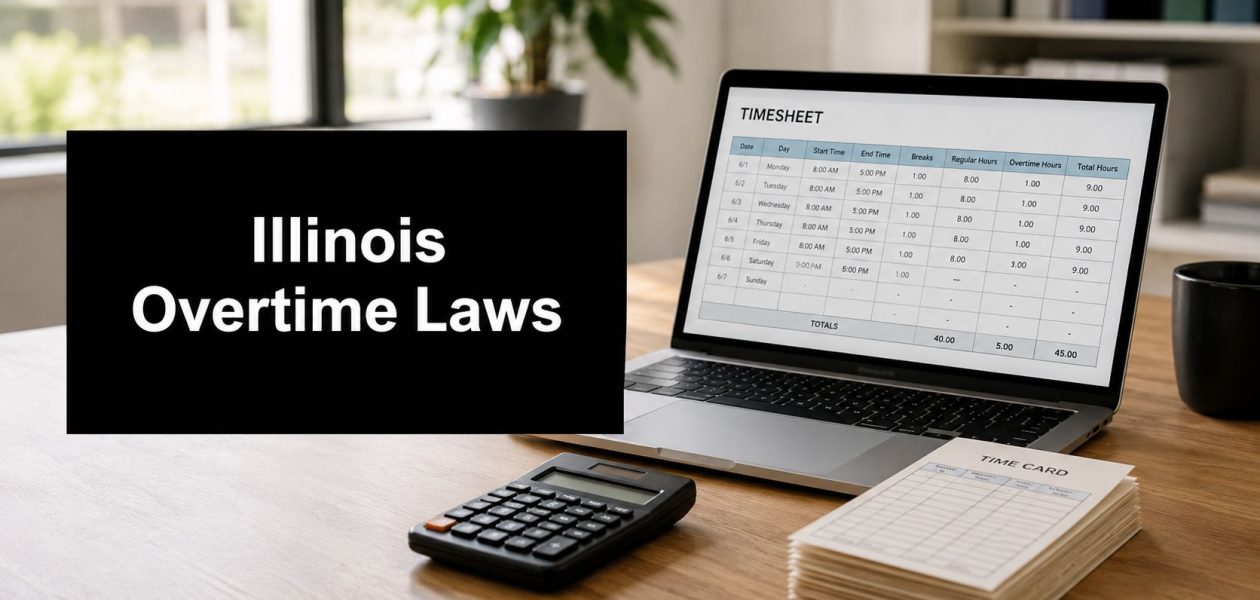
A client sends feedback late Friday. The launch still has to go live by Monday. Your account lead starts answering Slack messages at night, your designer reworks assets on Saturday, and your paid media team logs in Sunday to fix tracking before the campaign goes live.
That sequence is normal in agency life. The payroll risk hiding inside it is also normal.
Most agency owners don't get into trouble because they meant to short someone. They get into trouble because they run payroll based on job title, assumptions, or approval rules that don't match how overtime law works. A salaried employee gets treated as exempt because “that's a manager role.” A project bonus gets left out of the week's overtime math. A team lead tells people overtime wasn't approved, so payroll shouldn't count it. That's where small mistakes turn into expensive ones.
If you run a mid-sized agency in Illinois, overtime compliance isn't an admin box to check. It affects margins, staffing plans, weekend work, client pricing, and how much risk is present in your payroll process. Illinois overtime laws are pretty manageable once you build around the right trigger, classify roles carefully, and make timekeeping simple enough that people use it.
Why Last-Minute Projects Cost More Than You Think
A client asks for a weekend turnaround, and the account team says yes because the revenue matters. By Monday, the work is done, the client is happy, and the project looks like a win. Then payroll closes, managers start piecing together who worked when, and the margin on that job looks very different.

In a mid-sized agency, rush work rarely stays contained to one person. An account manager answers client messages after dinner. A project manager reshuffles deadlines and chases approvals. A designer logs in Saturday to revise assets. A media buyer makes platform changes from home so the campaign launches on time. If those employees are non-exempt, that time can create overtime exposure whether the work was scheduled or not.
What makes these situations expensive is not one dramatic payroll mistake. It is the operating pattern behind them. Agencies get into trouble when after-hours work is common, time entry happens late or inconsistently, and managers treat overtime approval as if it controls whether hours count. It does not. If the work was performed, the payment obligation is still on the employer.
The patterns I watch for in agency audits are usually predictable:
- After-hours tasks that never make it into payroll. Slack replies, quick edits, client calls, and platform checks often get treated as too small to record, even though they add up over a week.
- Titles that do too much work in the payroll process. “Manager,” “strategist,” or “lead” may sound exempt, but the legal question turns on actual duties and pay rules, not the title in the org chart.
- Approval rules that are stronger than the timekeeping system. A supervisor says overtime was not authorized, so the employee leaves it off the timesheet or payroll ignores it.
- Client service decisions with no labor check. Teams promise fast turnarounds before anyone asks whether the assigned staff can absorb the hours without pushing into overtime.
That last point affects pricing as much as compliance. A project that looked profitable at estimate can lose margin fast once extra hours, payroll corrections, manager review time, and client rework all hit the same week. Agency owners feel this most when they price tightly, rely on salaried staff to absorb overflow, and do not have a clean record of off-hours work.
A better response is operational, not rhetorical. Set a rule that all work time must be recorded, even if it was brief or not approved in advance. Use sample policy language that managers can apply consistently, such as: “All non-exempt employees must record all time worked, including after-hours calls, messages, edits, and remote logins. Working overtime without approval may lead to discipline, but all hours worked will be paid.” That protects the business on two fronts. It gives payroll a usable record, and it reduces the risk that a supervisor informally suppresses hours to save a budget.
Agencies that handle rush work well build the labor cost into the process. They decide who can approve extra hours, require same-week time entry, and train client-facing leaders to flag staffing pressure before a “quick favor” turns into a wage claim.
The 40-hour rule in Illinois explained
A client asks for a Friday night revision round, and your account team says yes. By Monday morning, the payroll question is not whether the work helped save the client relationship. It is whether the hours pushed a non-exempt employee over 40 in the agency's defined workweek.
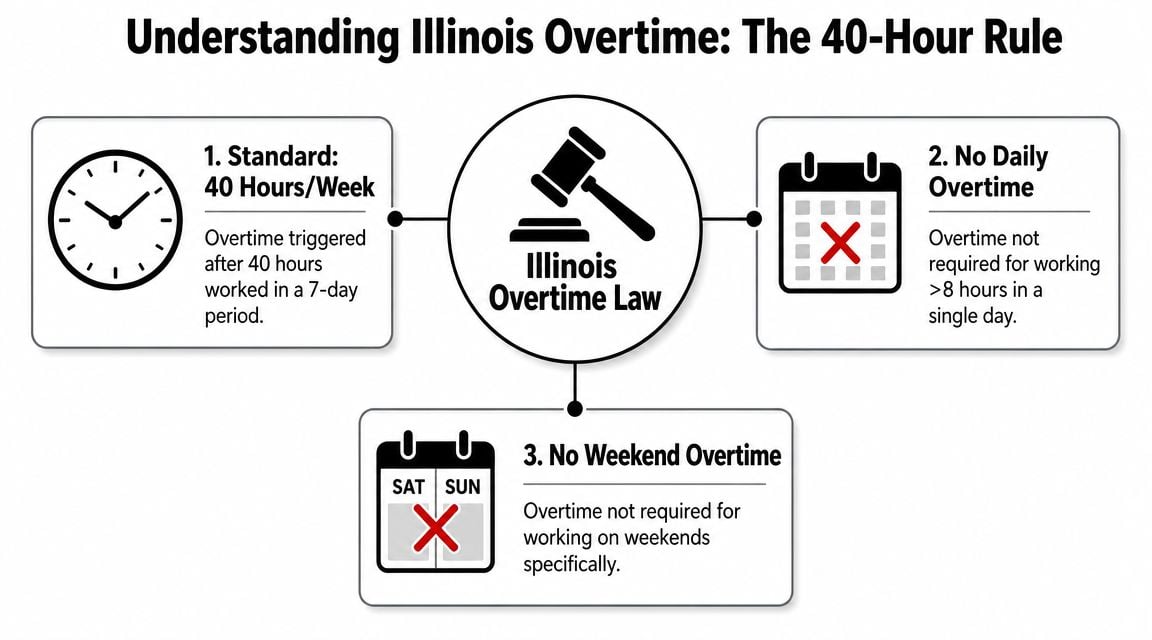
For most non-exempt employees in Illinois, overtime is triggered after 40 hours in a single workweek, and those overtime hours must be paid at 1.5 times the regular rate. The workweek must be a fixed period of 7 consecutive days that begins and ends on the same day each week, as summarized in Illinois wage and hour guidance.
For agencies, the practical mistake is treating overtime like a daily scheduling issue instead of a weekly counting issue.
Illinois generally does not require daily overtime for most workers. A late Tuesday does not create overtime by itself. Saturday production time, holiday monitoring, and after-hours Slack cleanup do not create overtime by label either. They matter because they add to the employee's total hours in that workweek.
That distinction affects staffing, pricing, and manager behavior. If your official workweek runs Monday through Sunday, a copywriter at 38 hours on Friday afternoon is a different staffing decision than that same copywriter at 31. Agencies that miss this point tend to approve client work first and sort out payroll later. That is where margin loss and wage risk start to overlap.
Use a simple control system:
- Set one official workweek. Monday through Sunday is common, but any fixed 7-day period can work.
- Match that workweek across payroll, timekeeping, and manager reports. If your PM tool shows one cycle and payroll closes on another, errors follow.
- Review weekly totals for non-exempt staff before weekend or after-hours assignments. A five-minute check can prevent an expensive approval chain on Monday.
- Require employees to record all work time. That includes home logins, client text responses, revision uploads, and internal fixes done after hours.
Here is sample handbook language I recommend for agencies: “The agency workweek begins Monday at 12:00 a.m. and ends Sunday at 11:59 p.m. Non-exempt employees must record all hours worked during that workweek, including remote work, after-hours communications, edits, uploads, and system access performed for business purposes.”
A few shortcuts create recurring problems:
- Counting only scheduled hours misses work that was performed.
- Swapping hours informally across weeks does not erase overtime if one workweek went over 40.
- Using billable time as a proxy for hours worked leaves out internal production, admin corrections, and client communication.
- Assuming salary solves the issue creates risk if the employee is still non-exempt.
I usually audit the workweek definition before I review anything else. If account leads approve rush work, employees enter time late, and payroll closes on a different cycle, the agency does not have a legal overtime process. It has three partial systems that disagree with each other.
One more practical point. If an employee is hurt while working extra time, wage-hour compliance and injury reporting can collide fast. Managers should know where to send people for important information for injured workers while keeping time records accurate for the hours already worked.
A clear workweek policy will not solve every overtime problem. It does give your managers a rule they can use in real time, and it gives payroll a clean starting point for calculations.
Exempt vs non-exempt employees in an agency
In this context, agencies make the most expensive assumptions.
A person can be salaried and still qualify for overtime. A person can have “manager” in the title and still be non-exempt. And a smart, experienced employee can still be misclassified if the day-to-day duties don't fit the exemption being used.
Illinois keeps overtime exemptions for categories such as executive, administrative, and professional employees under the Fair Labor Standards Act, as well as certain dealership, agricultural, radio or TV, commissioned, and institutional workers, as noted in the Illinois minimum wage and overtime FAQ. For agencies, the debate frequently centers on the executive, administrative, and professional buckets.
Agency titles are not the test
Here's the mistake I see most often. An owner maps exemptions to titles instead of duties.
A few examples:
| Agency role | Common assumption | Better compliance question |
|---|---|---|
| Account manager | “Exempt because they manage clients” | Do they mainly exercise the kind of independent judgment tied to the exemption, or do they mainly execute process and coordinate deliverables? |
| Project manager | “Exempt because they oversee work” | Are they truly directing the enterprise side of work, or are they scheduling, trafficking, updating timelines, and chasing approvals? |
| Graphic designer | “Exempt because the work is creative” | Does the role fit a professional exemption in a real way, or is it production-heavy work following set brand rules and client instructions? |
| Paid media specialist | “Exempt because it's strategic” | How much authority does the person actually have over budget, planning, and business decisions versus carrying out campaigns within preset rules? |
That analysis isn't always comfortable because agencies like clean org charts. Wage and hour law usually isn't that tidy.
What usually works better
You need a role-by-role review that uses actual job duties, not just offer-letter language. I'd look at:
- Decision authority. Does the employee make meaningful decisions, or mostly carry out established processes?
- Supervision reality. Do they supervise people in a way that matters for an exemption, or are they just the experienced person on the account?
- Production versus policy work. Many agencies call client delivery roles “administrative,” but a lot of them are really production and coordination jobs.
- How the role changed over time. A person may have started in a strategic role and drifted into hands-on execution as the agency grew.
If you can't explain the exemption in plain language using the employee's real week, you probably need a closer review.
There's another practical point here. Classification mistakes often travel with contractor mistakes. Agencies under deadline pressure sometimes mix employees, freelancers, and long-term “contractors” in ways that create risk on both fronts. For a plain-English outside read on that part of the issue, this piece on important information for injured workers is useful because it shows how worker status can affect legal rights beyond payroll.
Policy language you can actually use
A simple internal rule is better than a long policy nobody reads:
- Review every exempt role on a regular cadence. Especially after reorganizations.
- Don't classify by title alone. Require a duties review before marking a role exempt.
- Flag hybrid roles. Client-facing people who also produce work are often where mistakes sit.
- Train department heads. Creative, media, and client service leaders should know that compensation method and exemption status are not the same thing.
The trade-off is real. A broader non-exempt approach can mean more time tracking and more overtime cost in busy weeks. But that is still easier to manage than years of cleanup on a misclassified role.
How to calculate overtime pay correctly
Once you know the employee is eligible for overtime, the next issue is math. Agencies often oversimplify this aspect.
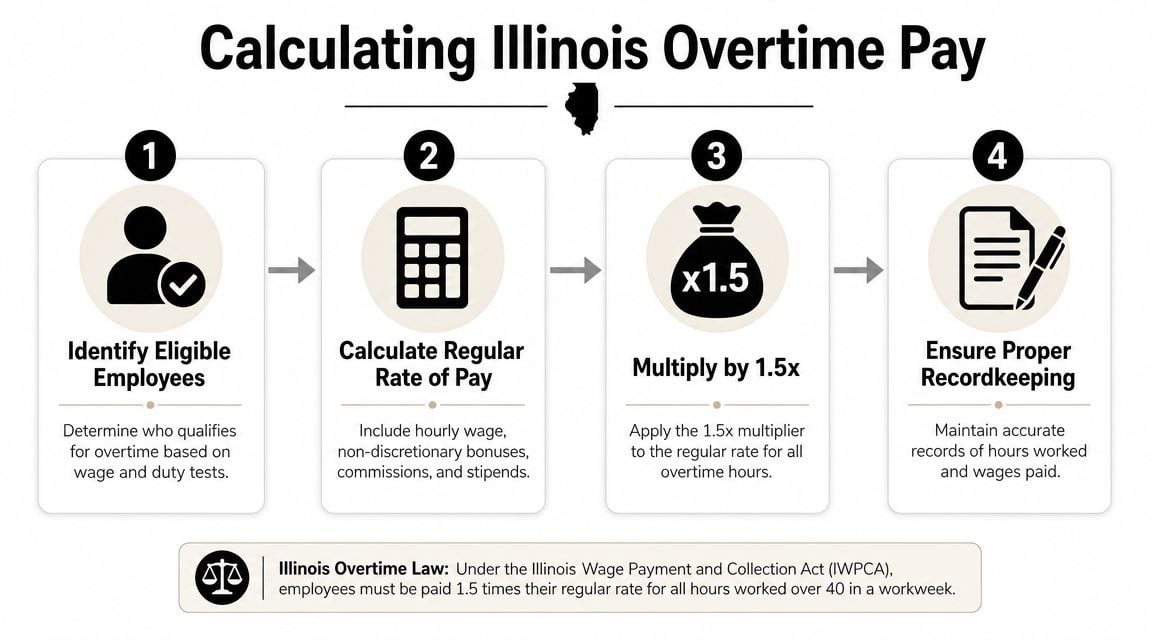
The easy version is an hourly employee with no extra forms of pay. The harder version is the one agencies deal with all the time. Shifted schedules, bonuses tied to client delivery, commissions, stipends, and non-exempt salaried roles. Those can affect the regular rate, which then affects overtime.
A simple hourly example
Start with the clean case. Suppose a non-exempt employee earns an hourly rate. If that employee works beyond the weekly limit, overtime pay is based on 1.5 times the regular rate for those overtime hours. That basic multiplier is part of the Illinois rule discussed earlier.
The key practical point is to count all hours worked in the workweek and then apply the correct overtime rate. Don't try to smooth hours across two weeks to make the numbers look cleaner. Payroll systems should calculate by the actual workweek.
A less simple agency example
Now take a salaried but non-exempt production lead who also receives a project-based bonus tied to campaign delivery. That bonus may affect the employee's regular rate for the week, which means payroll can't just divide the salary and stop there.
I'm keeping this qualitative here because the exact calculation depends on the structure of pay and the timing of that additional compensation. But the decision process should be consistent:
- Confirm overtime eligibility first. Don't jump into math until classification is right.
- Identify all pay that may affect the regular rate. Hourly wages are obvious. Bonuses, commissions, and stipends may need review too.
- Tie the compensation to the correct workweek. Agencies often pay extras later, while the overtime event happened earlier.
- Document the method used. If payroll changes a rule month to month, you create audit problems.
For agency teams that need cleaner reporting around how work time turns into payroll and profitability, this guide on calculating billable hours is helpful because it shows how to think about recorded time in a more disciplined way, even though billable time and overtime compliance are not the same thing.
Where payroll errors usually start
The bad calculation usually begins upstream. Time is incomplete. A manager approved part of the hours but not all of them. Payroll only saw billable entries and missed internal work. Or a bonus got treated as separate from overtime math because it came from a different report.
That's why agencies need bookkeeping and payroll teams talking to operations. This article with expert advice from Bookkeeping and Accounting makes the larger point well. Classification and payroll setup aren't side issues. They affect legal exposure and cost control at the same time.
Payroll rule: If your overtime calculation depends on manual detective work every pay period, the process is too fragile.
A practical workflow
Use a repeatable review path before payroll closes:
- First pass. Pull all non-exempt employees who crossed the weekly threshold.
- Second pass. Check whether the week included bonuses, commissions, or stipends that may affect the regular rate.
- Manager review. Ask one question, not ten: “Is there any work performed that is missing from the recorded hours?”
- Payroll signoff. Keep a written note on how irregular pay was handled.
This is less glamorous than client work, but it's the part that keeps one hard week from becoming a legal problem.
Illinois law vs federal FLSA
A Chicago account manager stays late all week to get a client launch out the door. Payroll runs from a national template built around federal defaults. The employee gets paid, but the Illinois rule that should have controlled was never applied. That kind of miss is common in multi-state agencies, and it usually starts with a bad assumption: if the FLSA is covered, the state details will sort themselves out.
In Illinois, that assumption can cost you. Illinois employers still work inside the federal framework, but if state law gives the employee a better outcome, the Illinois rule is the one to use. The clearest example is the wage floor. Beginning January 1, 2025, Illinois sets the minimum wage at $15.00 per hour, so the minimum overtime baseline is $22.50 per hour, according to the Illinois Department of Labor minimum wage and overtime FAQ.
For agency owners, the practical issue is consistency. A payroll process built for three or four states often handles taxes correctly but misses overtime settings, exemption reviews, or employee location changes after a remote hire.
Side-by-side comparison
Use this as a management check, not just a legal summary:
| Provision | Illinois law | Federal FLSA |
|---|---|---|
| Weekly overtime structure | Overtime generally applies to eligible non-exempt employees who work more than 40 hours in a workweek | Overtime generally applies to covered non-exempt employees who work more than 40 hours in a workweek |
| Minimum wage floor tied to overtime baseline | $15.00 per hour starting January 1, 2025, which sets a minimum overtime baseline of $22.50 per hour | Federal minimum wage is lower, so Illinois employers follow the higher Illinois standard where it is more favorable to the employee |
| Exemptions | Illinois uses exemption categories that largely track executive, administrative, and professional roles, but state-level review still matters in practice | The FLSA also recognizes exemption categories, subject to federal tests and requirements |
| Practical compliance approach | Apply the Illinois rule when it gives the employee greater protection | Federal law sets the baseline, but it does not replace stricter state requirements |
This comes up often with remote teams. If your creative director sits in Indiana and your paid media coordinators sit in Illinois, one handbook and one payroll workflow may still require different overtime treatment by state.
Multi-state agencies need one extra control
Set a state-law review step before payroll closes. For each Illinois employee, confirm three things: primary work location, exemption status, and whether the pay setup uses Illinois minimum wage and overtime rules. I recommend assigning that check to one owner on the HR or payroll side, because shared responsibility usually turns into no responsibility.
A short written rule helps. Sample policy language can be as simple as: “Employees will be paid overtime in accordance with applicable federal, state, and local law. Where state law provides greater employee protection, the agency will apply the state standard.”
That policy only works if your systems match it. If managers approve time in the project platform, HR maintains classifications in the HRIS, and payroll processes checks in a separate system, someone has to verify that the Illinois employee is coded correctly in all three places.
For related payroll confusion that agencies often mix together, review this guide on overtime and holiday pay rules for employers.
The trade-off is simple. A single national payroll rule is easier to administer. A state-specific control is safer, and in Illinois, safer is usually cheaper than fixing underpayment later.
Your agency's compliance system
A compliant agency doesn't rely on heroic managers or memory. It builds a system that makes the right action the easy action.
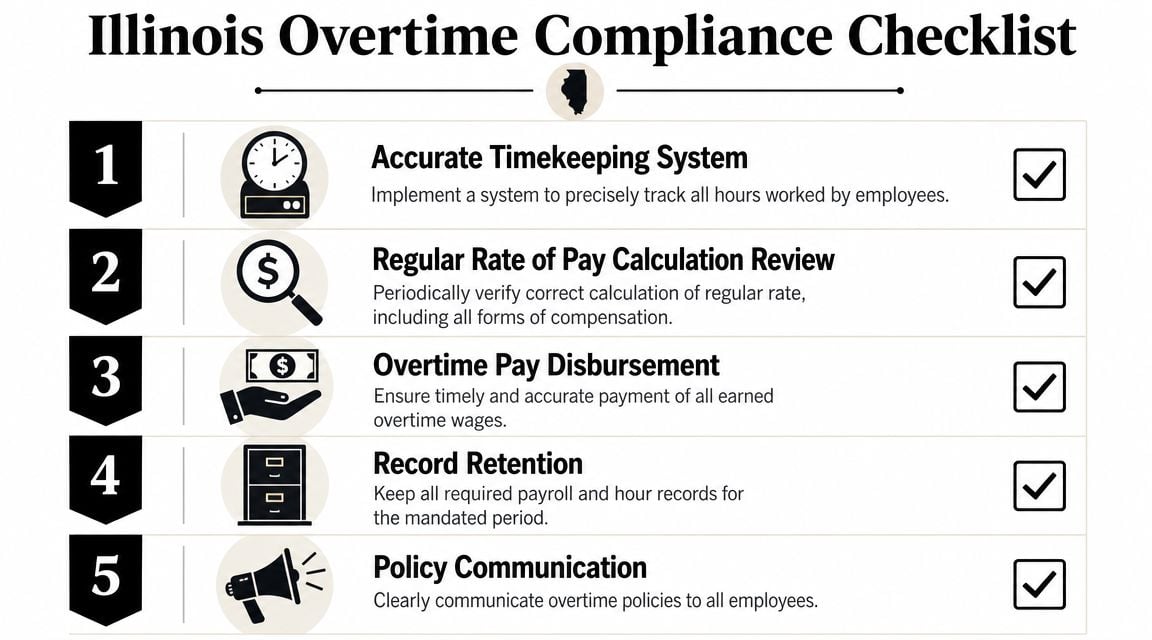
For most mid-sized agencies, that system needs four working parts. A clear workweek. Reliable time capture. A review process before payroll closes. Written policy language that managers can enforce.
The records that matter
If you want fewer overtime disputes, recordkeeping has to be boring and consistent. Track all hours worked for non-exempt staff, not just client-billable time. That includes internal meetings, revisions, admin work tied to client delivery, and after-hours tasks.
What works best is a setup where employees don't have to reconstruct their week from memory every Friday. When timekeeping is detached from the calendar, email, meetings, and project flow, people fill gaps poorly. That leads to under-reporting, manager guesswork, and bad payroll data.
If you're evaluating systems that reduce manual entry and make audit trails easier to review, look at time tracking software options for operational teams. The main thing you want is consistency. Fancy reporting is secondary.
Sample policy language for your handbook
Use plain wording. Legal-sounding policy often fails because managers and employees read it differently.
Employees must record all hours worked, including work performed outside normal schedules, from home, while traveling for agency business, or through after-hours communication related to client or internal projects.
Overtime for non-exempt employees requires advance manager approval. However, employees must report all overtime hours worked whether approved in advance or not, and the agency will pay for all hours worked as required by law.
Managers may address violations of scheduling or approval rules through performance management, but they may not ask employees to underreport or omit time worked.
Those three statements solve a lot of real agency problems. They separate pay obligations from conduct issues, which is exactly where many managers get confused.
A workable manager process
Don't over-engineer this. Give managers a short checklist:
- Before the week starts. Review likely workload spikes and move work where possible.
- Midweek. Check non-exempt staff who are trending high on hours.
- Before payroll closes. Confirm all work time is entered, including remote and after-hours tasks.
- After a busy week. Ask whether the overtime came from poor scoping, a staffing gap, or client-driven urgency.
The point isn't to eliminate overtime at all costs. Sometimes overtime is the right business choice. The point is to make it visible early, price around it when needed, and pay it correctly when it happens.
What happens when you get it wrong
When an agency mishandles overtime, the damage usually spreads in two directions at once. First, there's the direct wage issue. Then there's the trust issue with employees who start to wonder whether “everyone works late here” is really just unpaid labor by another name.
Problems also stack. A misclassified employee may have unpaid overtime exposure. Weak records make it harder to defend your position. Managers who discouraged reporting can turn a payroll mistake into a broader employee relations problem. Once lawyers or regulators get involved, the discussion isn't just about one rough week. It's about whether your system was built to comply at all.
The practical risk list
If your agency gets this wrong, you may face:
- Back-pay claims tied to unpaid overtime
- Interest and legal costs connected to the dispute
- Broader review of payroll practices once one issue surfaces
- Operational drag because leadership, HR, finance, and managers all get pulled into cleanup
- Client margin distortion because jobs looked profitable only when labor was undercounted
The cheapest time to fix overtime problems is before someone outside your agency starts asking for records.
A self-audit that's worth doing
You don't need a huge internal project to spot obvious problems. Pull a focused sample.
Start with non-exempt roles in departments that run hot. Compare calendar activity, messages, deliverables, and submitted time. Then review salaried roles that may have been treated as exempt based mostly on title. Finally, check whether your handbook says one thing while your managers do another.
Ask hard questions:
- Are people doing work after hours without recording it?
- Do project managers or account leads pressure staff to “keep the time clean” for client reasons?
- Are bonuses or extra pay items handled consistently in payroll review?
- Does anyone think unapproved overtime means unpaid overtime?
If the answer to any of those is yes, fix process first. Then clean up any pay issue quickly and document what changed.
Illinois overtime laws are manageable for agencies that stop treating payroll as an afterthought. The agencies that stay out of trouble don't have perfect weeks. They have clear classifications, complete time records, and managers who know that client urgency doesn't erase wage obligations.
If your agency is tired of chasing timesheets, rebuilding weeks from memory, and trying to reconcile calendars with payroll risk, TimeTackle is worth a look. It helps teams capture work from the calendar, organize time with less manual effort, and give operations leaders a clearer view of where hours go, which makes overtime review, staffing decisions, and reporting much easier to manage.