


The payroll run looks simple until it doesn’t.
A project manager stayed online late all week to get a client launch out the door. One employee worked a long holiday shift. Another took the holiday off but still shows a full week of paid time. Your agency has people in California, Colorado, and Florida, and payroll is due now. Someone on the team asks a fair question: “Do we owe overtime on top of holiday pay?”
That’s where agency operators get stuck. Not because the idea is hard, but because the rules split in ways that don’t match how work happens. Calendars show meetings, after-hours edits, client calls, and holiday coverage. Payroll systems want clean categories. State law adds another layer. If your tracking is loose, the same week can look compliant to one manager and wrong to another.
For a multi-state agency, overtime and holiday pay is less a payroll topic than an operating system problem. If hours enter the process late, by memory, or through inconsistent manager approval, you’ll either overpay, underpay, or spend too much time checking work you should already trust.
The year-end payroll headache you know too well
At the end of the year, payroll errors rarely start in payroll.
They start with a messy week. A client pushes a deliverable into a holiday. A team lead approves extra hours in Slack but forgets to note them in the timesheet. Someone logs “holiday” on one line and “client work” on another, but the calendar shows ten hours of meetings and production work on the same day.

The problem gets worse when your agency has people in more than one state. The same holiday week can trigger different pay outcomes depending on where the employee works, what your written policy says, and whether the holiday hours count as worked time or paid time off. If your team closes the books with spreadsheets and manager memory, you’re asking payroll to fix an operations problem after the fact.
What the bad week usually looks like
A familiar pattern shows up in agencies that are growing fast:
- The schedule changed midweek. A holiday was planned as time off, then a client emergency pulled someone back in.
- Managers approved work informally. The approval exists, but it lives in email, chat, or a meeting note.
- Payroll got mixed labels. “Holiday worked,” “holiday off,” and “overtime” get used like they mean the same thing, when they don’t.
- State rules got ignored. The team used a federal default even though one employee’s state has stricter rules.
Payroll mistakes usually come from classification mistakes. If the hour is tagged wrong, the math will be wrong too.
Agency owners often try to solve this with more review. That helps a little, but it doesn’t fix the source problem. Review is still manual, still late, and still dependent on whoever remembers the context of that week.
The clear difference between overtime and holiday pay
Most payroll confusion starts with one bad assumption: that holiday pay and overtime are interchangeable. They aren’t.
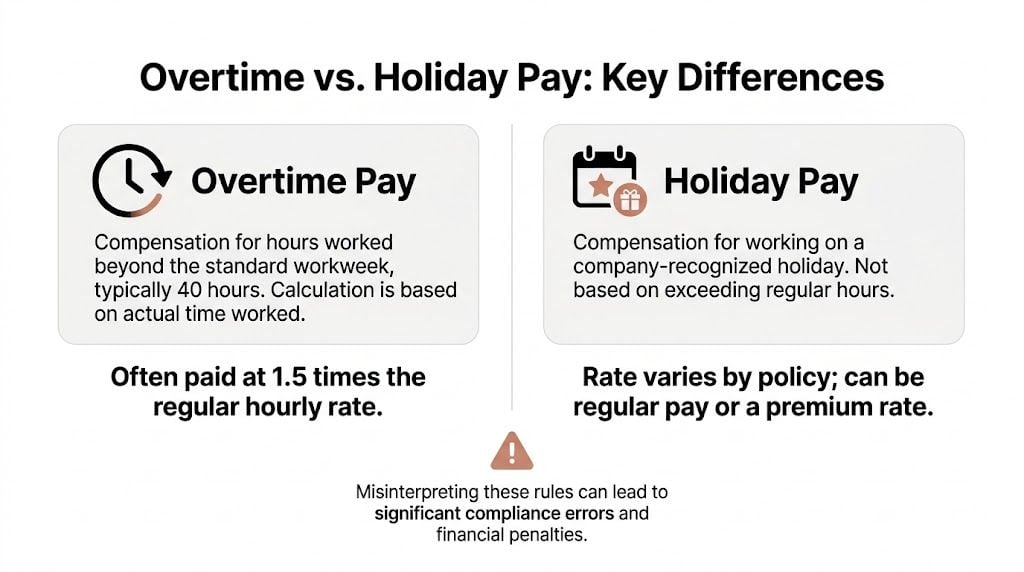
Overtime pay is a legal pay concept tied to hours worked. Holiday pay is usually a policy choice tied to a calendar date your company recognizes. Sometimes the same shift touches both. That doesn’t make them the same kind of pay.
What overtime is
Overtime is the extra pay due when a non-exempt employee crosses the legal threshold for overtime under the rule that applies to them. Under federal law, that threshold is tied to hours worked in the workweek. The reason this matters is simple. The law cares about work performed, not just pay issued.
If someone works beyond the threshold, payroll has to calculate overtime correctly. This is not optional, and it doesn’t depend on whether the day felt special, was busy, or fell on a holiday.
What holiday pay is
Holiday pay is different. A company may choose to offer paid holidays, premium pay for holiday work, or both. That decision usually lives in the handbook, offer letter, union agreement, or payroll policy.
A few agencies pay regular wages for a holiday shift. Others pay a premium rate. Some give paid time off if the employee doesn’t work, but a different premium if they do. All of that is policy design, unless a state rule says otherwise.
Why agencies mix them up
The confusion comes from the same week showing both concepts at once.
An employee might:
- take a paid holiday off and still receive pay for the day
- work on a holiday and receive a premium under company policy
- work enough total hours in the week to trigger overtime
- do all of the above in one payroll period
That’s why the right question is never “Was it a holiday?” The right questions are:
- Did the employee actually work those hours?
- Did those worked hours cross an overtime threshold?
- Does company policy add a separate holiday premium?
- Does state law change the regular calculation?
Practical rule: Treat holiday status, worked status, and overtime status as separate fields. When teams mash them into one code, payroll has to guess.
What works is a clean structure. One field tells you whether the day is a recognized holiday. Another tells you whether the employee worked. A third handles the pay rule that follows. What doesn’t work is one catch-all label like “holiday OT,” because it hides the exact reason the pay is changing.
Understanding the federal baseline with the FLSA
Every agency needs one baseline rule before it deals with state variation. In the U.S., that baseline is the Fair Labor Standards Act, or FLSA.
Under the FLSA, non-exempt employees must receive overtime pay of at least 1.5 times their regular hourly rate for hours worked beyond 40 in a workweek, and paid holiday time that wasn’t worked does not count toward that overtime threshold, as explained in the U.S. Department of Labor’s FLSA overtime fact sheet. That federal rule is the floor your payroll process has to meet.
Hours worked is the phrase that matters
The phrase agencies need to keep front and center is hours worked.
If an employee receives paid holiday time off, those paid hours may affect gross pay for the week, but they don’t automatically count toward overtime under the federal rule. That distinction is where many payroll mistakes start. Someone sees more than forty compensated hours and assumes overtime is due. Under the FLSA, that’s not how the basic calculation works.
Here’s the clean federal view:
- Worked hours count.
- Paid but unworked holiday hours don’t count toward the overtime trigger.
- Working on a holiday doesn’t automatically create overtime by itself.
What federal law does not require
This part surprises agency owners all the time. Federal law does not require private employers to offer paid holidays. It also does not require a holiday premium just because someone worked on a holiday.
That means your agency can decide whether holiday work pays at regular rate, a premium rate, or some other policy rate, unless state law changes the rule. The legal obligation under the FLSA is overtime for worked hours over the threshold. Holiday treatment is a separate issue.
Why this matters in operations
If you don’t separate legal minimums from company policy, you can’t audit your payroll process clearly.
For example, your team may decide to be generous and pay a holiday premium. That’s fine. But payroll still has to know whether the premium is:
- a company benefit
- a legal overtime payment
- a payment that may affect the regular rate under a state-specific rule
That’s why the workweek definition matters too. Your agency should define one fixed seven-day workweek and stick to it. Managers often think in calendar weeks or project cycles. Payroll can’t. It needs one recurring frame for every overtime decision.
If your managers can’t answer “What is our official workweek?” without checking, your payroll policy is too loose.
What works is boring and clear. A fixed workweek. A clean distinction between worked and paid-not-worked time. A rule that managers use before the holiday week arrives, not after someone asks why their check looks off.
Navigating the maze of state-specific pay rules
Federal law gives you a starting point. Multi-state agencies don’t get to stop there.
Once employees work across state lines, your payroll process has to handle the stricter rule that applies to the employee’s situation, leading manual systems to break, because the same kind of holiday shift can produce a different pay result depending on the state.

California is the classic trap
California forces agencies to think beyond the weekly view. Daily overtime rules can apply, so a long holiday shift can create overtime even if the employee never crosses the weekly total that would matter under the federal baseline.
That matters in agency life because work doesn’t spread neatly. Production crunches, travel days, live events, and launch weeks create spikes. A ten-hour holiday shift isn’t rare in some service teams. If payroll only checks the weekly total, it can miss a state-triggered premium.
Colorado shows why holiday incentives get tricky
Colorado adds a different kind of complexity. The Colorado Supreme Court ruling in Hamilton v. Amazon.com Services LLC requires inclusion of holiday incentive pay in the regular rate for overtime, which differs from the federal approach and creates confusion for multi-state employers, as discussed in this analysis of holiday pay and overtime premiums.
For operators, the problem isn’t just legal theory. It’s process design. If your payroll team treats every holiday premium the same way across states, you can end up with the wrong overtime rate in Colorado even when the hours look ordinary.
The operating risk for agencies
Most agencies don’t fail because they ignore rules on purpose. They fail because they use one default setup for everyone.
That breaks in a few predictable ways:
- One handbook, many realities. The policy sounds clean at the company level, but the payroll math underneath varies by state.
- One earnings code, too many meanings. “Holiday premium” may need different treatment depending on where the employee works.
- One manager approval flow. A manager can approve extra work, but the system still needs to classify it under the right state rule.
- One audit trail, missing context. If a holiday shift was moved, split, or worked remotely, payroll needs proof of who worked, when, and where.
If you manage teams in states with stricter wage rules, you also need to think beyond the overtime issue itself. Public contract work and local reporting can add another compliance layer, which is why practical references like Florida's certified payroll reporting requirements are useful for finance and operations teams that already juggle multiple labor reporting obligations.
For agencies with distributed teams, state-specific tracking can’t live only in payroll. It needs to start earlier, when hours are captured and reviewed. If you have staff in Arizona too, a state-focused guide to overtime laws in Arizona helps operators map local rules before they become payroll exceptions.
The bigger your remote footprint gets, the less you can rely on “our payroll provider will catch it.” Providers process what you send them. They don’t fix bad time data.
What works is a rule set that starts with employee location, then applies the right pay logic from there. What doesn’t work is asking payroll to sort state law from a flat CSV export at the end of the week.
How miscalculations happen with real-world examples
Most errors don’t come from complicated formulas. They come from ordinary weeks that get coded the wrong way.
Here’s a simple set of examples using a $20 per hour base rate. The point isn’t to turn you into payroll software. The point is to show how small classification mistakes turn into wrong pay.
Example one, paid holiday off with no overtime
An employee works 40 hours in the week and also receives 8 hours of paid holiday time off.
A lot of managers will say, “That’s 48 paid hours, so overtime applies.” Under the FLSA, that is wrong. Overtime is based on hours worked over 40. If the employee worked 40 and the extra 8 were holiday pay for time not worked, no overtime is owed under the federal rule. J.J. Keller gives this exact kind of distinction in its discussion of holidays and overtime confusion.
Example two, a worked holiday can still be ordinary time
Suppose the employee works 8 hours Monday through Friday, and one of those days is a holiday your agency chose to keep open. Your policy pays a holiday premium, but the employee still worked only 40 total hours for the week.
In that case, the holiday work may earn premium pay because of your policy, but it doesn’t automatically earn overtime under the federal rule. Because of this, agencies overpay by stacking premiums without checking whether the law requires both.
Example three, overtime triggered by actual hours worked
Now take a week where the employee works 45 hours total, including hours on a holiday. At a $20 base rate, overtime must be paid at at least $30 per hour for the 5 worked hours over 40 under the federal baseline.
If your holiday policy also pays premium rates, payroll has to determine whether that premium is separate from the overtime obligation or whether it already covers part of it under the applicable rule. It is at this point that hand-built spreadsheets begin to fail.
A shift can be “holiday worked” and “overtime” at the same time, but those labels answer different questions.
Example four, the premium may already satisfy part of the overtime duty
J.J. Keller gives a useful benchmark scenario. If an employee works 41 hours, including 9 hours on a holiday paid at 1.5x, the holiday premium often satisfies the FLSA overtime obligation for the single hour over 40. The employee has already received premium pay that meets the federal minimum for that overtime hour.
That doesn’t mean “holiday premium always replaces overtime.” It means payroll has to look at the exact pay structure before stacking more pay on top.
Sample overtime calculation for a holiday week
| Day | Hours Worked | Pay Rate | Daily Earnings |
|---|---|---|---|
| Monday | 8 | $20/hour | $160 |
| Tuesday | 8 | $20/hour | $160 |
| Wednesday | 8 | $20/hour | $160 |
| Thursday | 8 | $20/hour | $160 |
| Holiday worked | 9 | $30/hour (1.5x) | $270 |
This table shows the kind of week that causes confusion. Managers see the holiday premium and assume overtime still needs a second add-on. Sometimes yes, sometimes no. The answer depends on how the premium interacts with overtime under the rule that applies.
Where the math usually breaks
The common failure points are operational, not theoretical:
- Paid leave got counted as worked time. That creates overtime where none is legally due.
- Holiday premium got treated as a legal overtime payment in every case. That can underpay employees when the premium doesn’t fully satisfy the overtime rule.
- State rule changes got ignored. Federal logic got applied where state law required a different result.
- Managers edited totals, not source entries. The payroll number looked fixed, but the audit trail stayed broken.
If your team still calculates premium scenarios by hand, it helps to use a dedicated reference for double time calculation so managers stop guessing when a long day crosses into a higher pay tier under state law or company policy.
The lesson from these examples is simple. You can’t solve overtime and holiday pay from the paycheck backward. You have to start with clean source data, clear categories, and a rule set that matches where the employee works.
Building a compliant and clear payroll policy
A good payroll policy does two jobs at once. It protects the business, and it lowers day-to-day friction for managers and employees.
Most agency handbooks fail here because they stay at the level of intent. They say the company pays overtime when required and offers paid holidays. That sounds fine until a team lead asks whether a holiday shift should be coded as overtime, premium pay, both, or neither.
What your policy needs to say plainly
Your written policy should answer the questions people ask during a busy week.
Include these items in plain language:
- Define the workweek. State the exact start and end of your recurring seven-day workweek. Payroll can’t make consistent overtime decisions without this.
- List recognized holidays. Employees should know which dates are company holidays and how observed dates work if the holiday falls on a weekend.
- State the holiday work rule. If employees work on a company holiday, spell out whether they receive regular pay, premium pay, another day off, or some mix allowed by law and policy.
- State the overtime rule. Say that non-exempt employees receive overtime according to applicable federal and state law, and that overtime needs manager approval even when approved overtime must still be paid.
- Set recordkeeping expectations. Employees should know when to log time, how to tag holiday work, and what managers must review before payroll closes.
A policy should remove judgment calls, not create them.
Policy language should match how work happens
Agency work is messy by nature. Calendars shift. Client requests arrive late. Teams jump between internal work, billable project work, and support coverage. So your policy has to fit real operations.
What works is concrete language tied to actual workflows. What doesn’t work is a generic handbook paragraph copied from a template. If your team uses observed holidays, remote work, after-hours client support, or project-based staffing, the policy should deal with those cases directly.
And if you operate outside the U.S. or manage global teams, compare your approach with local guidance rather than assuming one payroll idea travels well. For example, teams reviewing cross-border leave and premium pay issues may find UK Paid Holiday Overtime useful as a separate framework, because the treatment differs from U.S. practice.
A written policy won’t solve every edge case. It will stop the repeat arguments, which is what most agencies need first.
How automation eliminates timesheet fatigue and errors
Manual payroll review breaks first during holiday periods, because that’s when work patterns stop looking routine.
During the 2024 U.S. holiday season, hourly workers averaged 32.5 overtime hours, and 14.7% worked on Thanksgiving Day, while workers in New Jersey averaged 44.0 overtime hours, according to Homebase’s holiday work report. When workload spikes like that, asking managers and employees to remember what counted as holiday work, overtime, paid leave, or exception time is a bad system.
Automation fixes the source data problem
The primary value of automation isn’t faster arithmetic. Payroll software already does arithmetic well enough. The hard part is getting trustworthy inputs.
A calendar-based tracking setup helps because it captures work from the systems people already use. Meetings, work blocks, client calls, and internal reviews show up with timestamps. Then the system can apply rules before payroll has to interpret the week by hand.
That matters a lot for agencies with distributed teams because the workflow can classify time more consistently than a manager trying to remember what happened after a long week.
What good automation should do
For overtime and holiday pay, the useful features are practical:
- Separate worked time from paid time off. The system should distinguish holiday leave from hours worked.
- Apply location-aware rules. Employees in different states may need different overtime logic.
- Tag holiday work automatically. If someone works on a recognized holiday, the system should mark it without waiting for manual entry.
- Create an audit trail. Payroll and operations should be able to see who changed what, when, and why.
- Give managers exception views. They need a short list of entries to approve, not a giant sheet to decipher.
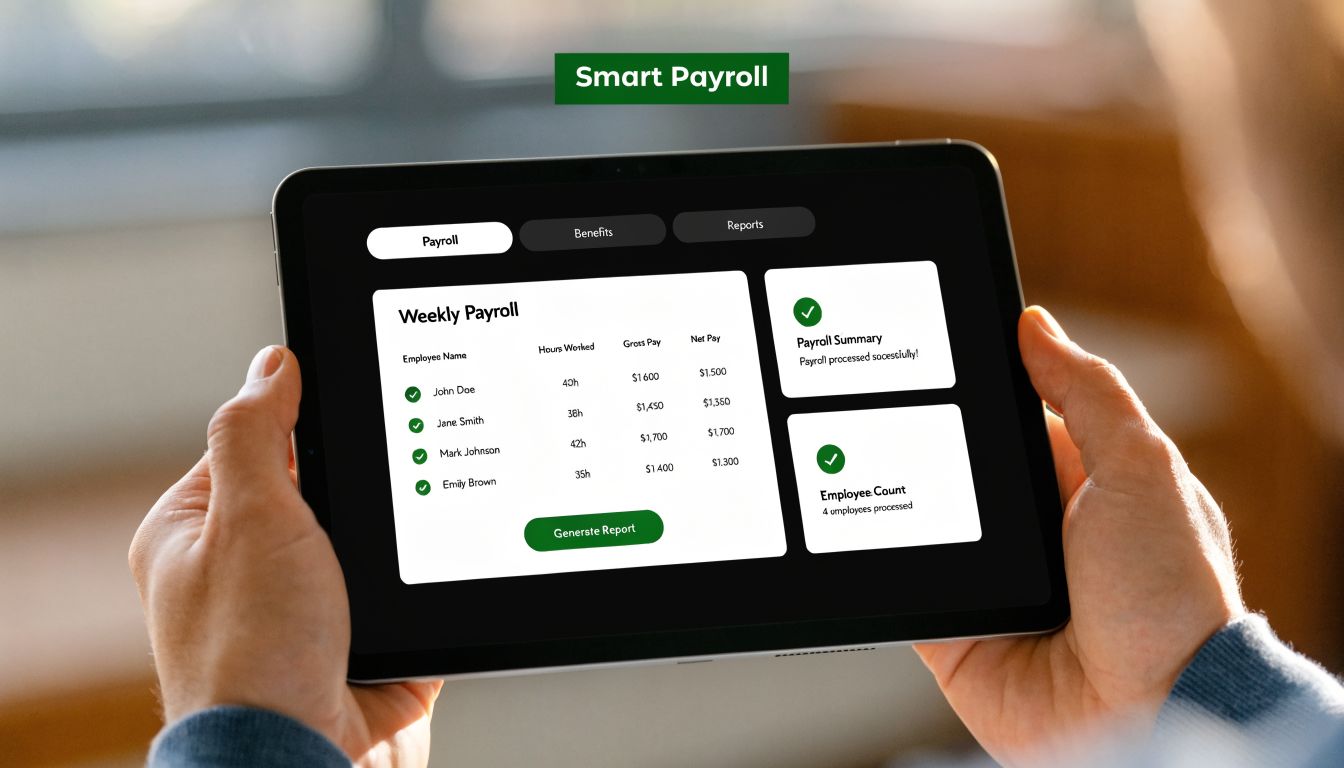
One option agencies use for this is automated timesheet software for agencies. TimeTackle connects calendars and other systems so teams can capture activities, tag time by rule, and review exceptions before payroll turns messy source data into messy pay decisions.
What does not work
What fails most often is the middle ground. Not fully manual, not fully automated. A spreadsheet fed by partial exports from calendars, chat, and project tools still leaves someone to translate reality into payroll codes at the end of the week.
The goal is not to give payroll more data. The goal is to give payroll cleaner decisions.
If your managers still chase employees for missing entries after a holiday week, you don’t have a timekeeping process. You have a repair process. Agencies grow out of that faster than they expect.
Frequently asked questions about pay rules
Can a private agency offer comp time instead of overtime pay
Usually no, not for non-exempt employees in the private sector. If overtime pay is due, the agency generally has to pay it. Swapping it for future time off is not a clean substitute under the usual private employer rule.
What if a paid holiday falls on a weekend
Your policy should say which weekday you observe. Agencies often observe the closest weekday, but the main issue is consistency. If the rule lives only in manager habit, payroll disputes are almost guaranteed.
Does travel time count toward overtime
Sometimes. Ordinary commuting usually doesn’t count the same way as travel that happens during the workday or for a special assignment. The right answer depends on the facts, so agencies should avoid broad assumptions and review travel rules with counsel or payroll specialists when the pattern is frequent.
Do bonuses affect overtime calculations
Some do. Non-discretionary bonuses can affect the regular rate calculation, while discretionary bonuses are treated differently. If a bonus is promised in advance or tied to defined performance criteria, treat it carefully and review it before payroll runs.
Should managers approve overtime in advance if it must be paid anyway
Yes. Pre-approval helps control cost and staffing, even though approved or unapproved overtime that was worked may still have to be paid under the law. The approval rule is a management tool, not a way around pay obligations.
If your agency is tired of fixing holiday-week payroll by hand, TimeTackle is worth a look. It helps teams capture work from the calendar, tag hours with rules, and review exceptions before they become payroll errors, which is exactly where multi-state agencies need more control.