



A client launch slips by two days. Your paid media team stays late. An account manager answers messages over the weekend. A junior strategist on salary jumps into revisions because nobody else is free. Monday morning, payroll has a simple question that turns into a legal one. Which of those hours count, who gets overtime, and how do you prove the math if someone challenges it later?
That's where a lot of Virginia agencies get into trouble.
Project work doesn't move in clean blocks. People switch between clients, internal meetings, revisions, travel, pitch prep, and after-hours cleanup. If your system for tracking time is “everyone generally knows what they worked,” you don't really have a system. You have exposure. And under Virginia overtime laws, that exposure can remain unseen until a former employee, lawyer, or wage claim brings it into focus.
Why Virginia overtime is a bigger risk than you think
The agency version of overtime problems usually starts with good intentions.
A team gets slammed. Leadership says, “We'll sort it out later.” Managers approve extra effort because the client matters. Then the week closes, and someone has to decide whether the extra hours belong on a timesheet, whether a salaried employee was non-exempt, and whether all of that work was captured at all.
For agencies, the risk is higher because the work itself is uneven. A manufacturing line has stable shifts. An agency doesn't. One team has a calm week while another team works nights on a website launch, a pitch, or a scope overrun that nobody priced well. The people most likely to miss overtime are often the same people leadership trusts the most, because they step in without being asked twice.
“If you can't reconstruct the week from records, calendars, and payroll data, you're already in a weak position.”
I've seen the same pattern over and over. Owners assume overtime risk only applies to junior hourly staff. It doesn't. The harder problems usually sit in the middle of the org chart. Coordinators, specialists, production staff, and some salaried employees may still be non-exempt. Once those people work variable project hours, bad assumptions spread fast.
What doesn't work is guessing. It also doesn't work to rely on job titles, broad salary labels, or manager memory. “Manager” on an org chart doesn't settle exemption status. “They never complained” doesn't settle whether hours were worked. “We didn't approve it” doesn't erase overtime if the work happened and the company knew or should have known.
For Virginia agencies, that means compliance is less about legal theory and more about operating discipline. You need clean classifications, reliable weekly hour totals, and records that hold up after the project stress is gone.
The foundation of Virginia's overtime rules
A common agency mistake starts like this. A project runs long, the team absorbs the extra hours, and payroll closes the week using partial timesheets because everyone is already on to the next client fire.

Virginia overtime law is simple at the rule level. A non-exempt employee who works more than 40 hours in a workweek must receive overtime pay at 1.5 times the regular rate. Where agencies get into trouble is not the headline rule. It is the weekly recordkeeping, classification, and pay calculation behind it.
The workweek controls the analysis
Overtime is measured by a fixed workweek, not by the day and not by the project.
That matters for Virginia agencies because labor does not show up in neat blocks. A content lead may work late on Monday and Tuesday for a launch, leave early Wednesday, then spend part of Saturday revising copy after client comments. Payroll has to total all compensable hours in that defined seven-day workweek. If the employee is non-exempt and the total passes 40, overtime is due.
This is also why manager approval is not the deciding factor. Unauthorized time can still be payable if the company knew or should have known the work was being done.
The regular rate requires more than an hourly number
Agency owners often assume overtime is easy if they know the employee's base rate. Sometimes it is. Sometimes it is not.
The harder cases involve salaried non-exempt staff, shift differentials, project-based incentives, or other non-overtime wages paid in the same week. In those situations, overtime turns on the employee's regular rate for that week, and that calculation can change with the pay mix. If your payroll team cannot show how the regular rate was built from the week's actual earnings and hours, the process is exposed.
I see this problem often in agencies that still patch together time and payroll data by hand. A timesheet Excel formula guide shows how quickly manual hour math becomes error-prone once schedules stop looking predictable.
Hours worked means time the business accepts or permits
For compliance purposes, the safer question is practical. Was the employee doing work for the agency?
That can include after-hours Slack follow-up, pre-meeting prep, client revisions from home, or weekend cleanup on a deliverable. Remote work makes this harder to spot, not easier to ignore. If account managers, producers, or coordinators regularly finish tasks outside posted hours, those minutes need to make it into the weekly total.
Accurate time capture is what protects the business here. Agencies with variable project hours need a system that records work as it happens, ties it to the correct week, and gives payroll a clean record before wages are processed. The same discipline you use to calculate instructor pay correctly applies here. Pay accuracy depends on complete inputs, not assumptions made after the week is over.
Calculating overtime pay correctly with examples
Common errors stem from these scenarios. The law sounds simple, but payroll errors happen when employers apply the wrong regular rate or assume salary means exempt.
Example one, hourly non-exempt employee
Say you have a paid media coordinator who earns $20 per hour and works 45 hours in one workweek.
The calculation is:
- Regular pay for the first 40 hours = 40 × $20 = $800
- Overtime rate = $20 × 1.5 = $30
- Overtime pay for 5 hours = 5 × $30 = $150
- Total gross pay for the week = $950
That's the easy version, and it's the version most owners think of when they hear “overtime.”
Where it breaks down is when the timesheet is incomplete. If the employee logged 42 hours, but Slack messages, calendar entries, and client edits show several more hours worked, your payroll record may not match reality. If you still use spreadsheets, this guide to a timesheet Excel formula shows why manual calculations often turn into cleanup work.
Example two, salaried but non-exempt employee
Now take a junior strategist who receives a weekly salary of $1,000 but is non-exempt. In a given week, that employee works 45 hours.
Under the Virginia statute's regular-rate framework, you look at non-overtime wages for the week and divide by total hours worked, subject to the exclusions recognized under the FLSA. In this example, if the weekly salary is the non-overtime wage for the week, the regular rate would be:
- $1,000 ÷ 45 hours = regular rate for that week
Then the overtime premium applies to the overtime hours based on that regular rate.
The point here is not to memorize one shortcut. The point is to avoid a common agency mistake. Paying someone on salary does not automatically remove overtime obligations. If the person is non-exempt, you still owe overtime.
Here's the practical way to consider it:
| Situation | What payroll should ask |
|---|---|
| Hourly employee worked late on client work | What were total hours for the workweek? |
| Salaried coordinator or specialist worked extra time | Is this employee actually exempt, or just salaried? |
| Bonus or other weekly pay involved | Does it affect the regular rate for that workweek? |
| Team lead approved comp time instead of overtime | Is that approach even appropriate for this workforce and setup? |
A lot of agencies patch around this with “we'll average it out next week” logic. Don't do that. Overtime is tied to the workweek in question.
If your business also manages other variable-pay staff, it helps to study systems built for recurring pay complexity. Tools that calculate instructor pay correctly can be a useful reference point because they force you to define what counts as payable work, which is exactly where many overtime disputes start.
Virginia law vs federal FLSA rules
Many agency owners assume federal law is the whole story. In Virginia, that assumption is too thin.
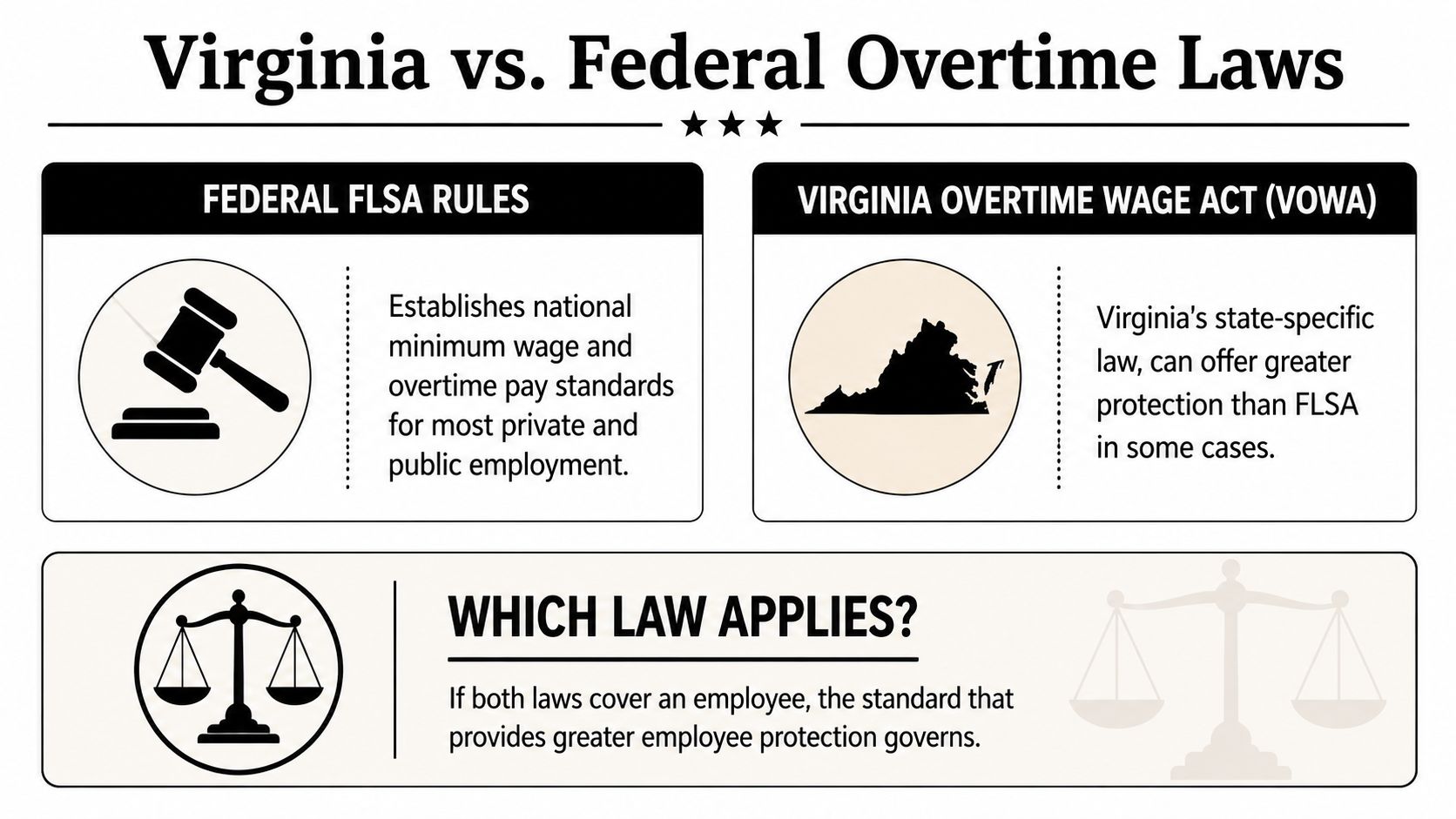
Virginia's overtime rules largely mirror the federal Fair Labor Standards Act on the main threshold. Covered non-exempt employees get overtime after 40 hours in a workweek, and there is no daily overtime requirement. But Virginia also gives employees a state-specific cause of action, its own limitations period, and its own damages structure, which commentary on the law notes can include treble damages for “knowing” violations, as discussed in the U.S. Department of Labor's overtime overview under the FLSA.
Where they match
For day-to-day agency payroll, the overlap is real:
- Weekly threshold applies after 40 hours in a workweek.
- Time-and-a-half baseline applies to non-exempt employees.
- No daily overtime rule means a long day alone doesn't trigger overtime.
- Federal exemption concepts still matter when classifying staff.
So if you've built your payroll around basic FLSA concepts, you're not starting from zero.
Where Virginia adds pressure
The problem is enforcement and remedies.
Virginia doesn't just echo the federal rule. It also gives employees a state path to bring claims. That changes the risk calculation for employers because the question isn't only “did we follow the general federal standard?” It's also “what happens if someone sues under Virginia law?”
Here's the cleaner comparison:
| Issue | Federal baseline | Virginia layer |
|---|---|---|
| Overtime trigger | Over 40 hours in a workweek | Same weekly trigger |
| Daily overtime | Not required by the FLSA baseline | No daily overtime requirement |
| Cause of action | Federal claim route | State-specific overtime claim route |
| Damages structure | Federal remedies apply under federal law | Virginia has its own remedies structure |
If you want a more operational breakdown of overtime treatment across scenarios like holidays and weekly totals, this explanation of overtime and holiday pay is useful for payroll teams that need to translate rules into recurring process.
Virginia agencies should think of compliance as layered. The federal rule gives you the base frame. Virginia changes the consequences when your process fails.
That's why a casual approach is expensive. An owner may look at payroll and think, “We're close enough.” But “close enough” is exactly the standard that falls apart in a wage claim. The agency either classified people correctly, tracked all hours, and paid correctly for that week, or it didn't.
Common overtime exemptions for agencies
A Virginia agency usually gets into overtime trouble here: a salaried employee works late through a launch, jumps on weekend client calls, and logs 50-hour weeks for a month. Payroll treats the role as exempt because the title sounds senior. If the duties do not support that classification, those extra hours turn into back-pay exposure fast.
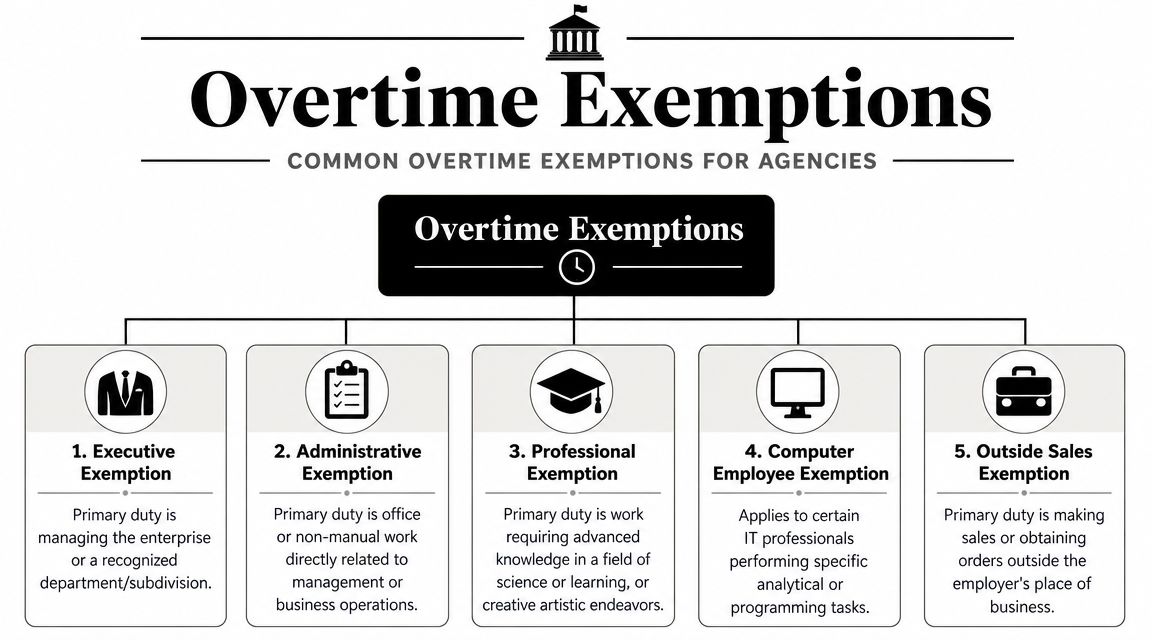
Virginia agencies generally use the federal FLSA exemption framework. In practice, that means the usual white-collar categories still matter: executive, administrative, professional, and outside sales. The mistake is assuming salary or title settles the issue. It does not. The test turns on how the person is paid and what the person does each week.
Titles are cheap. Duties are what count.
Agency owners feel this pressure more than many employers because project hours swing hard from week to week. During a quiet month, a questionable classification may never surface. During a client fire drill, a website launch, or a pitch cycle, the risk becomes obvious. If your agency cannot show who worked, when they worked, and why the role was classified as exempt, you are relying on assumptions instead of records.
Here is where agencies usually get it wrong:
- Account manager: Often treated as exempt because the role handles clients. But if the work is mainly follow-up, scheduling, status updates, and process coordination, the exemption argument gets weak.
- Graphic designer: Some creative roles may qualify. Production-heavy design work performed under close direction often does not fit as neatly as owners expect.
- Project manager: This is a frequent problem role in agencies. If the job is largely task tracking, deadline management, and chasing approvals, that is different from high-level business discretion.
- Agency operations director: This role can fit an executive or administrative exemption, but only if the person has real authority over staff, policy, budgeting, or significant business decisions.
A short comparison helps:
| Exemption type | Agency role examples | Common mistake |
|---|---|---|
| Executive | Department head, operations leader | Giving a manager title to someone with little real supervisory authority |
| Administrative | Senior operations or finance-side roles | Treating routine client or project coordination as independent business judgment |
| Professional | Certain specialized creative or learned roles | Assuming all design, strategy, or content work qualifies |
| Outside sales | Field-based sales roles | Applying the exemption to inside sales, account service, or hybrid remote roles |
The trade-off is simple. Classifying a role as exempt may make payroll easier, but a weak classification becomes expensive during heavy-work weeks. Agencies with variable project loads need tighter review, not looser review.
I usually recommend a role-by-role audit at three points: when the job is created, when duties change, and before someone is moved to salary-exempt status. Pair that review with automated time tracking, even for roles you believe are exempt. You may not need to pay overtime for a properly exempt employee, but you do need clean records if the classification is challenged later.
That point matters in real disputes over unpaid wages. Firms like Scher, Bassett & Hames about unpaid wages regularly handle cases that start with a simple pay question and grow once the employer cannot support its classification decision.
For Virginia-based agencies, the practical rule is this: do not classify by title, do not guess based on salary, and do not wait for a complaint before checking actual duties against actual hours worked.
Employer duties and penalties for non-compliance
A client asks for weekend revisions before a Monday launch. Your account lead answers emails on Saturday, a designer logs late-night changes from home, and payroll closes the week using the hours on the original schedule. That is how a routine agency week turns into an overtime claim.
The employer's job is not limited to paying overtime when it is obvious. The job is to capture all hours worked, calculate pay correctly for the workweek, keep records that hold up under scrutiny, and stop manager habits that hide off-the-clock work. In Virginia agencies, that usually breaks down during busy client periods, remote work, and project-based staffing changes.
If a dispute starts, your records will carry most of the weight. Patchy timesheets, edited entries without an audit trail, and informal Slack or email work outside scheduled hours make it much harder to defend your payroll decisions. For agencies with variable project hours, manual cleanup at the end of the week is a weak control. You need a system that records time as the work happens and shows who changed what.
Virginia employees can pursue unpaid overtime, liquidated damages, and attorney fees if the employer gets this wrong, as noted earlier. Claims can also reach back further when the violation is willful. The legal exposure is real, but the operational failure usually comes first.
Where agencies usually get into trouble
These are the patterns I see most often:
- Hours worked outside the timesheet: After-hours edits, client messages, prep work, and remote revisions never make it into payroll.
- Role changes without payroll review: A coordinator takes on more work, more client pressure, and longer weeks, but nobody revisits how the role is paid.
- Manager pressure to keep budgets clean: Supervisors tell staff not to log extra time, then still expect the deliverables.
- Weak recordkeeping: Times are rounded, overwritten, or approved in batches without a clear history.
The trade-off is straightforward. Tight time controls can feel burdensome in a fast-moving agency. Weak controls cost more when an employee challenges pay and you cannot show what happened in a given week.
That is why I push agencies toward time-tracking best practices for variable-hour teams instead of relying on manager memory and spreadsheet corrections. Accurate, automated tracking does two jobs at once. It helps payroll pay correctly, and it gives leadership a usable record if a former employee questions overtime later.
If you want a plain-English look at how unpaid wage disputes can unfold in practice, this article from Scher, Bassett & Hames about unpaid wages is worth reading for context, even though the underlying laws differ by state.
For Virginia agency owners, the practical standard is simple. If people can work unpredictable hours, you need a process that captures those hours accurately, preserves the record, and flags payroll risk before it becomes a claim.
A compliance checklist and time-tracking best practices
A good overtime process should survive a busy month, a payroll turnover, and a former employee's questions. If it only works when your operations manager manually cleans everything up, it isn't stable.
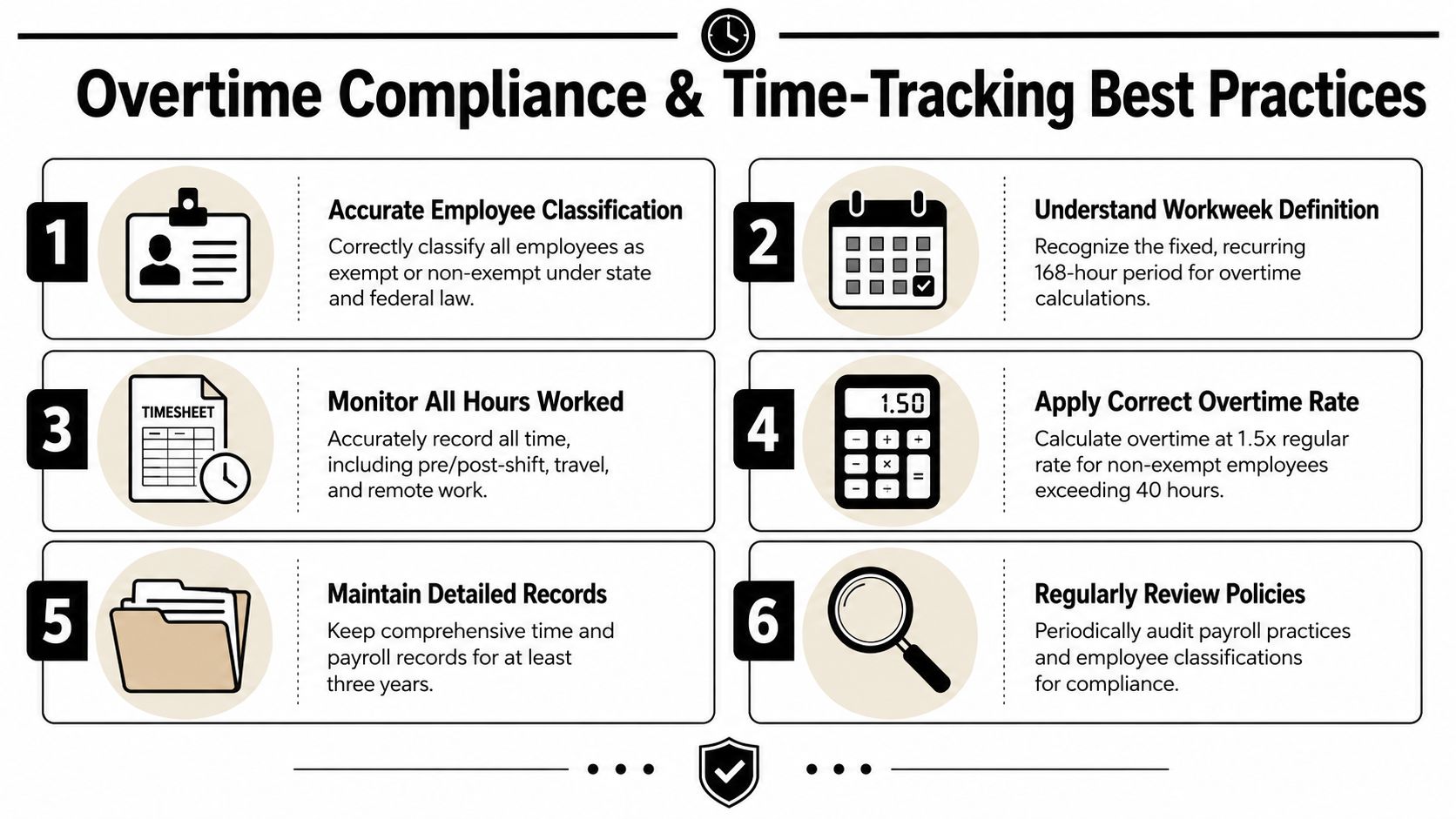
The checklist agency owners should actually use
Use this as an operating checklist, not a policy poster.
- Review classifications on a schedule: Audit exempt and non-exempt status when roles change, when people get promoted, and during annual compensation reviews.
- Fix the workweek definition: Make sure payroll, managers, and employees all know the exact recurring workweek your company uses for overtime calculations.
- Capture all time worked: Include remote work, after-hours edits, meeting prep, travel tied to work, and client communications that count as working time.
- Check the regular rate logic: If a non-exempt employee is salaried or receives other non-overtime wages in the week, make sure payroll applies the correct calculation.
- Keep records that explain the story: You should be able to trace hours from employee activity to timesheet to payroll result without guesswork.
Why manual timesheets keep failing agencies
Manual entry breaks down for one reason above all others. It asks busy people to remember work after they've already done it.
That's a poor fit for agencies, where work happens in fragments across meetings, internal reviews, Slack, email, and client calls. People forget short tasks. They underreport late-night cleanup. Managers approve broad totals because they're trying to move fast. Then payroll works from records that look clean but aren't complete.
A practical fix is to build time capture closer to the work itself. Calendar-based tracking, CRM-linked activity records, and automated categorization reduce the gap between what happened and what got logged. They also make audits easier because you're not rebuilding a week from memory.
If your team is reworking its process, this guide on time tracking best practices is a good starting point for setting cleaner rules around capture, review, and reporting. And if you want a broader business case for cleaner records, this piece on how teams boost productivity with time tracking is useful because it connects compliance discipline to operational visibility.
Better time tracking doesn't just reduce payroll mistakes. It gives agency leaders a cleaner view of staffing, scope creep, and client profitability.
What good looks like in practice
A solid setup usually has these traits:
| Practice | What it looks like |
|---|---|
| Time capture | Employees log work close to real time, not at week's end |
| Manager review | Supervisors review exceptions, not vague totals |
| Payroll handoff | Payroll receives clean weekly data with clear classifications |
| Audit trail | The business can connect calendar activity, project work, and paid hours |
| Policy enforcement | Overtime approval rules exist, but worked time still gets paid when required |
Most agencies don't need a more complicated policy. They need a recordkeeping system that reflects how agency work happens.
If your agency is tired of chasing timesheets after the fact, TimeTackle is worth a look. It helps teams capture time from calendar activity, organize work by client or project, and keep reporting cleaner without asking employees to rebuild their week from memory. For Virginia overtime compliance, that kind of recordkeeping discipline can make the difference between a manageable payroll process and a preventable wage dispute.