



Professional photographer rates in the U.S. typically fall between $100 and $300 per hour, and the national average is $164 per hour. That's the fast answer, but it rarely explains why one quote feels fair and another feels shocking.
A small business owner sees this all the time. You need fresh brand photos, a team headshot day, or event coverage. One photographer quotes what looks like a manageable rate. Another comes back much higher. Both say they're charging “hourly,” but the numbers don't line up, and that's where the confusion starts.
The problem is simple. Photographer rates per hour sound neat, but photography is almost never just an hour with a camera. Clients often compare shoot-time only. Photographers often price in the work around the shoot. Those are not the same thing.
That gap is where most pricing arguments happen. It's also where a lot of photographers undercharge and where a lot of clients assume they're overpaying. If you understand what sits behind the listed rate, the pricing starts to make sense fast.
The big question about photography pricing
A local shop owner asks for “just a couple of hours” of photography for a new website. Then the quote lands, and the reaction is predictable: “Why is this so much if you're only shooting for two hours?”
That question is fair. The market is wide, and the published numbers don't always help. According to Thumbtack's photographer pricing data, the national average hourly rate for professional photography services in the United States is $164, with a low-end average of $122 and a high-end average of $364. Bark's marketplace data also puts U.S. hiring rates for a professional photographer in 2026 at $100 to $300 per hour, with a national median around $200 per session in standard session work, based on Bark's photography pricing guide.
Those numbers help, but they don't solve the actual issue. A client doesn't buy a national average. They buy a specific type of work, in a specific market, with a specific level of planning, editing, and usage attached to it.
Why the quote feels inconsistent
Photography pricing gets messy because people use the same words for different things. “Hourly” might mean:
- Shoot time only, where editing and prep are billed elsewhere
- A blended business rate, where the photographer builds admin and post-production into the quote
- A minimum booking structure, where an hourly figure exists but the job still has a floor
That's why two quotes for “two hours” can be far apart without either photographer doing anything wrong.
A listed hourly rate is a pricing signal, not a full description of the job.
Venue type adds another layer. If you're planning coverage at a heritage property, logistics, restrictions, and timing can change the quote even before the camera comes out. Couples trying to price that kind of job often find photographer costs for historic venues useful because venue rules and access affect the workload more than clients expect.
Typical photographer rates by experience level
Experience changes pricing fast, but not in a straight line. Early-career photographers often compete on access and affordability. Established specialists charge for judgment, consistency, speed, and the ability to solve problems without drama.
According to FreelanceCalc's freelance photographer rate guide, beginner photographers in the 0 to 2 year range commonly charge $50 to $120 per hour, while “Specialist/Luxury” photographers with 10+ years of experience command $250 to $500+ per hour. That jump is driven by specialization and the value of the deliverable, not just time spent shooting.
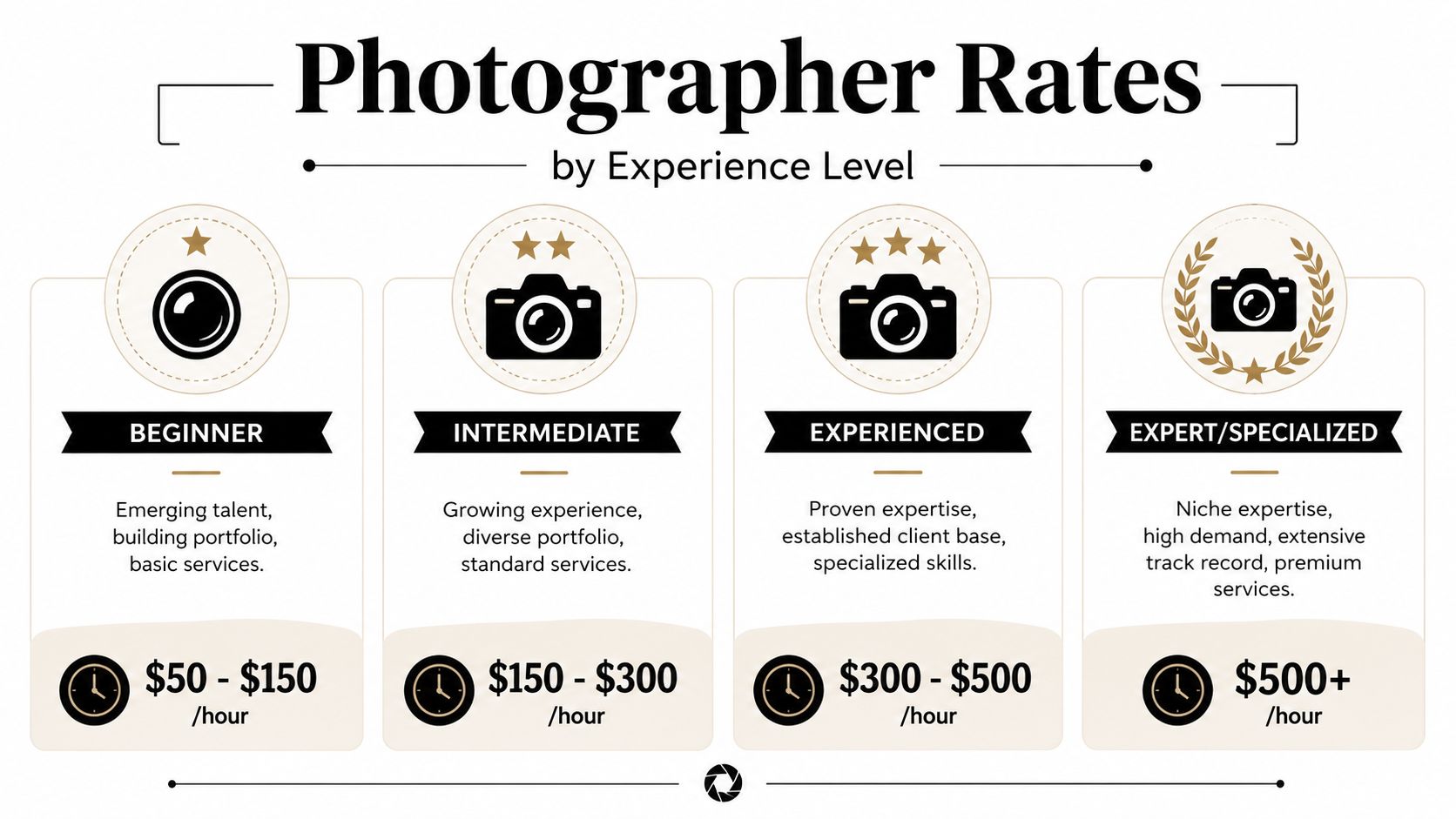
Here's the visual version:
A simple way to read the tiers
| Experience tier | Typical pricing pattern | What the client is usually paying for |
|---|---|---|
| Beginner | Lower entry pricing | Portfolio-building work, simpler jobs, fewer systems |
| Intermediate | Market-rate general service | More consistency, better direction, broader portfolio |
| Experienced | Higher professional pricing | Reliable execution, stronger process, niche skill |
| Expert or specialized | Premium pricing | Category expertise, licensing awareness, low-risk delivery |
The infographic uses broader market-facing buckets, and that's useful in practice because many clients compare photographers this way anyway:
- Beginner: $50 to $150 per hour
- Intermediate: $150 to $300 per hour
- Experienced: $300 to $500 per hour
- Expert/Specialized: $500+ per hour
What changes as rates go up
The camera body doesn't explain the jump. The business does.
A newer photographer may still make strong images, but they usually need more time to prep, more time to edit, and more effort to manage changing conditions. An experienced photographer has already seen the common problems. Bad conference-room lighting, a late client, a rushed timeline, a nervous executive, mixed color temperatures, a location that looked better on the scout than it does live. They adapt fast.
Practical rule: Clients don't pay top rates for someone to press the shutter. They pay for fewer mistakes, better direction, and a cleaner result under pressure.
For photographers, this matters because copying a higher-end competitor's number without matching their process usually backfires. For clients, it matters because the cheapest rate can become the most expensive choice if the job needs to be redone.
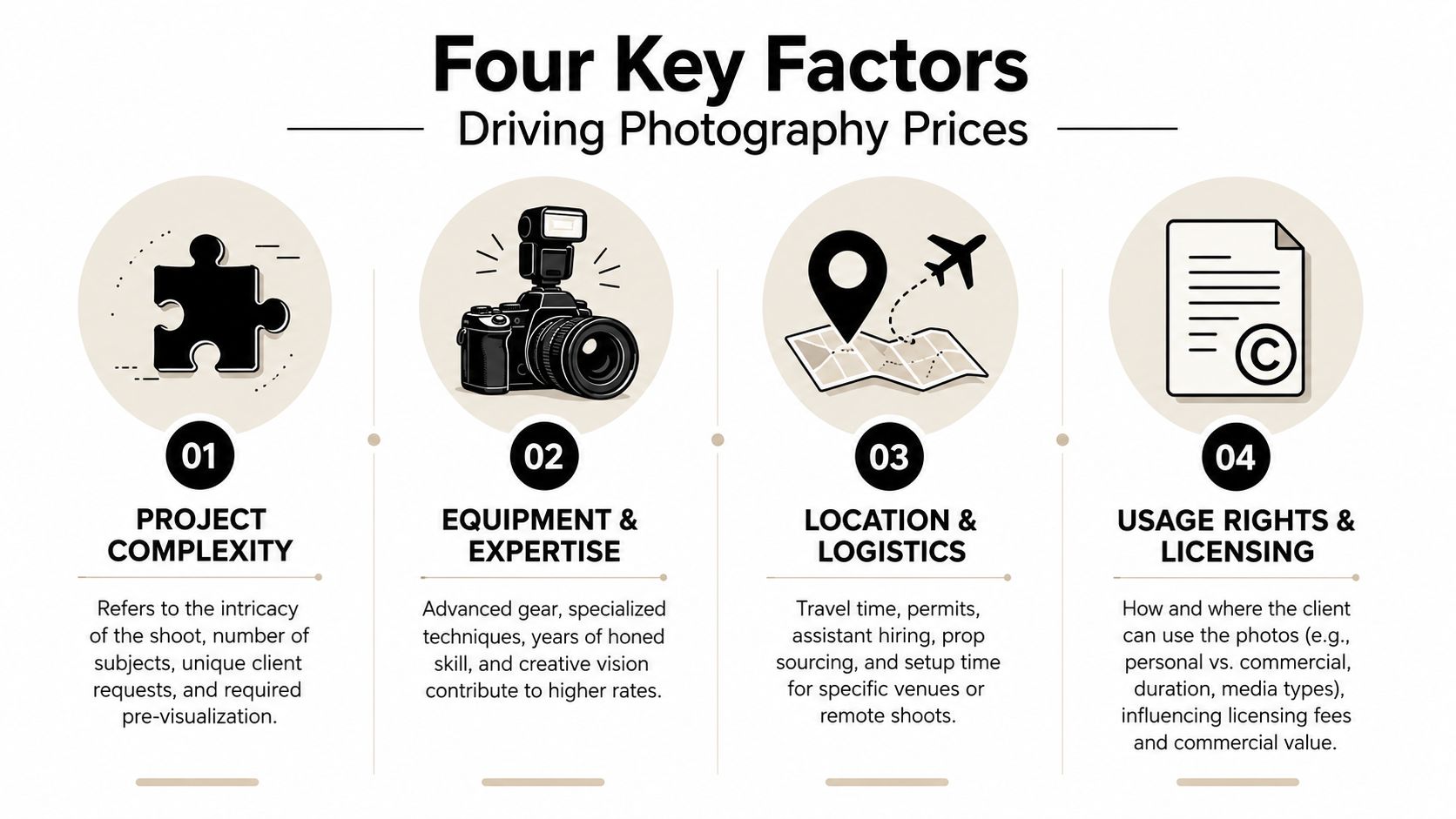
Four key factors that drive photography prices
Once you move past experience, four things shape the quote more than anything else: the kind of work, where the job happens, how the images will be used, and how messy the logistics get.
The niche changes the pricing model
Not every photography job should be priced by the hour. According to Wedio's photography pricing list, corporate event photographers charge $220 to $280 per hour, family photo shoots range from $145 to $500 per hour, commercial photographers often charge per image, and wedding photographers typically use day rates of $1,100 to $4,400.
That tells you something important. The structure follows the work.
A family session often fits an hourly model because the client wants time, guidance, and a selected set of finished photos. A commercial product job may hinge more on image count, retouching standards, and usage. A wedding is a full-day production with long coverage, travel, timeline management, and delivery expectations, so day rates make more sense.
Location affects the quote
Location is not just “city versus small town.” It can mean parking, permits, travel time, loading gear, weather backup plans, elevator access, or whether the shoot is remote enough that half the day disappears in transit.
Global comparisons show how much markets differ. ContractRates.fyi's market analysis puts the worldwide average photographer rate at $129 per hour, with the U.S. at $100 to $400 per hour, the UK at £75 to £300, Canada at CAD $250 to $2,500, and Australia at AUD $400 to $3,000. Even inside one country, rates move with demand, cost of doing business, and client expectations.
Usage rights change the value
Licensing is where many clients get surprised, especially in commercial work. If an image is for a private family album, that's one thing. If the same image is for a homepage, ad campaign, brochure, sales deck, trade show display, and paid social, the commercial value is different.
This is one reason commercial photographers often avoid pure hourly billing. The image may take one hour to shoot and many more to prepare, but its business value can live far beyond that day.
Complexity creates invisible cost
A “simple” shoot often isn't simple. Four executives with tight calendars, one office with poor light, mixed-brand wardrobe, and a need for both horizontal and vertical crops is a more complex assignment than a single founder portrait in one room.
Here are the details that push pricing up:
- More people: Group coordination always takes longer than clients expect.
- Harder environments: Warehouses, live events, and active workplaces need stronger technical control.
- Tighter output needs: Multiple crops, retouching standards, and brand consistency add labor.
- More moving pieces: Assistants, stylists, props, or permits increase cost even before editing starts.
Clients don't need to memorize all of this. They just need to know that photography pricing is built around risk, labor, and business value, not only the clock.
Why the hourly rate is more than just shoot time
This is the part most pricing pages miss. The camera-facing hour is only the visible part of the job.
A photographer can charge what looks like a strong rate and still end up with a thin take-home number once editing, admin, gear prep, travel, and file delivery are counted. According to VenueLook's analysis of photography pricing and productive time, a photographer billing $150 to $300 per hour may net only $25 to $75 per hour after unpaid editing, travel, and equipment time are factored in.
That's the hidden math behind hourly pricing.
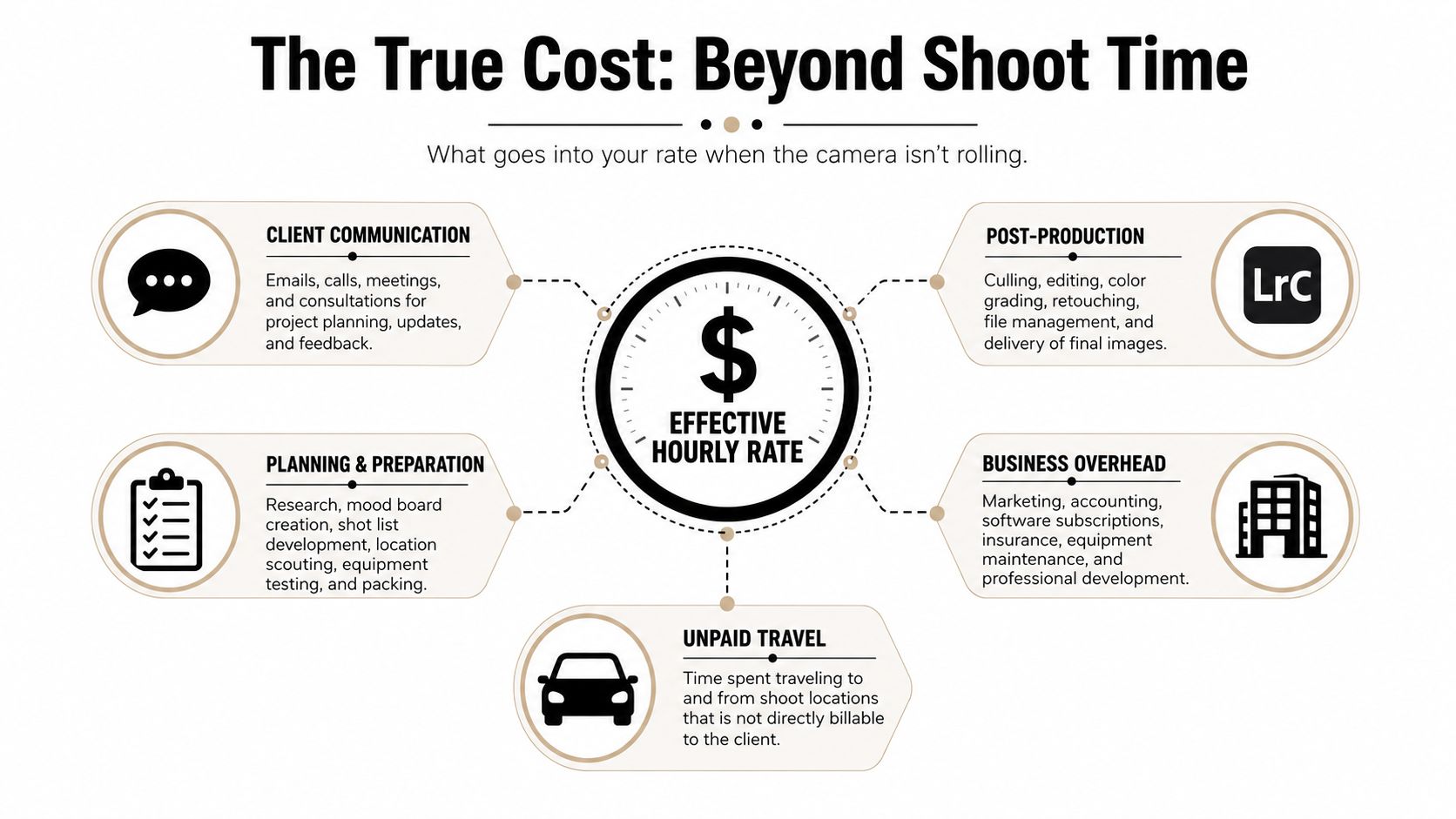
The work clients don't see
Clients usually see the visible service. They see the photographer arrive, direct the shoot, and deliver images later. They don't see the hours wrapped around that session.
Those hours often include:
- Client communication: Inquiry replies, discovery calls, estimate revisions, scheduling, and reminders
- Planning work: Shot lists, mood boards, location checks, gear prep, battery charging, file structure
- Post-production: Culling, color correction, retouching, exports, gallery setup, delivery notes
- Business overhead: Invoicing, bookkeeping, insurance, software, backups, and marketing
- Travel time: Getting to and from locations, parking, loading, unloading, and setup
“Hourly” in photography often means “the hour must pay for many hours.”
That's true in other service businesses too. If you've ever tried to budget effectively for podcast studios, you've seen the same pattern. The posted session rate never tells the whole story by itself. Setup, engineering support, file handling, and turnaround shape the actual cost.
Why this matters for photographers
New photographers often make one mistake first. They set a rate based on what feels acceptable to clients, not on what the full workflow costs them. Then they book work, stay busy, and still feel broke.
A listed rate can look fine on paper while the actual project drags profit down. Editing a big gallery late at night, chasing approvals, and exporting multiple versions for web and print can wipe out the margin.
Why this matters for clients
Clients don't need to feel guilty about asking what's included. They should ask. Clear scope saves both sides trouble.
Ask things like:
- What does post-production include
- How many final images are part of the quote
- Is travel included
- Are usage rights limited or broad
- What triggers extra fees
Those questions usually lead to better quotes and better hires. The goal isn't to squeeze the hourly number lower. It's to understand what work the fee buys.
How to calculate your own hourly rate
If you're a photographer, don't start with competitor envy. Start with your math.
Your rate needs to cover your pay, your business costs, your non-billable time, and your margin for growth. If you skip any one of those, your price may attract work but still fail as a business.
Start with a simple formula
Use this basic framework:
- Choose your income target. Pick the amount you need to pay yourself.
- Add annual business costs. Think gear, software, insurance, storage, education, travel, and marketing.
- Estimate realistic billable hours. Not all working hours are billable. Some hours go to sales, admin, and maintenance.
- Divide the total by billable hours. That gives you a baseline rate.
- Adjust for market fit and specialty. A baseline is a floor, not your final quote.
If you want a structured walkthrough, this guide on calculating freelance rates is a useful reference for turning business costs and working time into a real pricing number.
Don't ignore hidden labor
Most self-employed photographers often miscalculate. They estimate only camera-in-hand time. That makes their rate look competitive, but it often means they're pricing a full workflow as if it were a partial one.
Track a few jobs from first inquiry to final delivery. Count every email, every planning call, every hour spent culling, every drive, every revision round. If the total shocks you, that's normal. The first time, it's a common shock.
Reality check: If you don't track the full job, you're not calculating a rate. You're guessing.
Use AI carefully
AI editing tools change the labor mix, especially for newer photographers. According to VSCO's photography pricing guide, pricing guides often miss how global remote work and AI editing tools are compressing traditional hourly rates by 20 to 40 percent for entry-level photographers, and AI tools can reduce per-image editing time from 30 minutes to under 5 minutes.
That does not mean everyone should slash prices. It means efficiency changes your options.
You can use faster editing in a few ways:
- Keep rates stable and improve margin
- Offer quicker turnaround as a premium
- Price simpler jobs more competitively
- Move from hourly pricing toward project or per-image pricing when that fits better
What doesn't work is pretending faster delivery has no impact on your pricing model. If your workflow changes, your business math changes too.
Set a floor, then quote by job
I usually tell photographers to know their true hourly floor even if they don't sell by the hour. A clean hourly baseline helps you test whether half-day, day-rate, or package pricing is profitable.
That gives you flexibility. You can quote in a way clients understand while still protecting your margin behind the scenes.
A client's guide to budgeting for a photographer
Clients get better outcomes when they stop shopping for the lowest posted hourly rate and start buying the result they need.
A cheap rate can be a good deal for a simple job. It can also become expensive fast if you get weak direction, inconsistent editing, or files that don't fit the channels you need. If the goal is web banners, team bios, print collateral, and social crops, you are not buying “one hour.” You're buying usable assets.
Pick the pricing model that fits the job
Different jobs need different buying logic.
| Job type | Pricing model that often fits best | Why |
|---|---|---|
| Short portrait session | Hourly or session fee | Clear scope, predictable output |
| Corporate event | Hourly with minimums | Coverage time drives the work |
| Brand shoot | Project fee | Planning, output, and usage matter more than clock time |
| Wedding | Day rate or package | Long coverage and complex delivery |
The easiest way to waste budget is to force every job into hourly pricing. A package can be clearer. A day rate can be safer. A project fee can remove a lot of friction when the brief is more about outcome than time.
Ask better questions before you hire
Good clients make pricing cleaner because they give useful detail up front. Ask these questions before you compare quotes:
- What's included in the fee: Editing, retouching, travel, delivery format, image count
- What is the turnaround: Fast delivery often changes workload
- How will the images be used: Personal use and commercial use are not the same
- What happens if scope changes: More people, more setups, or more revisions can shift price
If you need a clean way to structure the money side, this invoice template for hours worked helps translate a quote into something both sides can review without confusion.
Value beats a low sticker price
A photographer who charges more but gives clear art direction, handles logistics calmly, and delivers polished files on time is often the better buy. That's especially true for commercial work, where the images have a job to do.
The best budget question is not “Who is cheapest?” It's “Who can deliver the images we actually need without creating more work for us later?”
Time tracking tips for accurate and profitable billing
A two-hour shoot can turn into six or seven hours of real work once you include emails, prep, travel, culling, edits, delivery, and the follow-up that lands after the gallery goes out.
That gap is where pricing breaks.
Photographers who only count camera-in-hand time usually undercharge. Clients who only compare shoot hours often miss why one quote is higher than another. Accurate time tracking fixes both problems because it shows the full cost of producing the images, not just the visible part of the job.
What to track on every job
Use one method for every project. Spreadsheets, timers, calendar tags, and project tools can all work if you apply them consistently.
Track these categories separately:
- Pre-sale time: Inquiry replies, estimate writing, discovery calls, follow-ups
- Production time: Travel, setup, shoot time, breakdown
- Post-production time: Culling, editing, exports, delivery, revisions
- Admin time: Invoicing, contracts, file management, archiving
A simple system to track billable hours makes patterns easier to spot. You quickly see which jobs are edit-heavy, which clients need extra hand-holding, and which services look profitable on paper but drain your week.
Use the numbers to change your pricing
Collecting time logs is only useful if you review them after delivery.
Look at the jobs that felt rushed. Check whether the problem was the shoot itself or the hidden work around it. A portrait session with easy lighting and fast selects may produce a better margin than a shorter product job with rounds of retouching and approval emails. That is the kind of trade-off that should change how you quote.
For photographers, this review helps set minimums, tighten packages, and charge properly for revisions, rush delivery, or travel.
For clients, it gives a clearer way to compare quotes. A higher hourly rate may still be the better buy if the photographer runs an efficient process and delivers polished files without extra rounds of fixes.
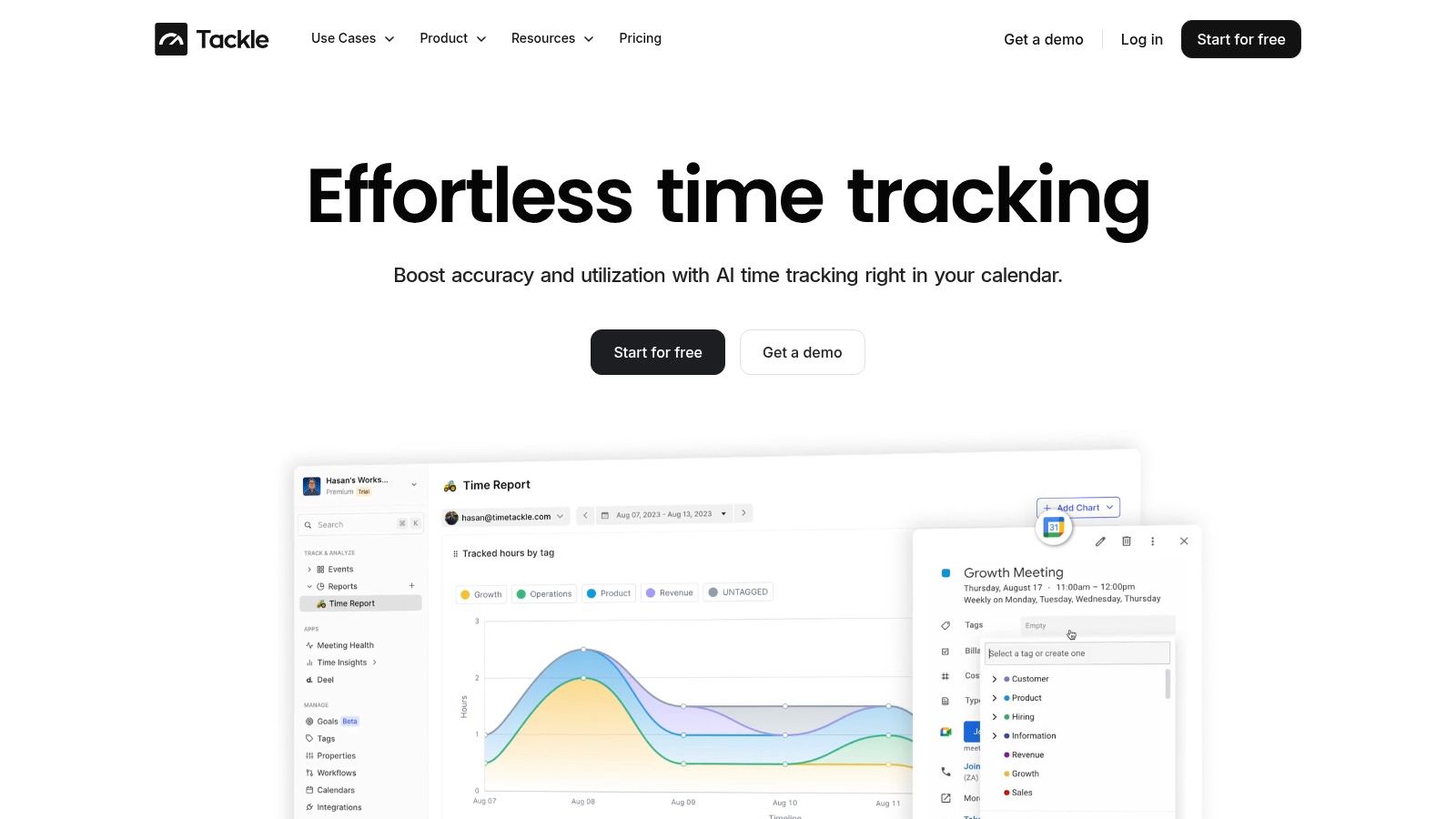
If you want cleaner billing, less timesheet drag, and a better handle on where your team's hours go, TimeTackle is worth a look. It helps teams capture time from real work activity, sort it by client or project, and turn that data into better pricing, better reporting, and fewer missed billable hours.