



You can feel Hawaii labor law risk long before anyone says the word “audit.”
It usually starts with something ordinary. A project manager approves a late client sprint. A designer logs hours in a spreadsheet the next morning from memory. Someone gets a bonus tied to delivery. Recruiting posts a remote role with a vague pay line because nobody wants to reopen the comp model. None of that looks dramatic in the moment. But for a mid-sized agency, that mix of manual tracking, fast hiring, and uneven pay practices is where compliance problems start.
The state of Hawaii labor laws matters most when your agency is growing and your systems haven't caught up yet. If you run a team across Honolulu, neighbor islands, or hybrid roles that report into one central operation, you need more than a handbook. You need rules your managers can follow, payroll inputs you can trust, and records you can pull fast when a question comes up.
Navigating hawaii's employment laws without the headache
A lot of agency owners don't struggle because they ignore the law. They struggle because the law hits operations in small places. Hours live in calendars, Slack messages, and old spreadsheets. Pay decisions sit in email threads. Hiring managers post jobs fast, then HR cleans up the wording later. That setup works until it doesn't.

In practice, Hawaii compliance is less about legal theory and more about whether your business can answer plain questions without scrambling. What did this employee work? How did you calculate overtime? Why does one posting show a range and another doesn't? If someone leaves, when does final pay go out and who owns that task?
That's why I like to treat labor law as an operating system issue. If the workflow is messy, the legal risk follows. If the workflow is clean, most compliance work gets easier because the facts are already there.
A good comparison comes from other jurisdictions with their own employment complexity. If you've ever had to think about choosing the right Ontario labour expert, you already know the pattern. The business problem is rarely “we don't care.” It's usually “we're moving fast, and nobody translated the rules into a repeatable process.”
Keep this standard in mind. If a manager can't explain the pay rule in one minute, the process is probably too loose.
For a Hawaii agency, the fix usually comes down to a few basic shifts:
- Stop relying on memory: People forget start times, client calls, and after-hours edits.
- Give one owner each workflow: Hiring, payroll review, leave tracking, and final pay need named owners.
- Tie policy to actual tools: If your team works from Google Calendar, Outlook, Slack, and a payroll platform, your compliance process has to match that reality.
- Review edge cases early: Hybrid staff, bonus pay, junior staff, and remote hiring create questions that need answers before payroll closes.
The foundations of hawaii pay rules
If you only remember two Hawaii wage rules, make them these. First, the state minimum wage is higher than the federal rate. Second, overtime for non-exempt employees turns on the workweek, not the day.
According to Hawaii employment law guidance, Hawaii's minimum wage is $14.00 per hour as of January 1, 2024. It is scheduled to increase to $16.00 per hour on January 1, 2026, and $18.00 per hour on January 1, 2028. The same source states that Hawaii requires non-exempt employees to receive one and one-half times their regular rate for all hours worked over 40 in a workweek.
What that means for agency owners
If you run a mid-sized shop, don't treat the minimum wage schedule as background noise. It affects more than entry-level pay. It puts pressure on pay bands, contractor comparisons, junior coordinator roles, and any service line where margins are already tight.
A lot of owners make the mistake of updating only the bottom of the pay scale. That usually creates compression. Your more experienced staff then ask why the gap between levels narrowed, and that conversation lands in HR, finance, and team leads all at once.
Use this rule of thumb. When the floor rises, review the structure above it too.
Where employers get tripped up
Hawaii overtime sounds simple because the trigger is over 40 hours in a workweek. But “simple” doesn't mean “safe.” Problems show up when agencies mix flexible schedules with weak time records.
Here's the practical side:
- Non-exempt means tracked hours matter: If a coordinator answers client requests after hours, those minutes can count.
- Weekend work isn't automatically overtime: The issue is total hours in the workweek.
- Comp time in private agencies is risky territory: Managers often try to “balance it out later,” but payroll still has to reflect actual legal pay obligations.
- Approval rules don't erase payment duties: You can discipline unauthorized overtime. You still may have to pay for time worked.
Practical rule: Build payroll around recorded time, not around what managers expected people to work.
The cleaner your time data, the easier this gets. If your operations team is reviewing how overtime and holiday pay logic works in modern systems, this guide on overtime and holiday pay is a useful operational reference.
A simple planning table
| Issue | What to do |
|---|---|
| Minimum wage changes | Update budgets, comp bands, and pricing assumptions before the effective date |
| Overtime exposure | Confirm which roles are non-exempt and that hours are tracked consistently |
| Hybrid work | Capture time worked outside the office, not just scheduled office hours |
| Manager approvals | Train managers that unapproved overtime can still require pay |
Decoding overtime and employee classification
Overtime mistakes usually come from one of two problems. The first is bad math. The second is bad classification. Both show up often in agencies because roles look professional on the surface, but the law cares about how people are paid and what work they do.

The regular rate is not always the base hourly rate
According to Paylocity's Hawaii overtime summary, Hawaii's overtime calculation under HI Rev. Stat. § 387-3 requires the regular rate to include non-discretionary bonuses. The same source notes that a miscalculation can create a 10-20% variance in liability. It gives this example: an employee earning $16 per hour with a $200 weekly bonus who works 45 hours has a regular rate of $17.78, not $16.
That's the kind of detail that causes real trouble. An agency thinks it paid time and a half because payroll multiplied the base hourly rate. But if a recurring production bonus or other non-discretionary amount should have been included, the overtime number was off from the start.
When your pay practice changes, your overtime math may change too. Don't assume payroll logic updates itself.
Classification is where agency roles get messy
Titles don't decide exemption status. Job duties and pay structure do. That matters because agencies love titles that sound senior long before the role has real authority.
Here's where I see confusion most often:
- Account managers: Some manage client strategy and exercise independent judgment. Others mostly coordinate timelines and chase deliverables. Those are not the same role.
- Design leads: A strong creative title doesn't answer the exemption question by itself. The actual duties do.
- Sales staff: Some compensation structures create easy assumptions that don't hold up under closer review.
- Project managers: If they mainly execute schedules, route communication, and track tasks, don't assume they're exempt because they sit in meetings all day.
A better way to review classification
Use a role audit instead of a title audit.
| Review question | Why it matters |
|---|---|
| How is the employee actually paid? | Pay basis affects exemption analysis |
| What decisions can they make on their own? | Independent judgment matters |
| Do they manage people or just workflows? | Managing tasks is not the same as managing employees |
| What changed in the role over time? | Roles drift, and old classifications linger |
For contingent staff, freelancers, and mixed staffing models, this resource on contingent labor management can help operations teams think through classification and oversight in a more structured way.
What works and what doesn't
What works is a documented review of real duties, tied to payroll setup and manager training.
What doesn't work is copying a title from another agency, assuming salary alone solves overtime, or waiting until a complaint arrives to ask whether the role was classified correctly.
Breaks, leave, and final pay procedures
Good employers still stumble, and the reason isn't intent. It's handoffs. Leave sits with HR, schedules sit with managers, and final pay sits with payroll. If those people don't share one process, errors creep in.
Breaks and leave need a real workflow
For day-to-day management, don't bury leave rules in a handbook and assume that's enough. Managers need a simple intake path for requests, and employees need to know where to put them.
A practical setup usually includes:
- One intake channel: Email inbox, HR system, or ticket flow. Pick one.
- Clear approval steps: Managers should know when they approve, when they escalate, and when HR makes the call.
- Central records: If leave sits in private messages, it will get missed.
- Return-to-work notes and related documents: Store them in one secure place, not in a manager's desktop folder.
Honolulu and state leave requirements can create issues if supervisors improvise. The safest approach is consistency. If one manager allows informal time-off tracking and another requires strict documentation, you create confusion and potential fairness problems.
Final pay is a deadline issue, not a courtesy issue
When someone resigns or you terminate employment, the final paycheck process needs a checklist. That checklist should live outside anyone's memory.
I'd include these steps:
- Confirm the separation date and whether the departure is voluntary or involuntary.
- Pull all final time records before payroll runs, including any work performed outside normal schedules.
- Review earned wages and any policy-based payouts that your company owes under its own rules.
- Assign one person to release final pay and one person to verify it.
- Document delivery so you can show what was paid and when.
Fast separations create sloppy payroll. Slow down long enough to verify the last week of work.
Vacation payout questions also belong here, but the answer often turns on company policy and the specific facts. That means you should review the written policy, confirm how it has been applied, and avoid making one-off exceptions that you can't defend later.
For agencies trying to clean up absences, sick days, and schedule records, this guide on how to track employee attendance is a practical place to start.
What managers should never do
A short “don't” list saves a lot of pain:
- Don't promise leave outcomes on the spot if HR needs to review eligibility.
- Don't delay final pay because equipment hasn't been returned unless your legal advice says your process allows that.
- Don't let off-system texts become the official leave record.
- Don't assume a quiet departure is low risk. Many wage claims come from routine exits, not dramatic ones.
Ensuring fairness with pay equity and anti-discrimination laws
A lot of employers think pay equity work is mostly about avoiding claims. That's too narrow. In Hawaii, it's also a hiring discipline issue. If your pay ranges are messy, your recruiting process exposes it. If your team is doing substantially similar work at inconsistent rates, a posting can bring that tension to the surface fast.

According to the Hawaii labor law poster summary, effective January 1, 2024, employers with 50 or more employees must disclose an hourly rate or salary range in job postings. That requirement applies to remote positions. The same source ties the rule to pay equity under HI Rev. Stat. § 378-2.3, which prohibits pay differentials for substantially similar work based on protected characteristics.
Why this matters for agencies
Agencies often have role sprawl. You may have “Senior Account Manager,” “Client Strategist,” “Digital Lead,” and “Program Manager” all doing close variations of the same work across teams. If each department built its own compensation logic, your posting ranges may expose inconsistency that had gone unnoticed.
That doesn't mean every difference is unlawful. It does mean you need a reasoned structure that you can explain.
What a sound pay review looks like
Start with the work, not the title.
- Group roles by actual duties: Similar work should sit in the same review bucket even if titles differ.
- Check remote postings carefully: If the role is open to Hawaii applicants, don't treat the pay range requirement as optional.
- Review manager discretion: Wide discretion without documentation usually creates uneven outcomes.
- Keep a short written rationale: If two employees are paid differently in similar roles, document the legitimate business basis.
A posted range is not just a recruiting line. It's a public statement about how disciplined your pay system is.
What fails in real life
The worst approach is to post a range that was never tested against actual internal compensation. Next is letting every department write its own hiring band. A close third is treating remote jobs as somehow outside the normal Hawaii compliance lens.
Fairness work also needs manager training. Anti-discrimination policies don't matter much if front-line leaders still make ad hoc pay decisions or use loose language in performance reviews and hiring discussions.
Recordkeeping and staying audit-ready
Most wage and hour problems get worse because the employer can't reconstruct what happened. Hours are incomplete. Payroll notes are missing. A manager approved something verbally and forgot. The employee's calendar says one thing, the spreadsheet says another, and finance has a third version.
That's why recordkeeping is not admin cleanup. It is your proof.
Keep records that answer real questions
In a mid-sized agency, your records should let you answer these questions fast:
| Question | Record you need |
|---|---|
| What hours did the employee work? | Daily and weekly time records |
| What did you pay them? | Payroll records, wage rates, bonus details |
| When did the employment relationship start or end? | Hire and separation records |
| What policy applied? | Current handbook, compensation policy, leave policy |
The more your operation depends on flexible schedules, the more valuable a clean source of time truth becomes. Manual timesheets often fail because they ask people to recreate a week after the fact. That's when small omissions turn into payroll errors.
Why automation matters
Calendar-based time tracking can solve a problem agencies often ignore. People already live in Google Calendar and Outlook. Their day is visible there before it ever hits a timesheet. If your system captures work from the tools people already use, your records are easier to maintain because they reflect actual workflow instead of memory.
This matters for compliance because clean records make disputes less subjective. They also help operations teams spot overtime patterns, off-hours work, and uneven workloads before those issues become payroll or employee relations problems.
Build an audit-ready process
Use a simple operating model:
- Capture time close to when work happens.
- Review exceptions weekly, not months later.
- Store pay-related changes with context, not just the final number.
- Keep one system of record for core employment data.
- Train managers to document decisions when they affect pay or time.
A good compliance system is boring in the best way. People know where requests go. Payroll has the inputs it needs. HR can pull records without hunting. If a question lands on your desk, you answer it with documents instead of guesses.
A practical hawaii labor law compliance checklist
Most compliance plans fail because they're too abstract. Owners leave a meeting with a stack of issues and no first move. A checklist fixes that if it's short enough to use and specific enough to matter.
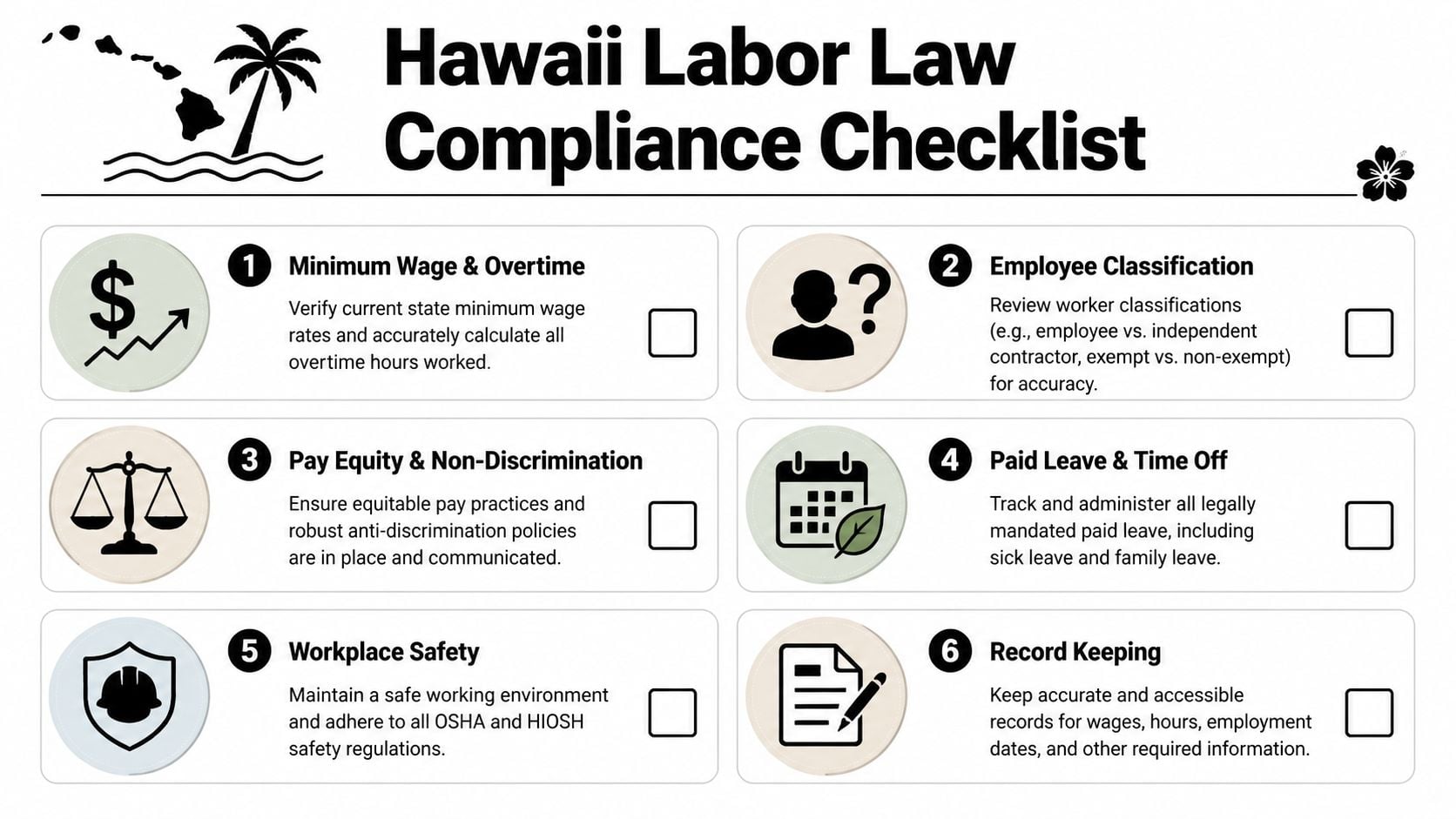
Weekly and monthly review list
- Check active pay rates: Confirm no non-exempt employee falls below your current Hawaii pay floor, and review whether planned wage changes affect your pricing or staffing model.
- Audit overtime inputs: Make sure bonuses and other required pay components feed into overtime calculations where needed.
- Review classifications: Spot-check roles that changed duties, especially project management, client service, and creative lead positions.
- Clean up job postings: If your headcount triggers Hawaii's posting rule, verify that ranges appear where they should and match your internal compensation structure.
- Test your records: Pull one employee file and see if you can trace hours, pay changes, leave records, and separation steps without asking three departments for help.
Quarterly leadership check
I'd also ask leadership to review two broader questions.
First, are managers making pay and scheduling decisions in a consistent way, or are team leads running their own systems under one company logo?
Second, does your stack of HR, payroll, calendar, and reporting tools create one version of the truth, or four competing ones?
If your tech setup is fragmented, it may be worth reviewing broader compliance management solutions to see how other teams centralize policy controls, records, and operational oversight.
Compliance gets easier when ownership is visible. Every task on this list should have a name next to it.
Save this as your short action plan
- Verify wage settings and future budget assumptions
- Review non-exempt hours and overtime logic
- Recheck exemption and worker classification calls
- Update pay ranges in job postings if required
- Standardize leave and final pay workflows
- Confirm records are complete and easy to retrieve
Frequently asked questions about hawaii employment
Do tipped employees follow different wage rules in Hawaii
Yes, tipped roles can involve special pay rules. The main point for employers is not to assume that tip-based pay excuses weak tracking or casual payroll setup. If you employ tipped workers, confirm your wage practices and overtime calculations with up-to-date legal and payroll guidance specific to that workforce.
Are there special overtime issues for agricultural or seasonal workers
Yes, some categories can involve different rules or exceptions. If your agency doesn't operate in those industries, this may not affect you directly. But if you have field operations, event staffing, or unusual worker arrangements, don't assume your standard overtime setup covers every case.
Do I have to give meal breaks to employees under 18
Minor workers can trigger special break and scheduling obligations. If you hire interns, office support staff, or junior employees who are under 18, build that review into onboarding instead of trying to fix it after schedules are already set.
Do I have to pay out unused vacation when someone leaves
That often depends on your written policy and how you've applied it in practice. The safest path is consistency. Review the policy, confirm the final balance, and make sure payroll and HR are using the same rule before final pay goes out.
What's the biggest mistake agencies make with the state of hawaii labor laws
They treat compliance as a legal document problem when it's really an operations problem. If time records are weak, classifications are stale, and managers improvise around leave or pay, the policy manual won't save you. Clean workflows do.
If your agency is tired of chasing timesheets, rebuilding weekly hours from memory, and patching together payroll inputs from calendars and spreadsheets, TimeTackle is worth a look. It helps teams capture work from the calendar, organize it with rules and tags, and turn daily activity into cleaner records for operations, reporting, and billing.