



It's late. A client launch is tomorrow morning, Slack is still active, and your team is doing what agencies always do when deadlines close in. They're finishing decks, fixing tags, revising copy, and jumping on one more call before sign-off.
That's usually when the overtime question hits.
Not in the abstract. In payroll. In policy. In that uneasy moment when you realize some of the people still online are hourly, some are salaried, some work hybrid schedules, and at least a few have job titles that sound exempt even if their day-to-day work says otherwise.
For a New Jersey agency, that's not a paperwork issue. It's a wage-and-hour issue. If your systems treat overtime as something managers approve after the fact, or something employees “should know” to log correctly, you're carrying more risk than most owners realize.
The overtime question every agency leader dreads
A project manager stays online until 9 PM to get a client presentation over the line. A paid media specialist logs in early the next morning to clean up campaign settings. An account lead answers client messages from a phone after dinner because “it only took a few minutes.”
That pattern feels normal inside an agency. It also creates the exact kind of overtime mess that turns into back-pay disputes later.

The hard part isn't spotting long hours. It's knowing which hours count, which employees qualify, and whether your payroll setup matches what your team does. Many agency leaders think the risk sits with junior hourly staff. In practice, the bigger blind spot is often the salaried employee with a mixed role. Someone who manages a piece of client work, does hands-on execution, and has enough autonomy to look exempt on paper.
Why agencies get this wrong
Agency work blurs lines fast. A “manager” may spend most of the week producing deliverables. A “director” may still handle direct client execution. A remote employee may work in short bursts across the day, which means unrecorded time creeps in unless you have a clean process.
You also have competing incentives:
- Client pressure: Deadlines push people to work first and record later.
- Timesheet fatigue: People stop logging small tasks, especially after-hours work.
- Role creep: Job descriptions drift, but payroll classifications stay frozen.
The overtime problem usually starts long before payroll runs. It starts when the role, the schedule, and the tracking method stop matching each other.
If you run a New Jersey agency with hybrid teams, overtime compliance is operational work. Legal rules matter, but the day-to-day fix is cleaner systems, clearer role decisions, and less guesswork.
The foundation of NJ overtime rules
The basic rule is simple. In New Jersey, non-exempt employees must receive 1.5 times their regular hourly rate for hours worked over 40 in a workweek. As of 2025, the state minimum wage is $15.49 per hour, which means the overtime rate is at least $23.24 per hour, according to this New Jersey overtime overview.
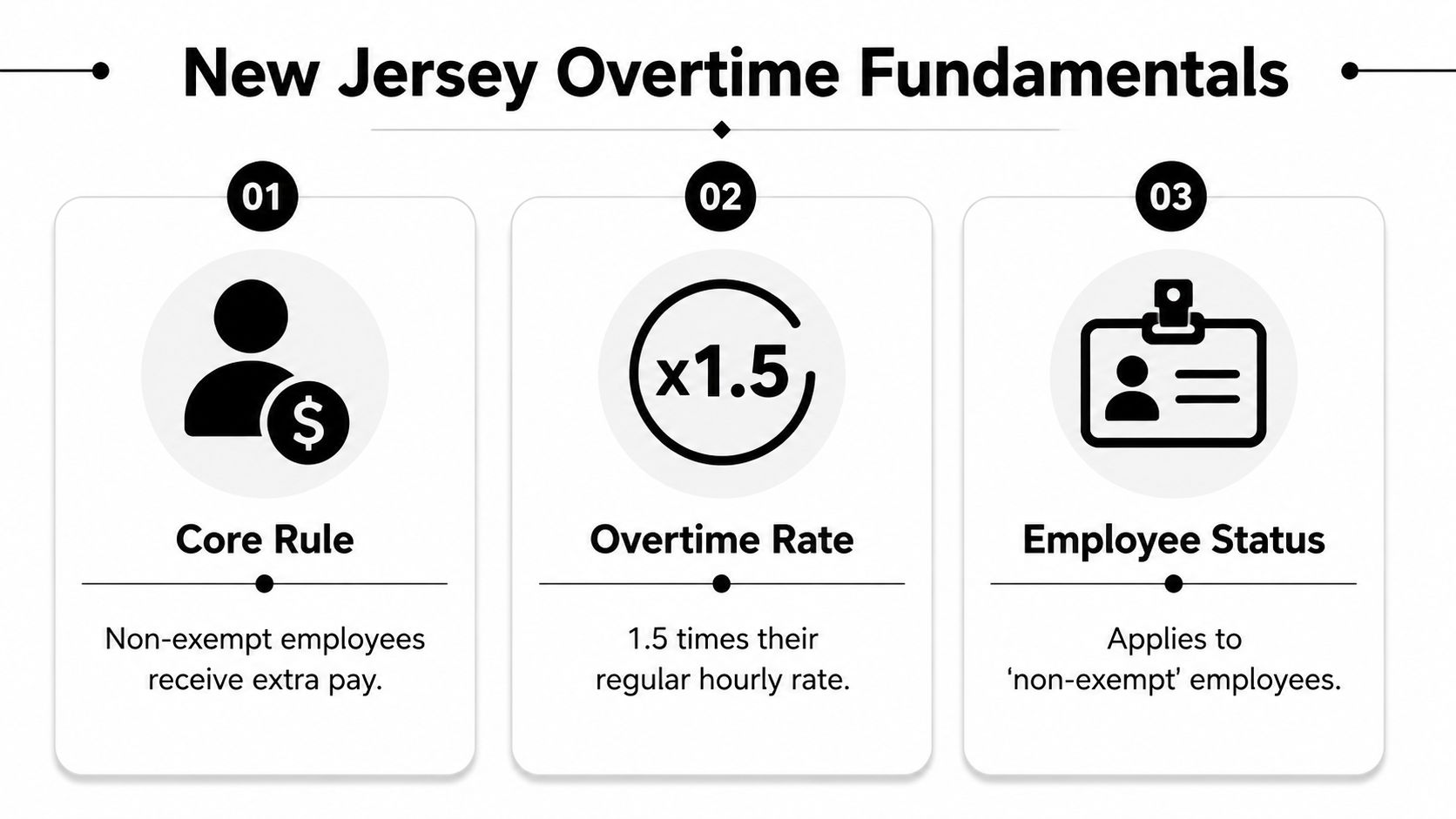
That sounds straightforward until you apply it to real agency work. “Regular rate” is not always the same thing as a base hourly figure in your head, and “workweek” does not mean a pay period, a project cycle, or a rough average over a busy month.
The workweek is the unit that matters
New Jersey follows the federal baseline, but the rule turns on one thing. The workweek.
A workweek is a fixed, recurring block of time. It isn't something you move around to fit client work, and it isn't something you smooth out across two weeks because one was heavy and the next was light. If your payroll or time tracking setup treats overtime at the pay-period level instead of the workweek level, that's a process flaw, not a minor detail.
For operations teams, that means your tools need to calculate hours by the defined week first. Billing cycles come later.
What this means in practice
If you manage agency operations, keep these points in plain view:
- Non-exempt status drives overtime. If the employee is non-exempt, overtime rules apply after 40 hours in the workweek.
- The rate is time-and-a-half. That multiplier applies to the employee's regular rate.
- Minimum wage still matters. The state wage floor affects the lowest lawful overtime rate.
For a more practical breakdown of pay treatment across extra hours, holiday work, and premium pay issues, it helps to review overtime and holiday pay rules in plain language.
Practical rule: Don't build your overtime process around manager memory. Build it around a fixed workweek, recorded time, and a payroll rule your team can explain without opening a law book.
Who is covered and who is exempt
Most agencies get exposed in this area.
The common mistake is treating salary as the answer. It isn't. A salary can be part of the analysis, but it does not settle whether someone is exempt from overtime. The federal FLSA sets the baseline for exemptions, and the salary threshold for exemption was raised to $684 per week, or $35,568 per year. A blocked 2016 rule had aimed to raise that figure to $47,476, according to Paycor's state overtime law summary.
That low federal threshold is part of the problem. It leaves plenty of salaried workers in roles that look white-collar, but don't cleanly fit the duties tests.
Job title means very little
In agency life, titles inflate fast. “Strategist,” “manager,” and “director” can describe very different realities across firms. What matters is what the employee does.
A few examples:
| Agency title | May be exempt | May be non-exempt |
|---|---|---|
| Creative Director | If the role genuinely leads, directs, and meets exemption tests | If the person mainly produces creative work with limited management authority |
| Account Manager | If the role fits administrative exemption standards in actual duties | If most time goes to client coordination, follow-ups, and execution support |
| PPC Specialist | Less likely if work is primarily hands-on campaign management | Often non-exempt if the role is execution-heavy |
| Implementation Specialist | Depends on discretion and role design | Often non-exempt when work follows defined process and delivery tasks |
That's why title-based classification fails. Agencies often write senior-sounding titles to match client expectations or career paths. Payroll then follows the title instead of the duties.
The white-collar issue in agencies
Most disputes show up around the familiar exemption buckets: executive, administrative, and professional. But in practice, many agency roles sit in a gray area.
You should ask:
- Who supervises people? Not who mentors them informally, but who has real management authority.
- Who makes independent business decisions? Not who follows standard client workflows with some judgment.
- Who spends most of the week doing production work? That answer matters more than the job title in the HRIS.
Current guidance often leaves employers thin on the hybrid middle ground, especially for salaried staff. If you want a practical outside reference on navigating exempt employee pay requirements, that resource is useful because it forces the right question. What does the employee do, and how does the business classify that work?
If your exemption decision starts with “they're on salary,” you're already on weak ground.
A safer way to think about coverage
Use a default posture of caution. Assume a role may qualify for overtime until you can support the exemption with actual duties, current compensation setup, and a job description that matches reality. In agencies, the risky roles are rarely the obvious hourly ones. They're the salaried hybrids who supervise a little, produce a lot, and work across client accounts without a clean classification file behind them.
Calculating overtime for different employee types
After identifying non-exempt status, the next challenge involves calculation. Government agencies often commit preventable errors during this phase, particularly regarding salaried staff working in hybrid positions.
Existing guidance is thin on salaried non-exempt employees in hybrid jobs, and that gap creates real risk when employers classify based on salary instead of duties, as noted in Jibble's New Jersey overtime law overview.
Hourly employees are easier, but only if you count all time
For a standard hourly employee, the calculation is direct. Count total hours in the workweek. Pay the regular hourly rate for the first 40 hours. Pay 1.5 times the regular rate for the overtime hours.
That part is easy.
What usually breaks is time capture. If your coordinator checks email after hours, joins a quick client call from home, or cleans up a task list on a Sunday, that time may still count as work. If it isn't recorded, your payroll math can be “correct” and still be wrong.
Salaried non-exempt employees need a conversion step
For a salaried non-exempt employee, New Jersey overtime is calculated by converting the weekly salary into a regular hourly rate, then applying the time-and-a-half multiplier for hours over 40.
The formula is straightforward: (weekly salary / 40) x 1.5 for overtime hours.
Here's the structure:
| Step | Calculation | Example |
|---|---|---|
| 1 | Identify weekly salary | Weekly salary amount |
| 2 | Convert salary to hourly rate | Weekly salary / 40 |
| 3 | Find overtime rate | Hourly rate x 1.5 |
| 4 | Count overtime hours in the week | Hours worked over 40 |
| 5 | Calculate overtime pay owed | Overtime rate x overtime hours |
This sounds simple, but the operational trap is classification drift. A salaried account lead who still spends most of the week building reports, handling client requests, and executing campaign work may be non-exempt even if the team has always treated the role as salaried “management.”
The gray zone agencies should audit first
Start with roles that combine client ownership and production work. In many firms, that includes account management, implementation, retention, paid media, SEO, lifecycle marketing, and project delivery.
Check these signals:
- The employee is salaried, but their work is mostly execution.
- Their title sounds senior, but they don't control staffing or pay decisions.
- They use the same workflow as junior team members, just with more client contact.
- No one can explain why the role is exempt except “that's how we've always done it.”
If your payroll team also handles premium pay issues, double-time calculation guidance can help separate overtime treatment from other pay rules that managers often mix together.
Clean overtime math depends on a clean role decision first. If the classification is shaky, the spreadsheet won't save you.
Common pitfalls and how to avoid them
A hybrid account manager logs 44 hours one week, then 36 the next. Payroll sees an 80-hour pay period and assumes everything balances out. That is the kind of routine agency mistake that creates overtime exposure.
The pattern is usually operational, not intentional. Managers approve client work in Slack, employees finish edits from home, and payroll receives incomplete records after the week has already closed.
Averaging hours across weeks
This is one of the fastest ways to get the math wrong. Under New Jersey wage rules, overtime is tied to a fixed workweek, not a two-week payroll cycle. The New Jersey Department of Labor and Workforce Development explains that employers must pay overtime based on hours worked over 40 in the workweek, not on an averaged pay period, in its Wage and Hour Compliance FAQs.
Agencies miss this because payroll often runs biweekly while labor risk builds weekly.
How to avoid it: Set one defined workweek in your timekeeping and payroll systems. Review exceptions by week before payroll is finalized. If your team exports time by pay period only, fix that reporting gap first.
Treating salary as exemption
Mid-sized agencies get caught here all the time. A salaried employee can still be entitled to overtime if the actual job is heavy on execution, production, revisions, reporting, trafficking, or direct client delivery.
Titles create false confidence. “Strategist,” “supervisor,” or “account lead” does not answer the legal question. Actual duties do.
How to avoid it: Audit the roles that sit in the gray zone first. In agency work, that usually means account management, paid media, SEO, lifecycle, project management, implementation, and retention roles. Compare job descriptions to the work people really do across a normal month, including hybrid days and after-hours client requests. If the person does not truly direct the work of others or exercise the level of independent judgment required for exemption, treat the role as high-risk and review it carefully.
Missing small pockets of working time
A ten-minute client call before dinner. Slack replies from a phone. Quick edits after a campaign launch. Each instance feels minor. Over time, those entries become the difference between a clean record and a wage claim.
Hybrid agencies are especially exposed because work happens across laptops, phones, calendars, and chat tools. If your system only captures time entered when the shift concludes, you are depending on memory instead of records.
How to avoid it: Give employees one easy method to log all work time, including short bursts outside normal office hours. Then train managers to stop sending the mixed message that overtime is discouraged but off-hours responsiveness is expected. You can require approval for overtime. You still have to pay for time worked.
Small gaps in time records usually point to a bigger process problem, not a careless employee.
Weak records and undocumented role changes
Agencies change fast. A coordinator becomes a client lead. A specialist starts supervising freelancers. A project manager begins doing hands-on production because a client account is understaffed. If the role changes and the classification file does not, your paperwork is already behind reality.
That gap matters when someone challenges pay practices. Good records show what the employee did, when they worked, how you calculated pay, and why the role was classified the way it was.
How to avoid it: Tie classification review to operational events. Recheck exempt status when someone is promoted, inherits direct reports, takes on a major book of business, or shifts from strategy into execution because of staffing pressure. Keep the job description, manager notes, and payroll setup aligned.
A useful comparison comes from outside agency work. Hospitality operators watch labor inputs closely because small errors show up fast in margins. The discipline behind calculating restaurant labor costs with AnchOps is useful here for the same reason. It treats labor tracking as part of operating control, not a payroll cleanup exercise.
What a safer process looks like
The agencies that stay out of trouble do a few things consistently:
- Use one fixed workweek across timekeeping, payroll, and manager reviews
- Audit gray-zone salaried roles based on actual duties, not titles
- Capture work done on mobile, chat, and after hours
- Review classification after role changes, not just at hiring
- Train managers on workload control and recordkeeping, especially in hybrid teams
If overtime compliance depends on employees reconstructing a week from memory, the process is too weak.
Your agency's compliance toolkit
A clean overtime process is cheaper than a disputed one. It also runs faster. That matters when your operations team already has enough on its plate.

The goal isn't to turn your agency into a law firm. The goal is to make overtime compliance boring. When the system works, no one has to guess, reconstruct a week from memory, or argue over whether a phone call “really counted.”
What your toolkit should include
You need records that match how your team works, especially if you run hybrid schedules and client-facing roles.
Build around these pieces:
- Role audit files: Keep current job descriptions, exemption decisions, and notes on actual duties. If a role changes, update the file.
- Weekly time review: Check hours by fixed workweek, not by invoice cycle or payroll summary.
- Manager rules: Require managers to review workloads before overtime becomes routine, but don't rely on pre-approval alone to erase worked time.
- Payroll logic: Make sure salaried non-exempt calculations follow the correct conversion method.
- Employee notice and rate clarity: Staff should know how their pay works and what they must record.
What works and what doesn't
What works is simple. Systems that capture work close to where it happens. Calendar-based teams should not have to rebuild their week from scratch in a separate spreadsheet by day's end.
What doesn't work is also simple. Manual timesheets submitted late, vague policies about after-hours work, and exemption decisions made once then forgotten forever.
A practical operating standard is to review your process against time tracking best practices for modern teams. The right setup should make it easy to catch workload spikes, see missing entries, and compare role design against recorded activity.
Good compliance is operational hygiene. You don't need a heroic effort. You need a repeatable one.
An internal audit that won't stall out
If you want this to stick, keep the audit tight:
- Pull a list of all salaried roles.
- Mark the ones with mixed client and production duties.
- Compare job descriptions to real work patterns.
- Review weekly hours for hidden overtime behavior.
- Fix classification, tracking, and manager instructions together.
Do that well, and overtime stops being a surprise.
Enforcement, penalties, and why this matters
A typical agency problem looks like this. A salaried account manager answers client messages at night, joins a Sunday prep call before a pitch, and fills in time only for scheduled meetings. Six months later, that pattern becomes a wage complaint. At that point, the issue is no longer a payroll cleanup. It is an investigation, a document pull, manager interviews, and a much more expensive conversation than the one you could have had during a role audit.
New Jersey can pursue wage and hour violations through the Department of Labor, and overtime disputes often bring more than back pay. If the state or an employee finds that overtime was missed, the cost can include unpaid wages, added damages, penalties, legal fees, and extra scrutiny of your broader pay practices. Willful conduct creates even more exposure.
For mid-sized agencies, that risk shows up in places leaders often underestimate. Salaried staff with mixed duties are common. Hybrid schedules make after-hours work harder to see. Client service teams often work in short bursts across email, chat, calls, and decks, which means weak records can make a bad classification decision look intentional.
That is why enforcement matters operationally, not just legally. A single complaint can force you to defend how you classified roles, how managers approved work, how payroll calculated overtime, and whether your records match what people did. If those systems do not line up, you lose time fast. You also lose your advantage in settlement discussions.
If you use a PEO, keep your assumptions realistic. A PEO may help with payroll administration and HR support, but that does not automatically transfer wage and hour responsibility away from your agency. Review comparing PEO wage and hour responsibilities so you know which tasks the provider handles and which decisions still sit with your leadership team.
The practical takeaway is simple. If exempt roles are fuzzy, time capture is incomplete, and managers allow off-the-clock habits to become normal, risk already exists. Fixing classification, tracking, and payroll rules before a complaint is cheaper than trying to reconstruct six months of hybrid agency work after one.