



If you employ adults in Wisconsin, state law doesn't require you to provide meal or rest breaks. But if you choose to offer breaks, any authorized break under 30 minutes must generally be paid, and workers under 18 must get a 30-minute, duty-free meal period for every six consecutive hours worked.
That split catches a lot of agency owners off guard. They assume break law is mostly about whether they have to offer lunch or rest periods. In Wisconsin, the harder part is usually payroll and recordkeeping, because a casual “take a quick break” culture can turn into wage problems fast if managers aren't consistent.
If you run a marketing, creative, consulting, or implementation agency, this matters more than it seems. Agencies live on calendars, client calls, Slack pings, and people eating lunch while still answering messages. That's exactly where break compliance gets messy. A policy that feels flexible can still create risk if unpaid meal periods aren't really duty-free, or if paid short breaks vanish from time records.
Navigating Wisconsin's surprising break laws
A common agency scenario looks like this. You hire a new account manager in Milwaukee, update onboarding docs, and move on. Then someone asks, “What's our break policy?” and the answer in the handbook is either vague, copied from another state, or written years ago by outside counsel who didn't know how your team works.
That's where Wisconsin gets tricky. The law sounds simple at first, which makes people think they can wing it. In practice, the simple part is the legal rule. The hard part is how that rule lands inside a modern agency where people move between Zoom, email, creative work, and client emergencies all day.
“If your policy doesn't match how managers actually run the day, it won't protect you.”
I've seen agencies make two opposite mistakes. Some offer no written guidance at all because they heard Wisconsin doesn't require breaks for adults. Others copy a detailed policy from a different state and then ignore it in daily operations. Both approaches create avoidable headaches.
A better approach is to separate three questions:
- What does Wisconsin require: Know the legal floor, especially for minors and paid break time.
- What does your agency want to offer: Choose a structure that fits client work, remote staff, and team expectations.
- How will you track it: If people take short breaks, skip lunch, or work through lunch, your records need to match reality.
For agencies trying to think beyond compliance alone, break design also affects morale and workflow. If you're reworking the employee experience, this practical piece on how smart vending improves workplace efficiency gives a useful operations angle. Not because snacks solve compliance, but because break habits are often shaped by the physical workplace more than leaders realize.
The core rule for adult versus minor employees
The foundation of Wisconsin law on breaks at work is a sharp age split. For employees 18 and older, Wisconsin does not require employers to provide meal or rest breaks. For workers under 18, the state requires a 30-minute, duty-free meal period for every six consecutive hours worked, according to the Wisconsin Department of Workforce Development.
That single distinction should drive how you build policy, scheduling, and manager training.
What this means for adult employees
If your workforce is entirely adult, Wisconsin gives you room to design your own break practice. You can offer paid rest breaks, unpaid meal periods, flexible lunches, or no formal break structure at all. That flexibility sounds nice, but it shifts responsibility onto you.
You need a clear internal rule because employees will fill in the gaps themselves. One supervisor may encourage stepping away for lunch. Another may expect instant Slack replies all day. One team may log every break. Another may never record lunch at all.
That inconsistency is where trouble starts.
What this means for minor employees
If you hire interns, seasonal help, office assistants, or part-time staff who are under 18, this is not optional. Once a minor works six consecutive hours, the required 30-minute, duty-free meal period applies under Wisconsin rules in the DWD guidance linked above.
That matters even for agencies that don't think of themselves as hiring “young workers.” Summer staff, event assistants, studio runners, and admin support can all fall into this category. If you employ minors, make sure scheduling software and supervisors both reflect the rule.
Here's the simplest side-by-side view.
| Break Type | Employees 18+ | Employees Under 18 |
|---|---|---|
| Meal breaks | Not required by Wisconsin law | 30-minute, duty-free meal period required for every six consecutive hours worked |
| Rest breaks | Not required by Wisconsin law | No separate rest break rule stated in the verified Wisconsin guidance provided |
| Policy need | Employer should set a clear internal policy | Employer must meet the meal-period requirement and document it |
The practical takeaway for agency owners
Don't stop at “adults don't have to get breaks.” That's legally true, but operationally incomplete. You still need to answer basic questions inside your business:
- Who gets scheduled breaks: Client-facing teams, production staff, and hybrid employees may need different guardrails.
- Who might be under 18: Review interns, part-time hires, and temporary roles.
- Who approves exceptions: A manager should never improvise unpaid meal handling on the fly.
- What goes in the handbook: If it's not written down, managers will make up their own version.
If you get this age split right from the start, the rest of your break policy gets much easier.
When you must pay for breaks the 30-minute rule
Most Wisconsin break mistakes have nothing to do with offering breaks. They come from paying for them the wrong way.
Wisconsin guidance follows the federal approach for short breaks, and state guidance says any employer-authorized break under 30 minutes must be paid. For longer breaks, a break of 30 minutes or more may be unpaid only if the employee is completely relieved of duties and free to leave the premises. If the employee stays on duty, the time is compensable, as explained in this legal summary of Wisconsin break-pay rules from HQ Law.
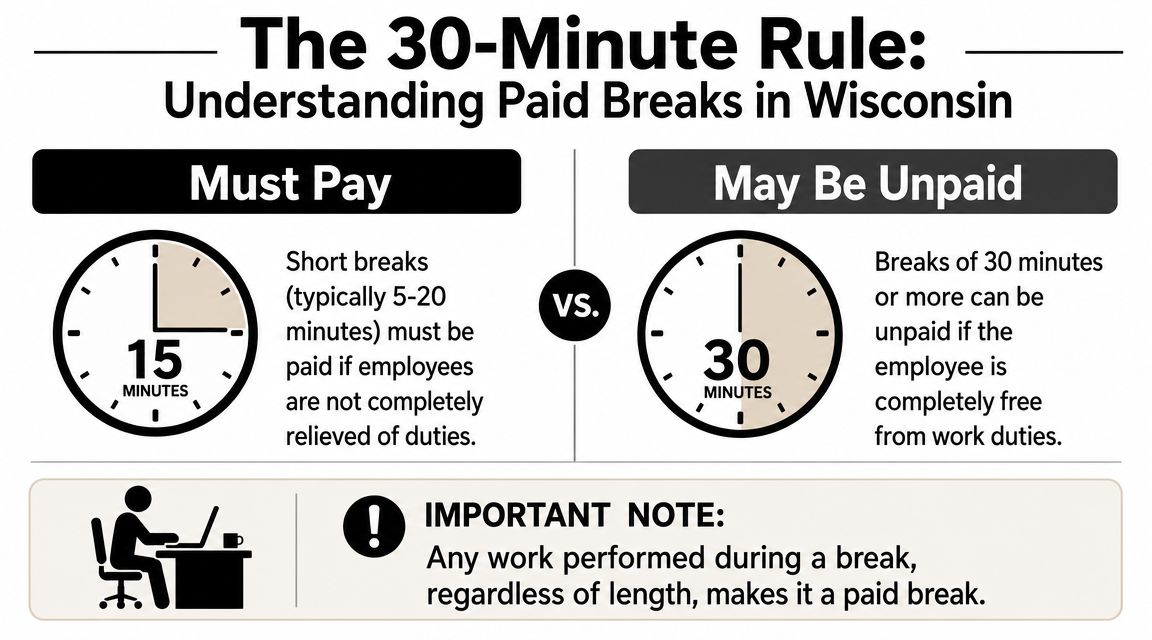
Short breaks are paid time
This is the rule many agencies miss because they treat breaks casually. If you tell staff they can grab coffee, stretch, or step away for a short reset, that time usually counts as paid work time under Wisconsin guidance.
That means things like these should not disappear off the clock:
- A quick coffee break: If you authorize it and it's under the threshold Wisconsin treats as paid time, count it.
- A short mental reset between meetings: Same issue. If it's part of the workday, it's usually paid.
- A brief walk after a client call: If the employee remains in the flow of the workday, you should treat it carefully.
- A manager-approved short break for remote staff: Remote work doesn't erase compensable time rules.
For agencies still relying on manual punches, a tighter clock in and out process becomes particularly helpful. Not because everyone needs rigid punch culture, but because break records get unreliable fast when teams are left to guess what counts.
Unpaid meal periods need real duty relief
The legal test is not whether you called it “lunch.” The test is whether the employee was free from work duties.
If your account director eats at her desk while watching an urgent client inbox, that does not look like a clean unpaid meal period. If your remote project manager is “on lunch” but still expected to answer Slack from a key client, same problem. If your receptionist must stay available to greet visitors while eating, that time likely needs to be paid.
Practical rule: If an employee has to monitor, respond, remain available, or keep one eye on work, don't assume you can treat that break as unpaid.
What works and what doesn't
Some break setups hold up well in agency environments. Others don't.
| Approach | What usually works | What usually fails |
|---|---|---|
| Paid short breaks | Simple, low-friction, easy to explain | Pretending they don’t count as time worked |
| Unpaid meal periods | Clear start and stop, no work duties, manager respect for boundaries | Lunches interrupted by Slack, calls, or “quick questions” |
| Flexible break culture | Fine when rules are written and payroll matches reality | Informal norms with no documentation |
| Remote team lunches | Fine if employees are truly off duty | “Lunch” that still includes monitoring messages |
The biggest trap is partial relief. Agencies love flexibility, but the law likes clean categories. If you want an unpaid meal period, treat it like real off-duty time. Anything less invites disputes.
How to build a compliant break policy for your agency
A break policy should do two jobs. It should tell employees what they can expect, and it should tell managers what they may not do.
Most agencies get into trouble because the handbook says one thing and team leads do another. A decent policy is not long. It is specific.
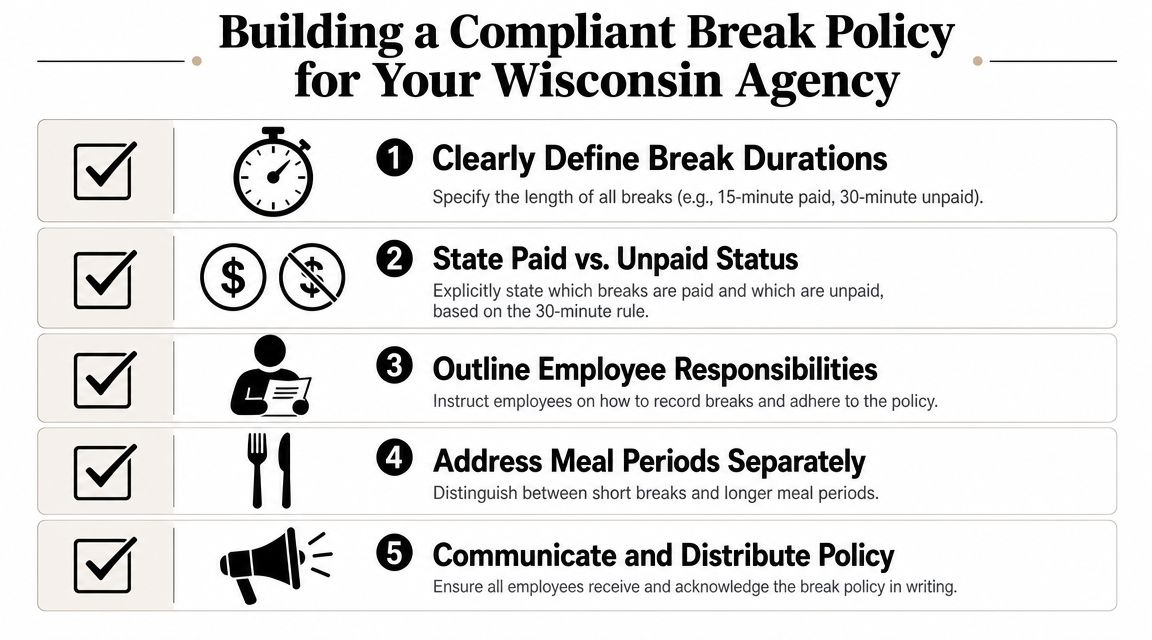
Put the policy in writing
At minimum, your handbook should answer these points in plain English:
- Break lengths: State which short breaks your agency allows and how long meal periods are.
- Paid versus unpaid status: Be explicit. Don’t make employees infer this from payroll practice.
- Duty expectations during lunch: Spell out that unpaid meal periods must be work-free.
- Recording rules: Tell employees how to record unpaid meal periods and what to do if they work during one.
You do not need legal theater. You need usable language.
A simple policy might say that the agency offers paid short rest breaks at manager discretion and an unpaid meal period for employees scheduled long enough to take one. It should also say employees must report any meal period during which they performed work, so payroll can pay that time correctly.
Train managers, not just employees
Many violations start with a well-meaning manager who says, “Take lunch, but keep your phone nearby in case the client calls.” That one sentence can turn an unpaid meal period into paid time.
Your supervisors need practical examples, such as:
- Client service staff: If they must monitor a priority account, don’t code that lunch as unpaid.
- Creative teams: If someone chooses to sketch ideas while eating, you need a rule for how that time gets reported.
- Remote staff: “Away” status is not enough if the person is still expected to respond.
- Front desk or office support: Coverage needs to be scheduled, not assumed.
A policy without manager training is just a document waiting to be ignored.
Build for real agency schedules
Agencies don’t run on factory whistles. Some people have back-to-back calls. Some have deep work blocks. Some are in-office, some remote, some hybrid. So your policy needs enough structure to be compliant and enough flexibility to fit actual work.
I’d rather see a simple, enforced policy than a perfect policy no one follows.
If you need help tightening handbook language or sorting through edge cases before they turn into legal cleanup, it can be useful to bring in outside support like Hire Paralegals for document and workflow help. That’s especially useful when HR, operations, and legal all have partial ownership of the policy and no one has time to clean it up properly.
For agencies trying to connect policy with scheduling, payroll, and supervisor accountability, this primer on workforce management for growing teams is a good operational companion. The legal rule is only half the job. The other half is making daily practice match it.
Using time tracking and recordkeeping to avoid penalties
The cleanest break policy in the world won’t save you if your records are weak.
When a wage dispute comes up, agencies often discover they’ve been running on assumptions. They assumed lunch was unpaid because the handbook says so. They assumed remote staff stepped away fully. They assumed managers handled exceptions consistently. Those assumptions fall apart fast if the time record says nothing useful.
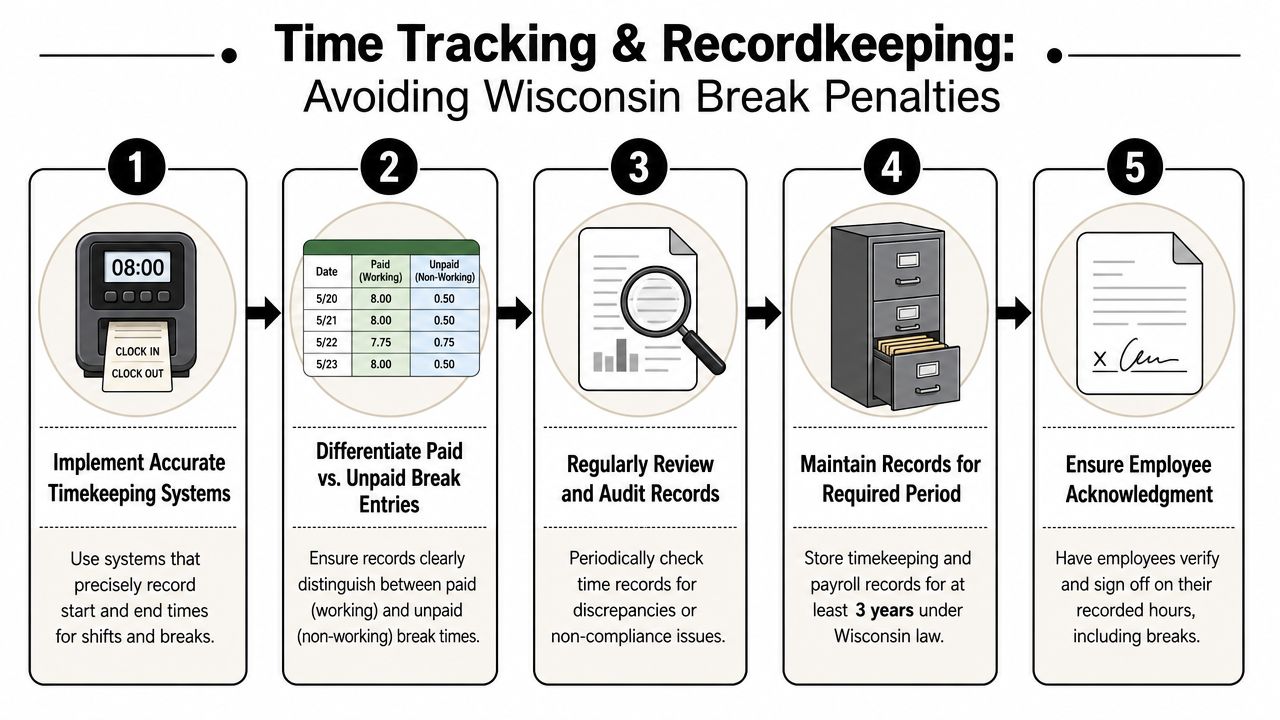
Manual systems break down first
Paper sheets, spreadsheet logs, and after-the-fact timesheet entry all create the same problem. They rely on memory.
That’s bad enough for client billable time. It’s worse for break compliance, because breaks are small, irregular, and easy to forget. People remember project work. They don’t always remember whether lunch was interrupted by a call, whether they answered three Slack messages, or whether they stayed available while eating.
Here’s where manual processes usually fail:
- Short paid breaks vanish: Nobody records them because they feel too minor.
- Unpaid lunches get auto-deducted: But no one checks whether the employee worked.
- Remote interruptions go unseen: The calendar, inbox, and chat history tell one story while the timesheet tells another.
- Manager corrections are inconsistent: One lead fixes missed meal periods, another ignores them.
Better records lower friction
You want a system that captures work close to when it happens, not days later. For agencies, that usually means combining time data with the calendar and reviewing exceptions regularly instead of waiting for payroll week.
The practical goal is simple. Create records that show when someone worked, when they were off duty, and when an unpaid break was interrupted.
Good records do two things at once. They help you pay people correctly, and they give you something defensible if an employee says, “I worked through lunch all the time.”
If you’re still dealing with weekly timesheet cleanup and manager guesswork, a more automated approach can reduce a lot of that friction. This guide to automated timesheet software for agencies is useful because it focuses on the operating reality agency leaders face, not just payroll theory.
What to audit every month
Don’t wait for a complaint. Review patterns before they become habits.
Look for things like repeated auto-deducted lunches, teams with no recorded meal exceptions, supervisors whose staff always appear to take perfect breaks, and client-facing roles that regularly show activity during unpaid meal windows. Those are the places where policy and reality often drift apart.
A short monthly review by HR, payroll, or operations can catch most issues early. It also sends a message to managers that break handling is part of normal operational discipline, not an afterthought.
Frequently asked questions on Wisconsin break laws
Do adult employees in Wisconsin have to get a lunch break?
No. Wisconsin does not require employers to provide meal or rest breaks to employees who are 18 or older, as covered earlier from the Wisconsin DWD guidance. That said, many agencies still choose to offer them because a written break structure is easier to manage than pure improvisation.
If I offer two short breaks, can I make them unpaid?
Usually, that’s the wrong move. As covered earlier, Wisconsin guidance treats employer-authorized breaks under the applicable threshold as paid time. If you offer short breaks, build your payroll process around paying them.
What does “completely relieved of duties” mean in real life?
It means the employee is not doing work and is not expected to stay available for work. If they must watch Slack, answer a phone, monitor email, cover reception, or stay engaged with client issues, you should treat that break carefully because it may be compensable.
Can remote employees take unpaid lunch breaks?
Yes, but remote work doesn’t lower the standard. If the person remains expected to respond during lunch, the fact that they are at home doesn’t turn it into a clean unpaid meal period. The issue is duty relief, not location.
What if an employee chooses to work through lunch?
Pay for the time worked. Then address the policy issue separately with coaching or supervision.
A lot of agencies make the mistake of treating this as a disciplinary problem first and a payroll problem second. It’s the other way around. Pay correctly first. Then fix behavior, expectations, workload, or manager habits.
Do I need a different rule for minors?
Yes. If you employ workers under 18, your scheduling and manager practices need to account for the required meal period described earlier. Don’t rely on a general adult policy and assume it covers everyone.
Should I auto-deduct meal periods from time records?
Be careful. Auto-deductions can work only if you have a reliable way for employees to report interrupted or missed meal periods and a real process for correcting payroll. Otherwise, auto-deducting can hide unpaid work.
What’s the safest approach for an agency?
The safest approach is a simple written policy, manager training, and records that reflect actual work patterns. You don’t need a complicated rulebook. You need a policy that matches the way your teams really work.
If your agency is tired of chasing timesheets, fixing break errors by hand, and guessing whether recorded lunch periods match reality, TimeTackle is worth a look. It helps teams capture work from the calendar, reduce manual reporting, and build cleaner records for payroll, utilization, and operations without adding more admin work to everyone’s week.