

People love to say coffee is one of the highest-margin products in food service. On paper, that sounds true. In practice, it can wreck a café owner's judgment.
Most coffee shops run on a gross margin of 75%–80% of sales, yet IBISWorld-based analysis puts average industry profit margins at only 4%–5% of sales, with total industry profit at about $3.2 billion in 2020 according to this coffee shop margin analysis. That gap is the whole story. A drink can look wildly profitable while the business behind it stays fragile.
That's why coffee house profit margins aren't one number. They're the result of dozens of small calls you make every day. How much milk goes into each latte. Who you schedule at 2 p.m. on Tuesday. Whether pastries bring real profit or just more waste. Whether your rent is survivable for your traffic pattern. Whether your menu pushes customers toward items that leave money behind.
Owners who understand that gap tend to make calmer, better decisions. Owners who don't often chase sales and still wonder why cash feels tight.
Why an 80% margin can be a dangerous myth
The “coffee shops make huge profits” story starts with a real number and ends with the wrong conclusion.
Yes, many coffee drinks carry a strong gross margin. That's the appealing part of the business. But gross margin only tells you what's left after direct product cost. It says nothing about payroll, rent, utilities, repairs, card fees, cleaning supplies, software, or the slow weekday hours that still require staff on the floor.
The dangerous part of the myth
When owners fixate on a single drink's markup, they often make bad operating choices. They add low-selling menu items because “the ingredients are cheap.” They overschedule because sales feel decent. They underprice premium drinks because they assume coffee already has plenty of room. They carry too much food because it makes the case look full.
None of that helps if the business only keeps a thin slice of revenue at the end of the month.
Practical rule: Never confuse product markup with business profit.
The sharper way to think about a café is this. Every sale first has to pay for ingredients. Then it has to carry labor. Then occupancy. Then everything else that keeps the doors open. By the time all of that is covered, the number left is usually much smaller than new owners expect.
What owners should focus on instead
If you want a realistic grip on coffee house profit margins, watch the decisions that change the bottom line every week:
- Pricing discipline: Small underpricing errors spread across every transaction.
- Labor fit: One bad schedule can wipe out the gain from a busy morning.
- Waste control: Over-pouring milk and stale food drain margin.
- Sales mix: The items you sell matter as much as how much you sell.
A café rarely fails because espresso has poor markup. It fails because the owner believed that markup was enough.
Gross vs net profit the two numbers you must know
If you own a café, you need two margin numbers in your head at all times. Gross profit tells you whether your products are priced and costed well. Net profit tells you whether your business model works.
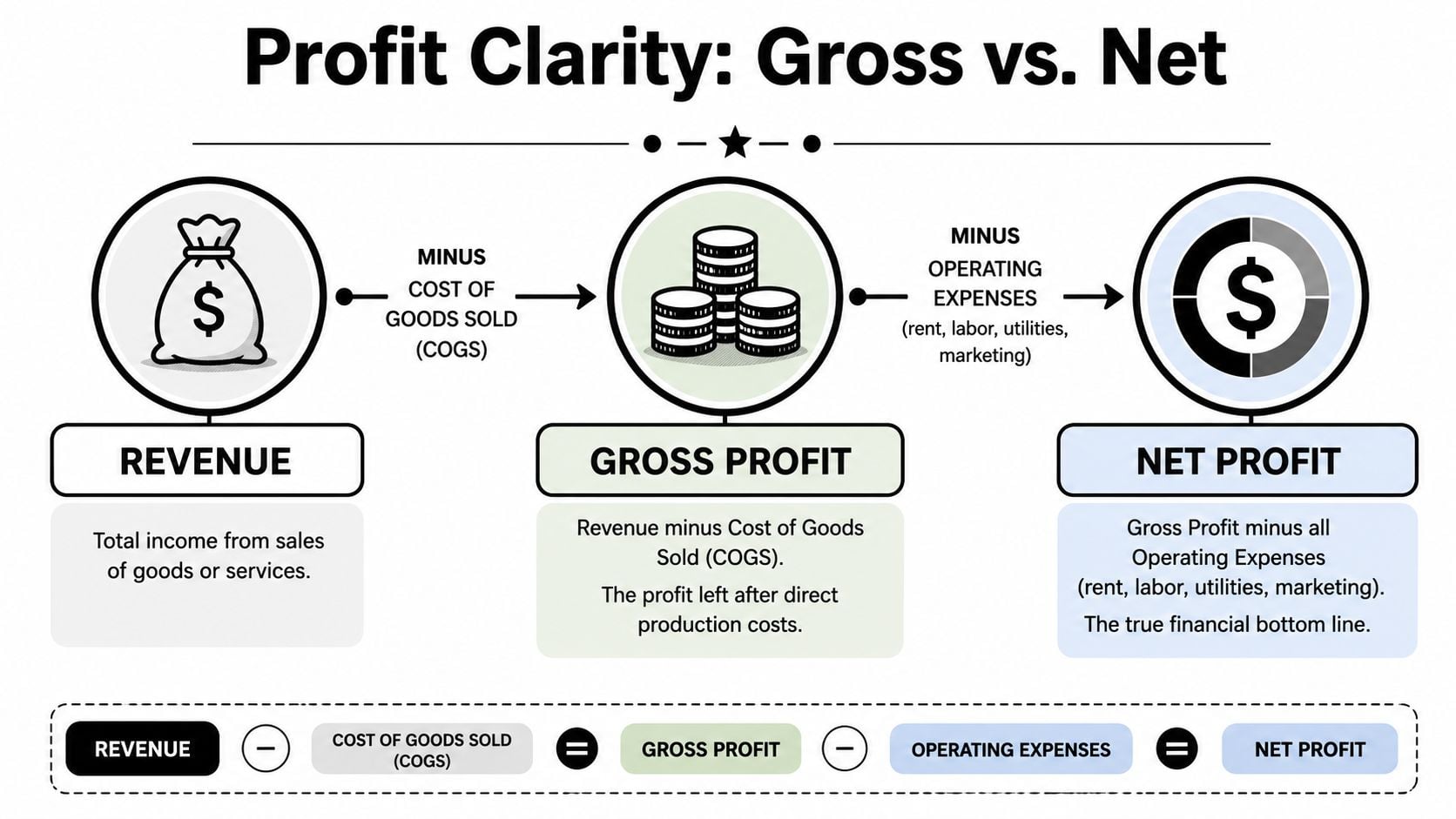
Here's the clean distinction. Gross profit is revenue minus direct product cost. Net profit is what remains after every operating expense is paid.
Gross profit is about the item
Think about one latte. You sell it. To make it, you use beans, milk, cup, lid, and maybe syrup. Those inputs are your cost of goods sold, or COGS. Subtract those from the selling price, and you get gross profit on that drink.
That's useful because it tells you whether your menu pricing makes sense. If your item costs drift up and you don't change prices, your gross margin shrinks first.
If you want a basic formula refresher, this guide on the gross profit rate equation lays out the math in a simple way.
Net profit is what pays you
Now zoom out from one latte to the whole shop. You still have gross profit from sales, but then you subtract payroll, rent, utilities, software, merchant fees, marketing, repairs, cleaning, insurance, and the rest. What survives is net profit.
That number is the truth.
For independent coffee shops, benchmark data shows beverage gross profit can reach 75%–80%, but final net profit often falls to 2.5%–10% after operating costs, based on independent coffee shop benchmark guidance.
Gross margin pays for the product. Net margin pays for the business.
Why owners mix them up
The confusion usually comes from the floor. Baristas see the cost of a drink. Owners see the menu price. Both can feel healthy. But neither view captures the full expense stack.
A simple way to keep it straight:
| Measure | What it answers | What it includes |
|---|---|---|
| Gross profit | “Did we price this item well?” | Revenue minus direct product cost |
| Net profit | “Did the shop actually make money?” | Gross profit minus all operating expenses |
When owners track only gross margin, they tend to overestimate how healthy the business is. When they track both, they start making better calls on menu, staffing, and hours.
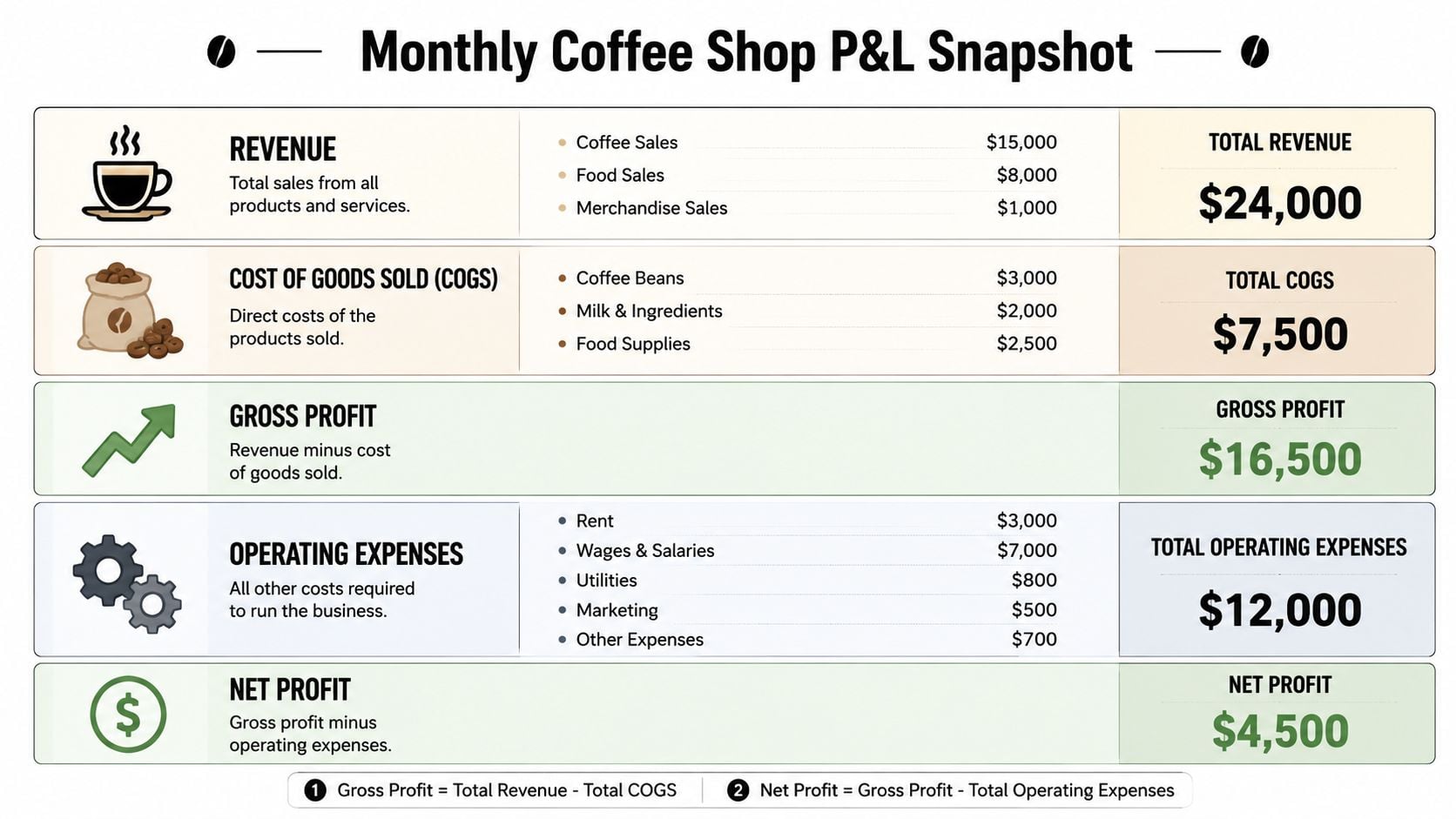
A typical coffee shop profit and loss statement
A busy café can still lose money every month. That is why the profit and loss statement matters. It turns a shop that feels active into a set of numbers you can manage.
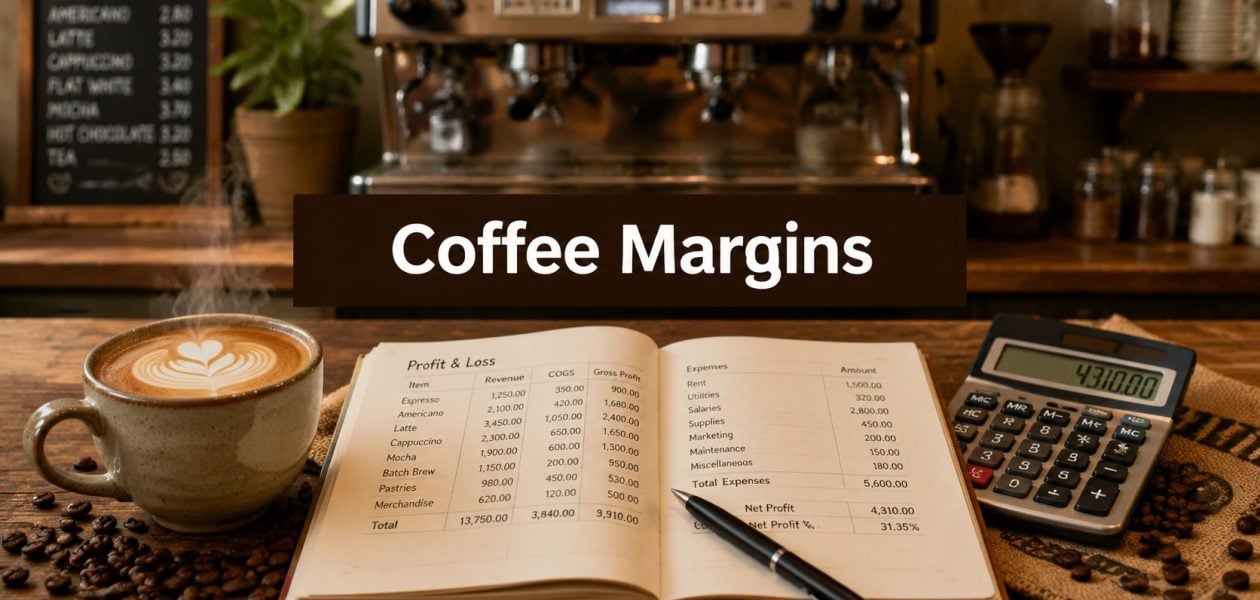
A monthly P&L starts with sales, subtracts direct product cost, then subtracts operating expenses. What remains is net profit. The format is simple. The value comes from seeing where the gap opens up between strong gross margin on drinks and the much thinner profit that survives after payroll, rent, and overhead.
The basic structure
Start with revenue by category. For most shops, that means beverages, food, retail beans, and any other sales worth tracking separately. Then list COGS, followed by operating expenses such as labor, occupancy, utilities, software, merchant fees, repairs, cleaning, insurance, and admin.
That detail matters.
A clean P&L shows whether the problem is mix, pricing, labor discipline, or fixed overhead. It also helps owners separate startup decisions from current operating performance. If you're still budgeting a new location or comparing your model to early-stage assumptions, these common coffee shop startup expenses give useful context, but the P&L is what tells you whether the shop works now.
If you need a plain-language breakdown of the expense side, this guide on how to calculate operating expenses is a useful reference.
What a healthy P&L usually shows
The National Coffee Association's café operator guidance says successful stores keep a close eye on four lines in particular: cost of goods sold, labor, occupancy, and operating profit, because each one can move quickly as sales mix or traffic changes (café business resources from the National Coffee Association). In practice, many operators use target ranges for COGS, labor, and occupancy, then adjust by concept, service model, and local rent pressure.
Use those ranges as control points, not promises.
- High COGS: The usual causes are waste, poor recipe discipline, discounting, or too much low-margin food.
- High labor: Coverage may be too heavy for actual transactions, or the menu may be too complex for the sales volume.
- Heavy occupancy costs: Rent is fixed. If sales are too low, occupancy starts eating the margin that drinks appear to create.
- Weak cash despite decent percentages: Several small misses are adding up across the month.
A café can post strong drink margins and still show a weak net result. That gap is the whole story.
How to read your own numbers
Read the P&L like an operating report, not an accounting form. Compare each line to last month and ask what changed on the floor. Did average ticket rise because of a price increase, or because more customers bought food? Did labor improve because schedules got tighter, or because service suffered and sales fell? Did COGS move because suppliers raised prices, or because waste got worse?
In this context, owners get traction. Every line on the statement connects to a daily decision.
If milk cost jumps, check drink build, waste, and ordering. If labor drifts, review deployment by hour, not just total weekly payroll. If rent feels too heavy, the answer is usually better sales per labor hour, a stronger average ticket, a better menu mix, or all three.
Good operators do not admire the P&L. They use it to find the next correction fast.
The biggest leaks analyzing your key cost drivers
A café can sell drinks with strong gross margins and still struggle to keep cash in the bank. The gap usually comes from three places: product cost, labor, and occupancy. None of them ruin the month on their own. A few small misses in all three do.
That is why coffee house profit margin is not one number. It is the result of daily decisions. How tightly recipes are followed, how accurately shifts are scheduled, how much waste gets tolerated, and whether sales are high enough to carry fixed costs.
COGS leaks usually start with execution
Higher bean and dairy prices matter, but store-level discipline matters just as much. I usually find the same issues first: milk overpouring, inconsistent shot counts, pastry waste, syrups expiring on the shelf, and grab-and-go items that disappear without being recorded. Owners often feel these losses without seeing them clearly on the P&L.
Healthy shops usually keep a close watch on both product cost and labor because those two lines move fast and punish weak controls. If either starts drifting, check operations before blaming the market.
Weekly inventory is one of the fastest ways to get clarity. Count your key items every week. Compare what should have been used against what was used. Then trace the gap. A simple sheet built around the food cost percentage equation helps turn that review into something your team can act on.
Labor leaks show up between peaks
Labor problems rarely come from the busy half hour. They come from the hour before and the two hours after, when staffing stays high but transactions fall off.
The usual pattern looks like this:
- Static schedules: The same weekly template stays in place even after traffic patterns change.
- Role overlap: Openers, mids, and closers stack on top of each other because tasks are vague.
- Weak cross-training: One person can bar, another can register, but the shift cannot flex as demand changes.
- Slow station design: Poor bar flow forces extra labor onto the floor to maintain speed.
This is a hard trade-off. Cut too deep and service slips. Staff too heavily and payroll eats the margin. The fix is better deployment by hour, not broad payroll cuts.
If you are still building the model, realistic coffee shop startup expenses matter here too. Early choices on equipment, layout, and menu scope often decide how much labor the shop will need every day.
Rent punishes weak sales density
Rent is fixed, so it gets more dangerous when sales soften. A good site with high occupancy cost can still work if the shop has enough traffic, pricing power, and throughput. A cheaper site can still underperform if customers do not come back often enough or the average ticket stays low.
Owners cannot manage rent the same way they manage milk waste or scheduling. They manage it by raising sales per labor hour, improving ticket mix, increasing repeat visits, and using the space well across more dayparts.
This is the practical point. Gross margin on a latte may look excellent. Net margin depends on whether the whole operation is tight enough to protect what that latte should have earned.
How to actually improve your coffee house margins
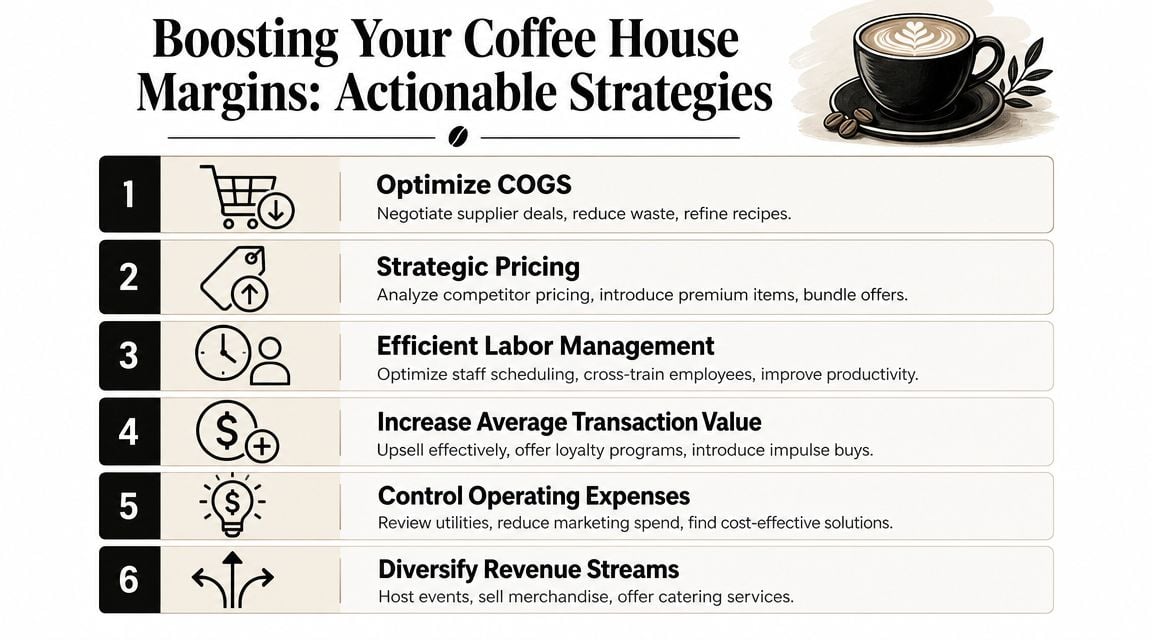
Better margins rarely come from one heroic move. They come from repeated small corrections. A tighter recipe. A cleaner schedule. A better upsell. A food item removed because it looked good in the case but didn't earn its keep.
That's good news, because most owners can improve profit without changing their whole concept.
Fix the menu before you chase more traffic
Menu mix is one of the cleanest profit levers in a café. Beverage gross margins often exceed 70%, while food gross margins are typically 55%–65%, based on this menu mix and café margin breakdown. That means not every added sale helps equally.
A lot of owners treat food as an automatic growth path. Sometimes it is. Sometimes it adds prep, waste, slower service, and lower margin. The answer depends on execution.
Use a menu review that asks blunt questions:
- Which drinks carry the best margin and sell often? Put them where customers see them first.
- Which items create complexity? If a pastry line creates waste and slows service, trim it.
- Which add-ons earn well? Alt-milk charges, flavor upgrades, and premium sizes can improve the ticket if customers accept them.
- Which items are emotional favorites but financial drags? Keep fewer of those than you want to.
Owner check: If your menu has items your team can't cost confidently, your menu is too loose.
Tighten cost control at the store level
Most cost control isn't glamorous. It's recipe cards, pars, purchase discipline, and manager follow-through.
Start with the basics:
- Standard recipes: Write them, train them, check them.
- Waste logs: If staff throw things out, record what and why.
- Ordering limits: Don't let hopeful demand shape purchasing.
- Supplier reviews: Compare quality, pack size, and delivery reliability, not just invoice price.
Utility costs deserve a look too, especially if your espresso equipment runs hard all day. If you want a practical read on coffee machine running costs, that breakdown helps owners think more clearly about machine-related power use.
Build schedules from sales patterns
Good labor management is less about “cutting hours” and more about matching labor to real demand. Pull sales by hour and by daypart. Then build coverage around actual volume, not memory.
A better labor system usually includes:
| Focus area | What to do |
|---|---|
| Peak staffing | Put your strongest people where queue speed matters most |
| Slow periods | Run lean, with staff who can flex across stations |
| Prep timing | Move prep into hours that don't require extra customer-facing coverage |
| Cross-training | Teach bar, register, runner, and close tasks across the team |
Cross-training matters more than many owners think, because it gives you flexibility without always adding headcount. The best café teams don't just work hard. They move where the work is.
Raise the average ticket without becoming pushy
You don't need a scripted upsell every time. You need a menu and service flow that make the next purchase easy.
A clean pastry display near the register, a visible premium seasonal drink, or a simple prompt about a drink add-on can do more than a bloated menu board. The point is to make the profitable choice feel natural.
That's what good margin work looks like in a café. Quiet, repeatable, and built into daily operations.
Measuring what matters KPIs and a simple margin calculator
If you only look at monthly profit, you'll catch problems late. Margin management works better when you watch a short list of operating signals every week.
The first metric I'd track is average ticket size. It tells you whether pricing, upselling, and menu mix are improving. The second is sales by daypart, because staffing without daypart context is guesswork. The third is sales per labor hour, which gives managers a direct way to judge whether a schedule matched demand.
The KPIs worth watching every week
Keep the list short enough that someone will use it:
- Average ticket size: Shows whether customers are buying enough per visit.
- Sales per labor hour: Helps spot overstaffed shifts.
- Category mix: Beverage, food, and retail sales often tell a margin story before the P&L does.
- Waste notes: Even simple logs can reveal recurring prep and ordering mistakes.
If you want a finance-side companion metric for evaluating return on spending decisions, this guide to mastering the profitability index is a useful read.
A simple calculator structure that works
You can build a practical margin calculator in Excel or Google Sheets without getting fancy. Give it input fields for revenue categories, product purchases, labor cost, occupancy costs, utilities, marketing, software, repairs, and any other recurring expenses.
Then build a few outputs:
- Gross profit
- Gross margin
- Total operating expenses
- Net profit
- Net margin
Add one more useful layer. Create scenario inputs so you can test changes before making them. For example, you can model what happens if food sales rise but food waste rises too, or if a price increase changes ticket size.
Good operators don't wait for accounting to explain the month. They build a simple model and check it often.
A calculator won't run your café. It will make the trade-offs visible, which is usually enough to improve decisions fast.
The bigger picture regional differences and future trends
A strong margin in one market can look weak in another. That's why café owners get into trouble when they copy benchmark numbers without adjusting for location, format, and customer behavior.
A downtown shop with high rent and dense foot traffic has a different margin structure than a neighborhood café with lower occupancy cost and steadier regulars. A grab-and-go concept can support labor differently than a full sit-down space. Even menu expectations change. In some markets, customers accept premium drink pricing easily. In others, they resist small increases but buy more food.
What changes by region and model
The local math matters more than broad averages. Ask practical questions.
- How expensive is labor in your market?
- Does your traffic come in short peaks or a steady stream?
- Can your concept command premium pricing?
- Do customers want speed, seating, food, or all three?
Those factors shape what “good” coffee house profit margins look like for your specific shop.
What the next few years will reward
The U.S. coffee shop market is maturing, with projected growth slowing from 6.9% CAGR in 2020–2025 to 1.3% CAGR in 2025–2030, according to this U.S. coffee shop market analysis. That projection matters because slower market growth usually gives owners less room to cover mistakes with rising sales.
So the next phase of café profitability will reward operators who do ordinary things well, every week. Clean pricing. Strong scheduling. Category-level menu decisions. Better purchasing. Faster service. A brand strong enough to justify what the menu asks customers to pay.
Coffee will always look attractive from the outside because a cup can carry a strong markup. The operators who last know the harder truth. A good café isn't built on one big margin. It's built on many small decisions that hold together.
If your team spends too much time building reports instead of acting on them, TimeTackle is worth a look. It helps teams track time through calendars and workflows, reduce manual reporting, and get a clearer view of how work, cost, and productivity connect. That kind of visibility makes margin conversations faster and a lot more useful.