



Overtime isn't taxed at a special higher federal rate. Under the newer federal rules, eligible workers may deduct up to $12,500 of qualified overtime compensation each year, or $25,000 for joint filers, but the confusion on your paycheck usually comes from withholding, not from a separate overtime tax.
If you're reading this after a long week and staring at a pay stub that feels disappointing, you're not alone. I've heard the same question from employees, supervisors, and department heads for years: “Why does my overtime check look like taxes ate half of it?”
The short answer is that payroll and tax filing are not the same thing. Your employer withholds money from each check based on payroll formulas. Your real tax bill gets settled later, based on your total income and filing status. Those are related, but they're not identical, and that gap is where most of the confusion lives.
There's also a newer wrinkle now. Since the IRS described a federal overtime deduction in July 2025, many workers have heard some version of “no tax on overtime” and assumed overtime is now tax-free. It isn't. The rule is narrower than that, and if you don't understand the fine print, your paycheck will still look confusing.
The real reason your overtime paycheck looks smaller
Those asking “is overtime taxed at a higher rate” are really asking a different question. They're asking why the net pay from an overtime check feels smaller than expected.
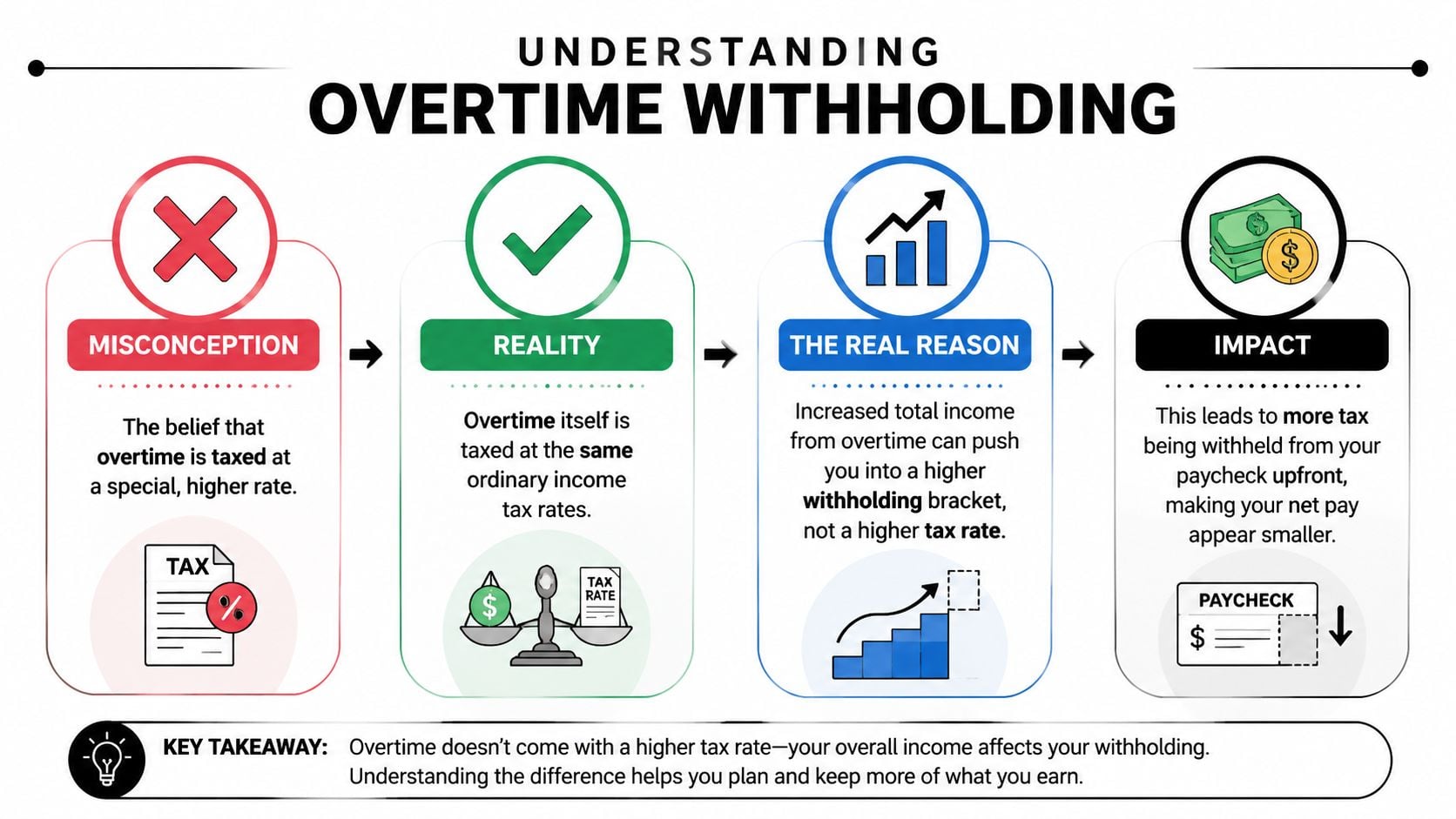
The answer starts with one basic rule. Overtime is ordinary income, not a special category with its own federal tax rate. Nowsta's explanation of overtime withholding puts it plainly: overtime is taxed under the same federal income tax system as your regular wages, and what changes most often is the withholding calculation.
Think in buckets, not one giant tax rate
I explain tax brackets to employees with a bucket example.
Picture your income filling a row of buckets. The first bucket gets taxed at one rate. When that fills up, the next dollars spill into the next bucket, which has a different rate. Your whole income doesn't suddenly get taxed at that higher rate. Only the dollars in that next bucket do.
That matters because a lot of people think this:
“I worked overtime, so my whole paycheck got taxed at a higher rate.”
That's not how the federal income tax system works.
What usually happens is simpler. Your payroll system sees a larger check for that pay period and calculates withholding as if checks of that size may continue. That can make the withholding on that one paycheck look aggressive, even when your final year-end tax bill won't match that exact pattern.
Here's the visual version:
Why payroll feels harsher than tax filing
Payroll runs on formulas. Your tax return runs on your full-year reality.
That's why a paycheck with extra hours can feel off. The system may withhold more upfront because the check is bigger, while your actual tax liability gets sorted out later when your full-year income is known.
Practical rule: A paycheck can have higher withholding without your overtime being subject to a special tax rate.
This same confusion shows up with other pay types, too. If you want a plain-English comparison, Australia Wide Tax Solutions on bonus tax is useful because it shows how irregular pay often looks overtaxed at the paycheck level even when the final tax outcome works differently.
If you manage payroll or approve extra hours, it also helps to understand how premium pay fits into wage calculations more broadly. TimeTackle has a simple guide on overtime and holiday pay that gives helpful context on how these pay categories differ operationally.
A tale of two paychecks: Overtime withholding in action
Employees usually stop arguing with the math at this point, because side-by-side checks make the issue obvious.
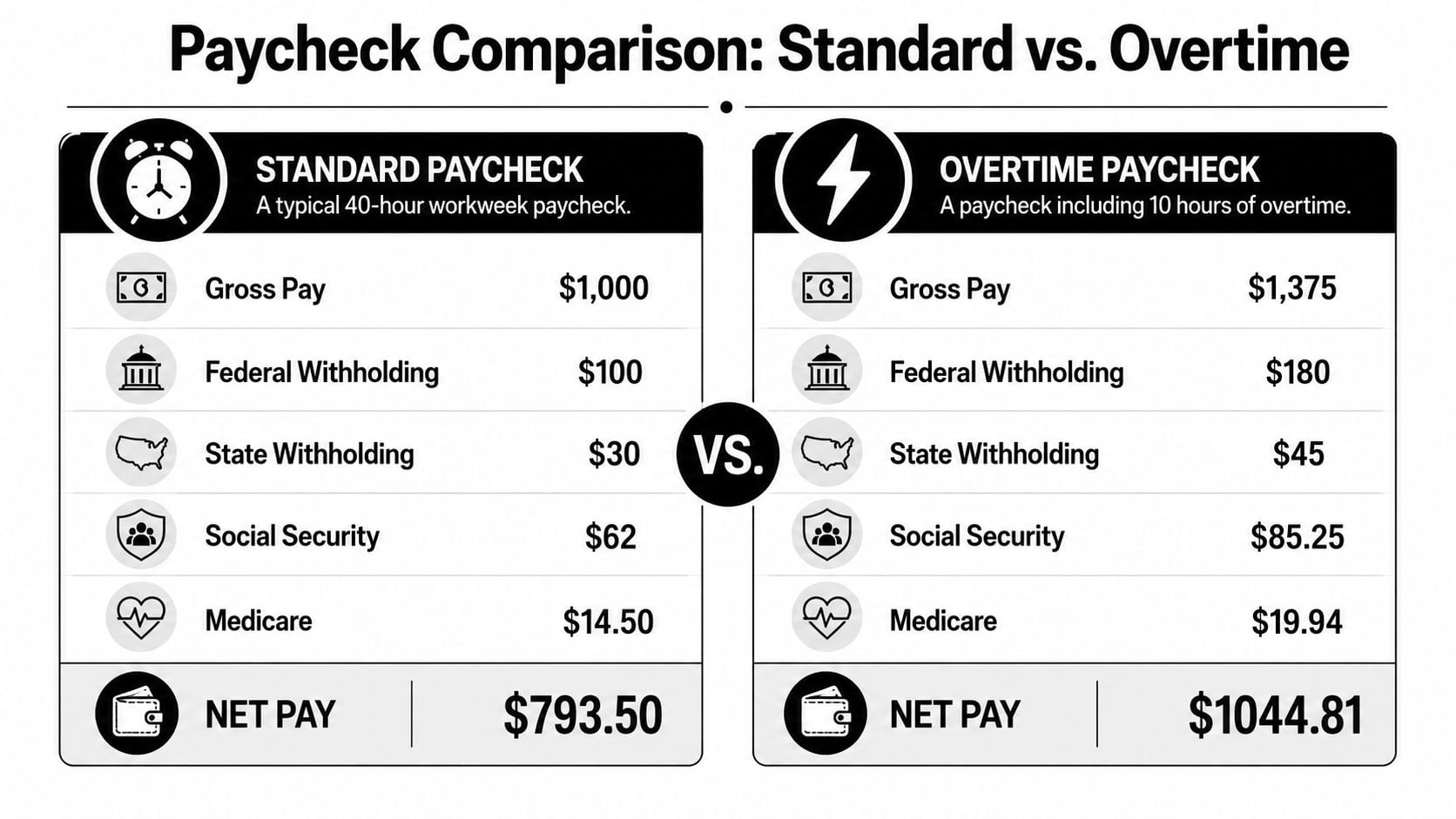
Here's a sample comparison. It shows how an overtime check can produce a larger gross amount, a larger tax withholding amount, and still leave the employee feeling underwhelmed.
Side-by-side paycheck example
| Paycheck | Gross pay | Federal withholding | State withholding | Social Security | Medicare | Net pay |
|---|---|---|---|---|---|---|
| Standard paycheck | $1,000 | $100 | $30 | $62 | $14.50 | $793.50 |
| Overtime paycheck | $1,375 | $180 | $45 | $85.25 | $19.94 | $1044.81 |
What jumps out right away is the federal withholding line. The gross pay rises, but the withholding rises faster, so the employee sees more earnings but not as much extra take-home pay as expected.
That's the budgeting problem.
Cone Law Firm's overtime tax explainer makes a point I agree with from years in payroll: the gap between payroll withholding and final tax liability matters because it creates a short-term cash flow surprise, especially for hourly workers who budget around net pay.
What the employee actually feels
Most workers don't compare annual tax formulas. They compare one Friday to the next.
So the reaction sounds like this:
- “I worked extra and barely saw it.” The employee is comparing effort to net pay, not gross pay.
- “They taxed my overtime more.” What they're seeing is usually bigger withholding, not a separate overtime tax.
- “It wasn't worth it.” That may be a cash flow reaction, even when the extra work still increased total after-tax income.
If you've ever worked with payroll outside the U.S., the pattern feels familiar. A good primer on Australian pay-as-you-go tax system shows the same broad principle: withholding systems often estimate tax during the year, while the final return cleans things up later.
The new 2026 federal overtime tax deduction
The older answer to “is overtime taxed at a higher rate” was pretty straightforward. No, it isn't. End of story.
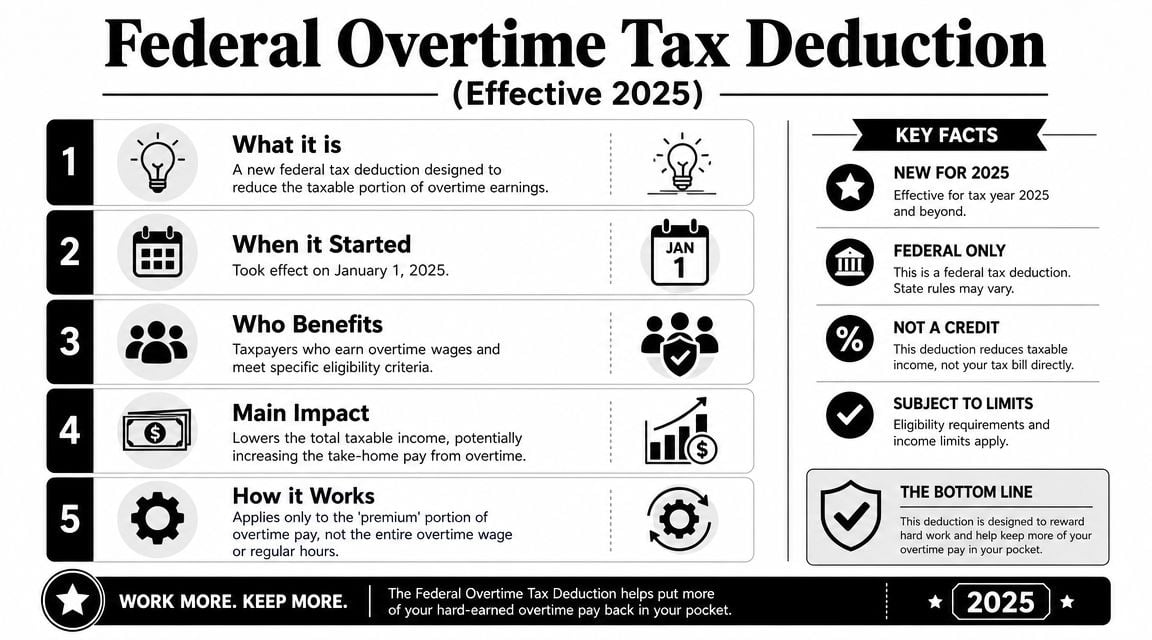
The newer answer is a little more interesting because there's now a federal deduction tied to overtime compensation. The IRS says eligible workers may deduct up to $12,500 of qualified overtime compensation annually, or $25,000 for joint filers, with phaseouts beginning at $150,000 MAGI for single filers and $300,000 for joint filers, according to the IRS overtime deduction guidance.
That's a real change. But it doesn't mean every dollar of overtime is suddenly tax-free.
What changed
A major milestone came in July 2025, when the IRS described the federal overtime deduction as part of broader tax changes. That matters because it marked a widely publicized federal rule tied directly to overtime compensation, rather than a made-up idea about an “overtime tax bracket.”
The deduction applies to qualified overtime compensation. That phrase matters more than the headlines.
What the deduction does and doesn't do
Here's the clean version:
- It does reduce taxable income for eligible workers. That can lower what you owe when you file.
- It doesn't erase all taxes on overtime. It is a deduction, not a blanket exemption.
- It doesn't automatically fix paycheck withholding. You may still see normal withholding during the year.
- It does have income limits. The phaseout starts at $150,000 MAGI for single filers and $300,000 MAGI for joint filers under the IRS guidance above.
This is why workers can hear “no tax on overtime” and still see taxes come out of an overtime check. Payroll withholding can stay the same even when filing-time deductions change the final outcome.
Why this matters to employees and employers
For employees, the deduction changes the year-end picture. You may owe less federal income tax than you expected if your overtime fits the rule.
For employers, the bigger issue is communication. If managers say “overtime is tax free now,” employees will feel misled the moment they open their pay stub. A better message is this: a deduction may help at filing time, but regular payroll withholding can still appear unchanged in the moment.
What counts as a qualified overtime premium?
This is the part often overlooked.
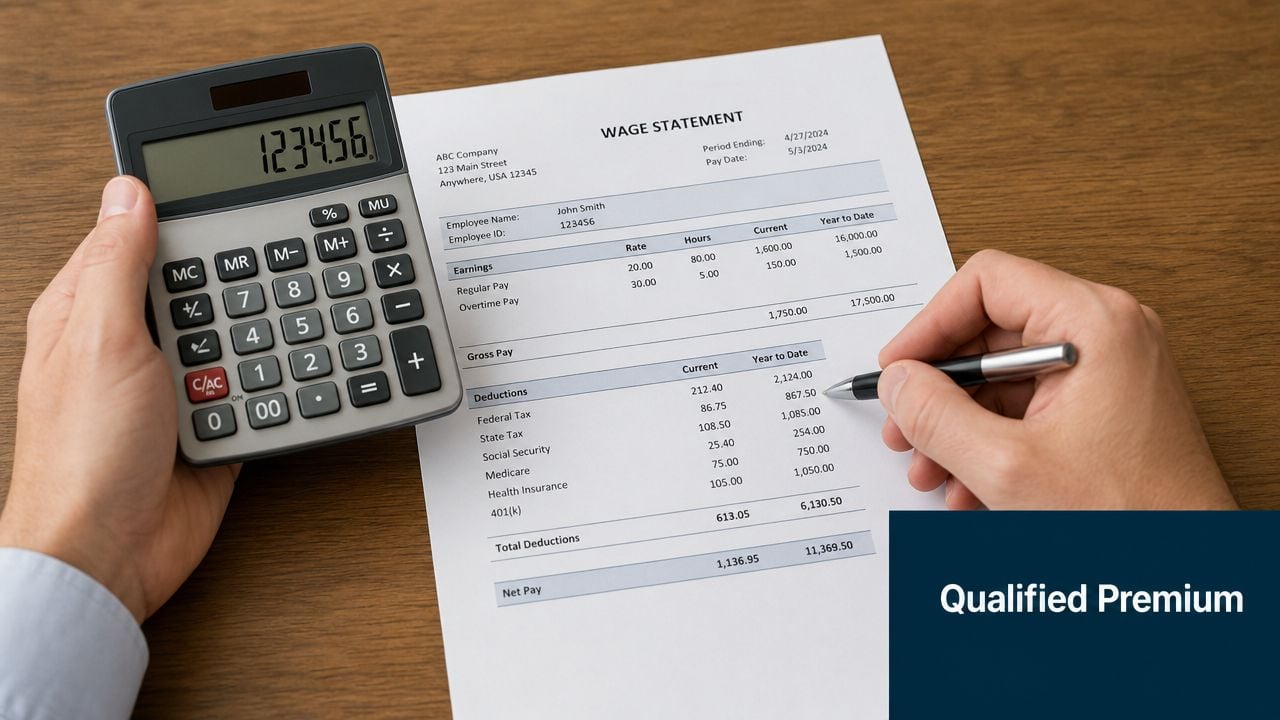
The deduction does not apply to your full overtime wage. It applies to the premium part above your regular rate. IRS guidance says qualified overtime compensation is the portion that exceeds the worker's regular rate, which in practice is usually the 50% premium in time-and-a-half pay. Fidelity gives a clear example in its overtime deduction explainer.
A simple way to calculate it
Use this basic logic:
- Regular hourly rate: your normal rate
- Overtime rate: your time-and-a-half rate
- Qualified premium: the difference between those two rates
The Fidelity example is clean and easy to remember:
| Item | Amount |
|---|---|
| Regular hourly rate | $20 |
| Overtime hourly rate | $30 |
| Qualified overtime premium | $10 |
If you earn $20 an hour and your overtime rate is $30, only the extra $10 may qualify for the deduction. Your original $20 per overtime hour is still treated like ordinary taxable wages.
Why employees get tripped up here
People hear “overtime deduction” and assume the full time-and-a-half amount qualifies. It doesn't.
“The extra half” is the part to watch in a standard time-and-a-half setup.
That distinction matters at tax time, especially if you're estimating what the deduction may do for you. If you count the whole overtime check instead of just the premium portion, you'll expect a much larger tax break than the rule allows.
Don't forget FICA and state income taxes
The federal deduction is helpful, but it doesn't wipe the slate clean.
TurboTax's write-up on the rule notes that the newer federal overtime tax break is a deduction, not an exemption, and that Social Security and Medicare taxes still apply to overtime pay under the normal rules in its qualified overtime deduction overview.
What still comes out of overtime pay
Two things often stay in place even when a worker qualifies for the federal deduction:
- FICA taxes still apply. That means Social Security and Medicare still come out of overtime wages under the regular payroll process.
- State income tax may still apply. This article is about federal rules. Your state may follow different rules, and some states won't mirror federal treatment.
That's why an employee can qualify for the federal deduction and still feel like plenty of money came out of the overtime check. Some of those deductions are still fully in force.
Why state rules make this harder
Managers often answer from memory based on federal rules alone. That's risky.
If your team works across states, or even just in one state with its own overtime quirks, check the state-specific rules before making a blanket statement. For California teams, for example, TimeTackle's guide on how to calculate overtime in California is a useful operational reference because state wage rules can affect how overtime gets calculated before taxes even enter the conversation.
How to adjust your tax withholding and plan ahead
Once people understand the difference between withholding and final tax liability, the next question is practical: “What should I do with that information?”
My answer is simple. Don't wait until filing season to discover your withholding was off.
Start with your year, not your last paycheck
A single overtime check can distort how things feel. What matters more is your full-year pattern.
If you expect overtime to keep happening, look at the year as a whole. If the overtime was a one-off, don't assume every future check will look the same. The payroll system only sees what's on that payroll run.
A good first move is to use the IRS withholding tools and compare your current paycheck pattern with what you expect for the rest of the year. If your overtime is steady, a new Form W-4 may make sense. If it's irregular, you may decide to leave withholding alone and settle the difference when you file.
Practical steps that help
- Review your pay stub line by line. Separate gross pay, federal withholding, FICA, state withholding, and net pay.
- Estimate your overtime pattern. Are you in a busy season, or was this just one tough week?
- Update your W-4 if needed. If your year is changing, your withholding should reflect that.
- Track overtime cleanly. If your hours are messy, your pay and tax planning will be messy too.
Manager note: Employees usually don't need a lecture on tax theory. They need help reading the pay stub and understanding what may happen by year-end.
If you like comparing how different tax strategies affect take-home pay over time, the Everglow Prosperity guide to cutting tax is worth reading as a broad example of how planning choices can change the end result, even when the paycheck-level effect isn't obvious right away.
For agency leaders, this is also where operations and payroll meet. If your team tracks time poorly, you'll struggle to explain overtime, audit it, or plan withholding conversations with any confidence.
A manager's guide to overtime tax questions
If you lead a team, this issue won't stay personal for long. It becomes a management problem the minute two employees compare pay stubs in the break room.
The fix is communication. Don't wait for frustration to build.
What managers should say
Keep it short and accurate:
- Overtime isn't taxed at a special higher federal rate.
- Your paycheck may show higher withholding because the check is larger.
- The federal overtime deduction may help at filing time if you qualify.
- FICA and state taxes may still apply.
That message is easier for employees to trust because it matches what they see on the pay stub.
You can also give supervisors a one-page internal FAQ and train them not to improvise tax advice. If your teams regularly ask how premium pay works, TimeTackle's guide to time-and-a-half pay is a solid resource to share for wage basics before the tax questions even start.
A calm, accurate answer saves HR time. It also builds trust, which matters more than most managers realize.
If your team struggles to track overtime cleanly, explain pay differences, or connect calendar work to accurate reporting, TimeTackle can help. It pulls time data from calendars and connected systems, reduces manual timesheet chasing, and gives operations leaders a clearer view of where hours go, which makes payroll conversations a lot easier when overtime starts piling up.