



If you run a mid-sized agency in Montana, labor compliance usually shows up at the worst time. A client deadline slips, your team works late, someone logs weekend revisions from home, and payroll lands on your desk with a simple question that doesn't have a simple answer. Who should get overtime, what counts as working time, and how much documentation is enough if a performance issue later turns into a termination dispute?
That's where montana labor laws feel different from the generic HR advice you see online. A lot of national guidance assumes a standard at-will state, a standard office setup, and a standard hourly workforce. Montana doesn't fit that mold, and agencies don't either. You've got account managers on salary, designers on hourly pay, consultants moving between client calls and internal meetings, and remote staff whose workday often lives inside Outlook, Google Calendar, Slack, and a project tool.
The practical problem isn't reading the statute. It's building daily habits that hold up when payroll is tight, a manager makes a rushed call, or the state asks for records later. That means clean classifications, reliable time capture, timely pay, and documentation that says more than “wasn't a fit.”
Navigating Montana labor laws without the legal headache
A Bozeman agency owner recently described a situation I hear often. The team had a heavy client launch, two designers worked extra hours from home, a project manager answered emails over the weekend, and nobody was fully sure what belonged on the timesheet. The owner wasn't trying to cut corners. The problem was that the business had grown faster than its payroll habits.

That's a significant issue for many firms dealing with montana labor laws. The rules matter, but so does the shape of the work. Agency work is fragmented. A day might include client calls, internal planning, proposal writing, revisions, admin tasks, and after-hours cleanup. If you rely on memory or loose spreadsheets, small errors stack up fast.
Where agency owners usually get tripped up
Most mistakes start in one of these places:
- Mixed classifications: A salaried employee gets treated as exempt without a real review of what they do.
- Remote work drift: Managers approve flexible schedules, but nobody defines how after-hours work gets recorded.
- Thin documentation: Performance concerns live in chat messages or vague notes instead of a clear record.
Practical rule: If a manager can't explain how time gets recorded for off-calendar work, the system isn't ready for a wage dispute.
The fix is less dramatic than people think. You need a payroll process that matches Montana rules, a timekeeping method people will use, and manager training that turns “common sense” into repeatable practice.
What works in practice
For agencies, the best compliance systems are boring. They tell staff what counts as work, when overtime must be approved, how corrections get made, and where records live. They also assume remote employees will sometimes work in short bursts outside a normal schedule, because that's how project-based work happens.
What doesn't work is relying on annual handbook acknowledgments and hoping managers apply the rules consistently. They won't. People under deadline take shortcuts, and those shortcuts usually show up later in payroll, claims, or exit disputes.
The core of Montana wage and hour rules
The wage and hour basics are where a lot of Montana employers need to slow down and get precise. As of January 2026, Montana's minimum wage is $10.85 per hour, with a lower $4.00 rate permitted for non-FLSA covered businesses with gross annual sales of $110,000 or less. All non-exempt employees must receive 1.5 times their regular rate for hours worked over 40 in a workweek, according to the Montana Department of Labor and Industry labor market information page.
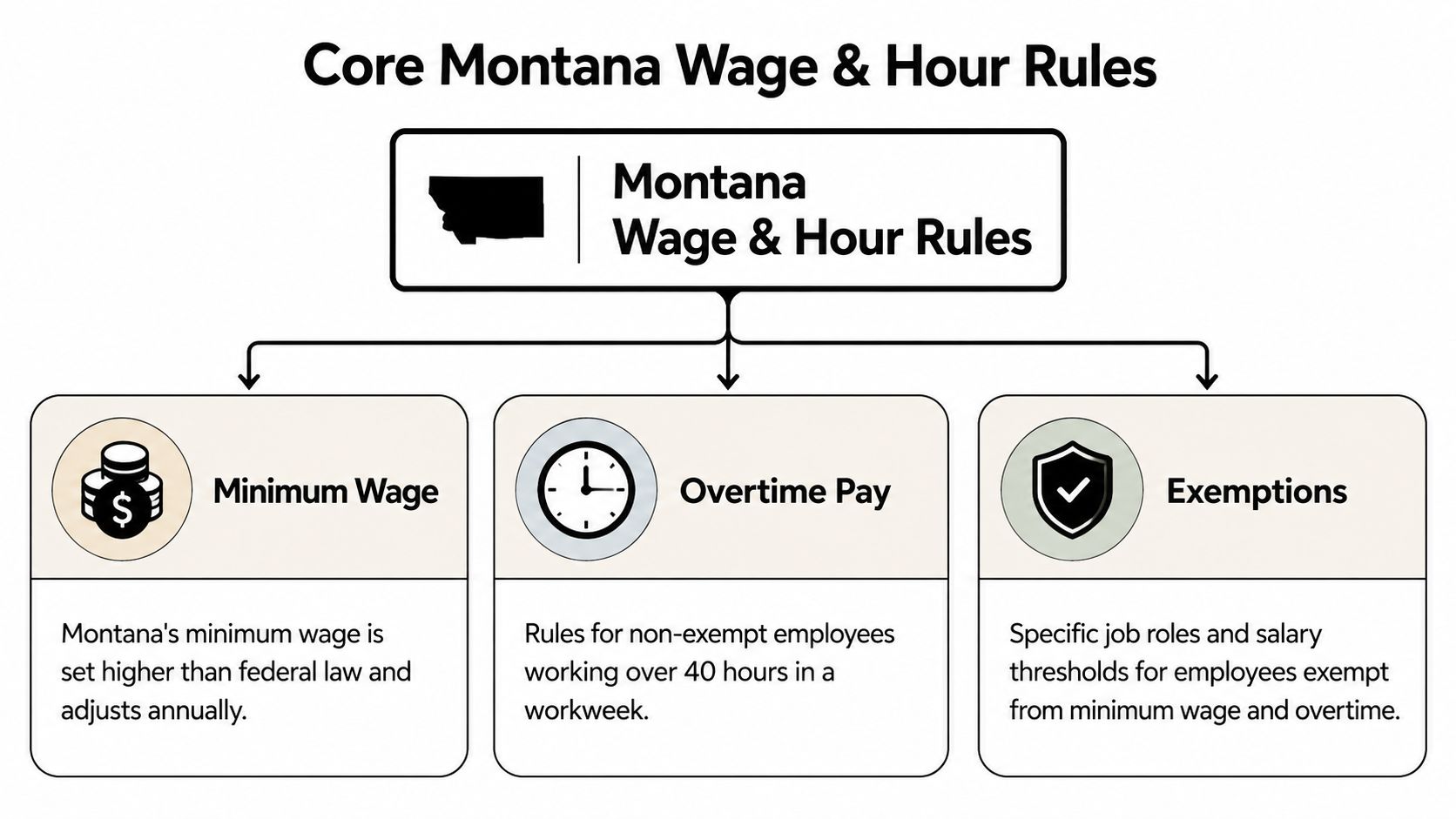
That sounds simple until you map it onto agency roles. The hard part usually isn't the wage rate itself. It's deciding which employees are non-exempt and therefore entitled to overtime, and which employees are properly exempt based on both pay basis and job duties.
Salary alone doesn't decide exemption
A common owner mistake is assuming salaried means exempt. It doesn't. In agency settings, many employees have professional-sounding titles but still spend most of their time executing production work, following set processes, or doing work that doesn't fit an exemption cleanly.
Look closely at roles like these:
- Project coordinators: If they track tasks, chase approvals, and update systems, that doesn't automatically make them exempt.
- Designers and content staff: Creative work can look professional, but exemption depends on the actual duties, not the title.
- Account managers: Some have real authority and independent judgment. Others mainly relay client requests and manage timelines.
If you haven't reviewed job descriptions against what people do all week, your classification process is weak. The safest habit is to audit duties with the manager, the employee, and payroll together. That usually reveals whether the role fits the exemption you've been assuming.
Overtime problems usually start with bad time capture
For non-exempt remote staff, the question isn't whether overtime is allowed. The question is whether you're capturing all hours worked. Calendar blocks, CRM notes, Teams calls, and late-night edits can all point to work activity, but they don't replace a clear policy on what employees must record.
A timesheet that ignores “quick client fixes” after hours is still inaccurate, even if everyone agrees the work only took a little while.
Good overtime management also means using a real workweek definition and sticking to it. Don't let managers invent their own logic like averaging hours across pay periods or offsetting long days with short days. Overtime hinges on hours over 40 in the workweek, not on whether the employee seemed busy overall.
For a practical payroll-side breakdown of premium pay issues, this guide on overtime and holiday pay rules is a useful operations reference.
What a solid setup looks like
A reliable wage and hour process usually includes:
- Role reviews: HR and department leaders review exempt status against actual duties, not offer-letter language.
- Workweek discipline: Payroll uses one clear workweek and trains managers to approve, monitor, and correct time inside that frame.
- Remote hour rules: Employees record all working time, including short tasks outside normal hours.
- Audit trails: Corrections stay visible, so you can explain who changed a time entry and why.
If your agency has grown from founder-led oversight into layered management, this is usually the first area I'd tighten.
Managing pay, breaks, and final paychecks
Once classification is in order, the next place employers stumble is the basic mechanics of paying people correctly and on time. Montana's Wage Payment Act requires timely wage payments, and the Compliance and Investigations Bureau processes claims for unpaid overtime, minimum wage, and other compensation. Employers who need guidance can contact the bureau at (406) 444-6543, as noted in the Montana wage and hour laws guide.
That matters because pay disputes rarely begin with a dramatic violation. More often, payroll gets messy after a resignation, a disputed commission, or an off-cycle correction that nobody owns.
Pay routines need to survive real life
In a healthy agency, payroll should still run cleanly when a manager is on vacation, when a remote employee forgets a timesheet entry, or when someone leaves mid-pay period. If your process depends on one person remembering every exception, it's fragile.
I generally tell employers to pressure-test payroll against these questions:
- Can payroll see approved hours and changes clearly?
- Can managers explain what counts as paid working time during short breaks or interrupted days?
- Can you calculate a final check fast, without hunting through email and spreadsheets?
- Can you prove when wages were due and when they were paid?
A process that works only when everyone behaves perfectly isn't really a process.
Breaks and off-the-clock work
Break issues get overlooked in professional services because the work feels less shift-based than retail or hospitality. But remote teams still need structure. If a non-exempt employee works through lunch while answering client messages, or takes a short break and then jumps back into task work, payroll needs a record that matches reality.
The bigger risk is informal work. Agency staff often “just handle one thing” before dinner or after putting kids to bed. If the employee is non-exempt, those small pieces of work can still count as compensable time. A manager doesn't get to accept the benefit of the work and then act surprised by the hours.
Manager reminder: “Please don't work overtime without approval” is not the same as “we don't have to pay for it.”
For businesses reviewing pay-cycle design, this comparison of semi-monthly vs bi-weekly pay is worth reading because timing affects approvals, reconciliation, and final wage handling.
Final pay is where sloppy records hurt most
Final checks expose every weakness in your recordkeeping. If vacation balances are unclear, bonus terms aren't documented, or hours worked in the last week are still sitting in a manager's inbox, you've created unnecessary risk.
The practical move is to standardize exits. Use a short offboarding payroll checklist, lock down all outstanding time entries, confirm any owed compensation under your policy, and give one person authority to resolve open questions quickly. That kind of discipline saves you from turning a clean separation into a wage claim.
Understanding leave, disability, and discrimination laws
A compliant workplace in Montana isn't just about wages. Your policies also need to deal with fair treatment, protected status, and leave administration in a way managers can follow.
Montana law under Title 49 Chapters 1 through 4 prohibits discrimination based on protected categories including race, sex, age, and disability, and it requires reasonable maternity leave. For agency owners, that means your handbook can't stop at generic equal opportunity language. It needs real procedures for accommodation requests, leave conversations, and manager escalation.
The handbook has to match the way your team works
A lot of mid-sized firms have copied policies that sound polished but break down in practice. They say employees should “contact HR” without saying how. They mention accommodations without saying who handles the process. They promise equal treatment while letting individual managers make ad hoc calls on remote work, schedule changes, or medical needs.
That approach creates inconsistency, and inconsistency is what turns everyday people issues into legal ones.
A stronger policy set usually includes:
- A clear intake path: Employees know where to bring concerns about discrimination, harassment, disability accommodation, or leave.
- Defined manager limits: Supervisors know they can't deny a request on the spot just because it seems inconvenient.
- Written follow-up: HR documents requests, next steps, and decisions so the file tells a coherent story later.
- Remote-work context: Policies account for staff who work from home and may need schedule or equipment adjustments.
Accommodation and leave decisions need discipline
For disability issues, the mistake I see most often is speed in the wrong direction. A manager wants to be efficient, so they say yes or no too quickly. But accommodation requests usually require a documented process, not a hallway answer.
The same goes for maternity-related issues and other protected leave situations. A fair process asks what the employee needs, what the job requires, and what options the company can reasonably provide. It doesn't assume one manager's personal view is enough.
Good HR files don't read like debate transcripts. They show dates, requests, responses, and the reason for the decision.
For teams that still handle leave requests through email threads and memory, a structured employee time off request form can at least bring consistency to intake and approvals.
Fairness is an operations issue, not just a legal issue
Agency owners sometimes treat these laws as a separate HR topic. They're not. Leave and discrimination problems affect staffing plans, client delivery, morale, and manager credibility. If one supervisor bends rules for favored employees while another follows policy, your legal risk grows and your culture gets worse at the same time.
A fair workplace usually feels more operationally stable because people know the rules, managers don't freelance, and exceptions get documented before they turn into arguments.
The Montana exception to at-will employment
This is the part of montana labor laws that catches out-of-state founders and new Montana managers off guard. They assume employment works like it does almost everywhere else. In Montana, that assumption can cause real damage.
Under Montana's Wrongful Discharge from Employment Act, employers must have “good cause” for termination after a 12-month automatic probationary period, according to this Montana employment law guide. That single rule changes how you should think about performance management, supervision, and documentation.

The first year matters more than many employers realize
The automatic probationary period gives employers room to assess fit. But too many businesses waste that window by staying informal. Managers give soft verbal feedback, skip written follow-up, and hope a struggling employee either improves or quits.
Then month thirteen arrives.
Now the company wants to terminate, but the file contains almost nothing beyond vague statements like “communication issues” or “missed expectations.” That's weak in any state. In Montana, it's especially risky.
“Good cause” needs records, not impressions
When I review termination files in Montana, the strongest ones usually have contemporaneous detail. Not legal drama. Just clean records. Dated feedback. Specific examples. Evidence that expectations were communicated and performance was measured against them.
For modern agencies, that often means you need activity records that go beyond annual reviews. Project-based work leaves a trail if you preserve it properly. Calendar history, client meeting records, task ownership, billable versus non-billable time patterns, missed deadlines, and follow-up notes can all support a performance narrative when they're captured consistently.
If a manager says an employee repeatedly dropped handoffs or failed to follow through, the file should show when, where, and how often that happened.
That's why forensic-grade audit trails matter here. If records can be edited without trace, or if managers backfill notes only after a dispute starts, the documentation loses weight fast.
What owners should change immediately
If your managers still run performance issues through casual chats and scattered messages, tighten the process now. You don't need a giant HR bureaucracy, but you do need consistency.
Focus on these habits:
- Start documentation early: Use the probationary period to record expectations, coaching, and results.
- Tie feedback to work: Reference client projects, deadlines, responsiveness, quality issues, and follow-through.
- Keep records dated and stable: Preserve a timestamped trail instead of rewriting history later.
- Train managers on the standard: “Not a fit” is not a reason. Managers need better language and better evidence.
Montana employers can still make hard personnel decisions. They just need to make them with a file that can stand up afterward.
An employer's compliance checklist
Most compliance problems don't come from one giant mistake. They come from ten small gaps that nobody owns. If you run a mid-sized agency, use the checklist below as an operating review, not a legal formality.
One point worth calling out here: Montana does not allow a tipped minimum wage. All employees must be paid the full state minimum wage before tips, so payroll and timesheet systems shouldn't carry a “tipped” category, and wage rates need to be kept current with annual inflation-based changes, as explained in this Montana employment law overview.
Montana employer compliance checklist
| Compliance Area | Action Item | Why It Matters |
|---|---|---|
| Employee classification | Review exempt and non-exempt roles against actual duties, not job titles | Misclassification often starts with inflated titles and outdated job descriptions |
| Payroll configuration | Remove any tipped-pay setup and confirm wage rates update correctly | Montana pay rules don't allow a tipped minimum category |
| Timekeeping | Set one clear process for recording all hours worked by non-exempt staff, including remote work | Agencies lose accuracy when after-hours tasks and short work bursts go unrecorded |
| Manager training | Train supervisors on overtime approval, off-the-clock work, accommodations, and documentation | A good policy fails if managers improvise |
| Handbook review | Update wage, leave, anti-discrimination, complaint, and termination language for Montana-specific rules | Generic multi-state handbooks often miss Montana-specific risk |
| Final pay process | Create an exit checklist for time approval, accrued compensation review, and payroll signoff | Final checks expose weak records faster than routine payroll does |
| Performance documentation | Keep dated coaching notes and role-specific evidence during the probationary period and after | Weak files make termination decisions harder to defend |
| Reporting and records | Make sure payroll, HR, and operations can retrieve records quickly | When a claim appears, speed and clarity matter |
Where outside help actually pays off
Some owners try to solve all of this with legal review alone. Legal review matters, but it won't fix a messy payroll file or a broken chart of accounts. For agencies that need stronger financial controls around payroll, job costing, and compensation workflows, working with an experienced Hire CPA can be a practical complement to HR and legal support.
What to audit this quarter
If you want a manageable starting point, review these four items first:
- Time records: Pull a sample of remote employees and compare calendars, project systems, and submitted time.
- Termination files: Check whether recent performance issues are supported by dated documentation.
- Payroll codes: Confirm your system reflects Montana rules and doesn't carry legacy categories from other states.
- Manager behavior: Ask managers how they handle after-hours work and leave requests. Their answers will tell you whether your written policies are real or decorative.
A good checklist shouldn't sit in a policy folder. It should change how your managers run the week.
Common compliance pitfalls and how to avoid them
The most common Montana mistakes are predictable. They happen when employers grow fast, trust informal habits, and assume a modern office workforce needs less structure than a traditional hourly team.
Poor recordkeeping is a frequent problem, especially for remote teams. The Montana compliance guidance summarized by Paylocity notes that recordkeeping failures make up a significant share of citations, yet many employers still lack a solid method for documenting work in hybrid settings.
Problem and fix in real agency terms
Problem: Managers treat remote work as self-documenting.
Calendar invites, Slack messages, and CRM activity feel like enough, but they rarely create a clean payroll record by themselves.
Fix: Define what employees must record, how corrections happen, and who reviews the record each week.Problem: The company pays salary and stops tracking time.
That can work for properly exempt employees. It breaks down fast when a role was classified loosely or has changed over time.
Fix: Audit duties periodically, especially after promotions, reorganizations, or service-line changes.Problem: Performance concerns stay verbal too long.
In Montana, weak documentation creates extra risk once the probationary period has passed.
Fix: Use dated notes tied to actual work output, deadlines, communication lapses, and coaching steps.Problem: Compliance lives in HR alone.
In agencies, operations leaders, department heads, and finance all shape labor risk.
Fix: Build a shared process between HR, payroll, and line management, with one owner for each step.
Don't treat workers' comp as a separate silo
A lot of agency owners think wage law, leave, and workers' comp can be managed separately. In practice, the records overlap. Time records, leave notes, accommodation discussions, and incident reporting all affect each other. If you need a broader reference point, this state-specific workers' comp compliance guide is a useful companion resource.
The through-line is simple. Montana compliance gets harder when your records are scattered and your managers invent local rules. It gets easier when timekeeping, payroll, documentation, and leave handling all follow one operating system.
If your team is tired of manual timesheets, scattered calendar data, and weak reporting, TimeTackle gives agencies a cleaner way to capture work from calendars and connected tools, organize it with rules and tags, and turn it into records your operations and payroll teams can use. For Montana employers dealing with remote work, overtime visibility, and documentation pressure, that kind of structure can make compliance much easier to manage.