


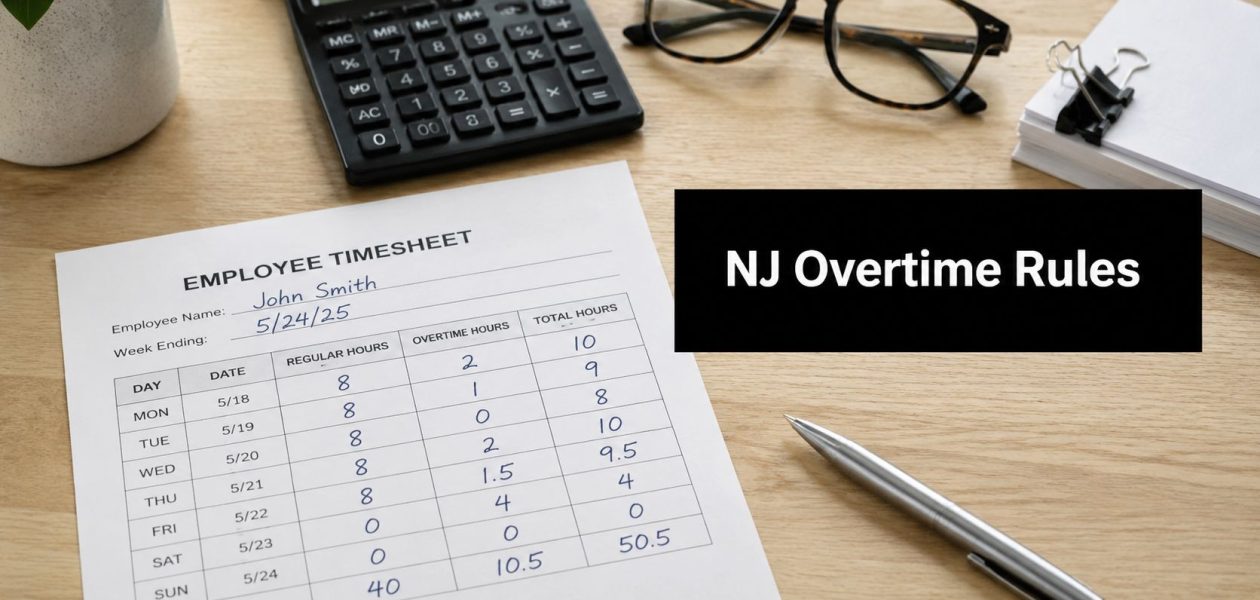
At its core, New Jersey’s overtime law seems simple enough. But as any employer knows, the details matter, and getting them wrong can be costly. The main rule you have to get right is this: you must pay non-exempt employees 1.5 times their regular rate of pay for any hours they work beyond 40 in a single workweek. This isn't a guideline—it's a hard rule under both state and federal law.
The fundamentals of overtime in New Jersey
Everything is based on that 40-hour workweek. Think of it as the trigger for overtime pay. Once an employee crosses that line, a different set of payment rules kicks in. Understanding how this works is the first step to staying compliant and avoiding serious financial headaches.

This 40-hour threshold is the foundation of both the New Jersey Wage and Hour Law and the federal Fair Labor Standards Act (FLSA). For businesses with changing schedules, like professional services firms or creative agencies, this benchmark is a major operational trigger. Even a small amount of untracked time can suddenly push an employee into overtime, which impacts your payroll and increases your legal risk. You can find more official guidelines by reviewing the state's resources on these wage requirements on nj.gov.
What actually counts as a workweek?
So, what does the law mean by a "workweek"? It's defined as any fixed and regularly recurring period of 168 hours—seven consecutive 24-hour periods.
The key here is that it doesn't have to follow the calendar week. You, the employer, can set your own workweek. It could start on Wednesday at 9:00 AM and end the following Wednesday at 8:59 AM. The only rule is that once you set it, you have to be consistent. You can't just change the workweek's start date to avoid paying overtime.
The math behind time and a half
Calculating the overtime rate is another area where employers can stumble. The "time and a half" rate is based on an employee's regular rate of pay, not just their hourly wage. This difference is important. The regular rate includes their base pay plus any non-discretionary bonuses, commissions, or other pay.
Let's use an example based on New Jersey's minimum wage, which is scheduled to be at least $15.00 per hour by 2026.
For an employee earning the future $15.00 minimum wage, their overtime rate would be $22.50 per hour ($15.00 x 1.5). If that employee worked a 45-hour week, you would be legally required to pay them for those extra 5 hours at that higher rate.
This calculation is a legal mandate. Mastering this simple math is basic to keeping your payroll accurate and compliant.
Who is actually entitled to overtime pay
Let's clear up one of the most expensive misunderstandings in New Jersey employment law: paying someone a salary does not automatically make them ineligible for overtime. It's a common myth, but the reality is that NJ overtime rules care far more about what an employee actually does than how you pay them.
This brings us to the difference between non-exempt and exempt employees. Simply put, non-exempt employees must be paid overtime. Exempt employees do not. The deciding factor isn't a fancy job title or a salaried paycheck; it all comes down to whether their specific job duties pass a series of strict legal tests.
The myth of job titles
You can give an employee the title of "Team Lead" or "Office Administrator," but if their daily work doesn't line up with the legal definition of an exempt role, that title is basically meaningless in a wage dispute. The law always looks past the title on a business card to see the real work being done.
Think about a "Project Manager" at a design firm. If their day is spent moving creative assets, updating timelines, and coordinating schedules—without any real authority to make high-level business decisions—they are almost certainly non-exempt. Even on a salary, they would be owed overtime for every hour worked past 40 in a week.
The "white-collar" exemption tests
For an employee to be legally considered exempt, their role must meet the criteria for one of the "white-collar" exemptions. There are four main categories to know:
- Executive Exemption: This applies to employees who are genuinely managing the business or a major department. Their main duty must be management, and they need to have the power to hire, fire, or have their recommendations on these matters given serious weight.
- Administrative Exemption: This covers employees whose main job involves office work directly related to the company's management or general business operations. The key here is that they must exercise discretion and independent judgment on significant business matters.
- Professional Exemption: This is for roles that require advanced knowledge in a field of science or learning (like doctors, lawyers, or engineers), usually gained through extensive specialized education. It also includes certain roles in artistic or creative fields.
- Outside Sales Exemption: This applies to employees whose primary duty is making sales or obtaining orders and who customarily and regularly work away from the employer's place of business.
Getting this classification right is where many employers fail. The lines can be blurry, and the rules are not static. To put this in perspective, a New Jersey Policy Perspective report analyzed what would happen if the state adopted a more protective overtime standard. It projected that an estimated 842,000 salaried workers—a staggering 38% of the total salaried workforce—could suddenly become eligible for overtime. You can read more about these overtime policy projections at njpp.org.
That statistic alone shows just how many salaried positions could be misclassified right now. If an employee's role fails to meet every part of these strict tests, they are non-exempt and must be paid overtime, no matter what their salary is.
Correctly calculating overtime isn't just about good payroll practices; it's a strict legal mandate under NJ overtime rules. While the basic idea of "time and a half" sounds simple, the reality is full of details that can easily trip up even careful employers, leading to big penalties. Let's walk through exactly how to get the math right every time.
The foundation of any overtime calculation is what the law calls the "regular rate of pay." This isn't always a person's straight hourly wage. You have to factor in all forms of pay, like commissions and non-discretionary bonuses, to arrive at the true hourly rate for that specific workweek.
Calculating for hourly employees
For a standard hourly employee, the math is fairly simple. You find their overtime rate by multiplying their regular hourly wage by 1.5, and that's the rate you apply to every hour they work beyond the 40-hour mark.
Here's a quick example:
- An employee earns $20 per hour and works 45 hours in a week.
- Their regular pay is $800 (40 hours x $20/hour).
- Their overtime rate is $30 per hour ($20 x 1.5).
- Their overtime pay is $150 (5 overtime hours x $30/hour).
- The total gross pay for the week comes to $950.
Calculating for salaried non-exempt employees
This is where things get tricky, and where we see a lot of employers make costly mistakes. If you have a salaried employee who doesn't meet the criteria for an exemption, they are definitely entitled to overtime pay. The first step is to convert their fixed salary into a "regular rate" for that specific week.
To calculate the regular rate for a salaried, non-exempt employee, you divide their total weekly salary by the total number of hours they actually worked that week. This means their regular rate can change from one week to the next.
For example, a non-exempt administrative assistant earns a $1,000 weekly salary. One week, they work 50 hours to meet a deadline.
- First, find the regular rate for that week: $1,000 / 50 hours = $20 per hour.
- Next, calculate the overtime premium. The employee has already been paid their "straight time" for all 50 hours through their salary. They are now owed an additional half-time premium for the 10 overtime hours.
- The half-time premium is $10 per hour ($20 / 2).
- The total overtime due is $100 (10 hours x $10).
- So, their total pay for that week is $1,100 ($1,000 salary + $100 overtime).
For a deeper look at these calculations, our guide on time and a half pay is a great resource.
The first step, of course, is determining who is and isn't exempt. It’s not about how much someone is paid or what their job title is; it's about their day-to-day job duties.
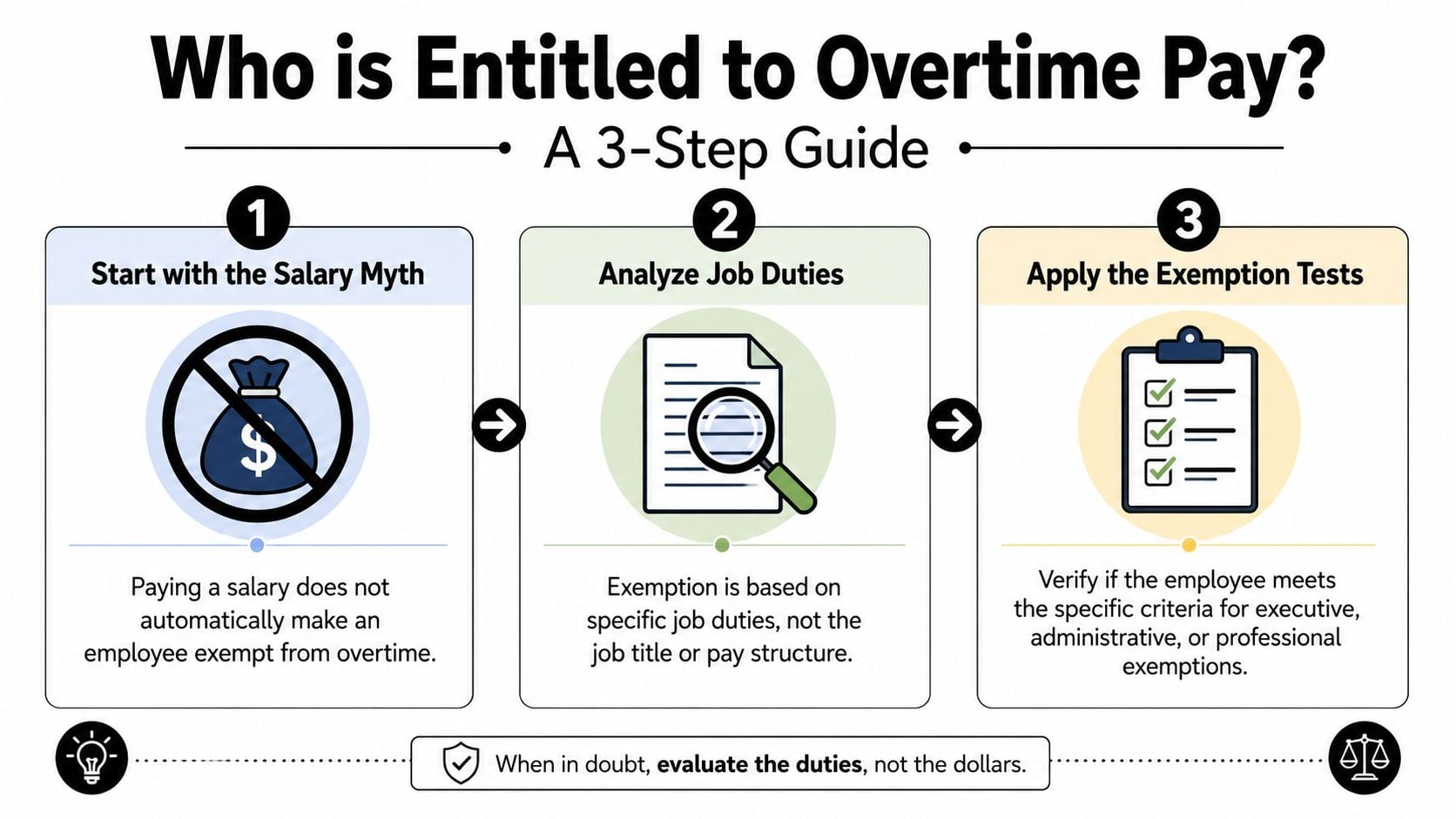
As the infographic shows, eligibility depends on a careful analysis of an employee's actual responsibilities when measured against specific legal tests for executive, administrative, and professional roles.
To illustrate these calculations more clearly, the table below breaks down a few common scenarios.
Overtime calculation examples
This table shows how to properly compute weekly pay for different types of employees, including how commissions can affect the regular rate.
| Employee Type | Weekly Pay Breakdown | Regular Rate Calculation | Total Weekly Pay (with OT) |
|---|---|---|---|
| Hourly Employee | $22/hour wage Works 43 hours | $22.00 regular rate $33.00 OT rate ($22 x 1.5) | (40 x $22) + (3 x $33) = $979.00 |
| Salaried Non-Exempt | $900/week salary Works 50 hours | $900 / 50 hours = $18.00 regular rate $9.00 half-time premium | $900 salary + (10 OT hours x $9) = $990.00 |
| Hourly + Commission | $20/hour wage $200 non-discretionary commission Works 45 hours | (45 hrs x $20) + $200 = $1,100 total comp $1,100 / 45 hrs = $24.44 regular rate $12.22 half-time premium | $1,100 straight pay + (5 OT hrs x $12.22) = $1,161.10 |
These examples show just how important it is to track all hours and pay accurately to ensure your calculations are built on the right foundation.
Navigating special industry rules in New Jersey
To make matters more complex, New Jersey law includes some unique rules for specific industries. For instance, certain employers in the trucking industry must pay their drivers overtime at a rate of at least 1.5 times the state minimum wage, not the employee’s regular rate.
As of 2026, with the state minimum wage likely to be around $15.00 per hour (it's indexed to inflation), this means the overtime floor for many of these workers is $22.50 per hour, regardless of their base pay. This is a perfect example of why just knowing the federal rules isn't enough; you have to stay on top of New Jersey's specific wage and hour laws, which often provide greater protection for employees.
Recordkeeping and notice requirements for employers
Calculating overtime correctly is important, but it's only part of the story. If you can't prove you paid your team properly, you're leaving your business exposed. When it comes to NJ overtime rules, detailed records aren't just good administrative practice; they are a legal shield.
In a wage dispute, the state often places the burden of proof on the employer. Without solid, detailed timesheets and payroll data, your side of the story can fall apart fast. Sloppy or missing records can be just as costly as getting the pay rate wrong in the first place.

What records you must keep
New Jersey's Department of Labor and Workforce Development (NJDOL) is clear on this: you must keep precise payroll records for at least six years. Think of these files as your primary defense during an audit or legal challenge.
For every non-exempt employee, your records need to clearly document:
- The employee's full name and address
- Their regular hourly pay rate for each workweek
- The total hours worked each day and each workweek
- A breakdown of total weekly straight-time and overtime earnings
- All deductions taken from their wages
- The total wages paid and the date of payment for every pay period
That last point on daily and weekly hour tracking is where many businesses get into trouble. Guessing, using estimates, or asking employees to remember their hours after the fact is a recipe for disaster. It’s simply not a legally defensible strategy, and it’s a big reason why manual spreadsheets are becoming a major liability.
If you're still using older methods, you can learn more about why it's so important to maintain a proper timesheet and weigh the pros and cons of different tools.
Posting official notices
Beyond keeping individual records, you also have a public-facing duty. New Jersey law requires all employers to post official wage and hour notices in a prominent place where every employee can easily see them, like a break room or main hallway.
This is non-negotiable. These posters inform your team about their rights regarding minimum wage, overtime, and other labor standards. You can download the required posters for free directly from the NJDOL website. Failing to display them can lead to fines and, just as importantly, can signal to auditors that you might be lax on your other compliance duties. It's a simple, five-minute task that shows good faith right from the start.
What happens when you get overtime wrong
Miscalculating overtime in New Jersey isn't just a small payroll mistake. The state takes wage laws very seriously, and a mistake can snowball into big financial and operational problems far faster than most business owners realize.
If an employee files a successful wage claim, the look-back period alone can be staggering. You could be ordered to pay back all unpaid overtime for up to two full years.
Financial penalties that add up fast
But the costs don't stop there. New Jersey law hits non-compliant employers with what are known as liquidated damages—a penalty that can be as high as 200% of the total wages owed.
Think about that for a moment. A simple error could mean you end up paying triple the original amount of unpaid overtime. On top of all that, you’ll almost certainly be responsible for the employee’s attorney fees. A seemingly minor misstep can easily grow into a five-figure liability for just one employee.
More than just a financial hit
Beyond the direct costs, a wage and hour lawsuit or an investigation from the New Jersey Department of Labor and Workforce Development (NJDOL) is incredibly disruptive. These proceedings drain your time, money, and focus, pulling you and your key staff away from running your business.
A public lawsuit can also do lasting damage to your company’s reputation, making it much harder to attract and retain the talent you need to grow. The takeaway is simple—the potential fallout from getting overtime wrong is far more painful than the effort it takes to get it right from the start. For a refresher on the basics, our guide on overtime and holiday pay is a great place to begin.
Frequently asked questions about New Jersey overtime
Even when you feel you have a handle on the main rules, real-world situations can create confusion. Let’s clear up some of the most common questions we hear from employers about NJ overtime rules.
Can we give employees "comp time" instead of overtime pay?
This is a classic question, and for private businesses, the answer is a firm no. While you might see government agencies offering compensatory time off, that flexibility doesn't extend to the private sector in New Jersey.
If a non-exempt employee works more than 40 hours in a workweek, the law is crystal clear: you must pay them cash wages at 1.5 times their regular rate. Trying to substitute that pay with time off later is a direct violation of wage and hour laws, which opens your business up to serious penalties.
Do we have to pay overtime for work on a holiday or weekend?
Not automatically. New Jersey overtime isn't triggered by the day of the week or a specific date on the calendar. It’s all about the total hours worked within your company's official workweek.
For example, imagine your workweek is Monday through Sunday. An employee could work a full eight-hour shift on a Saturday. But if their total hours for that week are still 40 or less, you don't owe them any overtime. The clock for overtime pay only starts ticking after they’ve surpassed 40 hours of actual work time in that seven-day period.
Is employee travel time compensable?
This is where it gets a little more nuanced, as it all depends on the kind of travel. The law makes a sharp distinction between an employee's daily commute and travel that is a required part of the job.
- Commute Time: The trip from an employee's home to their primary workplace and back again is not considered work time. You are not required to pay for it.
- Work-Related Travel: Any travel that happens after the workday has begun is a different story. Driving between job sites, running an errand for the company, or traveling to another city for a special one-day assignment all count as paid work time.
Keeping accurate records of this kind of travel is absolutely necessary for staying on the right side of the law.
Manually tracking every minute of work, especially for things like intermittent travel, can feel impossible and puts you at huge compliance risk. TimeTackle helps by automatically pulling all work activities from your team's calendar. This gives you a precise, verifiable record that protects your business and ensures every hour is accounted for properly. Learn more about how we help agencies streamline their time tracking at https://www.timetackle.com.