

You're probably here because someone on your team asked a simple question that turned into an annoying one: “Do we have to give lunch breaks in Pennsylvania?”
For agency owners, operations leaders, and HR managers, that question rarely stays simple for long. You may have salaried staff who block lunch on Google Calendar but still answer Slack. You may have hourly coordinators who clock out for lunch, then jump back in to answer a client call. You may also have interns or younger part-time workers, which changes the rule set again.
That's why articles on Pennsylvania break law often leave employers half-informed. They tell you what the law says, but they don't tell you how to run the workday without creating payroll risk. In practice, PA lunch break laws are less about whether lunch exists and more about how you schedule it, record it, and treat it in payroll.
The common misconception about PA break laws
A lot of Pennsylvania employers assume the state must require lunch breaks for everyone because that feels like basic workplace law. I hear that assumption most often from service firms that work across state lines, especially agencies with staff in Pennsylvania, New Jersey, Delaware, or New York. Once you manage people in more than one state, it's easy to import one rule into another place where it doesn't apply.
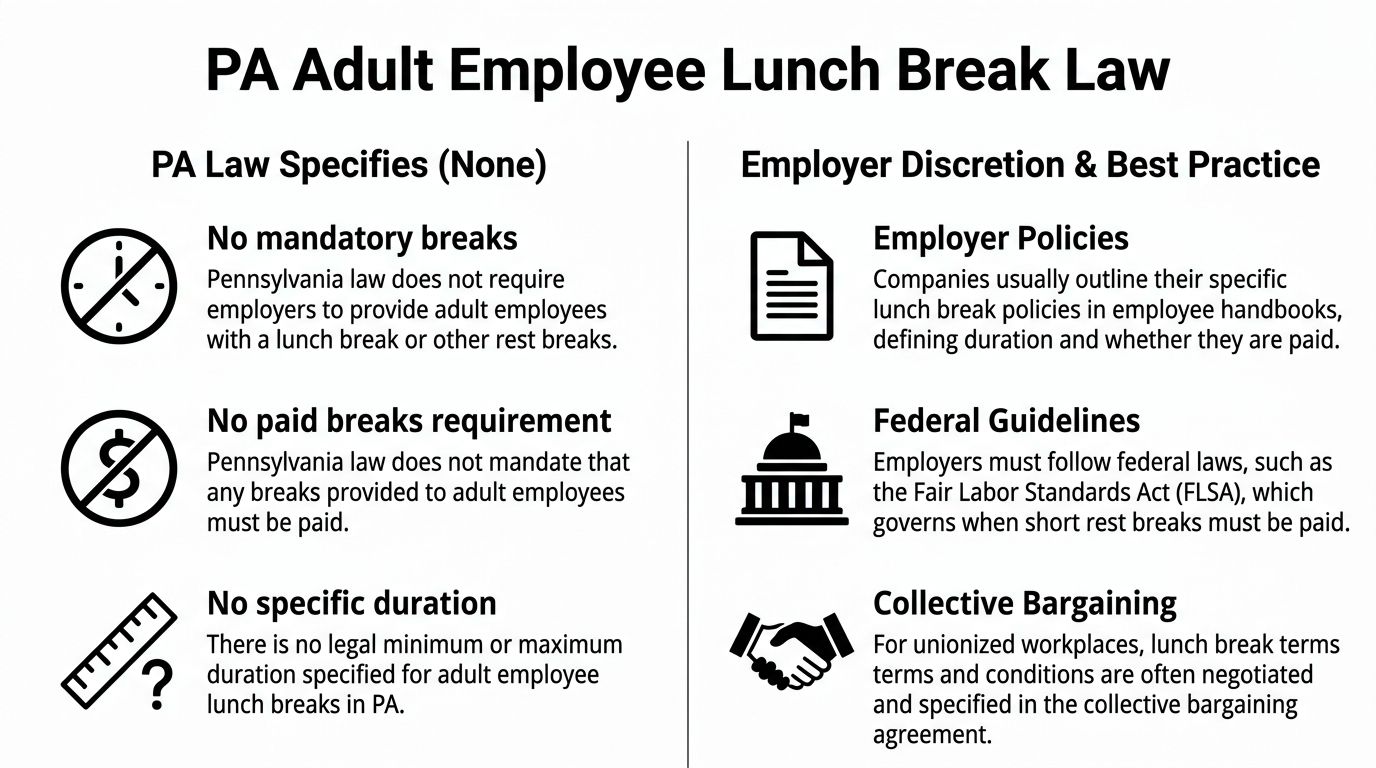
The surprise is this. For most adult employees in Pennsylvania, state law does not require a lunch break or a rest break. The Pennsylvania Department of Labor and Industry wage FAQs state that employers are not required to give breaks to employees age 18 and over, while federal pay rules still apply if breaks are offered.
That's the part many employers miss. They stop at “not required” and assume they're done. They aren't.
If your firm offers breaks anyway, and most firms do, then your real risk shifts from “Did we provide a break?” to questions like these:
- Was the break paid or unpaid
- Was the employee fully relieved of work
- Did a manager interrupt the meal period
- Did the time record match what really happened
Practical rule: The legal problem in Pennsylvania usually isn't failing to create a lunch policy for adults. It's creating a loose one that payroll, managers, and employees all interpret differently.
For agencies and professional services teams, this gets messy fast because work doesn't always stop cleanly. A media buyer may eat lunch while monitoring campaign spend. A client success manager may stay “available” during lunch in case a customer escalates. A finance employee may step away from the desk but keep Teams open on a phone.
That's why the better question isn't “Does PA require lunch?” It's “When we say someone is on lunch, are they really off duty?”
What Pennsylvania law requires for adult employees
For adult employees in Pennsylvania, the state-level rule is straightforward. There is no state-law requirement for a lunch or rest break. The more important rule comes from federal wage law when you choose to give breaks. According to Labor Law Center's Pennsylvania lunch and break law summary, short breaks of about 5–20 minutes are compensable work time, while a meal period of 30 minutes or more may be unpaid only if the employee is completely relieved of all duties.
What counts as paid time
Employers often encounter trouble regarding short breaks. If you offer a short break, you generally need to pay for it. If someone takes ten minutes for coffee, steps outside, or grabs a quick snack, that usually stays on the clock under the federal standard described above.
That means you shouldn't treat every “break” as unpaid just because the employee wasn't actively typing or on a call.
A short list helps:
- Coffee or restroom breaks: These are generally paid when they fall into the short-break category.
- A quick reset between meetings: If it's a brief pause in the day, treat it as work time.
- A manager-approved short breather after a hard client call: Still usually paid.
- An employee stepping away briefly while staying reachable: Also points toward paid time.
What counts as an unpaid meal period
An unpaid meal period is different. The employee must be completely relieved of all duties. If they must answer phones, watch a shared inbox, monitor a support queue, or remain on call in any real sense, you should assume that time is paid.
That's the operational test I use with employers: if the company still expects availability, it probably isn't a true unpaid meal break.
If your employee is eating lunch with one eye on Slack, you should think very carefully before calling that time unpaid.
For agencies using digital scheduling and time systems, process matters more than policy language. If your handbook says lunch is unpaid, but your culture expects instant response, your handbook won't save you.
What works in practice
For adult employees, the safest workflow usually includes these controls:
| Issue | What works better |
|---|---|
| Employees forget to record lunch | Prompt them to log meal periods the same day |
| Managers interrupt breaks casually | Train managers that unpaid lunch means no work asks |
| Staff stay available “just in case” | Treat that period as paid unless they are fully off duty |
| Payroll guesses based on standard schedules | Use actual time records instead |
If your firm still relies on manual edits at the end of the week, you're asking payroll to reconstruct reality after the fact. A better setup is a real-time process tied to calendars, clock events, and manager review. This is the same operational logic behind strong hours-worked tracking practices for payroll and compliance.
The strict rules for minors and specific worker types
The adult rule is flexible. The rule for younger workers is not.
Pennsylvania has a sharper requirement for minors, a point on which many otherwise careful employers slip. If you employ anyone age 14 through 17, that worker must receive a 30-minute uninterrupted break after 5 or more consecutive hours of work, as explained in this Pennsylvania break-law discussion focused on minors and seasonal farmworkers. The same source notes that seasonal farmworkers are also entitled to a 30-minute break after 5 hours of work.
Why “uninterrupted” matters
A lot of employers think they can fix this with common sense. They can't. For minors, the break has to be a real break, not a half-break.
If a younger employee gets pulled back to the register, asked to check a message, or told to cover the front desk “for just a minute,” you may have a problem because the law calls for an uninterrupted break. In operations terms, that means you need coverage planning, not just a note in the schedule.
For agencies and office-based firms, this can still matter. Maybe you don't hire teen staff often, but if you bring in part-time assistants, seasonal help, or younger interns for events, content production, or admin support, your standard adult workflow may not be enough.
Why “consecutive hours” matters
The second trap is the phrase consecutive hours. If a minor works up to that threshold without the required break, you can't cure the issue later by saying, “They ate at their desk after that.”
You need the day built correctly before the shift starts.
Here's what usually works better than informal manager judgment:
- Use age flags in scheduling: If the worker is a minor, the system should identify that automatically.
- Set shift warnings early: Don't wait until the worker has already crossed the limit.
- Require a true duty-free break: No messages, no front-desk coverage, no client handoff.
- Document exceptions immediately: If the break was missed or interrupted, escalate it the same day.
A minor-break rule is a scheduling rule first and a payroll rule second. If the shift is built wrong, payroll can't repair the compliance issue later.
One policy for adults won't cover everyone
Many handbooks prove inadequate in this area, often using one short paragraph for all employees, even though the break rules differ by worker type.
If your business includes both adult staff and minors, split the policy and split the workflow. That means separate scheduling expectations, separate manager training, and separate review checks. The law is different enough that your operations should reflect it.
Federal law vs Pennsylvania law which one applies
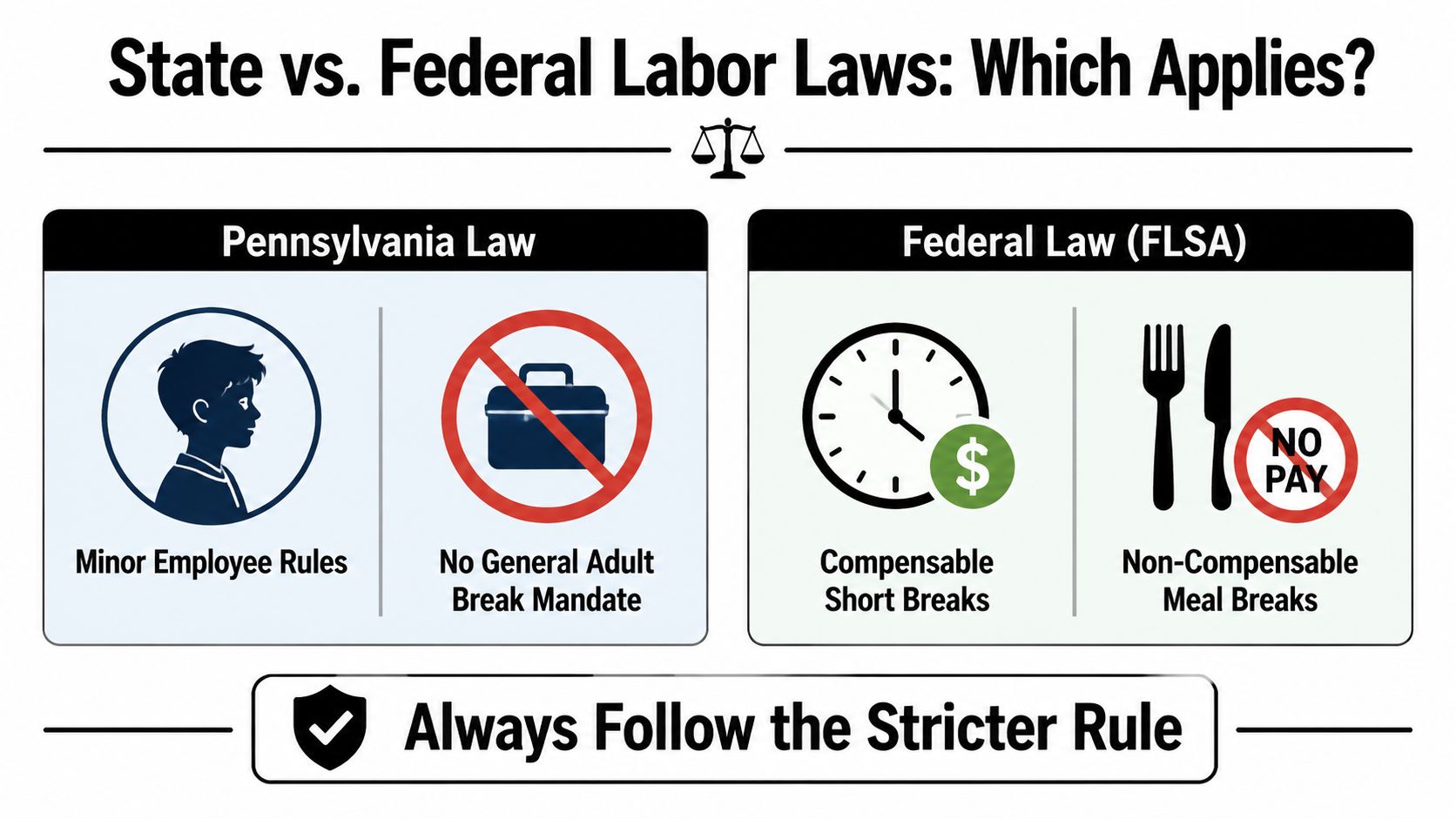
Employers often ask whether they should follow federal law or Pennsylvania law, as if they must pick one. That's not really how compliance works. You follow the rule that applies to the worker and the situation, and when rules differ, the more protective standard is the one you should use.
For meal breaks, Pennsylvania is a good example of a state where break rights are state-specific, not universal. The U.S. Department of Labor's state meal-break summary shows that states vary widely. For example, Massachusetts requires at least a 30-minute meal break after 6 hours worked, while Pennsylvania's main statewide break mandate applies to minors and seasonal farm workers.
A simple way to decide which rule controls
Use this working rule:
| Situation | Rule to apply |
|---|---|
| Adult employee in Pennsylvania gets a break | Federal pay rules control how that break is treated |
| Minor employee in Pennsylvania works a long consecutive shift | Pennsylvania's stricter break rule controls |
| Multi-state team with workers in several locations | Check the state where the employee works, then compare it to federal rules |
That matters for remote and hybrid teams. If your headquarters is in Pennsylvania but you employ someone elsewhere, you can't assume Pennsylvania practice travels with the company.
Why this matters operationally
For agencies, this is rarely just a legal memo issue. It changes workflows in scheduling, time review, and overtime calculations. If your managers don't understand when paid time continues through a “break,” weekly totals can be wrong. That's one reason break handling and overtime and holiday pay rules often need to be reviewed together in the same workflow.
Don't separate break compliance from payroll logic. They affect each other every pay period.
The larger point is simple. Pennsylvania's silence on adult lunch breaks does not mean “no rules.” It means the rules come from a mix of federal pay treatment, state protections for specific worker groups, and your own policies.
Creating a compliant break policy with sample language
A break policy does two jobs at once. It tells employees what to expect, and it gives managers and payroll a clear rule to follow when the workday gets messy.
For Pennsylvania employers, that matters because the legal answer is often only the starting point. Adult meal periods are largely shaped by pay rules and by what your own policy says in practice. If supervisors handle lunches one way in client services, another way in design, and a third way in account management, you create payroll inconsistency and dispute risk even if the handbook looks acceptable on paper.
A usable policy should match your actual workflow. If your agency uses a time clock app, PSA, or digital timesheet, the policy should tell employees exactly how to record meal periods, what happens if a lunch is interrupted, and who fixes the record. If your approval process already runs through a manager review step, connect the policy to that process and require review before payroll closes. A formal time card approval workflow helps catch missed or interrupted meal periods before they turn into wage issues.
What a workable policy should cover
The strongest policies answer the questions that come up on a normal Tuesday, not just in an audit.
Cover these points:
- Who the rule applies to: Adults, minors, hourly employees, salaried nonexempt employees, and any department-specific scheduling rules.
- What counts as paid time: Short rest breaks and any meal period during which the employee is still working or must remain available.
- When a meal period can be unpaid: Only when the employee is fully relieved of duty for the full meal period.
- How time must be recorded: The exact method, such as clocking out and in, submitting a timesheet entry, or using an approved break code.
- What happens if the break is interrupted: Employees should report the interruption the same day, and managers should know who updates the time record.
- How minor employees are handled: State the stricter rule plainly so schedulers and supervisors do not miss it.
If you are reviewing handbook language more broadly, Kons Law's regulatory compliance guide is a useful reference because it treats compliance as policy, documentation, training, and review, not just legal wording.
Sample handbook language
Use this as a starting point, then have counsel review it for your workforce, locations, and timekeeping system:
Employees may receive meal and rest periods based on business needs and company policy. Short rest periods are paid working time. A meal period may be unpaid only if the employee is fully relieved of all work duties for the entire meal period. Employees must accurately record the start and end of each meal period using the company's timekeeping procedures. Employees must report any work performed during an unpaid meal period so the time can be paid correctly. If a meal period is interrupted, the employee must notify their manager or payroll on the same workday, or as soon as practical, so the time record can be corrected. Employees ages 14 through 17 will receive the break required by applicable Pennsylvania law.
That language works because it does more than repeat a legal standard. It tells employees what to do, tells managers when an unpaid lunch fails, and gives payroll a basis for corrections.
Policy mistakes that create problems fast
Some policy language causes trouble almost immediately:
- “Lunch is automatically deducted every day.” This creates risk if employees answer emails, take calls, or keep working through lunch.
- “Employees must stay available during lunch.” If they are still on duty, the meal period may need to be paid.
- “Managers can edit time records if a lunch was likely taken.” Payroll decisions need actual records, not assumptions.
- “Each department may handle breaks its own way.” That leads to inconsistent pay practices across teams doing similar work.
Keep the policy short, specific, and tied to real operations. The best version is one a supervisor can apply during a busy day without guessing.
Practical compliance time tracking and recordkeeping workflows
A break policy on paper won't protect you if your daily workflow says something else. In most audits and disputes, the question becomes simple: what happened, and can you prove it?
That is why break compliance should live inside your operating process, not just your handbook. For agencies and professional services firms, I usually recommend a workflow that ties together scheduling, time capture, manager review, and payroll signoff.
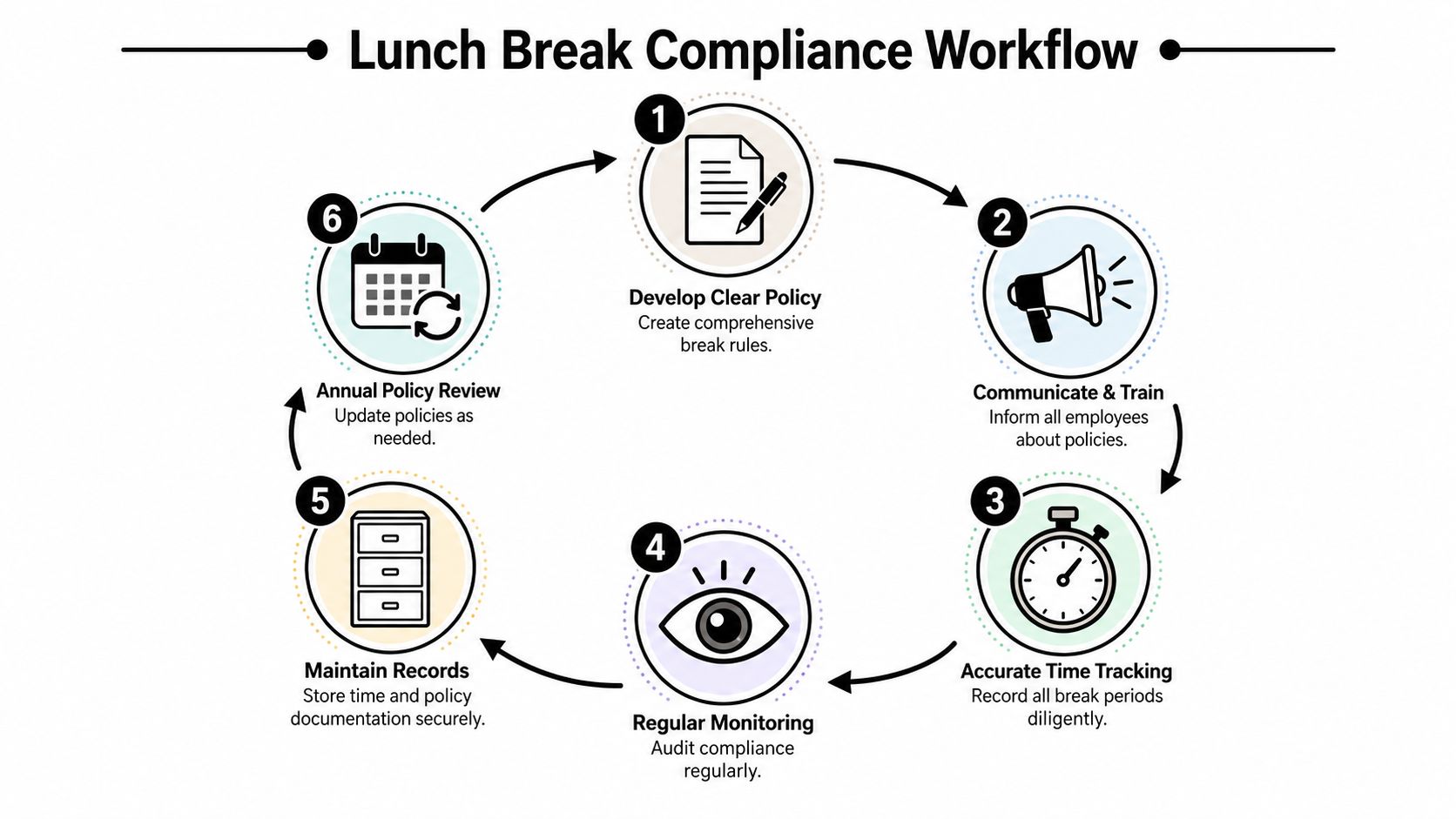
A practical workflow that holds up better
Start with the workday, not the policy PDF.
Build break expectations into schedules
If your team uses Google Calendar, Outlook, a PSA, or shift planning software, put the expected meal period into the schedule for roles that take structured lunches. For minors, set a stronger control so supervisors see the issue before the shift crosses the legal limit.
Capture actual time, not ideal time
Don't rely on “standard lunch deductions” if people regularly eat at desks, answer calls, or stay online. The recorded break should reflect what happened, not what the schedule hoped would happen.
Flag interrupted meal periods
If an employee logs work, sends client messages, or joins a meeting during a supposed unpaid meal period, managers should review that same day. If the meal period wasn't duty-free, payroll may need to treat it as paid time.
Require manager approval with context
A basic approval click is weak. A stronger workflow asks managers to review exceptions, missed lunches, and edits before payroll closes the period. A structured time card approval process makes that review more consistent.
What records are worth keeping
Employers often keep too little or keep the wrong things. What helps most is a clean trail that shows policy, training, actual recorded time, and any corrections.
Good records often include:
- The current break policy and prior versions
- Manager training notes or acknowledgments
- Time entries showing break start and end, where applicable
- Correction logs for interrupted or missed meal periods
- Approval records that show who reviewed exceptions
The strongest record is not the most complicated one. It's the one that matches daily practice and can be explained without guesswork.
Where agencies need extra care
Professional services teams often blur the line between focused work and availability. Someone may block lunch on the calendar but still monitor email. Someone else may leave for lunch but answer a client text from a phone.
That's why break compliance works better when operations leaders decide one thing clearly: if we expect responsiveness, we should treat that time accordingly. Ambiguity is what creates disputes.
Common questions about Pennsylvania break laws
If an employee voluntarily works through an unpaid lunch, do I still have to pay them
If the employee performed work during what was supposed to be an unpaid meal period, you should review that time carefully and correct the pay record if needed. The legal issue usually turns on whether the person was fully relieved of duty. “Voluntary” doesn't solve the problem if the company knew or should have known the work was happening.
Do remote employees follow the same break rules
Yes. Remote work changes supervision, not the underlying break analysis. If a remote employee is on an unpaid meal period but still answering messages, joining calls, or monitoring work, the same practical concern exists. Remote teams need cleaner recording habits because casual interruptions are harder to spot.
Do I have to pay for coffee breaks or smoke breaks
Short breaks are generally treated as paid time under the federal rule discussed earlier in this article. If your company allows brief coffee, restroom, or smoke breaks, don't assume they can be unpaid just because they aren't productive time in the narrow sense.
Can I auto-deduct lunch from timesheets
You can create a standard process, but auto-deductions are risky if employees sometimes work through lunch or get interrupted. If you use them at all, you need a reliable way for employees to report exceptions and for managers to fix records before payroll runs.
What are the real risks if I get this wrong
The risk usually shows up as wage-payment disputes, bad time records, manager inconsistency, and preventable arguments during payroll review or employee complaints. For minors, the risk is sharper because the break rule is mandatory and needs active enforcement, not just a policy statement.
If your team is tired of patching together break records from calendars, chats, and end-of-week timesheets, TimeTackle can help you create cleaner time data with less manual effort. For agencies and professional services firms, that means fewer payroll guess calls, better visibility into actual work patterns, and a more reliable record when lunch breaks, interruptions, and approvals need to be traced back later.